
Tensions in the Middle East continue to escalate, pushing Brent crude above $100 per barrel!

Gaozhan Weekly Interest Rate Analysis | US-Iran Ceasefire Agreement Reached! Will the March Non-Farm Payrolls Support Rates Staying Unchanged? Oil Prices May Fall Below $90?
The202604phase

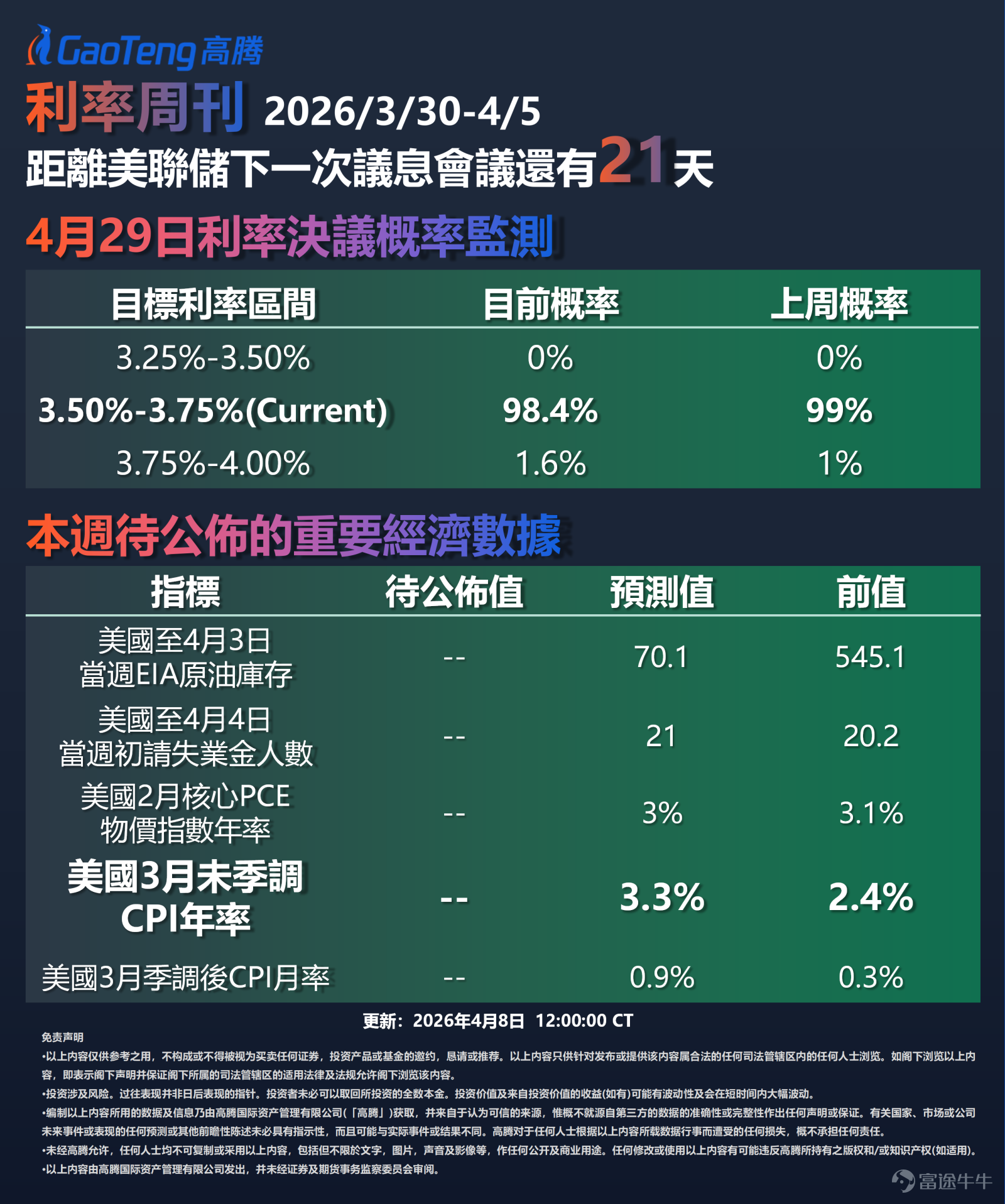
According to CME FedWatch data, there is still time before the next FOMC meeting21 daysCurrently, the market expects that the probability of maintaining interest rates3.50%-3.75%unchanged in the Fed’s next rate decision is98.4%, with the probability of a rate hike to 3.75%-4.00% basis points at1.6%. Compared to a day earlier, the probability of no change stands at 99.0%, while this week’s interest rate expectationsRemain stable; compared to a week ago, the probability of unchanged rates was99.0%, indicating that market expectations for the Federal Reserve maintaining the current interest rate range remain high; compared to a month ago, the probability of unchanged rates was82.5%, with a 17.5% chance of a rate cut, but now expectations for a rate cut have significantly receded, further supported by the stronger-than-expected rebound in March nonfarm payrolls.The Federal Reserveis expected to remainat the current rate level for a longer period。
US-Iran Situation: Trump announces two-week ceasefire, a turning point for the Middle East
This week saw a dramatic turn in the US-Iran situation.TrumpAt Eastern TimeApril 7in the evening, it was suddenly announced that, based on talks withPakistani Prime Minister SharifandPakistani Army Marshal Asim Munir, the US agreed to suspend bombings and attacks on Iran for a period oftwo weeks. This is a two-way agreement,Ceasefire agreementon the premise that Iran agrees to fully, immediately, and securely openStrait of Hormuz。
Trump stated: 'We have achieved and even surpassed all military objectives, and we have made significant progress toward reaching a long-term peace agreement with Iran as well as a Middle East peace agreement. We received Iran's ten-point proposal and consider this a viable basis for negotiation.' He called it 'A decisive and complete victory, one hundred percent, no doubt, revealing that a solid framework for reaching a long-term agreement already exists, includinga 15-point agreement, with most of the content already agreed upon.
Iran's Supreme National Security Councilissued a statement in the early morning of April 8, stating that based on the Supreme Leader’s recommendation and approval by the Supreme National Security Council, it accepted Pakistan’s ceasefire proposal. The statement said that Iran has achieved nearly all its objectives in this war, and the enemy 'suffered a historic and total defeat'.Iranian Foreign Minister Araghchistated that, under coordination with Iran’s armed forces and taking technical limitations into full consideration, within the nexttwo weeks, safe passage will be ensured.Strait of HormuzThe Yemeni peace talks will begin onApril 10in Islamabad, the capital of Pakistan, lasting fortwo weeks。
However,Israeli Prime Minister Netanyahustated that Israel supports Trump's decision to suspend attacks on Iran fortwo weeks, but the ceasefire does not include operations in Lebanon. This leaves a trace of uncertainty regarding complete stability in the Middle East.
Trump Goes 'TACO' Again: A Classic Move from Threats to Negotiations
Looking back at the beginning of this week, Trump issued an ultimatum to Iran, demanding within8:00 PM Eastern Time on April 7Previously achievedStrait of HormuzAgreement, otherwise the US military will destroy all bridges and power plants in Iran within4 hours. The entire country could be wiped out as early as tomorrow night. Trump stated that the US military has developed a set of plans which, once activated, will completely destroy every bridge and paralyze every power plant in Iran.Eastern Time, April 7Within four hours from 8:00 PM to midnight, every bridge in Iran will be completely destroyed and every power plant will be entirely paralyzed.
However, with Pakistan's mediation and Iran's positive response, Trump quickly shifted to diplomatic channels, showcasing his typical 'TACO' (Trump Always Chickens Out) strategy—issuing strong threats first, then reaching agreements through negotiations. This approach, though controversial, appears to have yielded interim results in this US-Iran crisis.
Iran’s proposedTen-Point PlanThe core content includes coordinating control with Iran's armed forces.Strait of HormuzPassage; end of the war against all members of the 'Axis of Resistance'; withdrawal of U.S. combat troops from all bases in the region; inStrait of HormuzEstablishment of a safe transit protocol; full compensation for Iran's losses; lifting of all primary and secondary sanctions; release of all frozen Iranian assets, etc. These items will be approved in a binding UN Security Council resolution.
Interest Rate Analysis: Easing of Geopolitical Risks, Stable Fed Policy Expectations
From the perspective of the interest rate market, the US-IranCeasefire agreementagreement has significantly reduced the geopolitical risk premium, but its impact on expectations for the Federal Reserve’s interest rate policy remains relatively limited. CME FedWatch data shows that the market’s expectation for the Fed to maintain the current interest rate range3.50%-3.75%is as high as98.4%, reflecting that investors believe the Fed will continue to adopt a wait-and-see approach under the current circumstances.
Notably, although geopolitical tensions have eased somewhat, energy prices remain relatively high, and inflationary pressures have not completely subsided. The challenge for the Federal Reserve lies in striking a balance between economic growth, the labor market, and inflation.Ceasefire agreementAlthough the risk of stagflation in the short term has been reduced,two weeksThe negotiation window period still holds uncertainties,If the agreement falls apart, the market may reprice rate hike expectations.。
From a historical perspective, the impact of geopolitical events on the Fed's policy tends to be short-lived unless they have a lasting effect on inflation and economic growth. The current market expectation is that the Fed will beginJuneorJulyits meeting by delivering moreclarity regardingthe future policy path.SignalWe will closely monitor the upcoming employment data andunadjusted CPI year-over-year rate.。
Strategist Viewpoint: Cautiously optimistic, but vigilant about variables two weeks from now.
Although the market reacted positively to the ceasefire news, strategists generally remain cautious. Chief strategist for Asia at Singapore Indosuez WealthFrancis TanFrancis Tan stated, 'This is a relief from the earlier excessive sell-off.' He added that energy pricesUptrendoffundamental driversare unlikely to see major changes anytime soon becauselost production capacity cannot be restored quickly. 'So, buyers beware.'
The market strategist at Moomoo ANZ commented, 'President Trump's agreement to postpone the attack on Iran has undoubtedly boosted global market sentiment. This can be seen as a turning point in the six-week-long Middle East conflict. However, the focus will now be ontwo weeksto achieve a permanent resolution,Ceasefire agreement,Strait of Hormuzand whether full access can be restored.'
Hebe Chen, senior global market analyst at Vantage, stated that inStrait of Hormuzthe situation where it remains 'the most expensive hostage globally,' it is still too early to buy into the 'permanent peace' narrative. Matthew Haupt, hedge fund manager at Wilson Asset Management, noted that markets will temporarily shift towards a risk-on mode, but 'we still need to seeStrait of Hormuzopen up... it's going to be a tensetwo weeks.」。
Homin Lee, strategist at Lombard Odier in Singapore, said: 'IfStrait of Hormuznavigation conditions begin to significantly improve, the market will see a rebound for the rest of the week. Traders will push hard for what's known asTACO trade, further reducing the'Hormuz premium'。」
Historical reference: Market implications of temporary ceasefires
Historically, temporaryCeasefire agreementoften brings a short-term market rebound, but its sustainability depends on the progress of subsequent negotiations. Following the brief easing period after the escalation of US-Iran tensions in 2020, the market experienced a similar recovery in risk appetite, but it later retreated as geopolitical friction heated up again. The uniqueness ofCeasefire agreementthis situation lies in the cleartwo-weekdeadline and specific negotiation arrangements, which provide the market with a relatively clear timeframe.
We will continue to monitorthe negotiations starting on April 10thin Islamabad, as well asStrait of Hormuzthe actual navigation situation. If the negotiations go smoothly, oil prices may fall further below $80 per barrel, easing global inflationary pressures; if the negotiations fail, the market may face renewed pressure from rising geopolitical risk premiums.
Market sentiment
On one hand,Ceasefire agreementhas brought a long-absent recovery in risk appetite, following previous concerns due toSectors that were oversold due to the 'Hormuz Premium' are expected to continue leading the gains.On the other hand,Two weeksThe negotiation window period is full of uncertainties,Strait of HormuzThe navigation situation remains the biggest variable. The market is caught between the joy of eased geopolitical tensions and concerns over future uncertainties, with volatility expected to remain high.
Market reaction: Asian stock markets rally collectively, crude oil plunges while gold surges
Following the news of the US-Iran ceasefire,Asian markets experienced a collective jump in jubilation。 $Korea Composite Index (.KOSPI.KR)$Surging 6%The benchmark Kospi index once soared 6.2%, leading the rise in Asian stock markets. $Nikkei 225 (.N225.JP)$ IntradayIncreaseExpands to exceed5%。 $Hang Seng Index (800000.HK)$Opened up 2.61%, $Hang Seng TECH Index (800700.HK)$Opened up 2.95%。 $Shenzhen Component Index (399001.SZ)$ Continued to rise in early trading,Up more than 3%, $Chinext Price Index (399006.SZ)$Up 5.56%, $SSE Composite Index (000001.SH)$Up 2.53%。
Crude oil market saw a sharp drop. $Crude Oil Futures (SEP6) (CLmain.US)$Plummeted over 13%, $Brent Last Day Financial MAY6 (BZ2605.US)$plummeting over 10%According to Bloomberg, trading volume surged as tensions eased, with approximately 240,000 Brent crude contracts changing hands in the first hour of global benchmark trading.
In the gold market, $Gold Futures (AUG6) (GCmain.US)$up more than 2%,rising nearly $40 and breaking through$4,800mark. Since the start of the Middle East war, gold has largely moved in tandem with stocks, as its traditional safe-haven appeal has been weakened by some investors needing to offset losses in other parts of their portfolios. Ahmad Assiri, a strategist at Pepperstone Group Ltd., said: 'In the short term, gold remains highly sensitive to political developments. The current ceasefire provides a window of relief, but it is conditional and fragile.'
$USD (USDindex.FX)$ dropped more than 0.8%,with market risk aversion gradually easing. If US-Iran negotiations proceed smoothly, it may return to levels seen in early February this year.。
Other major central bank activities
People's Bank of China: This week, the People’s Bank of China maintained a steady monetary policy tone, keeping open market operations flexible and appropriate. As US-Iran tensions ease, the pullback in oil prices will helpeaseChina'simported inflation pressure, providing more operational space for monetary policy.
European Central Bank: ECB officials continue to monitor the impact of the Middle East situation on energy prices.Ceasefire agreementOnce achieved, Europe’s energy import costs are expected to decrease, which will helpeasethe Eurozone'sinflation pressure, giving the European Central Bankroom to maintain current interest rate levelsby providing support.
Bank of England: The Bank of England stated it is ready to take action to curb new price pressures. As geopolitical risks ease, inflation expectations in the UK are expected to stabilize, and the market isBank of England interest rate hikeofBetting onlikely to be somewhatPullback。
Bank of Japan:Bank of Japan Governor Kazuo Ueda statedthat underlyingInflationis expected torise moderately,If short-term interest rates areraised at an appropriate pace,long-term interest rates will remain on a gentle upward trend. A easing of geopolitical risks will help stabilize Japan's energy import costs and support a moderate recovery of the Japanese economy.

Risk Disclaimer: The above content only represents the author's view. It does not represent any position or investment advice of Futu. Futu makes no representation or warranty.Read more

Comment (1)
to post a comment
4
3