
The United States and Iran are sticking to their respective positions—can peace talks proceed smooth

Anniversary of the 4.7 crash: From tariff storms to US-Iran tensions, what has the market taught us?
Fellow investors, do you remember what happened one year ago today?
Monday, April 7, 2025. During the Qingming Festival holiday, a flood of news about escalating tariffs gripped the nerves of countless investors. When trading resumed after the break, it marked the infamous 'Black Monday' etched into financial history.
A policy lightning bolt called 'reciprocal tariffs' struck from across the Atlantic in the United States, and the shadow of the trade war manifested itself in the most extreme and devastating way possible—in the form of plunging candlesticks cascading down the screens.If you were in the midst of it then, you might still recall the fear and helplessness in the face of such uncertainty.
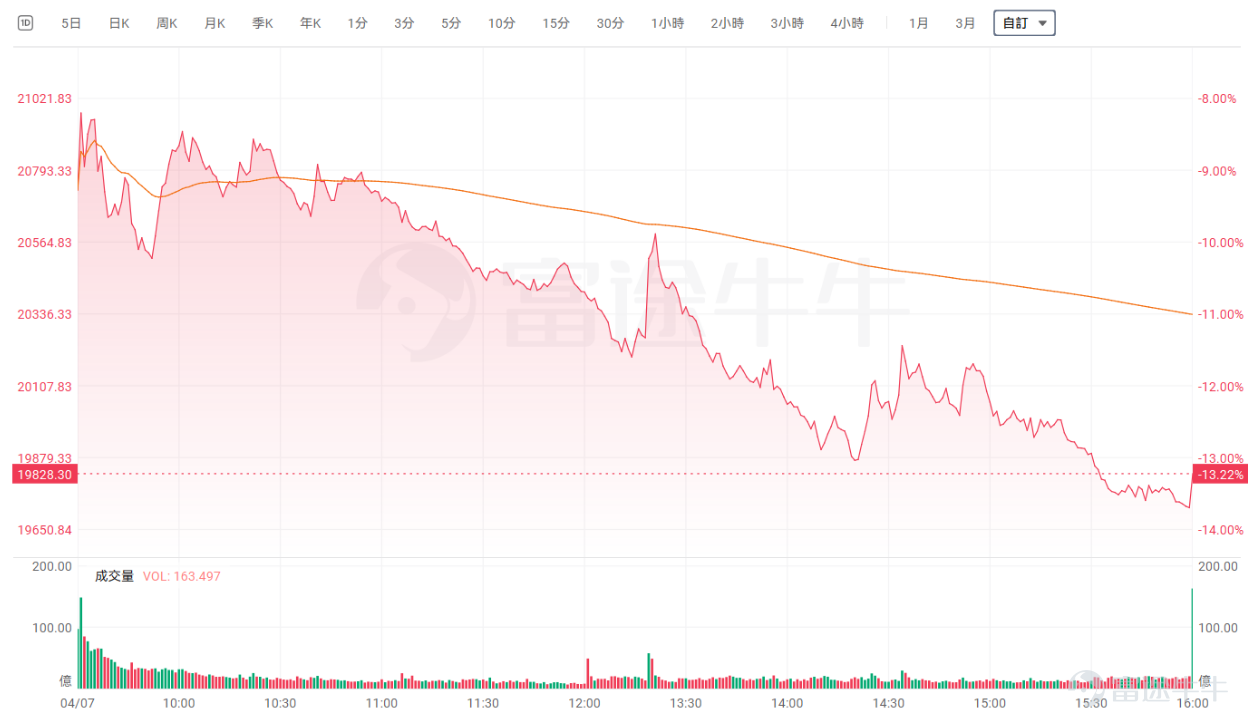
$Hang Seng Index (800000.HK)$ The market was hit hard right at the opening bell, plummeting over 3,000 points throughout the day with a drop exceeding 13%, marking the largest single-day fall since the 1997 Asian Financial Crisis. $Hang Seng TECH Index (800700.HK)$ with a decline of over 17%, marking the largest single-day drop in history.
Intraday chart of Hang Seng Index on April 7, 2025
Data source: Futubull.
And a year later,we find ourselves at the center of another storm - the escalation of the US-Iran conflict has brought geopolitical turbulence, once again putting pressure on global markets.Surging oil prices, stock market pullbacks, and rising risk aversion evoke a sense of déjà vu, prompting the reflection: History doesn’t repeat itself, but it often rhymes.
If we shift our gaze away from the current candlestick chart and look back at this tumultuous year, we might realize:A single day’s rise or fall will eventually be smoothed out by time, but the choices we make in panic often quietly shape vastly different investment outcomes for a long time to come.
Looking back: The darkest hour under the tariff storm
In early April 2025, the Trump administration announced a shocking "reciprocal tariff" policy - imposing a minimum 10% base tariff on all trading partners, with higher tariffs applied to certain countries, particularly China.
Investor sentiment shifted rapidly from confusion to collapse. Before policy clarity emerged, the market was concerned but held onto hope; when the worst-case scenario materialized, sentiment collapsed instantly.The panic that had built up before the holiday, compounded by the dismal performance of global markets during the break, triggered a 'catch-up selloff' storm as trading resumed on April 7.
That day, nearly all asset classes—stocks, crude oil, precious metals, cryptocurrencies—were falling in unison. This 'indiscriminate selling' is a classic sign of extreme market panic: investors no longer distinguish between good and bad assets; they simply want to liquidate and exit as quickly as possible.
US Federal Fund futures suggested the Fed would cut interest rates by 120 basis points within the year, reflecting deep market fears about an economic recession. Major institutions have raised their forecasts for a US downturn. Both the WTO and IMF issued warnings, stating that US tariff policies pose significant risks to the global outlook.
That day, social media was flooded with cries of 'sell everything,' 'run for your life,' and 'doomsday has arrived.' Many investors sold at the lows, some liquidating high-quality stocks they had held for years, while others vowed never to touch the stock market again.Fear is the most expensive emotion in investing.
Just two days later, on April 9, Trump suddenly announced a delay in imposing tariffs on countries that had not retaliated, granting a 90-day reprieve. Following the announcement, global markets staged an epic rebound— $S&P 500 Index (.SPX.US)$ recording the largest single-day gain since 2008— $Nasdaq Composite Index (.IXIC.US)$ surging over 12% in a single day.
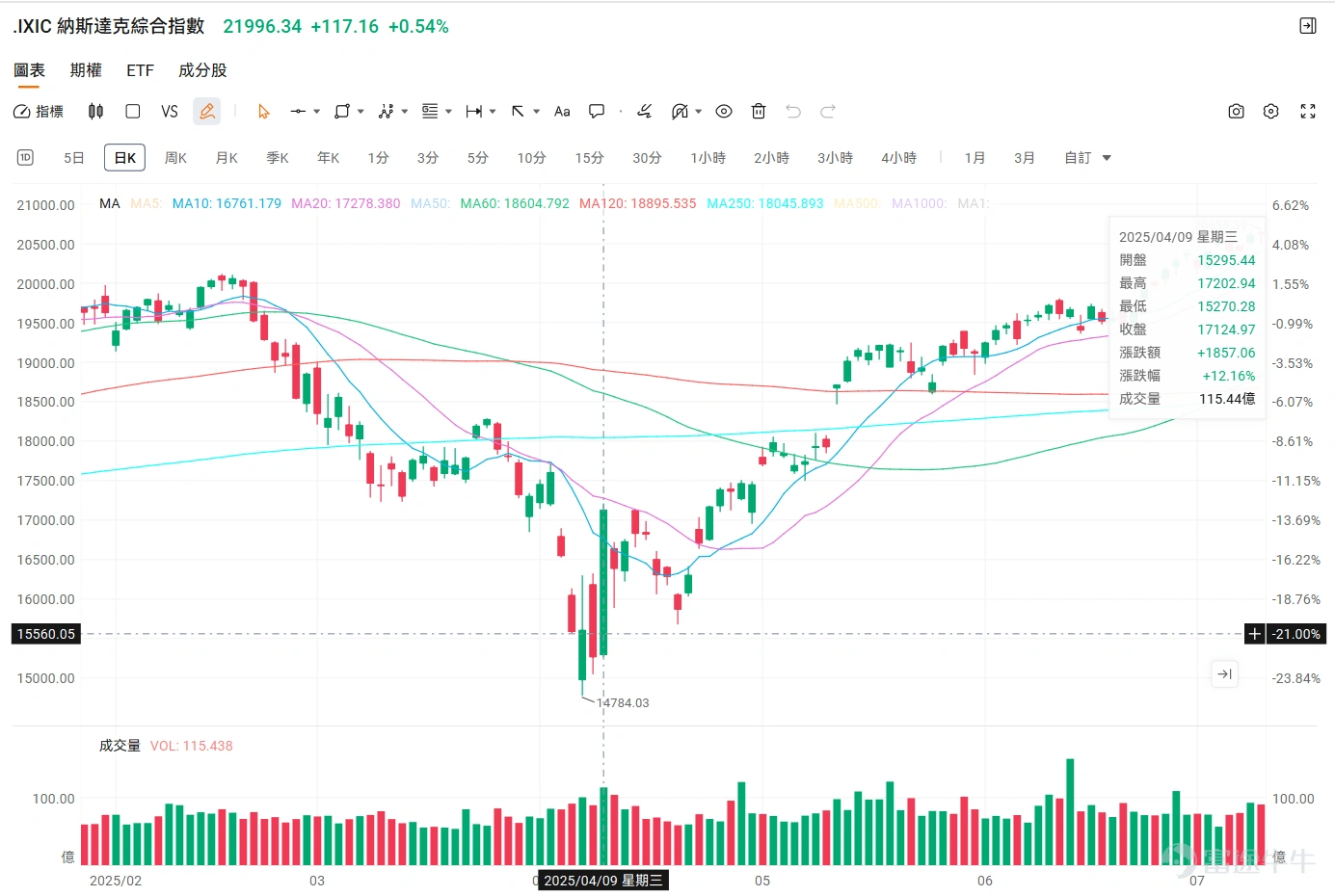
What followed made investors who had sold at the lows regret their decisions deeply. As trade tensions gradually eased, market panic continued to subside.By the summer of 2025, the US stock market had fully recovered from its losses in April; in the second half of the year, driven by the dual forces of the AI industry wave and better-than-expected corporate earnings, it continued to hit new historical highs.
This year's US-Iran conflict: familiar, yet different
In April 2026, the US-Iran conflict escalated sharply, reigniting market concerns as geopolitical tensions flared up again. Oil prices surged significantly due to the heightened tensions in the Middle East, pushing global economic uncertainty back into the spotlight. The US stock market retreated from its highs, led by declines in tech stocks, and investor anxiety returned in full force.
Although last year's tariff storm was fierce, it was essentially a 'policy game' — rules made by one person could also be withdrawn by that same person. After Trump announced a 90-day suspension, the market immediately rebounded in a V-shaped recovery. This is what’s known as the 'TACO trade': Trump Always Chickens Out, where panic comes fast and leaves just as quickly.
The Middle East conflict, however, is a multi-player game. Even if Trump wants to back down, he still needs approval from the other side of the table.
Compared to the swift resolution of Venezuela within hours earlier this year, Iran's situation is far more complex. As the conflict entered its second month, the US 'decapitation' strikes at the start of the war not only failed to destabilize Iran internally but instead galvanized a united front among hardliners, with no substantial signs of navigation resuming through the Strait of Hormuz.
Even though Trump has repeatedly sent mixed signals of both negotiation and escalation recently, Iran's stance will also determine whether this crisis can truly de-escalate. This is no longer a game that one person can unilaterally end.We can also observe that compared to last year’s 'Tariff Day,' Trump's influence on the market through social media has clearly diminished, with the market gradually becoming 'desensitized.'— When a signal repeatedly appears without substantive follow-up actions, the market learns to treat it as noise rather than a meaningful signal.
Additionally, the magnitude of the two market corrections is notably different.Taking the Nasdaq index as an example, last April's low fell more than 27% from its previous high, already surpassing the 20% threshold for a technical bear market. The current lowest point is down 13% from the previous peak, still within the range of 'technical correction.' The market adjustment has been structural, with capital continuing to flow between different sectors without triggering a panic-driven 'sell-off.'
Quality assets never disappoint over time.
Let’s go back to that suffocating 'Black Monday' a year ago. If someone had endured immense psychological pressure and purchased quality assets at the height of the market panic on April 7, 2025, what kind of returns would they be seeing now?

(The illustration is for explanatory purposes only and does not constitute any investment advice or guarantee.)
On April 4, 2025, while Hong Kong stocks were still closed for the Qingming Festival holiday, panic intensified,$SanDisk (SNDK.US)$plunging over 20% on the day and hitting a new low since its listing.
It was also during this year, driven by strong AI demand, that the storage industry experienced a 'super cycle.' From its lowest point, Sandisk surged an astonishing 27 times! The three giants of the storage industry,$Micron Technology (MU.US)$, Samsung ($CSOP Samsung Electronics Daily (2x) Leveraged Product (07747.HK)$) and Hynix ($CSOP SK Hynix Daily (2x) Leveraged Product (07709.HK)$) also recorded a significant increase.also recorded significant gains. Investors who sold their storage stocks a year ago due to tariff fears missed not just a rebound, but an entire era-level industrial wave.
Whether it was last year's tariff storm or this year's US-Iran conflict, in the longer time frame, they are merely 'points' in market volatility. Looking back at history, the 2008 financial crisis, the 2020 pandemic, the 2022 interest rate hike storm... every moment that seemed like the sky was falling turned out to be an excellent buying opportunity in hindsight. The market is a voting machine in the short term and a weighing machine in the long term — this phrase has been repeated countless times, but very few can truly remember it during a crash.
It’s important to note that not all assets are worth bottom-fishing during a crash. The key lies in whether you hold genuinely good assets.Does it have a strong competitive moat? Does it generate consistently growing cash flow? Is it aligned with the development trends of the times? If the underlying logic remains intact, a short-term decline is actually an opportunity to increase your position. If the logic is indeed impaired, then reduce your position when necessary — don’t let emotions cloud your judgment regarding your holdings.
As the memory of last year’s crash gradually fades, and as this year’s headlines on the US-Iran conflict eventually turn over, what the market leaves us with goes far beyond the peaks and troughs on the charts. It’s a vivid lesson teaching us to discern the nature of crises, understand the evolution of market sentiment, and maintain a cool head amidst the noise.
From the heart-stopping moments a year ago to now, how has your investment mindset evolved? In the face of future uncertainties, which 'unchanging' principles remain the backbone of your holdings? Fellow investors are welcome to share in the comments section.
Risk Disclosure: This content does not constitute a research report and is for reference only. It should not be used as the basis for any investment decision. The information involved in this article is not a comprehensive description of the mentioned securities, markets, or developments. Although the source of the information is considered reliable, no guarantee is provided regarding its accuracy or completeness. Additionally, no assurance is given regarding the accuracy of any statements, opinions, or forecasts provided herein.
Risk Disclaimer: The above content only represents the author's view. It does not represent any position or investment advice of Futu. Futu makes no representation or warranty.Read more


Comments (26)
to post a comment
50
66