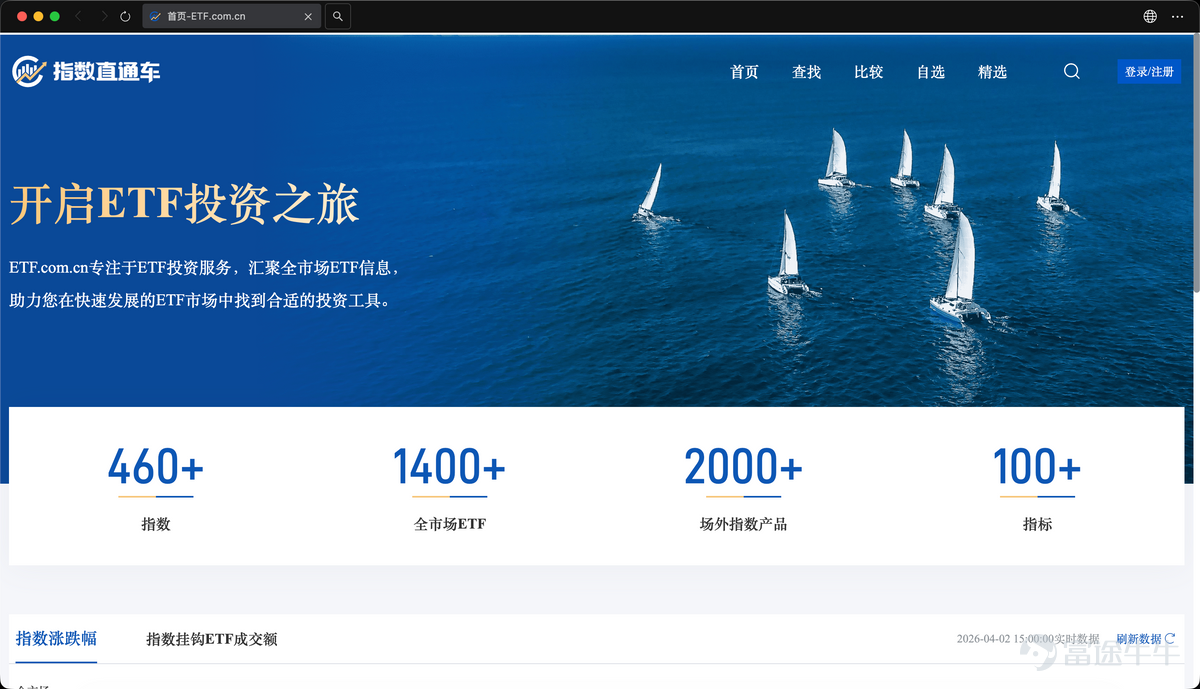

Farewell to mobile information fragmentation: E Fund's 'Index Express' web version makes ETF comparisons clear at a glance
Recently, E Fund Management officially launched the web version of 'Index Express' (www.etf.com.cn). Going back to September 2025, E Fund introduced the mini-program version of 'Index Express', with its core value being 'comprehensive ETF data'.

By the end of 2025, the domestic ETF market size had exceeded 6 trillion yuan. Competition in ETF investment is shifting from 'product supply' to 'tools and efficiency'. The significance of the web version of 'Index Express' is upgrading 'information supply' into 'decision-making efficiency'.
Compared to mobile devices, the most noticeable change in the web version is the increased information density brought by a larger screen.
Previously on mobile devices, investors found it difficult to simultaneously compare key metrics such as the scale, returns, and tracking errors of multiple ETFs, as information was fragmented. On the PC version, however, numerous charts and comparisons can be presented at once, making it easier for investors to form cross-sectional judgments.
In simple terms, this isn't just about having more data; it's about turning 'viewing data' into 'making decisions.' This reflects changes in the structure of ETF investors.
In the past, ETFs were primarily viewed as 'trading tools,' emphasizing liquidity and volatility. However, over the past two years, an increasing amount of capital has started using ETFs as asset allocation tools, especially industry-specific ETFs and cross-market ETFs. At this stage, the demand for screening, comparison, and review has become significantly higher than simply checking market trends.
The web version of 'Index Express' has two 'hidden features'.
The first is result export. The 'comparison' feature in the web version now includes a one-click export option, allowing users to save product comparison results for review, analysis, and decision-making.
The second is account integration. Both the mini-program and the web version can use the same account, enabling data synchronization. Users can casually check information on their phones and conduct in-depth analysis on their computers for a seamless experience.
Overall, the launch of the web version of 'Index Express' represents not only a product upgrade but also a signal within the ETF ecosystem: when there are already enough products, the next phase of competition will focus on who can help investors make choices more efficiently, rather than who can issue another new ETF. (Corporate Research Office, Zhang Yang)
Risk Disclaimer: The above content only represents the author's view. It does not represent any position or investment advice of Futu. Futu makes no representation or warranty.Read more
Comments
to post a comment