
Options Plaza: Earnings Super Week is here! How to use options to capture both bullish and bearish o

Options Trading Insights | Surged nearly 9% in a single day! Intel invests $14.2 billion to regain its semiconductor manufacturing edge—how to seize the CPU industry's growth opportunities?
This article is fromthe 'Options Trend Strategy' columnThis column aims to stand at the forefront of investment trends, interpreting opportunities within these trends and teaching readers how to use options to seize these opportunities.
*The following content is for investment education purposes only, does not represent any investment advice, and the information provided is time-sensitive, with data current as of the US market open on April 2, 2026. Please exercise caution when interpreting.
Yesterday (April 1), $Intel (INTC.US)$ and $Advanced Micro Devices (AMD.US)$ both outperformed the broader market. Intel closed up 8.84%, while AMD rose 3.33%. $SPDR S&P 500 ETF (SPY.US)$ The broader market was up just 0.75%, $iShares Semiconductor ETF (SOXX.US)$ while the sector rose 3.01%.
Although AMD outperformed the broader market, Intel's surge stood out even more, which cannot be solely attributed to the rise in the overall market or sector. Instead, it was driven by stock-specific factors, leading the market to assign it a higher valuation.
What exactly happened? Let’s take a closer look below.
Why Did Intel Suddenly Surge? Clarifying 3 Key Points
$Intel (INTC.US)$The main reason for the stock price surge comes from a catalyst event unique to the company itself.
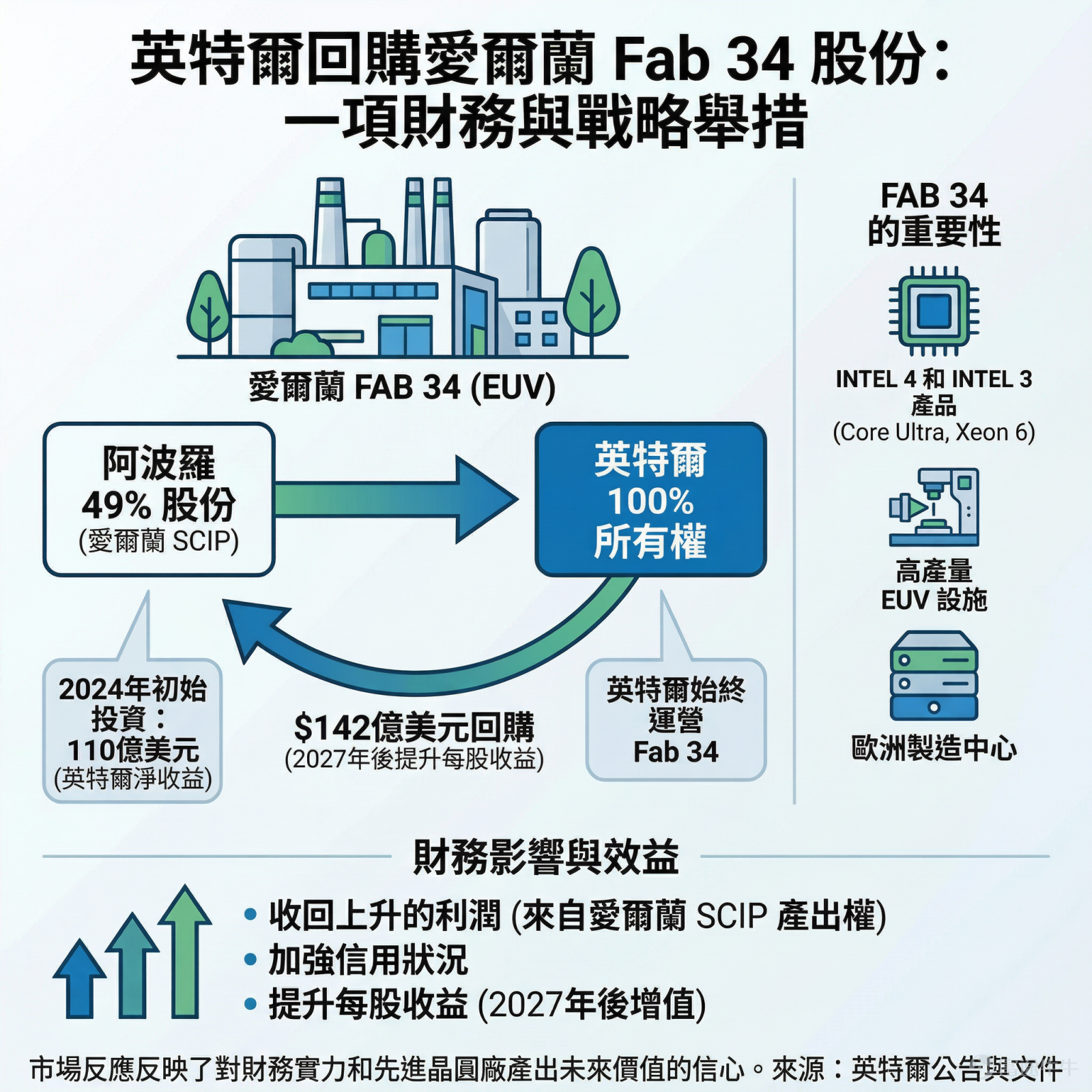
This event is,Intel spent $14.2 billion to buy back 49% of the shares in 'Fab 34,' an Irish wafer plant owned by Apollo. From now on, all profits from this wafer plant belong solely to Intel.
Many people may ask why the repurchase of a wafer plant's equity can cause such a dramatic rise in stock price. Let’s clarify three core issues: What is Fab 34, why does Apollo own its shares, and why did Intel spend a large amount of money to buy it back?
First, Fab 34 is no ordinary facility—it is one of Intel's most important advanced wafer plants in Europe, specifically producing high-capacity advanced chips like Intel 4, Intel 3, Core Ultra processors, and Xeon 6 server CPUs. It is also Intel's first high-capacity factory in Europe to use EUV (Extreme Ultraviolet) technology, making it crucial for Intel’s production capacity.
As for why Apollo holds shares, back in 2024, Intel launched the 'Semiconductor Co-Investment Program' (SCIP), under which Apollo contributed approximately $11 billion to Intel in exchange for a 49% stake in this wafer plant. However, note that although Apollo owns shares, Intel still handles the plant’s operation and management; Apollo merely holds rights to the plant’s output and sells the produced chips back to Intel.
The main reason Intel decided to buy back the shares was to secure full profits—previously, 49% of the plant’s earnings were shared with Apollo, but now all profits belong to Intel. Additionally, Intel can have more autonomy over managing its production capacity to address CPU supply shortages.
![This article is from[Share Link: the 'Options Trend Strategy' column]This column aims to stand at the forefront of investment trends, interpreting opportunities within these trends and teaching readers how to use options to seize these opportunities. *The following content is for investment education purposes only, not representing any investment advice. The information provided is time-sensitive and data is current as of the US stock market opening on April 2, 2026. Please exercise caution when interpreting. Yesterday (April 1), $Intel (INTC.US)$ and $Advanced Micro Devices (AMD.US)$ both outperformed the broader market. Intel closed up 8.84%, while AMD rose 3.33%. $SPDR S&P 500 ETF (SPY.US)$ The broader market was up just 0.75%, $iShares Semiconductor ETF (SOXX.US)$ while the sector gained 3.01%. Although AMD outperformed the broader market, Intel’s surge was more pronounced and cannot be solely attributed to overall market or sector gains. Instead, company-specific factors led the market to assign Intel a higher valuation. What exactly happened? Let’s take a closer look below. Why did Intel suddenly soar? Here are three key points explained. $Intel (INTC.US)$The major rise in the stock price mainly comes from a catalyst event specific to the company itself. This event is,Intel spent $14.2 billion to purchase 49% of the shares in 'Fab 34 in Ireland' held by Apollo...](https://nnqimage.futunn.com/sns_client_feed/999908/20260402/web-1775122851789-0LsvyY5SGQ.png/big?area=2&is_public=true&imageMogr2/ignore-error/1/format/webp)
What impact does this buyback have on Intel?
$Intel (INTC.US)$Intel itself has made it clear that this repurchase is not a loss-making deal: Starting from 2027, this wafer plant will continuously increase the company's earnings per share and make its financial position more robust.
According to Intel's 2025 earnings report, the Ireland SCIP project alone generated $268 million in revenue for the company (this portion of revenue did not originally fully belong to Intel). Intel forecasts that as the Ireland Fab 34 wafer plant gradually comes online, profits from this project will continue to grow in 2026 and will surge significantly by 2027.
Intel’s share repurchase means reclaiming the portion of profits originally distributed to other shareholders. Since it is expected that this project will become increasingly profitable in the future, Intel is buying back shares now so that it can capture all of the growing profits later.
This transaction has been widely interpreted by the market as a positive signal.
On one hand, this signals that the company's financial situation is stabilizing. When Intel sold this stake in 2024, it was facing significant capital expenditure pressure. Now, having the ability to conduct buybacks shows its balance sheet has strengthened and financial discipline has improved.
Looking at the latest earnings data, Intel’s free cash flow (FCF) in Q4 2025 surged 129.97% year-over-year to $800 million, with strong operating cash flow as well, giving it more confidence to carry out such capital operations.
On the other hand, it also reflects management’s confidence in its own business strategy and future prospects, especially in the layout of AI chip manufacturing.
Intel has transitioned from selling equity in 2024 to ensure survival, to now pursuing expansion. Its IDM 2.0 (Integrated Device Manufacturing 2.0) strategy has entered a substantive deepening phase, re-emphasizing the long-term value of integrated design and manufacturing.
What key signals does this convey at the industry level?
$Intel (INTC.US)$The heavy investment and financial cost to regain control of the Fab 34 plant is not only a crucial step in deepening its IDM 2.0 strategy but also sends a clear signal to the global semiconductor industry:
In the AI-driven computing power era, control over advanced manufacturing capacity itself has become a core strategic asset and competitive barrier. Coupled with the current severe CPU supply shortage, this is reshaping industry competition dynamics and forcing key players in the sector to reassess and adjust their strategies.
Reuters reported in February that both Intel and AMD have informed their clients in China: the supply of server CPUs is very tight, with no inventory available. For Intel, the delivery time for some products could take up to six months; for AMD, it’s between 8 to 10 weeks. Moreover, Intel’s server CPUs have already increased in price by over 10% in the Chinese market.
As early as January this year, Intel mentioned during its earnings call that there was a shortage of CPUs, and it expected inventory to drop to its lowest point in the first quarter of the year before gradually improving.
As large AI models move from training to large-scale deployment, demand for inference workloads has surged, and the importance of CPUs in handling complex logic, data scheduling, and managing AI agents has sharply increased.
Previously, CPUs were considered just an ordinary component in AI devices, nothing special. But now, people are finally realizing that CPUs have become a bottleneck in AI infrastructure — as AI systems grow larger and run longer, the demand for CPUs is increasing, while supply can’t keep up, making CPUs increasingly scarce.
Intel’s expensive move to reclaim the Fab 34 factory is precisely to bet on and control the production capacity and technological rhythm of this wave of CPU resurgence.
From a broader perspective, Intel’s move reflects a fundamental shift occurring in the semiconductor industry: from prioritizing efficiency to prioritizing control.
For decades, the semiconductor industry followed the logic of specialized division of labor, separating design from manufacturing to pursue optimal efficiency and cost. However, in today's AI-driven super-demand cycle, the value of certainty and controllability in the supply chain has surpassed mere cost considerations. The reality of widespread capacity constraints has given companies with internal manufacturing capabilities greater autonomy and influence over capacity allocation, technology iteration, and supply security.
Intel’s IDM 2.0 strategy is a bet on establishing this new rule. By regaining control over manufacturing, Intel positions itself as a comprehensive solution provider offering both products and capacity — a highly valuable advantage in the current industry environment.
What do other key players think? Let’s briefly discuss.
$Advanced Micro Devices (AMD.US)$:AMD is a direct beneficiary of the CPU shortage, with strong performance. Revenue, data center income, and earnings per share in Q4 2025 all significantly exceeded expectations. However, its biggest weakness is clear — as a fabless company, all of its advanced process capacity depends on Taiwan Semiconductor. When AI chip makers scramble for capacity, AMD’s CPU shipment pace essentially depends on how much capacity it can secure from Taiwan Semiconductor. Bank of America believes that with the launch of the MI400X product and OpenAI collaboration taking effect, the second half of 2026 will be a major growth inflection point for AMD, with potential earnings per share more than doubling. There are significant opportunities, but supply chain risks are also substantial.
$NVIDIA (NVDA.US)$:NVIDIA's profitability is beyond doubt, with its moat coming from its full-stack ecosystem — from GPUs to networking to the CUDA software, creating extremely high switching costs. However, it also relies on Taiwan Semiconductor’s advanced packaging capacity. But NVIDIA has long been unsatisfied with merely being the king of GPUs; its Grace and Vera server CPUs based on the Arm architecture directly enter the market dominated by Intel and AMD. Moreover, it has invested in Intel's foundry business, which essentially serves as a strategic move to mitigate supply chain risks.
$Taiwan Semiconductor (TSM.US)$:Under the near-monopoly in advanced process technology, Taiwan Semiconductor’s role has evolved from being a mere manufacturing service provider to becoming the resource allocation hub in the global computing power race. Most of its capital expenditure goes into advanced logic processes and factory construction, with capacity already booked until 2028. Who can secure Taiwan Semiconductor’s capacity, and how much they get, directly determines the product launch schedule and market competitiveness.
$Arm Holdings (ARM.US)$:The silent giant in the CPU architecture field, its ARM architecture is widely used in mobile phones and IoT devices. In recent years, it started a strategic transformation, shifting from traditional IP licensing to directly designing and selling data center CPUs, entering the AI inference market, and attempting to step out from behind the scenes in the CPU sector. The risk, however, lies in the fact that when it begins to compete directly with its licensing customers (such as NVIDIA), it might undermine the very ecosystem it depends on.
How to pair options strategies? Understand with three examples
After reviewing the fundamentals, you can next consider: If you agree with the broader trend of CPU shortages and capacity control, besides buying stocks, what other ways are there to participate? Below, we will explain corresponding options strategies for different categories.
For AMD, NVIDIA, and Arm, which have long-term logic but limited capacity,
These companies are all fabless, relying on Taiwan Semiconductor for advanced processes. They possess high growth potential, but need to hedge against the risks of sudden capacity crunches and valuation pullbacks.
If you are optimistic about the long-term trend but worry about excessive short-term volatility, consider a protective put option, which involves holding the underlying stock while purchasing out-of-the-money puts (for instance, strike price 5-10% below the current price).
The premium acts like an insurance fee; if the stock price rises, only this small cost is lost; if the stock price plummets due to supply chain issues or market corrections, the profit from the put option can partially offset the stock loss, locking in downside risk.
The expiration date profit and loss characteristics of this strategy can be referenced in the figure below (which includes only the options portion, not the underlying stock), intended solely for investment education purposes and does not constitute any investment advice:
![This article is from[Share Link: the 'Options Trend Strategy' column]This column aims to stand at the forefront of investment trends, interpreting opportunities within these trends and teaching readers how to use options to seize these opportunities. *The following content is for investment education purposes only, not representing any investment advice. The information provided is time-sensitive and data is current as of the US stock market opening on April 2, 2026. Please exercise caution when interpreting. Yesterday (April 1), $Intel (INTC.US)$ and $Advanced Micro Devices (AMD.US)$ both outperformed the broader market. Intel closed up 8.84%, while AMD rose 3.33%. $SPDR S&P 500 ETF (SPY.US)$ The broader market was up just 0.75%, $iShares Semiconductor ETF (SOXX.US)$ while the sector gained 3.01%. Although AMD outperformed the broader market, Intel’s surge was more pronounced and cannot be solely attributed to overall market or sector gains. Instead, company-specific factors led the market to assign Intel a higher valuation. What exactly happened? Let’s take a closer look below. Why did Intel suddenly soar? Here are three key points explained. $Intel (INTC.US)$The major rise in the stock price mainly comes from a catalyst event specific to the company itself. This event is,Intel spent $14.2 billion to purchase 49% of the shares in 'Fab 34 in Ireland' held by Apollo...](https://nnqimage.futunn.com/sns_client_feed/999908/20260402/web-1775122840973-jIp8GFvlBW.jpeg/big?area=2&is_public=true&imageMogr2/ignore-error/1/format/webp)
For Intel and Taiwan Semiconductor, which are striving to regain control of their production capacity,
Both companies either own or are strengthening their internal manufacturing capabilities, but there is still a significant difference in certainty between the two.
Intel's transformation story holds promise, but financial conditions and order prospects remain an issue. The stock price could surge significantly or consolidate sideways, but currently, the probability of a steady rise might be greater than that of a sharp spike.
If you're optimistic about its long-term share price but want to avoid the high cost of simply buying call options, or if you believe the stock price already reflects some positive factors in the short term with limited room for a sharp increase, consider the Bull Call Spread strategy. That is, buy at-the-money or slightly out-of-the-money call options while simultaneously selling the same number of call options at a higher strike price (e.g., 10-15% higher).
This strategy reduces the cost of bullish premiums, with maximum profit limited by the difference between the two strike prices, making it suitable for expecting steady upward movement without a sharp spike. If the stock price plummets due to unforeseen reasons, the loss is limited to the net premium, offering controlled risk.
The profit and loss characteristics at expiration can be referenced in the diagram below, provided for educational purposes only and not representing any investment advice:
![This article is from[Share Link: the 'Options Trend Strategy' column]This column aims to stand at the forefront of investment trends, interpreting opportunities within these trends and teaching readers how to use options to seize these opportunities. *The following content is for investment education purposes only, not representing any investment advice. The information provided is time-sensitive and data is current as of the US stock market opening on April 2, 2026. Please exercise caution when interpreting. Yesterday (April 1), $Intel (INTC.US)$ and $Advanced Micro Devices (AMD.US)$ both outperformed the broader market. Intel closed up 8.84%, while AMD rose 3.33%. $SPDR S&P 500 ETF (SPY.US)$ The broader market was up just 0.75%, $iShares Semiconductor ETF (SOXX.US)$ while the sector gained 3.01%. Although AMD outperformed the broader market, Intel’s surge was more pronounced and cannot be solely attributed to overall market or sector gains. Instead, company-specific factors led the market to assign Intel a higher valuation. What exactly happened? Let’s take a closer look below. Why did Intel suddenly soar? Here are three key points explained. $Intel (INTC.US)$The major rise in the stock price mainly comes from a catalyst event specific to the company itself. This event is,Intel spent $14.2 billion to purchase 49% of the shares in 'Fab 34 in Ireland' held by Apollo...](https://nnqimage.futunn.com/sns_client_feed/999908/20260402/web-1775122840331-spCjSy4Sm0.jpeg/big?area=2&is_public=true&imageMogr2/ignore-error/1/format/webp)
On the other hand, for Taiwan Semiconductor, which has a relatively robust fundamental position and dominates advanced processes, stock price volatility is lower and already at a relatively high level. For those who are long-term bullish but less willing to buy at current prices and prefer to accumulate on dips, the Cash-Secured Put strategy may be appropriate.
That is, sell put options at your target buy price (e.g., 8-12% below the current price) while reserving enough cash in your account to purchase the stock if exercised. If the stock price does not fall below the strike price, you can steadily collect the premium upon expiration; if it does drop below, you will passively acquire shares at a discounted price, lowering your actual holding cost below the prevailing market price.
The profit and loss characteristics at expiration can be referenced in the diagram below, provided for educational purposes only and not representing any investment advice:
![This article is from[Share Link: the 'Options Trend Strategy' column]This column aims to stand at the forefront of investment trends, interpreting opportunities within these trends and teaching readers how to use options to seize these opportunities. *The following content is for investment education purposes only, not representing any investment advice. The information provided is time-sensitive and data is current as of the US stock market opening on April 2, 2026. Please exercise caution when interpreting. Yesterday (April 1), $Intel (INTC.US)$ and $Advanced Micro Devices (AMD.US)$ both outperformed the broader market. Intel closed up 8.84%, while AMD rose 3.33%. $SPDR S&P 500 ETF (SPY.US)$ The broader market was up just 0.75%, $iShares Semiconductor ETF (SOXX.US)$ while the sector gained 3.01%. Although AMD outperformed the broader market, Intel’s surge was more pronounced and cannot be solely attributed to overall market or sector gains. Instead, company-specific factors led the market to assign Intel a higher valuation. What exactly happened? Let’s take a closer look below. Why did Intel suddenly soar? Here are three key points explained. $Intel (INTC.US)$The major rise in the stock price mainly comes from a catalyst event specific to the company itself. This event is,Intel spent $14.2 billion to purchase 49% of the shares in 'Fab 34 in Ireland' held by Apollo...](https://nnqimage.futunn.com/sns_client_feed/999908/20260402/web-1775122840339-xCnpToC1Kj.jpeg/big?area=2&is_public=true&imageMogr2/ignore-error/1/format/webp)
If you want more inspiration regarding options strategies, you can easily get it on the mobile app or the new desktop version by following these steps!
![This article is from[Share Link: the 'Options Trend Strategy' column]This column aims to stand at the forefront of investment trends, interpreting opportunities within these trends and teaching readers how to use options to seize these opportunities. *The following content is for investment education purposes only, not representing any investment advice. The information provided is time-sensitive and data is current as of the US stock market opening on April 2, 2026. Please exercise caution when interpreting. Yesterday (April 1), $Intel (INTC.US)$ and $Advanced Micro Devices (AMD.US)$ both outperformed the broader market. Intel closed up 8.84%, while AMD rose 3.33%. $SPDR S&P 500 ETF (SPY.US)$ The broader market was up just 0.75%, $iShares Semiconductor ETF (SOXX.US)$ while the sector gained 3.01%. Although AMD outperformed the broader market, Intel’s surge was more pronounced and cannot be solely attributed to overall market or sector gains. Instead, company-specific factors led the market to assign Intel a higher valuation. What exactly happened? Let’s take a closer look below. Why did Intel suddenly soar? Here are three key points explained. $Intel (INTC.US)$The major rise in the stock price mainly comes from a catalyst event specific to the company itself. This event is,Intel spent $14.2 billion to purchase 49% of the shares in 'Fab 34 in Ireland' held by Apollo...](https://nnqimage.futunn.com/sns_client_feed/999908/20260402/web-1775122845410-LuI8AGFA3d.png/big?area=2&is_public=true&imageMogr2/ignore-error/1/format/webp)
That’s all for today.Finally, here’s a small perk for fellow investors—welcome to claim it!Beginner's Options Package(*This promotion is available exclusively to HK invited users; click to learn more.Event Details Rules >>)
Risk Disclaimer: The above content only represents the author's view. It does not represent any position or investment advice of Futu. Futu makes no representation or warranty.Read more


Comments (5)
to post a comment
50
36