
SpaceX's confidential filing has sparked a surge of interest in the field of space science. Which advanced materials companies are poised for explosive growth opportunities?
Advanced materials are the cornerstone of space technology development. The space technology sector has extremely high requirements for material properties such as strength, hardness, high-temperature resistance, and corrosion resistance. Materials used in space technology and aerospace can be categorized into special metals, specialty polymers, ceramics, specialized coatings, power semiconductor materials, energy materials, and more.
Recent geopolitical disturbances have made supply chain security an increasingly serious issue, giving related companies a higher level of scarcity value.
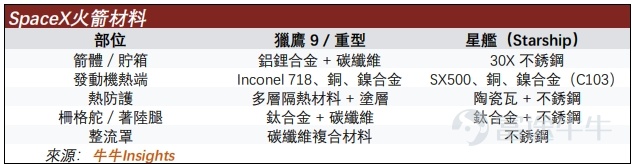
Looking at the materials used by SpaceX, essential materials include niobium metal, titanium alloys, and coatings. Although Starship eliminated carbon fiber, carbon fiber is still widely used in the field of space technology.

Space materials can be divided into the following categories:

1. Superalloys and special metals
Materials in this field include high-performance nickel-based, cobalt-based superalloys, and titanium alloys. Key application areas include aircraft engines, aerospace structural components, missile casings, and missile propulsion systems. A comparison of the performance of several types of metals is as follows:

Titanium alloys, superalloysRepresentative companies include $Carpenter Technology (CRS.US)$、$ATI Inc (ATI.US)$and$Howmet Aerospace (HWM.US)$ Weight reduction in aerospace structures requires the use of titanium (Ti), which offers the best overall cost-performance ratio. Among companies, Howmet Aerospace mainly engages in jet engine components, aerospace fastening systems, and titanium structural parts. Since its listing in 2020, its stock price has risen for six consecutive years, surging over 24 times cumulatively.
Niobium metal: The supply concentration of niobium metal materials is very high, and the United States only provides related products. The hot end of rocket engines must use niobium (Nb) for its high-temperature resistance; titanium and beryllium cannot withstand such conditions.$Materion (MTRN.US)$、 $Carpenter Technology (CRS.US)$Supply of related products. The hot end of rocket engines must use niobium (Nb) because it can withstand extremely high temperatures—neither titanium nor beryllium can.
Beryllium metal and copper-beryllium alloys: Their characteristics include extreme lightweight, high rigidity, fatigue resistance, and spark-free properties, often used in satellite structures, inertial navigation systems, X-ray windows, missile guidance system springs, and connectors. The representative company remains Howmet Aerospace, the world's largest high-purity beryllium producer. Beryllium (Be) is only utilized in high-end military and aerospace applications due to its high cost and toxicity.$Materion (MTRN.US)$, the company is the world's largest producer of high-purity beryllium. Beryllium (Be) is used only in high-end military and aerospace applications due to its high cost and toxicity.
2. Carbon Fiber
Carbon fiber can meet military needs for weight reduction, extended range, and energy savings, widely used in F-35, AH-64 Apache helicopter fuselages, UAV structural components like MQ-9, and lightweight parts for armored vehicles. The representative company is Futubull.$Hexcel (HXL.US)$。
3. Specialty polymers:
Special chemical polymers are essential materials. Specialty polymers used in space science are predominantly top-performing varieties with high-temperature resistance, extremely low-temperature endurance, radiation resistance, atomic oxygen resistance, low outgassing, high strength, and lightweight properties.
Among these, PEEK (Polyetheretherketone) material is lighter than metal, corrosion-resistant, and can partially replace aluminum and titanium. The main companies involved are $Celanese Corp (CE.US)$ 。
Fluoropolymers are the primary material used in sealing and insulation. Representative companies include Chemours. $The Chemours (CC.US)$ 、 $3M (MMM.US)$ 。
4. High-performance coatings for aerospace applications.
Coatings play a critical role in protecting aircraft structures from environmental factors such as moisture and salt spray, extending the service life of aircraft components and reducing surface friction. Representative companies primarily serve the civil aviation sector. $PPG Industries (PPG.US)$ This company also provides products such as sealants and adhesives. $Sherwin-Williams (SHW.US)$Through its high-performance coatings division, it supplies coatings for both civilian and military aviation. According to Futubull, its high-performance coatings division is projected to account for 28.94% of revenue by 2025. Additionally, $Honeywell (HON.US)$ it is also a key player in stealth materials, with its materials business falling under the aerospace segment.
5. Chip materials:
Space science mainly involves silicon carbide and gallium nitride. Due to the limitations on satellite size and weight, extreme space temperatures, and high-energy particle radiation, GaN is the dominant force in space RF and microwave applications, primarily used in satellite communications, radar, and core power amplification in phased arrays, with few substitutes available. Related companies include $ON Semiconductor (ON.US)$ 、 $Qorvo (QRVO.US)$ 、 $Sumitomo Electric Industries (5802.JP)$ 、 $Coherent (COHR.US)$ 。
Besides the giants in the above-mentioned niche fields, it is worth mentioning the UK-based company $Teledyne Technologies (TDY.US)$ which operates across multiple fields mentioned above and is a core manufacturer specializing in precision processing of advanced materials, special forming, and device integration. It holds irreplaceable technological barriers especially in areas such as C103 niobium alloy precision parts, YIG microwave materials, GaN RF devices, and aerospace composites.
Risk Disclaimer: The above content only represents the author's view. It does not represent any position or investment advice of Futu. Futu makes no representation or warranty.Read more

Comments (2)
to post a comment
17
35