
AMD's market cap breaks $1 trillion! Is the US stock AI rally staging a full-scale comeback?

Breaking Down CoreWeave's Financing: Dilution Risks Behind the AI Cloud Boom

Author | Eric
Neocloud rebounded strongly last night, driven by two key factors: First, the demand for AI computing power remains explosively strong; second, the financing environment appears to be loosening. Together, these two factors have an astonishing impact.
For giants with large tanker fleets like $CoreWeave (CRWV.US)$ or $NEBIUS (NBIS.US)$ For a company like Neocloud, strong demand alone is far from enough. These enterprises need to invest massive amounts of real money to buy GPUs, build computing clusters, and sign bigger contracts. When the market realizes that not only are their clients' demands booming, but also that raising capital has become easier, their stock prices will naturally skyrocket. CoreWeave's financing last night precisely confirms this point.
What makes CoreWeave’s latest financing round so impressive?
CoreWeave secured a financing deal last night with GPUs as the underlying assets, and at the asset level, it receivedinvestment-grade ratingThis sends a signal to investors that the credit market is now increasingly confident in 'AI infrastructure' as an asset class, moving away from the narrative of early-stage companies relying solely on AI hype and high-interest borrowing to survive. Backed by GPUs and client contracts, it is starting to look more like a serious infrastructure business capable of securing financing from traditional financial institutions.
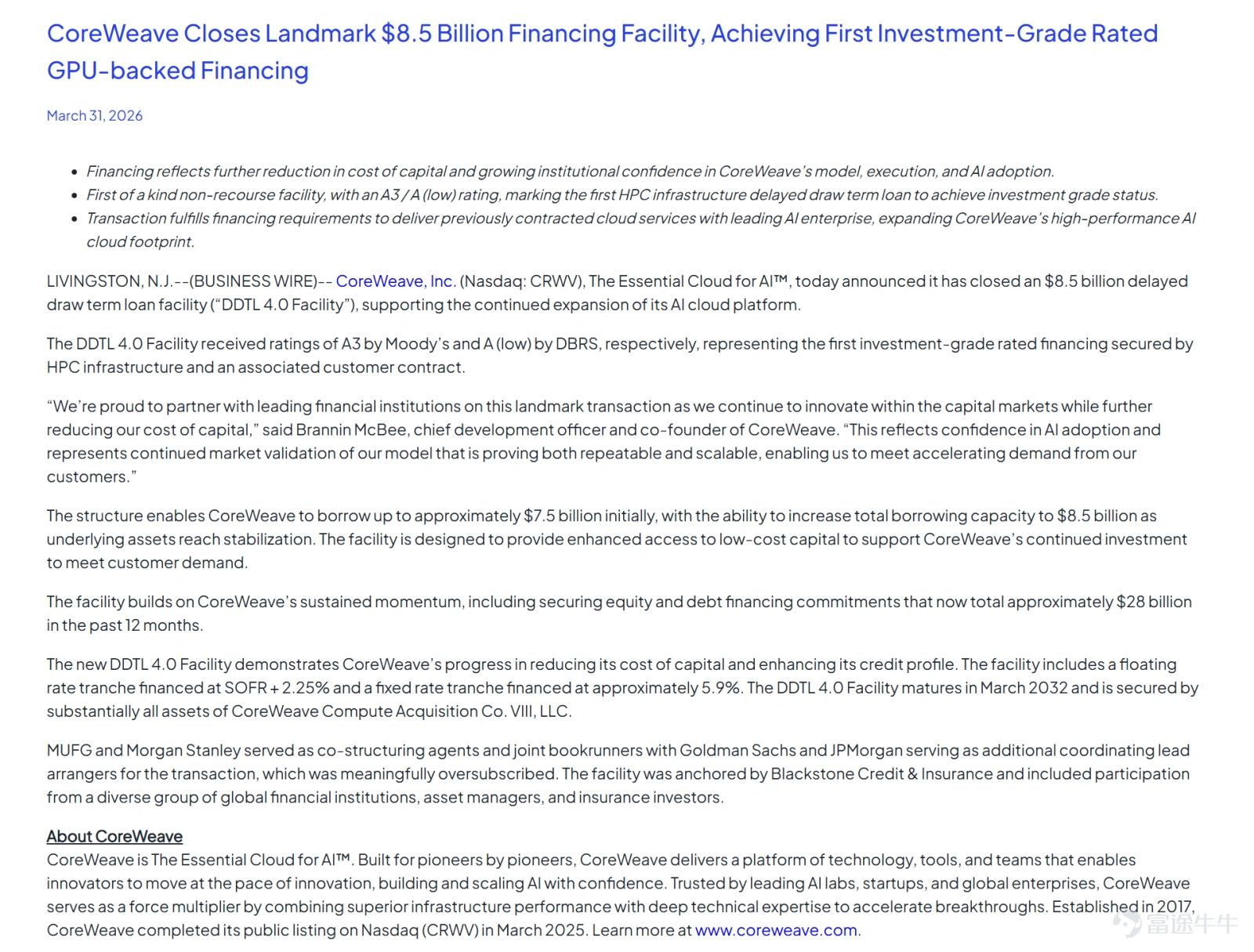
Of course, this does not mean that CoreWeave itself has suddenly become a low-risk company; it still carries risks. However, the capital market is becoming increasingly confident in the business logic behind AI cloud infrastructure.
The demand for computing power remains explosively strong
Another core reason this business model works is demand. The recent trend in Bloomberg’s GPU rental price index shows that the supply of both older and newer generations of chips remains extremely tight. This is the most critical part.Currently, not only are the latest chips highly expensive, but even older GPU prices remain very robust, let alone the fact that prices for new-generation GPUs continue to hit record highs.This indicates that the market's hunger for computing power is comprehensive and insatiable.

Essentially, these companies are selling access to scarce AI infrastructure. As long as enterprises, large model companies, and AI developers need computing power that exceeds the upper limit easily provided by tech giant cloud platforms, these specialized GPU cloud vendors have a huge space for survival. Strong demand keeps the utilization rate of computing power high, and high utilization supports rapid revenue growth, which in turn makes it easier to raise more funds. Once this flywheel starts spinning, its momentum is incredibly powerful.
A blind spot investors must not overlook
However, everyone should be aware that the emerging cloud industry remains an absolute 'cash guzzler.' It's completely different from a lightweight asset software model. For these companies to grow, they need to continuously pour in massive amounts of money. They need to buy more GPUs, add more servers, consume more electricity, expand capacity, and raise more capital. This is precisely why balance sheets are so crucial for companies in this sector.
Take CoreWeave for example: to scale up, they've already created an extremely complex financing mix that includes delayed draw term loans, notes, convertible bonds, OEM financing, and revolving credit facilities. NEBIUS, similarly, relies on substantial external funding to expand, with their balance sheet filled with large-scale convertible bond issuances and highly aggressive capital expenditure plans.
So, the real question now has nothing to do with whether demand exists. The demand is there, crystal clear. The core issue everyone should focus on is how much external funding these companies will still need before their business models can achieve self-sustaining profitability. This is where investors must remain constantly vigilant.
Why might they still face more debt or equity dilution in the future?
This is probably the most important reminder for all investors. Even if a company like CoreWeave just secured a nearly perfect major round of financing, it may still need to continue raising funds in the future. NEBIUS is in the same situation. As long as demand remains strong, they'll want to expand faster. And faster expansion often means a significant amount of additional funding is required.
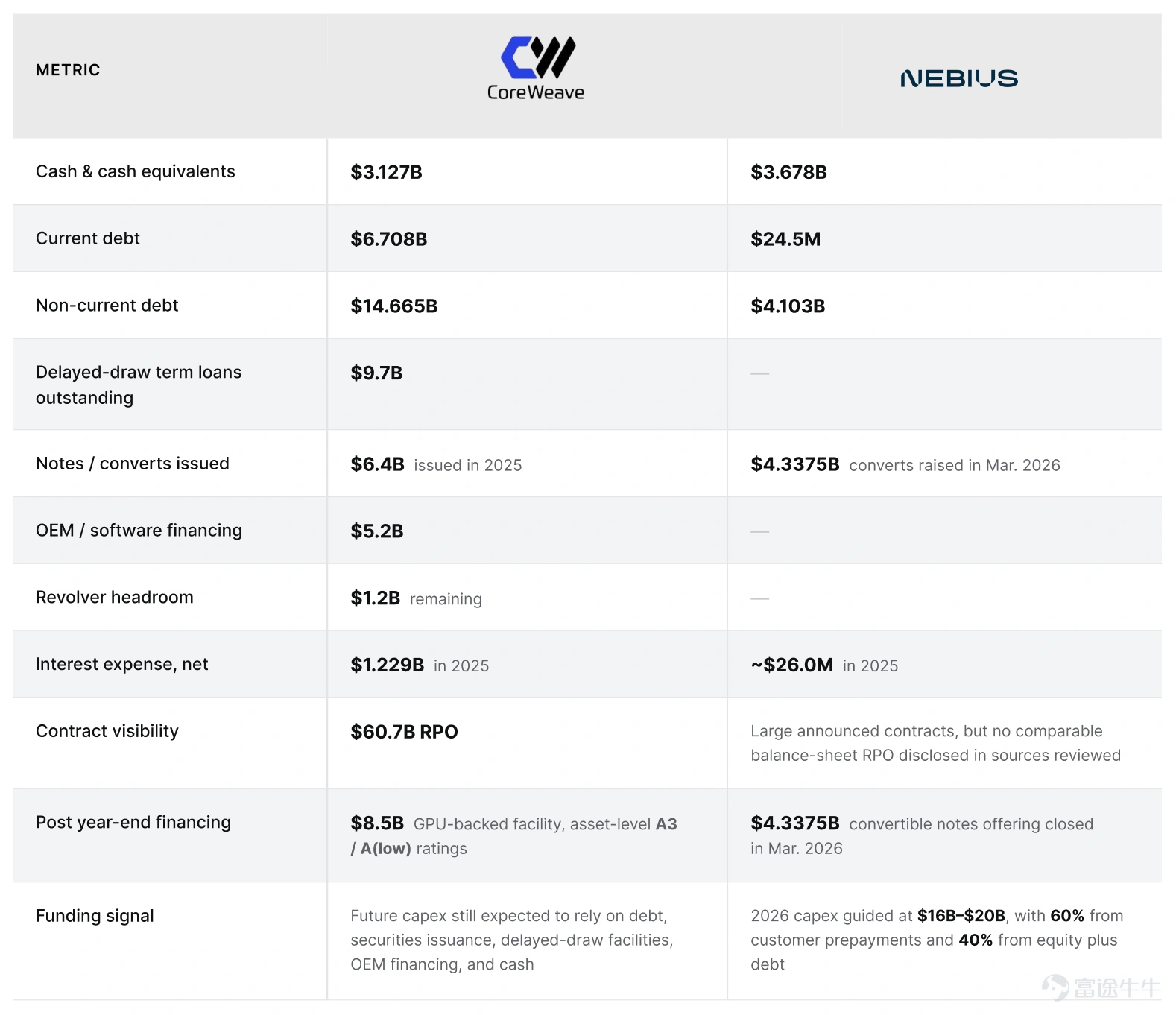
These sources of funding could be varied.It could involve increasing debt, issuing more convertible bonds, pursuing more structured financing, or even directly issuing more shares.Although major financing deals like CoreWeave’s can certainly boost market sentiment, they don’t entirely eliminate the risk of future equity dilution. It only indicates one thing: the terms for the next round of financing are likely to be better than the previous ones.
Summary
The demand in the Neocloud sector remains extremely stable at present. Whether it's new GPUs or older ones, leasing indices are continuously rising, indicating that the spot market for AI computing power is still very tight. Meanwhile, CoreWeave’s latest round of financing also shows that institutional capital is becoming increasingly flexible and confident when it comes to AI infrastructure. However, this absolutely does not mean investors can blindly buy in; the waters in this sector remain very deep.
The bullish thesis is straightforward: GPU scarcity, rising machine utilization rates, long-term customer contracts in hand, and growth rates in certain niche markets that far outpace traditional cloud service giants.
However, the risks are equally apparent. These companies remain cash-burning machines heavily reliant on financing. To stay in the game, they may need to continually pile on debt, issue convertible bonds, or sell additional shares. To truly understand this sector, the focus cannot merely be on whether there is demand — that’s only the basics. What really matters is whether these companies can maintain their bottom line and exercise strict financial discipline in the face of strong demand.
Risk Disclaimer: The above content only represents the author's view. It does not represent any position or investment advice of Futu. Futu makes no representation or warranty.Read more


Comments (2)
to post a comment
3
6