
Options Square: Micron earnings are coming—how to position in a volatile market?

Options Trading Strategies | Powell Turns Dovish, But Are US Stocks Still Shrouded in Uncertainty? Three Strategies to Help You Defend, Speculate, and Win Steadily
This article is from"Options Trading in Action"column, which strives to stand at the forefront of investment trends, interpreting opportunities within these trends and teaching readers how to use options to seize those opportunities.
*The following content is for educational purposes only and does not constitute any investment advice. The information provided is time-sensitive, with data as of the opening of the US stock market on March 31, 2026. Please exercise caution when evaluating the information.
Yesterday (March 30), remarks by Federal Reserve Chair Powell were interpreted by the market as dovish signals, providing some relief to financial markets that have been on edge due to inflation fears and geopolitical tensions.
However, after experiencing severe volatility since March, is this statement a fleeting moment in a downward trend, or the starting point of a new round of market movements? As investors, how should we manage risks and seize opportunities amid this complex macro puzzle? Let’s delve into the details.
Powell releases dovish signals, temporarily calming market fears
Here’s what happened: Last night, Powell visited Harvard University and gave a lecture to students at the Harvard School of Economics.
Prior to this, since late March, Wall Street had been gripped by a typical logic of supply shock panic: Middle East conflict pushing up oil prices → threatening the final leg of US inflation retreat → signs of stagflation emerging (slowing growth accompanied by stubborn inflation) → forcing the Fed to restart rate hikes → financial conditions tightening sharply → stocks facing the risk of a deep correction.
andPowell's speech at Harvard, with the core stance widely interpreted by the market as‘neutral leaning dovish’. He did not turn hawkish due to the recent spike in oil prices; instead, he made it clear that he tends to ignore such supply shocks and emphasized the downside risks in the labor market. These remarkssoothed the market’s fear of the Fed restarting rate hikes due to inflation rebounding, providing support for risk assets.
Specifically, his speech precisely addressed two key aspects of the aforementioned panic:
First, defining supply shocks as something to be ignored:Powell emphasized that supply-side shocks like surging oil prices are often temporary, while monetary policy has a long lag in affecting the economy. If monetary tightening were implemented to counteract a temporary price increase, by the time the policy took effect, the shock might have already passed, unnecessarily harming the economy. Therefore, he suggested that the usual practice is to ignore any type of supply shock (though with the precondition of closely monitoring inflation expectations).
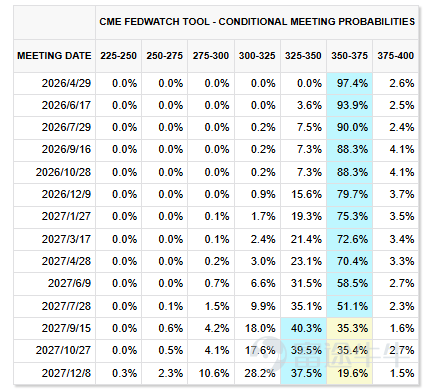
This directly and significantly reduced the market’s fear of the Fed raising rates in the near term. The CME Group’s FedWatch tool shows that the market’s expectation of an April rate hike has plummeted to a very low 2.6%.
![This article comes from[Share Link: "Options Trading Strategies"]This column strives to stand at the forefront of investment trends, interpreting opportunities within these trends and teaching readers how to use options to seize those opportunities. *The following content is for educational purposes only and does not constitute any investment advice. The information provided is time-sensitive, with data valid as of the US stock market open on March 31, 2026. Please exercise caution when interpreting. Yesterday (March 30), remarks by Federal Reserve Chairman Powell were interpreted by the market as a dovish signal, offering some relief to financial markets that have been jittery due to inflation concerns and geopolitical conflicts. However, after experiencing severe volatility since March, is this statement merely a fleeting moment in a downtrend or the start of a new trend? As investors, how should we manage risks and capture opportunities amidst this complex macroeconomic landscape? Let's delve into it. Powell Releases Dovish Signal, Temporarily Calming Market Panic Here’s what happened: Last night, Powell visited Harvard University and gave a lecture to students at the Harvard School of Economics. Before this, since late March, Wall Street had been gripped by a typical logic of supply shock panic: Middle East conflicts driving up oil prices → threatening the final leg of US inflation's retreat → signs of stagflation emerging (slower growth accompanied by stubborn inflation) → forcing the Fed to restart rate hikes → financial conditions tightening sharply → stocks facing the risk of a deep correction. andPowell's lecture at Harvard...](https://nnqimage.futunn.com/sns_client_feed/999908/20260331/web-1774953824065-CWqNvA3d1g.png/big?area=2&is_public=true&imageMogr2/ignore-error/1/format/webp)
Second, the focus on economic risks lies in employment.: Powell did not shy away from the policy dilemma faced by the Federal Reserve: the downside risks in the labor market on one side and the upside risks of inflation on the other. His remarks were seen as dovish because he openly acknowledged the former, pointing out that 'the labor market faces downside risks, which means interest rates should remain low,' and current inflation expectations still appear robust.
The latest macroeconomic data provides a basis for this: In February 2026, US non-farm payrolls unexpectedly fell by 92,000, and retail sales in January also dropped by 0.16% month-on-month. These signals indicate that economic momentum is slowing, supporting the view that the Federal Reserve should not tighten further.
By downplaying supply shocks and emphasizing the risks of an economic slowdown, Powell clearly conveyed to the market that the Fed’s current interest rate level is in a favorable position (that is, roughly within a neutral range at a theoretical equilibrium point where it neither stimulates nor restrains economic growth), and that policy will enter a data-driven quiet observation phase.
This means that unless there is evidence that inflation expectations are unanchored or broadly rising, rate hikes will not be restarted easily. The wait-and-see approach reduces the risk of sudden policy shifts, providing a temporarily stable environment for risky assets like US stocks.
Rebound ≠ Reversal: With three major headwinds looming, where will the US stock market go next?
While Powell's dovish signal is important, assessing the outlook for US stocks requires placing it within the context of the current complex macro landscape.
As of the close on March 30,all three major US stock indexes have seen significant pullbacks from their March highs。
![This article comes from[Share Link: "Options Trading Strategies"]This column strives to stand at the forefront of investment trends, interpreting opportunities within these trends and teaching readers how to use options to seize those opportunities. *The following content is for educational purposes only and does not constitute any investment advice. The information provided is time-sensitive, with data valid as of the US stock market open on March 31, 2026. Please exercise caution when interpreting. Yesterday (March 30), remarks by Federal Reserve Chairman Powell were interpreted by the market as a dovish signal, offering some relief to financial markets that have been jittery due to inflation concerns and geopolitical conflicts. However, after experiencing severe volatility since March, is this statement merely a fleeting moment in a downtrend or the start of a new trend? As investors, how should we manage risks and capture opportunities amidst this complex macroeconomic landscape? Let's delve into it. Powell Releases Dovish Signal, Temporarily Calming Market Panic Here’s what happened: Last night, Powell visited Harvard University and gave a lecture to students at the Harvard School of Economics. Before this, since late March, Wall Street had been gripped by a typical logic of supply shock panic: Middle East conflicts driving up oil prices → threatening the final leg of US inflation's retreat → signs of stagflation emerging (slower growth accompanied by stubborn inflation) → forcing the Fed to restart rate hikes → financial conditions tightening sharply → stocks facing the risk of a deep correction. andPowell's lecture at Harvard...](https://nnqimage.futunn.com/sns_client_feed/999908/20260331/web-1774953824147-nwQpT68MgS.png/big?area=2&is_public=true&imageMogr2/ignore-error/1/format/webp)
$Nasdaq Composite Index (.IXIC.US)$ closing at 20,794.64 points, compared to the high of 22,906.72 points on March 10, representing a pullback of approximately 9.22%. $S&P 500 Index (.SPX.US)$ Closing at 6,343.72 points, down about 8.08% from the high on March 2 (6,901.01 points), and is now approaching the technical correction range (a 10% drop from the peak). $Dow Jones Industrial Average (.DJI.US)$ Relatively resilient, closing at 45,216.14 points, down about 7.84% from the high on March 2 (49,064.67 points).
Behind this decline are three major macro-level pressures.
One stems from geopolitical risks and the specter of stagflation.The Middle East conflict has driven up oil prices, not only exacerbating inflation but also triggering deep market concerns about stagflation. This environment is highly unfavorable for equities as companies face the dual impact of rising costs and slowing demand. While Powell's remarks have significantly cooled market fears over short-term rate hikes, the inherent uncertainty in geopolitics remains unresolved.
Another stems from sticky inflation and policy gridlock.Although the U.S. CPI year-over-year has dropped from its peak to around 2.4%, the more indicative core PCE inflation was still as high as 2.83% in January 2026, far above the 2% target. This is precisely why the Fed maintained a wait-and-see approach during the March meeting while signaling a hawkish stance. A high-inflation environment directly suppresses stock market valuations, especially for interest-rate-sensitive technology growth stocks, as it delays and compresses the market’s expected room for rate cuts.
Yet another stems from cracks showing in economic data.Recent employment and consumption data released by the U.S. showed signs of weakness, indicating that the cumulative effects of prolonged high-interest-rate policies may now be starting to weigh on real economic activity. This constitutes downside risk for the markets, as it directly points to weakening economic growth momentum and deteriorating corporate earnings prospects, resonating with stagflation concerns triggered by geopolitical factors.
![This article comes from[Share Link: "Options Trading Strategies"]This column strives to stand at the forefront of investment trends, interpreting opportunities within these trends and teaching readers how to use options to seize those opportunities. *The following content is for educational purposes only and does not constitute any investment advice. The information provided is time-sensitive, with data valid as of the US stock market open on March 31, 2026. Please exercise caution when interpreting. Yesterday (March 30), remarks by Federal Reserve Chairman Powell were interpreted by the market as a dovish signal, offering some relief to financial markets that have been jittery due to inflation concerns and geopolitical conflicts. However, after experiencing severe volatility since March, is this statement merely a fleeting moment in a downtrend or the start of a new trend? As investors, how should we manage risks and capture opportunities amidst this complex macroeconomic landscape? Let's delve into it. Powell Releases Dovish Signal, Temporarily Calming Market Panic Here’s what happened: Last night, Powell visited Harvard University and gave a lecture to students at the Harvard School of Economics. Before this, since late March, Wall Street had been gripped by a typical logic of supply shock panic: Middle East conflicts driving up oil prices → threatening the final leg of US inflation's retreat → signs of stagflation emerging (slower growth accompanied by stubborn inflation) → forcing the Fed to restart rate hikes → financial conditions tightening sharply → stocks facing the risk of a deep correction. andPowell's lecture at Harvard...](https://nnqimage.futunn.com/sns_client_feed/999908/20260331/web-1774953825054-RBeD9wol6k.jpeg/big?area=2&is_public=true&imageMogr2/ignore-error/1/format/webp)
In summary,Powell's remarks have temporarily removed the risk of a short-term interest rate hike, potentially triggering a rebound from oversold conditions.Market sentiment may ease from extreme fear, and tech stocks that were excessively sold off due to worsening interest rate expectations could become the vanguard of the rebound.
However, does this mean a new bull market has begun? The answer is no. The core logic supporting the long-term upward trend in the market has already weakened.
The breach in technical indicators is a key warning signal.Both the S&P 500 Index and the Dow Jones Index have effectively broken below the 200-day moving average, which is considered the dividing line between bull and bear markets. This not only means that the upward trend of the past year has been disrupted but could also trigger programmatic selling by a large number of trend-following quantitative funds and long-term institutional investors, creating a negative feedback loop of 'breakdown → sell-off → further breakdown.' Historical data shows that during non-crisis periods, it typically takes 1-3 months for the index to consolidate and recover after breaking below the yearly line.
Secondly, the three major fundamental pressures remain unresolved. Powell's comments only alleviated the most pressing fear of an interest rate hike but did not solve any fundamental issues: the situation in the Middle East continues to push up oil prices and uncertainty; core inflation remains stubborn, far from the 2% target; whether the weakness in economic data will evolve into a trend of slowdown still needs to be observed. The Federal Reserve’s policy remains in a dilemma: economic downside risks do not support raising rates, but inflationary upside risks constrain its ability to cut rates. This deadlock will continue to suppress the market's valuation space.
Finally, market sentiment and capital flow have yet to reverse.Despite dovish signals, the market’s cautious mindset ahead of major events has not changed. More importantly, a key buying support is weakening: corporate stock buybacks are about to enter a quiet period. At the same time, some analysts point out that compared to 2025, retail investors’ enthusiasm for buying on dips has weakened this year. Lacking incremental capital to drive momentum, the sustainability and height of the rebound will be significantly reduced.
In the next month, developments in the Middle East and macroeconomic data such as US non-farm payrolls and CPI will continue to stir market nerves, while the Fed meeting at the end of the month will once again test its policy stance. The core trading logic of the market will shift from speculating on the number of rate cuts to verifying the possibility of a soft economic landing and guarding against stagflation risks.
For investors, the current market is more likely to offer trading opportunities within volatility rather than a clear trend for strategic positioning. While a rebound might be expected, viewing it as the start of a new bull market and being blindly optimistic could be premature. Before the significant easing of the three major pressures and the technical patterns of the market are repaired, maintaining prudence, controlling positions, and staying flexible may be a more robust strategy.
Uncertain Direction? Here Are 3 Option Strategies Suitable for the Current Market
Given the current market characteristics—volatile, directionless, with an anticipated rebound but lingering risks—options can be effectively used to express specific market views while strictly controlling downside risk. Here are three option strategies tailored to this environment.
Strategy One (Defensive): Protective Put – Buy Insurance for Your Holdings
Applicable Scenarios: You hold $Invesco QQQ Trust (QQQ.US)$ or certain tech stocks. The Nasdaq has already pulled back over 9% from its March high. Growth stocks sensitive to interest rates have been hit hard by persistent inflation and shrinking rate-cut expectations. You're particularly concerned about tail risks but don't want to exit the market entirely since a future rebound is still possible. What you need isn’t to leave the market but a safety net that allows you to hold your positions confidently amid uncertainty.
Strategy Composition: While holding QQQ (or other tech stocks), buy a put option with a lower strike price.
Strategy Logic: Buying a put acts as insurance for your holdings. No matter how much the market crashes due to unforeseen black swan events, your maximum loss is capped at a predetermined level set by the strike price of the put. This strike price serves as your stop-loss baseline. Meanwhile, your upside remains fully open. If tech stocks lead an unexpected strong rebound, you’ll still benefit fully from the gains in QQQ or other tech stocks.
Profit and loss characteristics: Maximum loss = the difference in value if the underlying asset falls from the current price to the Put strike price + the premium paid for buying the Put. This loss amount is fixed, predictable, and will not spiral out of control due to extreme market conditions. The upside profit theoretically has no cap, but the cost of purchasing the Put premium must be deducted from the final profit.
(*Additionally, if you find this strategy too costly, you can consider selling a Put with a lower strike price below the purchased Put to reduce costs, though this also narrows the profit potential.)
The profit and loss characteristics at expiration can be referenced in the diagram below, provided for educational purposes only and not representing any investment advice:
![This article comes from[Share Link: "Options Trading Strategies"]This column strives to stand at the forefront of investment trends, interpreting opportunities within these trends and teaching readers how to use options to seize those opportunities. *The following content is for educational purposes only and does not constitute any investment advice. The information provided is time-sensitive, with data valid as of the US stock market open on March 31, 2026. Please exercise caution when interpreting. Yesterday (March 30), remarks by Federal Reserve Chairman Powell were interpreted by the market as a dovish signal, offering some relief to financial markets that have been jittery due to inflation concerns and geopolitical conflicts. However, after experiencing severe volatility since March, is this statement merely a fleeting moment in a downtrend or the start of a new trend? As investors, how should we manage risks and capture opportunities amidst this complex macroeconomic landscape? Let's delve into it. Powell Releases Dovish Signal, Temporarily Calming Market Panic Here’s what happened: Last night, Powell visited Harvard University and gave a lecture to students at the Harvard School of Economics. Before this, since late March, Wall Street had been gripped by a typical logic of supply shock panic: Middle East conflicts driving up oil prices → threatening the final leg of US inflation's retreat → signs of stagflation emerging (slower growth accompanied by stubborn inflation) → forcing the Fed to restart rate hikes → financial conditions tightening sharply → stocks facing the risk of a deep correction. andPowell's lecture at Harvard...](https://nnqimage.futunn.com/sns_client_feed/999908/20260331/web-1774953824958-DQpRBCJNMV.jpeg/big?area=2&is_public=true&imageMogr2/ignore-error/1/format/webp)
Strategy Two (Speculative): Long Strangle – Betting on a volatility explosion
Applicable Scenarios: Sells pineapples, bananas, melons, avocados, and a variety of pre-prepared fruits and vegetables, juices, and snacks under the $SPDR S&P 500 ETF (SPY.US)$ : For instance, if you don't have a strong opinion on which direction the market will take next, but you firmly believe that regardless of direction, the magnitude of upcoming fluctuations will be significant. This judgment is based on solid macro factors: over the next month, developments in the Middle East situation, release of US Non-Farm Payroll and CPI data, and the Fed meeting at the end of the month will all come into play, any of which could serve as a trigger to break the current deadlock, causing SPY to experience sharp volatility.
Strategy Composition: Simultaneously buy one SPY Call option with a higher strike price and one SPY Put option with a lower strike price, both with the same expiration date. The Call strike price is above the current stock price, while the Put strike price is below the current stock price, creating a combination straddling both sides of the current price.
Strategy Logic: The core logic of this strategy is betting on both sides. You simultaneously hold the rights to profit from both upward and downward movements. If SPY rises significantly, your Call side profits; if SPY drops sharply, your Put side profits — as long as the profit from either side is sufficient to cover the total premium cost of both options, you make a profit. Essentially, what you are buying is not direction, but volatility itself.
Profit and loss characteristicsMaximum loss = the sum of the premiums paid for buying the Call and Put options, which occurs when SPY expires between the two strike prices — meaning the market neither surged significantly nor dropped sharply, with insufficient volatility, causing both options to lose value. Theoretically, the maximum profit has no upper limit. There are two breakeven points: upward is the Call strike price + premium per share, and downward is the Put strike price - premium per share.
It's important to note that, the biggest enemy of this strategy isn't incorrect directional judgment, but insufficient volatility and time decay. If the market continues to oscillate narrowly within the current range, the time value of both options will decay simultaneously every day. Even if the direction eventually turns out to be correct, if it comes too late, potential profits may be eroded by time. Therefore, this strategy is better suited for use during periods where clear catalysts (such as major data releases or policy meetings) are expected in the near term, while strictly controlling the holding period.
(*Additionally, if this strategy seems too costly, you can consider selling a Put option with a lower strike price below the purchased Put, and selling a Call option with a higher strike price above the purchased Call to reduce cost, though this also narrows the profit potential.)
The profit and loss characteristics at expiration for this strategy can be referenced in the following chart (which includes only the options portion and excludes the underlying asset), intended solely for investment education purposes and does not constitute any investment advice:
![This article comes from[Share Link: "Options Trading Strategies"]This column strives to stand at the forefront of investment trends, interpreting opportunities within these trends and teaching readers how to use options to seize those opportunities. *The following content is for educational purposes only and does not constitute any investment advice. The information provided is time-sensitive, with data valid as of the US stock market open on March 31, 2026. Please exercise caution when interpreting. Yesterday (March 30), remarks by Federal Reserve Chairman Powell were interpreted by the market as a dovish signal, offering some relief to financial markets that have been jittery due to inflation concerns and geopolitical conflicts. However, after experiencing severe volatility since March, is this statement merely a fleeting moment in a downtrend or the start of a new trend? As investors, how should we manage risks and capture opportunities amidst this complex macroeconomic landscape? Let's delve into it. Powell Releases Dovish Signal, Temporarily Calming Market Panic Here’s what happened: Last night, Powell visited Harvard University and gave a lecture to students at the Harvard School of Economics. Before this, since late March, Wall Street had been gripped by a typical logic of supply shock panic: Middle East conflicts driving up oil prices → threatening the final leg of US inflation's retreat → signs of stagflation emerging (slower growth accompanied by stubborn inflation) → forcing the Fed to restart rate hikes → financial conditions tightening sharply → stocks facing the risk of a deep correction. andPowell's lecture at Harvard...](https://nnqimage.futunn.com/sns_client_feed/999908/20260331/web-1774953824473-191tdF6EKW.jpeg/big?area=2&is_public=true&imageMogr2/ignore-error/1/format/webp)
Strategy Three (Conservative Approach): Cash-Secured Put — Passive acquisition at a discount, buying at reduced prices
Applicable Scenarios: Taking SPY as an example, you currently hold cash and remain confident in the long-term value of U.S. stocks, but feel the current price level is not an ideal entry point — the S&P 500 has pulled back about 8% from its high, which might seem like a bargain, but three major obstacles remain, technical indicators have broken down, and you're worried about entering mid-way. You have an ideal bargain-hunting price in mind, hoping SPY will drop further to that level before you enter. In the meantime, you don’t want your cash to sit idle, preferring that the waiting period itself generates some income.
Strategy Composition: Keep enough cash in your account to purchase 100 shares of SPY as collateral, while selling one SPY Put option with a strike price near your ideal purchase price.
Strategy LogicSelling a Put essentially means you are making a commitment to the market: if SPY falls below the strike price by the expiration date, you agree to buy SPY at that strike price. In return for taking on this obligation, you immediately receive a premium. Based on your scenario, this strategy creates a win-win situation: If SPY does not fall to your set price, the Put expires worthless and you keep the premium as a reward for your patience during the waiting period; if SPY does fall to that price, you purchase it at an ideal low price, and your actual buying cost is further reduced by the premium received—essentially giving you a discount on top of a discount.
Profit and Loss CharacteristicsMaximum profit equals the premium collected from selling the Put, realized when SPY closes above the strike price at expiration—at which point the Put expires worthless and you keep the full premium. The annualized return in the current volatility environment can be quite attractive. The maximum risk occurs if SPY drops significantly—although the premium you received acts as a buffer when you buy SPY at the strike price, if SPY falls far below the strike price, your position will face floating losses. Additionally, once the Put is exercised, your cash is converted into a stock position, losing the flexibility to wait for even lower prices.
Therefore, the core premise of using this strategy is that the strike price of the Put you sell must be a level at which you genuinely want to buy and hold SPY long-term, rather than blindly operating just to collect premiums. Only then, even if the option is exercised, you won’t feel forced but will have happily established your position at your desired price.
The profit and loss characteristics at expiration can be referenced in the diagram below, provided for educational purposes only and not representing any investment advice:
![This article comes from[Share Link: "Options Trading Strategies"]This column strives to stand at the forefront of investment trends, interpreting opportunities within these trends and teaching readers how to use options to seize those opportunities. *The following content is for educational purposes only and does not constitute any investment advice. The information provided is time-sensitive, with data valid as of the US stock market open on March 31, 2026. Please exercise caution when interpreting. Yesterday (March 30), remarks by Federal Reserve Chairman Powell were interpreted by the market as a dovish signal, offering some relief to financial markets that have been jittery due to inflation concerns and geopolitical conflicts. However, after experiencing severe volatility since March, is this statement merely a fleeting moment in a downtrend or the start of a new trend? As investors, how should we manage risks and capture opportunities amidst this complex macroeconomic landscape? Let's delve into it. Powell Releases Dovish Signal, Temporarily Calming Market Panic Here’s what happened: Last night, Powell visited Harvard University and gave a lecture to students at the Harvard School of Economics. Before this, since late March, Wall Street had been gripped by a typical logic of supply shock panic: Middle East conflicts driving up oil prices → threatening the final leg of US inflation's retreat → signs of stagflation emerging (slower growth accompanied by stubborn inflation) → forcing the Fed to restart rate hikes → financial conditions tightening sharply → stocks facing the risk of a deep correction. andPowell's lecture at Harvard...](https://nnqimage.futunn.com/sns_client_feed/999908/20260331/web-1774953824524-oRGM52csxf.jpeg/big?area=2&is_public=true&imageMogr2/ignore-error/1/format/webp)
If you want more inspiration regarding options strategies, you can easily get it on the mobile app or the new desktop version by following these steps!
![This article comes from[Share Link: "Options Trading Strategies"]This column strives to stand at the forefront of investment trends, interpreting opportunities within these trends and teaching readers how to use options to seize those opportunities. *The following content is for educational purposes only and does not constitute any investment advice. The information provided is time-sensitive, with data valid as of the US stock market open on March 31, 2026. Please exercise caution when interpreting. Yesterday (March 30), remarks by Federal Reserve Chairman Powell were interpreted by the market as a dovish signal, offering some relief to financial markets that have been jittery due to inflation concerns and geopolitical conflicts. However, after experiencing severe volatility since March, is this statement merely a fleeting moment in a downtrend or the start of a new trend? As investors, how should we manage risks and capture opportunities amidst this complex macroeconomic landscape? Let's delve into it. Powell Releases Dovish Signal, Temporarily Calming Market Panic Here’s what happened: Last night, Powell visited Harvard University and gave a lecture to students at the Harvard School of Economics. Before this, since late March, Wall Street had been gripped by a typical logic of supply shock panic: Middle East conflicts driving up oil prices → threatening the final leg of US inflation's retreat → signs of stagflation emerging (slower growth accompanied by stubborn inflation) → forcing the Fed to restart rate hikes → financial conditions tightening sharply → stocks facing the risk of a deep correction. andPowell's lecture at Harvard...](https://nnqimage.futunn.com/sns_client_feed/999908/20260331/web-1774953826204-y5fKO1EqGn.png/big?area=2&is_public=true&imageMogr2/ignore-error/1/format/webp)
That’s all for today.Finally, here’s a small perk for fellow investors—welcome to claim it!Beginner's Options Package(*This promotion is available exclusively to HK invited users; click to learn more.Event Details Rules >>)
Risk Disclaimer: The above content only represents the author's view. It does not represent any position or investment advice of Futu. Futu makes no representation or warranty.Read more


Comments (2)
to post a comment
30
35