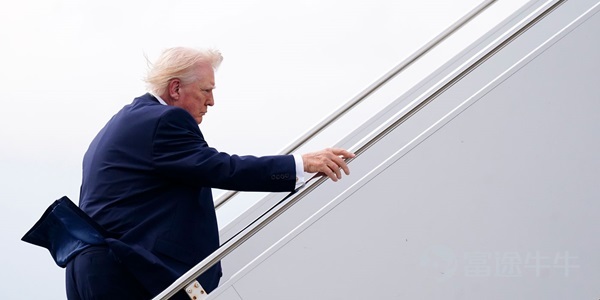

Good news from the Middle East! Trump says a U.S.-Iran deal is largely finalized

Fidelity Viewpoints | How are investment experts interpreting the escalation in the Middle East?
One month since the outbreak of the Iran conflict, the path to resolution remains uncertain, with recent developments showing a trend toward escalation rather than de-escalation.Salman Ahmed, Head of Global Macro and Strategic Asset Allocation at Fidelity, assesses the potential impacts of escalating tensions in the Middle East on markets and the regional situation.For more exciting video updates and market analysis articles, please follow @Fidelity International
![One month since the outbreak of the Iran conflict, the path to resolving the issue remains uncertain, with recent developments showing a tendency for escalation rather than de-escalation.Salman Ahmed, Head of Global Macro and Strategic Asset Allocation at Fidelity, assesses the potential impact of the escalating situation in the Middle East on markets and regional dynamics.For more video insights and market analysis articles, please follow @FidelityInternational[Give Me A Like] The nature of the Iran conflict has shifted once again over the past few days.Previously, when US President Trump reversed his stance last Monday by postponing the threat to destroy Iran’s energy facilities until April 5,what seemed like an emerging de-escalation has now turned into a more chaotic (but evidently foreseen) phase of escalation.How this conflict will be resolved and the costs it will entail (both short-term and medium-term) remain significant questions. Negotiations have stalled. All parties seem to have lost momentum for mediation, especially the talks led by Pakistan and supported by various regional players. Meanwhile,The scope of the conflict is gradually expanding. The Houthi missile attack on Israel has increased the risk of the conflict spreading across the region(although key waterways such as the Bab el-Mandeb Strait are currently still operational). The signals from the US remain mixed, wavering between negotiation and escalation, leaving the short-term path unclear.Meanwhile, the US deployment of marines into the conflict zone clearly increases the risk of escalation.The objectives of the US actions remain unclear, but discussions mainly focus on two possibilities: operations related to seizing enriched uranium, or actions targeting Kh...](https://nnqimage.futunn.com/sns_client_feed/232181561/20260331/web-1774953048140-e8rsbHGHOQ.jpeg/big?area=2&is_public=true&imageMogr2/ignore-error/1/format/webp)
The nature of the Iran conflict has shifted once again over the past few days.After US President Trump reversed his position last Monday by postponing the threat to destroy Iran's energy facilities until April 5, what seemed like a gradual de-escalation is now shifting towards a more chaotic (but evidently long-foreseen) escalation phase.How this conflict will be resolved and at what cost (both short-term and medium-term) remains a major question.
Negotiations have stalled,
with all parties seemingly having lost momentum for mediation, particularly the talks led by Pakistan and supported by various regional actors. Meanwhile,the scope of the conflict is gradually expanding. Missile attacks by Houthi forces on Israel have heightened the risk of the conflict spreading across the region(although key waterways such as the Bab-el-Mandeb Strait are still temporarily operational).
The signals from the US remain mixed, wavering between negotiation and escalation, thus the short-term trajectory remains unclear.In the meantime, the deployment of US Marines into the conflict zone has clearly increased the risks of further escalation.The objectives of the US actions remain unclear, but discussions are mainly focused on two possibilities: one related to operations concerning enriched uranium; the other targeting Kharg Island.
Between the two,an operation targeting the uranium enrichment facility seems more likely.If the US attacks Kharg Island, it could open a more direct and broader front, impacting energy flows immediately. However,any form of US ground deployment would constitute a substantive escalation in the situation.At that point, the key variables will be the scope, duration, and clarity of the outcome of the operation.
A long-anticipated escalation of the situation
Our current assessment is,the conflict has entered what can be described as an anticipated escalation phase.
This is not a completely uncontrollable or chaotic escalation, but rather,a phase where signs were evident, somewhat controlled but still carries risks of miscalculation.Neither side mentioned large-scale destruction of infrastructure during their communications, indicating restraint.
Tail risks have risen, but the nature of the risk has changed compared to last weekend.We believe that the most likely path is that further escalation will be used as leverage to force some kind of resolution,even if the outcome is incomplete, chaotic, or unstable.
The Strait of Hormuz remains blocked,
with the Strait of Hormuz still effectively contested.Shipping continues at an extremely slow pace, constrained by Iran and surrounded by uncertainty,(for instance, Pakistan coordinated the passage of 20 oil tankers through the strait, a move Trump described as a 'gift').Even if a resolution is eventually reached, it’s unlikely Iran would fully relinquish control over the strait,especially after its military capabilities are severely weakened due to sustained bombing by the U.S. or Israel.
A more likely outcome is that the Strait will reopen under Iran's control, accompanied by some form of implicit or explicit control or conditions. These may include informal tolls, selective interference, or a persistent threat premium. Reports suggest thatWestern military experts believe that unless there is a regime change in Iran, there is no military solution capable of unconditionally reopening the Strait of Hormuz.
This is crucial because most of the energy flowing through the Strait is destined for Asia. Therefore,The economic costs resulting from disruptions to the Strait will primarily be borne by Asian economies (rather than the US),a fact also reflected in relative market pricing.
The situation in the future is unlikely to return to pre-conflict conditions.The security framework for Gulf energy flows has undergone a structural shift to some degree.
Energy markets have not evolved into a collapse scenario.
We still assume that Brent crude prices will remain around $85 for the rest of the year.This reflects that even with a resolution to the conflict, a geopolitical risk premium will persist.
Some viewpoints suggest that,if a clean and straightforward solution can be reached, with Iran reintegrating into the international system, along with the elimination of risk premium,oil prices might quickly retreat to the $40–$50 range. Given the current highly complex environment, we consider such expectations overly optimistic.
Meanwhile, despite significant pressure on the physical energy market,the situation has not yet evolved into a scenario of sustained and large-scale supply disruption,becauseenergy infrastructure has not been widely damaged, and Iran has not completely blockaded the strait through methods like mining.。
Asia is at the epicenter,
with the economic transmission effects increasingly concentrated in Asia,followed by Europe.
The policy response in Asia has been swift and pragmatic.Governments have employed various measures such as price caps, subsidies, export controls, and the release of strategic reserves to limit the impact of energy prices on domestic fuel costs.In more vulnerable economies, governments have also started introducing demand-side measures, including energy rationing and behavioral adjustments.
These interventions have temporarily contained immediate inflationary impacts. However, if energy prices remain high over the long term, the burden will gradually shift.Governments' fiscal capacity is not unlimited, and central banks may eventually be forced to gradually shift away from their accommodative stance.
From a longer-term perspective, this event once again highlights the importance of diversification.As bottleneck risks come into focus, countries may place greater emphasis on renewable energy, nuclear power, and even, in some cases, a renewed reliance on coal when discussing and planning policies.
Asian markets under pressure
Asian stocks continue to underperform, with the MSCI Asia-Pacific Index experiencing a significant drop last week and remaining pressured early this week. Regional currencies have also come under noticeable pressure.The MSCI Asia Pacific Index has plunged over the past week and remained under pressure at the start of this week. Currencies across the region have also come under significant downward pressure., particularly for oil-sensitive economies such as India and Thailand.
Countries are stepping up their policy responses.The Reserve Bank of India has taken steps to limit open currency positions in order to stabilize the rupee exchange rate. In Japan, as the weak yen raises inflation concerns, authorities have intensified verbal interventions, while the central bank has adopted a more vigilant stance.
The bond marketAfter last week’s focus on inflation,Directionality has weakened recently, starting to strike a balance between growth concerns and inflation risks.
Summary
The situation is entering a foreseen yet dramatic escalation phase, with increasingly higher chances of arriving at a chaotic resolution.
Compared to the weekend, tail risks have increased in various ways. However, given the scale and extent of disruptions, there are greater incentives for all parties to contain the conflict.In our view, the most likely outcome is not a clean-cut end but rather a negotiated, messy resolution that fails to eliminate the underlying contradictions while allowing Iran to retain ongoing influence over the Strait.
It is unlikely that the energy market will quickly return to price levels before the conflict. We believe that some form of permanent geopolitical premium has been integrated into the energy market, with the costs borne mainly by Asia, which relies on Gulf energy, and secondarily by Europe.The United States has been relatively less impacted, but rising energy prices will still become a macro factor influencing economic growth, inflation, and policy outcomes.
Important Notice
This material is intended for use and reference by Hong Kong residents only. Investment involves risks. This material contains general information only and does not constitute an offer or solicitation for the purchase or sale of any securities, or an invitation to participate in Fidelity's investment management services, in any jurisdiction where such distribution, offer, or solicitation would be unlawful. Prospective investors should seek independent advice.
The information provided herein is accurate only as of the date of publication. Views and forecasts may change without prior notice. Any securities mentioned (if applicable) are for informational purposes only and should not be considered as recommendations to buy or sell such securities under any circumstances.
Fidelity, Fidelity International, and their associated logos are trademarks of FIL Limited. 'Fidelity', 'Fidelity International', the Fidelity International logo, and the F logo refer to FIL Limited and its affiliates.
Risk Disclaimer: The above content only represents the author's view. It does not represent any position or investment advice of Futu. Futu makes no representation or warranty.Read more

Comments
to post a comment
1