
Surging oil prices and ongoing conflicts! What new energy sectors will the chaos in the Middle East ignite?
Historically, global energy crises have often acted as key catalysts in accelerating shifts in energy structures.
The military strikes by the US and Israel on Iran have now lasted more than four weeks, but there appears to be no sign of this conflict de-escalating anytime soon.
As geopolitical tensions resurface in the Middle East and energy prices soar,the world seems to have suddenly realized that over-reliance on a single channel or region for fossil fuel supply always carries significant risks.
Analysts widely point out thatThe turbulence in the Middle East and the fragility of traditional energy supply chains will further push countries to accelerate their energy transition, expanding strategic layouts in renewable energy sources such as photovoltaic and wind power.As the 2022 Russia-Ukraine war triggered a restructuring of the energy landscape, the current conflict is also acting as a powerful driving force, becoming a catalyst for Europe and even the world to accelerate toward green energy.
This article will analyze for fellow investors why war drives the transformation of the energy structure and which companies are worth watching.
Why does war drive the transformation of the energy structure?
For a long time, the market has been accustomed to viewing the Strait of Hormuz as the lifeline of fossil energy; however, this waterway, only 21 miles wide,is also a key hub influencing the global green energy transition.The recent hostilities have not only driven up traditional energy prices but also caused severe short-term shocks to the green energy transition in the region and even globally.However, in the long run, this volatility is forcing the world to accelerate its move away from dependence on traditional energy sources, opening up new opportunities for transformation.
Specifically, the underlying logic of the global capital market is undergoing a shift:The weight of 'energy security' is surpassing that of mere 'energy affordability'.
1. The passive dilemma of traditional energy: The ongoing conflicts have made countries deeply realize that heavy reliance on fossil fuels from a single region, such as Middle Eastern crude oil, equates to placing the lifeline of national development on the powder keg of geopolitical risks. This extremely passive situation forces governments to elevate 'energy independence' to the highest level of national strategy.
2. Accelerated transition between old and new energy sources: High prices and extreme volatility in traditional energy sources are indirectly shortening the period for new energy sources to achieve price parity. When fossil fuels are no longer a cheap and stable option, alternative energy solutions like wind, solar, and nuclear power evolve from being 'environmental choices' to becoming 'critical necessities for survival,' which will accelerate energy substitution at the macro level.
Wall Street giant Jefferies has also previously noted that the current conflict has once again raised concerns about inflation and exacerbated the plight of energy-intensive industries.Meanwhile, the growing scale of wind and solar power generation in Europe is providing a crucial buffer.Unlike previous energy shocks, increased renewable energy capacity is increasingly moderating peak-hour wholesale electricity prices, although natural gas still occupies profit margins.
Which companies are worth watching?
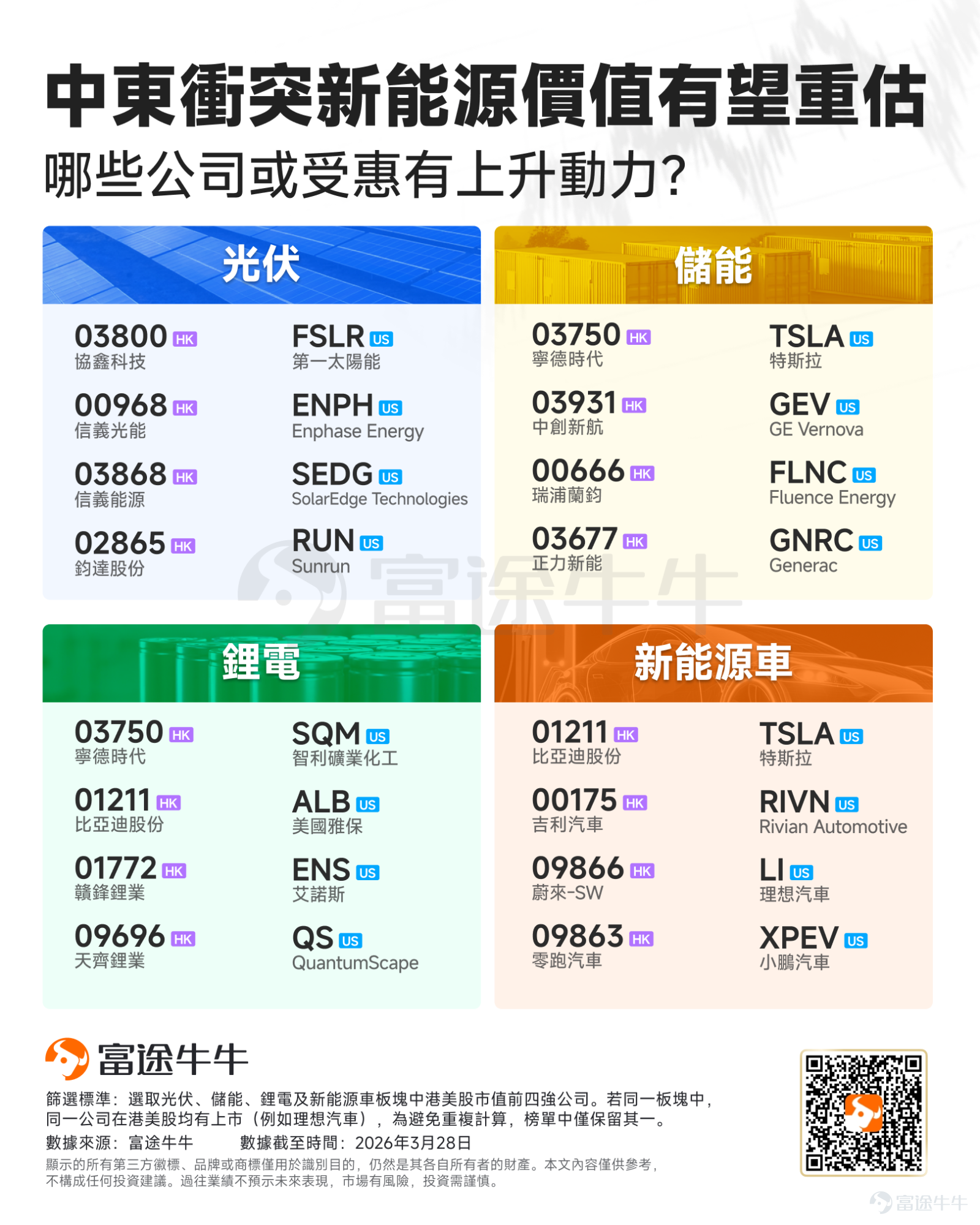
Overall, if the Middle East conflict leads to a prolonged blockade of the Strait of Hormuz, the energy shock to Asia-Pacific regions like Japan and South Korea could exceed that of Europe. Amid rising anxiety over energy security, the new energy sector is poised for a new wave of investment opportunities. Fellow investors have compiled a list of companies related to new energy for your reference.

1. Photovoltaic (PV)
Core driving logic: Rising oil and gas prices have pushed up electricity prices in Europe and America, stimulating demand for household PV and commercial & industrial PV installations; countries are accelerating energy transition to reduce reliance on a single energy source.
Hong Kong and U.S. stock-related companies:$GCL TECH (03800.HK)$ 、 $XINYI SOLAR (00968.HK)$ 、 $XINYI ENERGY (03868.HK)$ 、 $DRINDA (02865.HK)$ 、 $First Solar (FSLR.US)$ 、 $Enphase Energy (ENPH.US)$ 、 $SolarEdge Technologies (SEDG.US)$ 、 $Sunrun (RUN.US)$
2. Energy Storage
Core driving logic:The core solution to unstable renewable energy generation; increased electricity price volatility widens peak-to-valley price differences, enhancing the economic benefits and installation urgency of large-scale energy storage and residential energy storage.
Hong Kong and U.S. stock-related companies:$CATL (03750.HK)$ 、 $CALB (03931.HK)$ 、 $REPT BATTERO (00666.HK)$ 、 $ZENERGY (03677.HK)$ 、 $Tesla (TSLA.US)$ 、 $GE Vernova (GEV.US)$ 、 $Fluence Energy (FLNC.US)$ 、 $Generac (GNRC.US)$
3. Lithium Battery
Core driving logic:Lithium battery is the underlying support for energy transition, with the resource end (lithium ore) possessing commodity attributes that make it prone to impulse-like rebounds following inflation and energy crisis expectations.
HK and US stock related companies: $CATL (03750.HK)$ 、 $BYD COMPANY (01211.HK)$ 、 $GANFENGLITHIUM (01772.HK)$ 、 $TIANQI LITHIUM (09696.HK)$ 、 $Sociedad Quimica Y Minera De Chile (SQM.US)$ 、 $Albemarle (ALB.US)$ 、 $EnerSys (ENS.US)$ 、 $QuantumScape (QS.US)$
4. New energy vehicles
Core driving logic:Surging oil prices significantly increase the usage costs of fuel vehicles, highlighting the cost-effectiveness of electric vehicles and accelerating the process of fuel-to-electric substitution.
HK and US stock related companies: $BYD COMPANY (01211.HK)$ 、 $GEELY AUTO (00175.HK)$ 、 $NIO-SW (09866.HK)$ 、 $LEAPMOTOR (09863.HK)$ 、 $Tesla (TSLA.US)$ 、 $Rivian Automotive (RIVN.US)$ 、 $Li Auto (LI.US)$ 、 $XPeng (XPEV.US)$
In addition to the aforementioned substitutes,Nuclear power, which is often overlooked, deserves attention. As a stable and clean energy source, nuclear power’s strategic value stands out, and undervalued stocks in this sector are expected to recover.

Breaking it down further,Uranium mining includes $Cameco (CCJ.US)$ 、$Uranium Energy (UEC.US)$ 、$Energy Fuels (UUUU.US)$ 、$Denison Mines (DNN.US)$ 、$NexGen Energy (NXE.US)$ ; Nuclear fuel processing$Centrus Energy (LEU.US)$ 。
The midstream sector includes design, R&D, and construction, including:
$NuScale Power (SMR.US)$ is the first listed SMR nuclear power vendor; the company's core product is the SMR power module;
$Oklo Inc (OKLO.US)$ focuses on developing small modular reactors (SMRs), and the company is invested in by 'ChatGPT's father' Altman;
$NANO Nuclear Energy (NNE.US)$ specializes in developing small modular reactors, with its main business covering four areas related to SMRs, spanning manufacturing, fuel, transportation, and other segments, aiming to build a diversified vertically integrated industrial chain;
$BWX Technologies (BWXT.US)$ focuses on nuclear reactor component manufacturing and nuclear energy technology. The biggest difference between BWXT and SMR/OKLO is that BWXT is a large equipment supplier and technical service provider, primarily offering nuclear reactor components, nuclear fuel, and defense-related nuclear technologies to government and commercial sectors, with clients including the US government (e.g., providing nuclear reactors for naval submarines).
Summary
In summary, the ongoing geopolitical turmoil in the Middle East is forcefully reshaping the underlying logic of global energy with an urgent need for 'energy security.' The short-term pain and soaring oil and gas prices are no longer just inflation drivers but also catalysts accelerating the explosive growth of green sectors such as photovoltaics, energy storage, lithium batteries, new energy vehicles, and nuclear energy.
For investors, the supply chain crisis in traditional fossil fuels is precisely a historic opportunity for long-term deployment in the new energy industry chain. With market funds seeking both risk aversion and long-term growth certainty, energy transition has evolved from an 'environmental concept' into a hardcore 'survival game.'
In the future, closely monitoring and strategically deploying high-quality green energy and nuclear power stocks with core technological barriers that benefit from national energy independence policies will be key to capturing the next wave of era wealth dividends.
Risk Disclaimer: The above content only represents the author's view. It does not represent any position or investment advice of Futu. Futu makes no representation or warranty.Read more


Comments (7)
to post a comment
73
85