
Two major banks are both bullish—has gold passed its worst moment?

Oil prices surge back to $100, why is gold rising instead of falling? Two scenarios for the future market outlook, here’s a list of gold stocks & ETFs you should keep!
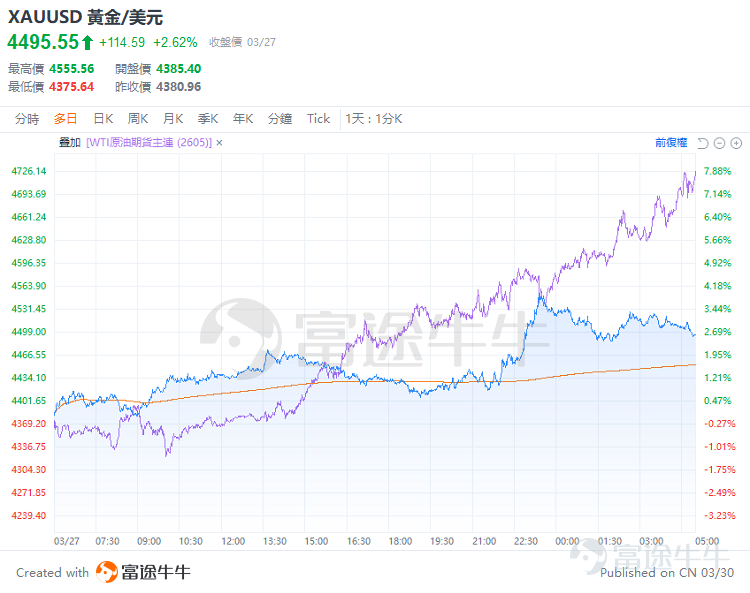
Last Friday, geopolitical tensions between the US and Iran escalated again, causing a rapid rise in global risk aversion sentiment, pushing oil prices strongly back above the $100 mark.
But keen investors must have noticed an unusual phenomenon:Behind the surge in crude oil, gold this time did not fall due to inflation and interest rate hike expectations but instead followed crude oil with a rare synchronized upward movement.

Some argue that this is not an accidental market fluctuation, but rather a profound shift in market pricing logic. This article will explain the underlying logic to fellow investors and highlight potential investment opportunities worth watching.
Logic reversal: Is gold no longer just an “ATM machine”?
In the classic trading framework of the past, people bought gold in turbulent times. However, in this round of Middle East conflict, gold is no longer a safe-haven asset.
This is mainly due to the conflict driving up oil prices, andRising oil prices → Increased inflation expectations → Sharply higher Fed rate hike expectations → Tightening liquidity, stronger dollar → Gold under pressure and falling. Moreover, when faced with concerns about a liquidity crisis, institutional investors often prioritize selling gold to replenish cash margins, causing gold to become a passive 'ATM machine' for withdrawals in the early stages of a crisis.
However, the current market is breaking this conventional mindset.Gold's 'safe-haven attribute' and 'inflation-resistant attribute' are strongly overshadowing market concerns about liquidity contraction. The market seems to be starting to realize that in an era of extreme geopolitical conflicts and shaken credit, gold is the most stabilizing asset.
Looking ahead over the next 1-2 months: Two scenario analyses
When looking at the upcoming macro situation, there are only two possible outcomes. Interestingly, regardless of which scenario unfolds, gold holds strong potential for upward movement:
Scenario A: Blockades persist (lasting more than 1-2 months) — triggering 'recession trading.' If geopolitical conflicts lead to supply chain blockades exceeding expectations, hyperinflation will inevitably erode global demand, quickly triggering 'recession trades' in overseas markets. In this scenario, the global supply chain will be forced to reshape, potentially ushering in a new cycle of commodities. Gold, as a hard currency against extreme tail risks, will once again become a core asset for global capital inflows.
Scenario B: Lockdown Eased (Gradual Passage) — Triggering 'Easing of Tightening Trades'. If tensions ease, a pullback in oil prices will directly 'cool down' inflation expectations. The pressure on the Federal Reserve to maintain an extremely hawkish stance will sharply decrease, and the market will immediately begin trading on marginal easing of monetary policy. Accompanying this isa decline in real interest rates,which is the most critical engine driving the main upward wave in gold prices.
Stripping away short-term disruptions to discern the 'three foundational pillars' supporting the bullish trend in gold prices.
If investors take a longer-term view, they will find that the macro backdrop facing gold has not faded but instead is becoming increasingly solid:
1. Downward pressure on real interest rates: Although there is still some noise in the market regarding interest rate hikes in the short term, the underlying vulnerabilities of the U.S. economy remain. This vulnerability essentially limits the absolute level of nominal interest rates, and once inflation remains high or the economy slows down, the downward trend in real interest rates becomes irreversible.
2. Reassessment of the dollar credit system: Against the backdrop of global geopolitical fragmentation and the US's disorderly debt expansion, central banks around the world are increasingly questioning the credibility of the dollar. 'De-dollarization' has evolved from a slogan into actual actions by central banks to increase their gold reserves, forming a strong underlying demand support for gold.
3. Geopolitical premium becomes normalized: The intensification of great power competition and frequent regional frictions indicate that global systemic risks are on the rise. In an era full of uncertainty, gold’s strategic safe-haven demand will persist in the long term, making the geopolitical premium a normalized component of gold prices.
A recent warning from Bank of America's Chief Investment Officer Michael Hartnett also corroborates this point. He pointed out,A bear market in the US President’s credibility often coincides with a bear market in the dollar(as was the case during the Nixon, Carter, and Bush Jr. eras).If Trump’s credibility suffers structural damage due to the situation with Iran, his ability to verbally intervene to boost Wall Street and attract foreign direct investment into the US will weaken accordingly. In such a scenario, a dollar bear market would return, and a bull market in gold and international stocks would restart as well.
Hartnett went so far as to say that if the long-term policy path moves toward 'AI = Universal Basic Income = Yield Curve Control,' both gold and Bitcoin will be the biggest winners of this structural change.
Which gold stocks are worth watching?
At present, most of the 'negative expectations' surrounding gold have already been priced in by the market to an extreme degree. The current macro environment is more akin to the 'stagflation' period of the 1970s than the high-interest-rate environment of the 1980s. The Federal Reserve now not only needs to control inflation but also must 'protect the economy and support the tech industry.'
Against this backdrop, gold may present investment opportunities. Below is a curated list of core gold-related stocks and targets in the Hong Kong and US markets:

Summary
CICC believes thatApril is a critical juncture,whether it will escalate from a 'paper disturbance' in the financial markets to an 'actual shock' in real production. As long as it’s not a pessimistic scenario where conflict persists into the second half of the year causing oil prices to remain above $100, assets that have factored in excessive pessimism, such as US Treasuries, gold, or even Hang Seng Tech, could offer attractive 'risk-reward' opportunities if tensions ease.
Risk Disclaimer: The above content only represents the author's view. It does not represent any position or investment advice of Futu. Futu makes no representation or warranty.Read more


Comments (6)
to post a comment
79
130