Dividend Income Made Easy: August Dividend Season Arrives, Yields Up to 21%

A defensive tool in volatile markets, look to the E Fund High Dividend ETF (3483.HK)
Recently, volatility in global capital markets has intensified, with uncertainty factors continuing to escalate, leading to fluctuating adjustments in various asset prices and a significant rise in investor risk aversion. Influenced by multiple factors, on March 23, the A-share, Hong Kong stock, and major Asia-Pacific stock markets experienced varying degrees of adjustment; that evening, market expectations of easing geopolitical risks pushed U.S. stocks to rebound, but overall uncertainty remains high. Meanwhile, traditional safe-haven assets such as gold also saw large fluctuations, with London spot gold once falling below $4,100 per ounce, highlighting the complexity of the current market environment. Notably,E Fund High Dividend ETF (3483.HK) $E FUND (HK) MSCI Asia Pacific Select High Dividend Index ETF (03483.HK)$demonstrating strong resilience against declines, the MSCI Asia Pacific High Dividend Index it tracks has shown relatively stable performance amid market fluctuations, rebounding in sync with the market on March 24, underscoring the defensive value of high-dividend assets in volatile environments. (Data source: Bloomberg)
I. High-dividend assets as a defensive choice in volatile markets
The uncertainty currently facing global capital markets mainly stems from two aspects: first, geopolitical developments remain unpredictable; second, hawkish signals from the Federal Reserve continue to strengthen. The March interest rate decision kept rates unchanged, and the dot plot indicated that expectations for interest rate cuts this year plummeted from three times to just once, while inflation forecasts were raised. Concerns over the Federal Reserve resuming interest rate hikes have intensified, pushing yields on 10-year US Treasuries higher, strengthening the US dollar index, and further pressuring various risk assets.
Against this backdrop, Asia-Pacific high-dividend assets with low valuations, high dividends, and robust cash flows have become an area of focus for investors in volatile markets. Their core advantage lies in their constituents being leading companies across regions, with solid fundamentals and excellent dividend payment records, providing relatively predictable cash flow support for portfolios.
II. Index rises against the trend, returning 8.6% since the beginning of the year
E Fund High Dividend ETF (3483.HK) closely tracks the MSCI Asia Pacific High Dividend Index, with its top ten components covering high-quality companies in sectors such as energy, finance, and industrials. These companies, thanks to their strong industry positions and operational capabilities, have demonstrated good risk resistance during market volatility. Specifically:
Energy sector: including PetroChina $PETROCHINA (00857.HK)$ , Sinopec $SINOPEC CORP (00386.HK)$ , China Shenhua $CHINA SHENHUA (01088.HK)$ Companies such as Woodside benefit from the high energy prices, with increased revenue and cash flow, enhancing dividend certainty.
Financial sector: ICBC $ICBC (01398.HK)$ State-owned banks like Agricultural Bank of China and China Construction Bank have valuations at historically low levels, coupled with stable dividend policies, providing foundational income support for the portfolio.
Industrial sector: COSCO Shipping Holdings $COSCO SHIP HOLD (01919.HK)$ Companies benefiting from the rise in oil transportation prosperity.
This diversified allocation structure, combining 'energy anti-cyclicality, financial stability, and industrial elasticity,' allows the portfolio to provide relatively consistent dividend income during market fluctuations while also benefiting from valuation recovery and industry upturns when the market stabilizes.
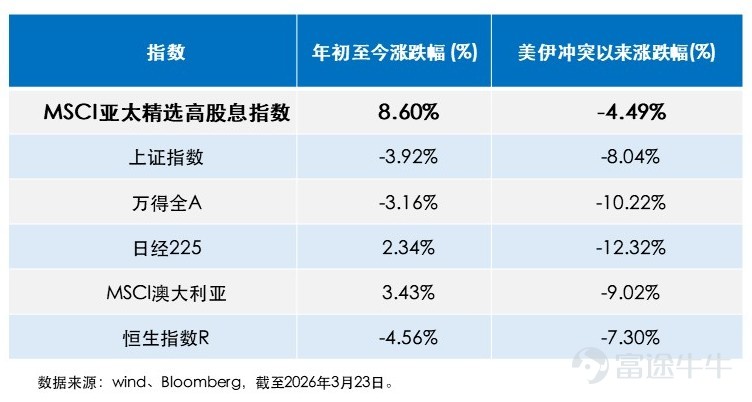
The index performance further confirms its value. Since the beginning of the year, the MSCI Asia Pacific Select High Dividend Index has risen against the trend, achieving an 8.6% return in a volatile market environment.

Third, cross-market diversification further reduces portfolio volatility.
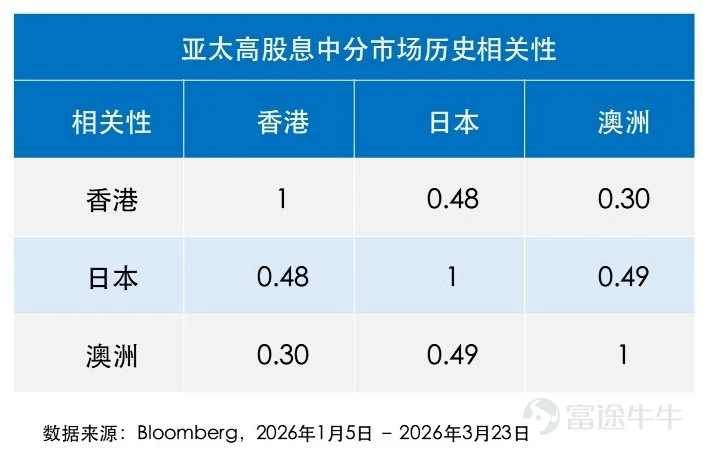
In addition to the quality attributes of its constituent stocks, another major feature of this index is its cross-market layout—covering three core markets: Hong Kong, Japan, and Australia. The economic cycles, policy environments, and industry structures of these three markets exhibit low correlation, resulting in significant diversification benefits.
Data shows that the correlation between the high-dividend indexes of Hong Kong, Japan, and Australia is below 0.5, indicating relatively independent market movements. Leveraging this low-correlation cross-market setup, the E Fund High Dividend ETF effectively disperses the volatility risk of a single market, avoiding significant impacts on the portfolio due to sharp adjustments in any regional market, thus achieving smoother net value performance.
IV. Allocation Strategies in a Volatile Market
For ordinary investors, the following allocation strategies can be considered in the current environment of high market uncertainty:
1. Emphasize the role of high-dividend assets: High-dividend assets, with their stable dividends and lower volatility, are suitable as a base allocation in an investment portfolio, helping to smooth overall fluctuations.
2. Focus on the value of cross-market diversification: A single market is often more affected by local policies and economic cycles; cross-regional allocation can reduce concentrated risks brought by volatility in a single market.
3. De-emphasize short-term timing: The core of a high-dividend strategy lies in sharing continuous corporate dividend payouts through long-term holding. Investors should focus more on its long-term return characteristics rather than short-term market fluctuations.
Currently, there remains considerable uncertainty in the global economy and market environment. The E Fund High Dividend ETF (3483.HK), with its dual advantages of high-quality, high-yield leading constituent stocks and cross-market diversified positioning, provides investors with a 'defensive barrier' in a volatile market. The MSCI Asia Pacific Select High Dividend Index it tracks not only possesses low volatility and high dividend attributes but also effectively hedges against single-market risk through the low correlation among the three regional markets, helping investors build a more resilient portfolio in a volatile market.
[Important Information] The issuer of this content is E Fund Management (Hong Kong) Co., Ltd. This content does not constitute an invitation or recommendation to invest in fund units. Investment involves risks, and fund prices may go up or down. Before investing, investors should carefully read the fund prospectus (including the 'Risk Factors' section) for investment risks related to the fund. This content has not been reviewed by the Hong Kong Securities and Futures Commission. For detailed important notices and disclaimers regarding the above funds, please visit the E Fund (Hong Kong) website:
Risk Disclaimer: The above content only represents the author's view. It does not represent any position or investment advice of Futu. Futu makes no representation or warranty.Read more

Comments
to post a comment
2