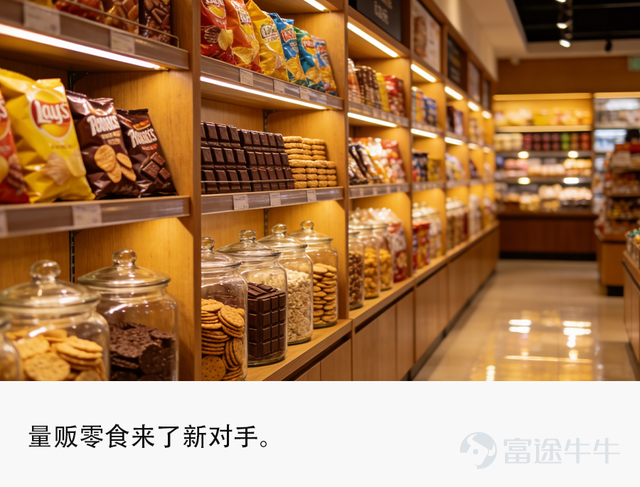

Without competing on low prices, fresh snacks are entering the core business districts of first-tier cities
Source | Tech Planet
Text | Zhang Ningyi
Amidst fierce competition in the bulk snack market, a new wave of snack shops is emerging.
They have not only abandoned the advantage of low-priced multi-category snack stores but also focused on high-quality products with 'short shelf lives,' making these 'fresh snack shops' the rising stars in the snack industry. Unlike the bulk snack stores found on every street corner, they entered the core business districts of various cities right from the start and even made their way into flagship malls in first-tier cities.
Although their scale currently cannot rival that of bulk snack stores, their expansion speed is impressive. 'Jiduoquan,' founded just a year ago, opened more than 60 self-operated stores in less than a year and has set an ambitious goal of 'reaching 1,000 stores.' Other brands are also rapidly expanding, continuously broadening their reach to more cities.
What exactly is this fresh snack trend, and can it carve out a new path in the crowded snack market?
Not pursuing low prices, bulk snack stores face a new rival
At 5 p.m., a long queue formed outside the Beijing Hopson One branch of 'Yili·nutco' (hereafter referred to as Yili), where customers were holding baskets waiting to check out. The tasting cart at the entrance and the promotional area for fresh canned tea drinks priced at 16.8 yuan for two bottles attracted crowds of people eager to sample and choose. Inside the store, tasting stations and open kitchens for live preparation could be seen everywhere. In a bustling commercial hub like Hopson One, which is full of trendy stores, this shop holds its own and has clearly become a new 'landmark,' drawing comparable foot traffic to popular bakeries like 'Butter and Bread' that always have long lines.
According to Tech星球's observations, Yili offers fewer product categories, mainly including loose-weighed items such as nuts, dried fruits, freeze-dried products, freshly baked goods, fresh beverages, homemade jams, ice cream, and other processed products. Their prices far exceed those of regular snack shops; for example, their pistachios cost 190 yuan per jin, comparable to Xueji Roasted Goods, known as the 'jewelry store of snacks.'
However, judging by its first-month revenue exceeding 6.2 million yuan at its Beijing flagship store, the high price hasn’t dampened consumer enthusiasm. On the contrary, thanks to its premium and refined product positioning, it has secured a foothold in many central shopping malls.
Yili initially started as a small traditional nut processing and retail workshop in Shenyang. Such snack shops used to exist only on random street corners, far from entering the central malls of first-tier cities. Now, however, by narrowing down its product categories and adopting meticulous development strategies, it has squeezed into the core areas of the commercial sector and entered the new track of fresh snacks. To date, it has nearly 70 stores nationwide.
Besides Yili, several other brands have emerged in the fresh snack space. For instance, Jinlimen, recognized as the pioneer in this field, originated in Changsha and now operates over 20 stores; Jiduoquan, also founded in Changsha, opened more than 60 stores within a year; Pumama, heavily deployed across Jiangsu, Zhejiang, and Fujian regions; and 'You Recommend,' a new brand launched by Mingming Hen Mang, one of the giants in the bulk snack industry.
Unlike traditional bulk snacks that emphasize cost-effectiveness, offer numerous SKUs, and have long shelf lives, fresh snacks no longer rely solely on low prices. Instead, they increase average order value, focusing on the 'freshness' and 'quality' of products. These items are prepared on-site and have short shelf lives, consolidating some categories into smaller groups of three or four key offerings to achieve rapid turnover.
This is also a type of consumer demand that is gradually emerging — small shops offering high-priced, high-quality products. People have lost the desire to shop in large supermarkets but hope to purchase appealing products in one place.
In terms of product composition, it is more similar to the self-made food sections of Hema and Sam's Club, covering various categories such as freshly baked goods, roasted nuts, dried fruits, candied fruit, and ready-to-eat foods, forming a matrix of on-site prepared products.
In addition to meeting consumer demands through its products, it has also accurately captured the preferences of young people in terms of scene creation and commercial marketing.
Regarding scene creation, Gavin Gao, a business planning and design practitioner, told Tech Planet that fresh snack brands have abandoned the traditional dense display model. Instead, they use open kitchens and scenario-based zoning to optimize the shopping flow, employing circular display cases and farm-style arrangements to downplay the commercial feel while providing the spatial check-in appeal and emotional value that young people crave, redefining the new snack consumption scene.
In terms of commercial marketing, these fresh snack brands promote the idea of 'step into the store and get hooked, browse and enjoy.' Through social media influencers on Xiaohongshu, they transform a simple purchasing action into an immersive experience of novelty, healing, social media check-ins, and leisurely enjoyment, creating a complete closed loop of 'product-space-experience-promotion.'
Additionally, Jiduoquan has adopted the popular 'one-day store manager' promotional model used by internet-famous stores, inviting celebrities like Li Xikan to act as temporary store managers, attracting large numbers of fans and capturing the attention of younger demographics.
From expanding in lower-tier markets to entering core malls in first- and second-tier cities.
Currently, most fresh snack brands maintain decent revenue streams.
A mall employee told Tech Planet that stores like Yili in the northern region typically achieve monthly revenues of over a million yuan. In the eastern China region, revenues can sometimes reach 2 to 3 million yuan, usually during peak periods or grand openings. Jinlimen in Changsha generates daily revenues of about 100,000 to 150,000 yuan per store, with lower figures still reaching at least 20,000 to 30,000 yuan per day. Moreover, the gross profit margin for fresh snacks is significantly higher than that of bulk snacks.
This has attracted major capital investments. Mingming Group (the parent company of Snack Busy and Zhao Yiming Snacks), a giant in the bulk snack industry, launched its fresh snack brand 'You Recommend' in Wuhan in January 2026. According to Retail Business Finance, the store is located in the Wushang Dreamworld Shopping Center in Wuhan, covering an area of approximately 300 square meters, with a single-store investment exceeding 6 million yuan. 'You Recommend' plans to open 800 stores, with 15 expected to open in Wuhan in 2026, and the second store scheduled to launch in June at the Wushang Mall in Wuhan.
A shopping mall leasing agent told TechPlanet that with a proven successful case already in sight, it's only a matter of time before major players enter the market. The per-square-meter efficiency of fresh snack stores far exceeds that of bulk snack stores scattered across streets and alleys. Their output and expansion model resemble that of Baoshifu from back in the day, targeting the top-tier quality consumer base.
A practitioner in the fresh snack industry told TechPlanet that the most crucial factors for entering the fresh snack market are channels and supply chains. Currently, businesses participating in this space have joined because they possess mature supply chains or channel resources. Fresh snacks originated from traditional snacks, and almost all players able to enter this track are 'established forces' within the snack industry. Without mature resources, it is often difficult to establish a brand that customers trust.
This practitioner stated that in terms of the supply chain, since the basic product structure and formulas of fresh snacks do not differ much from traditional retail—such as the production process for roasted nuts, or the recipes for beverages and braised foods—they merely involve upgrading products and production processes based on these foundations. Therefore, these 'established forces' can almost entirely rely on their existing supply chain resources for production.
For instance, 'Jiduoquan,' a well-known stinky tofu brand originating from Changsha under the Heisijingdian label, relies on Heisijingdian’s cold chain network to plan a three-tier daily distribution system: 'factory-regional warehouse-store.' Pumama depends on its parent company Weixin Holdings’ supply chain, adopting a 'production based on sales' model involving factory preparation of ready-to-eat frozen items reheated at the store. Yili focuses on chestnuts as its core product, with nearly 2,000 square meters of temperature-controlled storage near the production area and in Shenyang, utilizing active storage technology to maintain the freshness of raw chestnuts.
In terms of channels, various brands first use their existing franchisee networks for initial deployment, then gradually expand, moving from lower-tier markets towards core shopping malls in first- and second-tier cities.
Currently, among fresh snack brands, only 'Jiduoquan' has opened up franchising, but its requirements are significantly stricter compared to traditional bulk snack store franchises. After all, entering high-end malls requires a certain threshold. According to official data, Jiduoquan not only requires an investment budget of no less than 1.2 million yuan, with a deposit certificate of no less than 1.5 million yuan needed (a deposit certificate of 3 million yuan will be given priority for cooperation), but also demands that investors have retail operation and management experience, and currently operate no fewer than five shops under their investment and management.
However, shopping malls remain somewhat unclear about their stance toward such brands. A mall leasing agent told TechPlanet that in Beijing, most malls are still observing the development of fresh snack brands. Although these stores have high per-square-meter efficiency, their rent contributions are relatively low, nearly half or less compared to clothing and fashion brands. More importantly, the entry of fresh snack brands often impacts existing bakery brands, and balancing this is another factor shopping malls need to consider.
Hidden Concerns Behind Aggressive Expansion
For fresh snacks, product quality inevitably takes the top priority. Whether the products are fresh and hygienic, freshly made and stir-fried on-site, and healthy has become the primary concern for consumers.
According to consumer feedback, the quality of many fresh snack stores cannot be guaranteed. One consumer mentioned that in a store they had visited, due to the semi-open display method used for products like beef jerky and pork floss, flies were seen crawling on the food, and even after informing the staff, no relevant measures were taken. Other consumers reported finding expired food on the shelves.
A former employee of a fresh snack shop revealed that many of the store's bulk products are pre-made semi-finished goods that are processed and sold, differing significantly from the proclaimed 'made on-site.' For instance, roasted sweet potato fries are made by baking pre-made dried sweet potatoes in an oven, while ice cream is made using ready-made milk slurry, with the ingredient list not clearly labeled on the packaging.
The biggest issue with fresh snacks isn't just a problem with one particular step but rather the characteristic of being 'short shelf-life,' which demands perfection at every stage—raw material safety, zero contamination during production, seamless cold chain coordination, and real-time quality checks. Achieving all this perfectly is difficult in practice.
Such issues have already begun to surface. In January 2026, Jinlimen faced public backlash after its contract manufacturer was exposed by the media for severe food safety violations. Although Jinlimen quickly responded by setting up a compensation fund of 12 million yuan to offer consumers a tenfold refund, consumer trust was still affected.
To address these problems, stronger supply chain upgrades and better store quality management are required. The operational methods used by bulk snack stores as well as established prepared food sections like Hema and Sam’s Club could provide some insights. For example, digital traceability in production, full cold chain monitoring with expiration alerts in warehousing and logistics, and AI-based remote store inspections and standardized audits in store operations might ensure higher quality for fresh snacks.
While aggressively expanding, fresh snack brands should also focus more on product quality. After all, snack shops that market themselves on 'freshness' cannot afford to lose their most important advantage.
Risk Disclaimer: The above content only represents the author's view. It does not represent any position or investment advice of Futu. Futu makes no representation or warranty.Read more
Comments
to post a comment