
Two major banks are both bullish—has gold passed its worst moment?

Gaozhan · Interest Rate Weekly | Escalation of Middle East conflicts, rising stagflation risks, Fed faces policy dilemma?
The202603phase

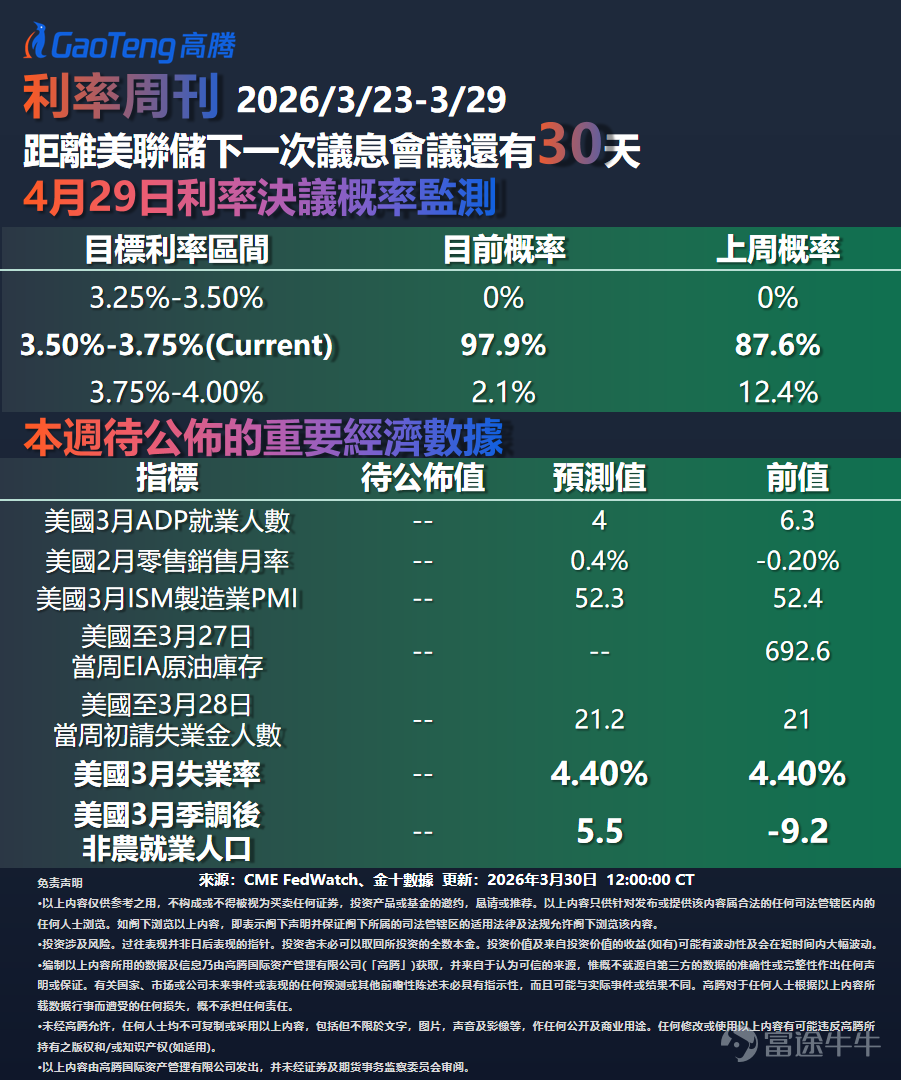
According to CME FedWatch data, there is still time before the next FOMC meeting.30 daysCurrently, the market expects that the probability of maintaining interest rates3.50%–3.75%unchanged in the Fed’s next rate decision is97.9%, and the probability of a rate hike to 3.75%–4.00% is2.1%. Compared with a week ago (March 20), when the probability of remaining unchanged was 87.6% and the probability of a rate hike was 12.4%, this week’s rate hike expectations have somewhat receded but remain high; compared with a month ago (February 27), when there was a 24.7% probability of a rate cut, now the expectation for a rate cut has significantly declined, and the possibility of a rate hike has returned to investors' focus.
Middle East Conflict Impacts Global Markets: Rising Stagflation Risks Lead to Reassessment of Policy Pathways
Last week (March 23 – March 29), Iran's ongoing escalation of conflict became the most critical variable disturbing global financial markets. With the US continuing to deploy troops to the Middle East and oil prices remaining high,Energy shockthe risk of inflationary pressures sharply increased, causing a profound shift in investors’ forecasts of the Fed’s policy path—originally expecting two or three rate cuts this year, the market has now started discussing the possibility of a rate hike.Stagflation riskSignificantly increases decision-making difficulty.
Fed Dynamics: Official divisions emerge, policy stance turns cautious
Several Fed officials spoke this week on the monetary policy outlook; overall tone turns cautious but internal divisions are evident.Governor Cookstated on March 26 thatIran conflict drives up inflation risks, changing the balance of risks, causing policymakers to be more concerned about inflation than employment. She pointed out that due to the impact of the war in Iran, inflation risks are greater now. Although the labor market is balanced, this balance is fragile.
Fed Vice Chair Jeffersonstated,Persistently high energy pricescould push other prices higher, but the impact of energy prices on inflation is relatively moderate. Unemployment is not expected to change significantly this year.Milanbelieves that AI will undoubtedly push up the neutral rate, but he clearly stated that currently,there is no need to consider raising interest ratesThe overall inflation rate is expected to rise, but it is too early to say that the core inflation rate will increase. He emphasized that policies should not be formulated based on short-term news headlines. The traditional central bank view holds that oil shocks do not affect core inflation, and the labor market still requires monetary policy support.
BaalOn March 24, Ball stated that policymakers may need to keep interest rates unchanged 'for some time' in response to inflation that is clearly higher than the 2% target. It is currently advisable to maintain the current interest rate and assess upcoming data.
Internal Disagreement: Hawk-Dove Debate Centers Around Energy Shocks and Employment Risks
Dove Viewpoint:
MilanAs the main proponent of 'rate cuts' within the council, Milan clearly stated that currentlythere is no need to consider raising interest ratesHe emphasized that policies should not be formulated based on short-term news headlines. The traditional central bank view holds that oil shocks do not affect core inflation, and the labor market still requires monetary policy support.
Hawk/Moderate Viewpoints:
Governor Cookstated,Iran conflict drives up inflation risks, shifting the risk balance so that policymakers are more concerned about inflation than employment.Baalindicated that policymakers may need to maintain current policy for "a period of time"Interest rates remain unchanged。Chicago Fed President Goolsbeewarned that the impact of an Iran warEnergy shockis posing a threat to the Fed’s dual mandate, complicating its monetary policy outlook and could potentiallydelay rate cuts— echoing Barr's view thatInflation risks and oil price support maintaining interest rates unchanged for a longer period。
Other major central bank activities
People's Bank of China: On March 27,People's Bank of ChinaHeld the 2026Financial Stability Work Conference. The conference concluded that the overall operation of China’s financial industry is stable, financial risks are continuously converging, and financial institutions as a whole remain healthy. On March 25, the central bank conducted a 500 billion yuan MLF operation with a one-year term. This week, the central bank maintained a steady open market operation, injecting a net 211 billion yuan on March 26, while conducting a 146.2 billion yuan seven-day reverse repo operation on March 27 at an operating rate of 1.40%. Central Bank GovernorPan Gongshengstated at the 2026 annual meeting of the China Development Forum on March 22 that they will continue to implementa moderately accommodative monetary policy, adding that China's current social financing conditions are in an accommodative state.
ECB:ECB President Christine Lagardeindicated that interest rates are currently at roughly neutral levels, fiscal policy remains neutral as well, and the ECB will not be paralyzed by any hesitation in responding to Iran.ECB Governing Council member Vujčićstated that with the escalation of the war in Iran,Stagflation riskthe central bank must be 'highly flexible and vigilant' in controlling prices, and officials may soon be able to assess whether the impact of the conflict requires a response through interest rate hikes. Market pricing shows traders havefully priced inexpectations for three ECB rate hikes this year, each by 25 basis points,rate hike expectations.The money market has fully priced in expectations that the European Central Bank will raise interest rates three times by September, with each hike being 25 basis points.
Bank of England: The Bank of England says it is ready to act to curb new price pressures.Traders increase bets on Bank of England rate hikesExpectations for a 25-basis-point rate hike in April have been fully priced in, and the expectation forBank of Englandto carry outfour 25-basis-point interest rate hikesby 2026 has been fully priced in.
Bank of Japan:Bank of Japan Governor Kazuo Uedaand expects underlying inflation to rise moderately. The Bank of Japan stated it will release the core CPI indicator on a monthly basis.
Market Reaction: Rising Rate Hike Expectations, Stagflation Concerns Weighing on Risk Appetite
Amid escalating geopolitical conflicts in the Middle East, concerns over the US economy falling intoStagflation riskare rising. Traders have increased bets on Fed rate hikes, with the likelihood of a rate increase this year now exceeding 50%. Swap markets indicate the Fed will raise rates by 20 basis points this year, compared to expectations of a 25-basis-point cut just a week ago.
Bank of America Securities analystsnoted that even if a ceasefire is reached in the Iran conflict, unless energy prices quickly retreat to pre-war levels, meaningWTI crude oil pricescontinue to hover aroundUSD 80 per barrelAbove this level,The Federal Reservemay still adopt a more倾向于 [Note: Missing clarification for financial context; recommend revising source text]Interest rate hikepolicy stance. Deutsche Bank analysis points out thatInvestorthey originally expected the Fed to cut rates two to three times this year, but nowthinkthere may not even bea single rate cut,and the market is already discussing the possibility of a rate hike.
The Organisation for Economic Co-operation and Development (OECD)predicts that the Federal Reserve will maintain its policy through 2026 and 2027.Interest rates remain unchangedHowever, many industry insiders also noted thatthe US labor marketcontinues to befragileand the surge in oil prices posesdownside risksto economic growth, which may make it difficult for the Fed to implement interest rate hikes.

Risk Disclaimer: The above content only represents the author's view. It does not represent any position or investment advice of Futu. Futu makes no representation or warranty.Read more

Comments
to post a comment
3
2