
AIA (01299) Short-term Analysis: Consolidation Awaits Breakout, ¥88 Becomes Key Threshold
As of March 27, 2026, AIA (01299) traded at ¥85.4, down 1.84%, with a turnover of ¥1.077 billion, indicating steady market trading. The short-term moving averages MA10, MA30, and MA60 are at ¥83.99, ¥84.22, and ¥84.67 respectively, showing an entangled state, reflecting that although the stock price has rebounded from a low, the medium- to short-term direction has not fully turned into a unilateral uptrend. At this stage, it appears more like consolidation followed by an attempt to break upwards.
Based on multiple technical indicators, the system's signal is "neutral" with a strength of 8. Several oscillation indicators such as the Williams %R and Stochastic Oscillator show an "overbought condition," while the CCI indicator signals "sell," indicating possible consolidation pressure in the short term. However, the Bull-Bear Power Indicator, Ichimoku Cloud, and MACD all signal "buy," with Bollinger Bands also showing "buy," confirming the continuation of the uptrend. According to technical analysis data, short-term support levels are at ¥83.8 and ¥80.5, while resistance levels are at ¥90.2 and ¥93.5. The probability of an upward move is 54%, with a 5-day volatility of 10%, indicating relatively moderate stock price fluctuations.
In terms of market news, as of March 27, the performance of Hong Kong-listed insurance stocks was mixed, with AIA following the broader market in narrow-range movements. According to mainland media reports, the detailed implementation rules for the new 'Ten National Policies' in the mainland insurance industry continue to be rolled out, leading to expectations of growth in new business value, with leading insurers likely to benefit. In addition, AIA has been consistently repurchasing shares recently, demonstrating management’s confidence in the company's prospects. In the same sector, China Life (02628) $CHINA LIFE (02628.HK)$traded at ¥25.28, up 0.96%; Ping An (02318) $PING AN (02318.HK)$traded at ¥58.66, up 0.86%, with overall sentiment in insurance stocks remaining stable.
Integrating the March 26th [HKEX Podcast] viewpoint, the program explicitly noted that AIA’s current price of HKD 87 is near the upper half of the recent range between HKD 78.7 and HKD 88, at a critical juncture where the stock is consolidating before attempting to break out upwards. Immediate support below lies around HKD 85 to HKD 84.3 (where multiple short- to medium-term moving averages converge), with further downside support at HKD 82. Resistance above is initially at the recent high of HKD 88; if broken, the next target will be the psychological level of HKD 90. The show's analysis suggests that for upward momentum to be confirmed toward challenging HKD 90, the share price must first decisively break and stabilize above the recent high of HKD 88. If it merely touches HKD 88 during intraday trading but fails to close above it, this would only indicate testing. Only a true breakout above HKD 88 and sustained trading above that level would provide the market conditions necessary to push toward HKD 90. Currently, the stock is hovering around HKD 87, close to the HKD 88 resistance, in a crucial moment where a breakout or lack thereof will determine the direction. The program also pointed out that warrant flows are most concentrated in call warrants with strike prices between HKD 90 and HKD 95, reflecting clear market attention on upside potential, while put warrants in the HKD 65 to HKD 70 range have also been deployed, showing some lingering divergence.March 26 [Hong Kong Stocks Podcast] Part 2 - AIA, Kuaishou, JD.com
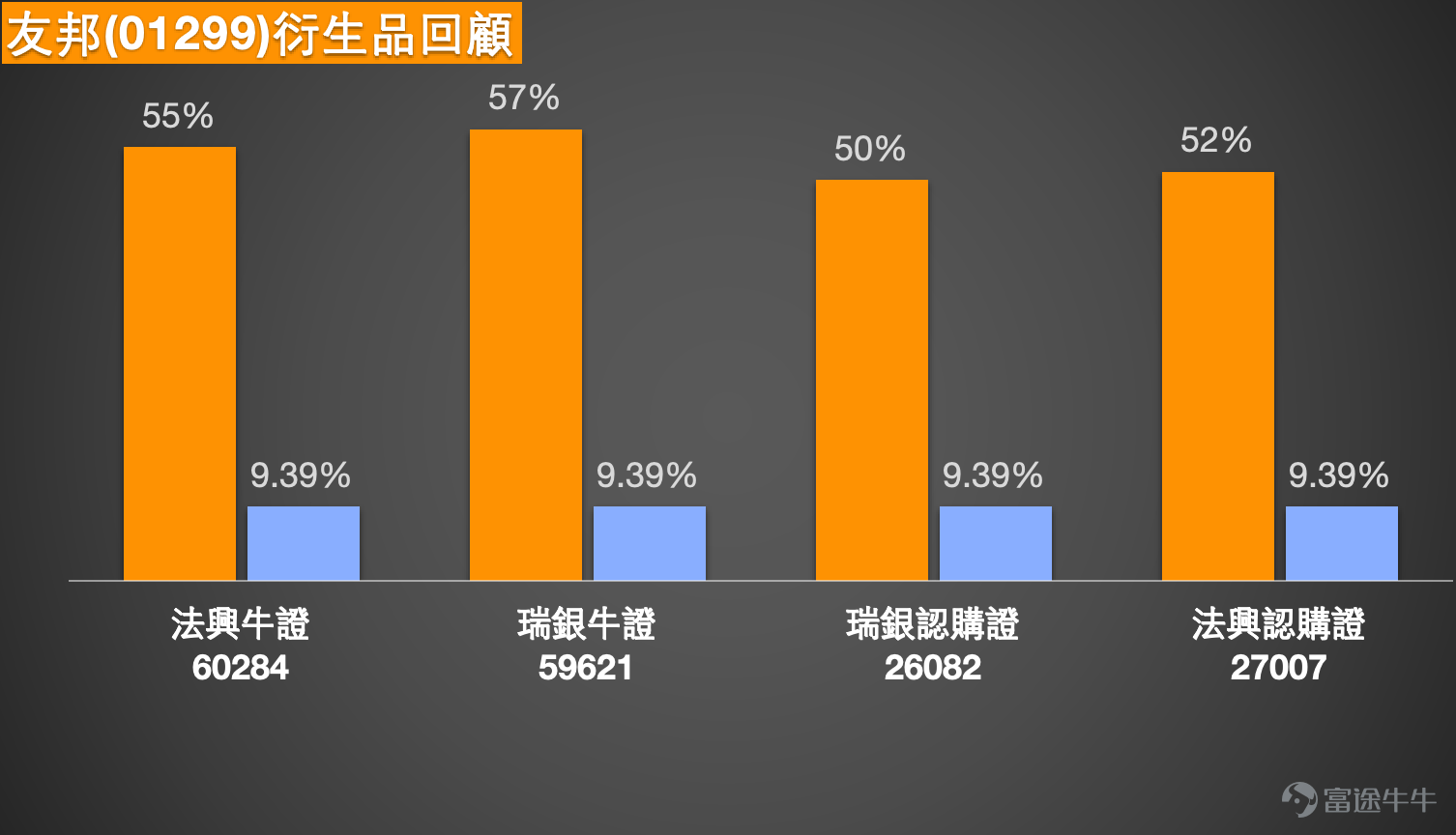
Reviewing the warrant market performance, according to the March 23 product recap, the four products mentioned recorded significant gains over the following two days (up to March 25), successfully capturing the rebound in the underlying shares. Among them, UBS Group's bull certificate (59621) surged by 57%, performing the most prominently; Societe Generale’s bull certificate (60284) $SG#AIA RC2606H.C (60284.HK)$ and Societe Generale’s call warrant (27007) $SG-AIA @EC2611B.C (27007.HK)$ rose by 55% and 52%, respectively; UBS Group’s call warrant (26082) gained 50%. During the same period, the underlying share rose by 9.39%, and the related bull certificates and call warrants effectively leveraged returns, demonstrating that in a clear rebound trend, appropriate derivatives can significantly amplify returns.

Based on technical analysis, market environment, and Podcast insights, AIA is at a pivotal consolidation phase awaiting a breakout in the short term. Investors should consider HKD 83.8 as the short-term defensive line and closely monitor the breakout situation at the HKD 88 resistance. If the share price can firmly stabilize above HKD 88, there is potential to further challenge resistances at HKD 90.2 and HKD 93.5; if it fails to break through and retreats, supports at HKD 83.8 and HKD 80.5 need attention. Below is an analysis of some relatively clear terms for warrants and bull/bear certificates, whose recovery and strike prices are closely tied to key technical support and resistance levels:
For bullish positions, consider HSBC call warrant (22975) $HS-AIA @EC2612A.C (22975.HK)$ and Bank of China call warrant (22387) $BI-AIA @EC2612A.C (22387.HK)$ . Their strike prices are HKD 91.7 and HKD 91.66, respectively, slightly above the first resistance level at HKD 90.2, making them slightly out-of-the-money structures. HSBC call warrant (22975) has the advantage of relatively lower implied volatility, with a leverage of 5x; Bank of China call warrant (22387) stands out for its ideal leverage and implied volatility, with a leverage of 4.8x. Both have strike prices close to the HKD 90.2 resistance zone, suitable for investors expecting the stock price to break through HKD 88 and move higher. For positions closer to the support level, consider bull certificates with a recovery price of HKD 76, such as J.P. Morgan bull certificate (64100) and UBS Group bull certificate (69178). J.P. Morgan bull certificate (64100) offers the highest actual leverage (7.4x) with lower premium; UBS Group bull certificate (69178) highlights the lowest premium and higher actual leverage (7.7x), both having recovery prices below the first support level at HKD 83.8, providing substantial buffer space.
For bearish positions, consider Bank of China put warrant (23997) $BI-AIA @EP2607B.P (23997.HK)$ and Macquarie put warrant (25248) $MS-AIA @EP2606A.P (25248.HK)$The strike prices of the two options are 70 and 69.99 respectively, below the second support level of 80.5, making them out-of-the-money structures. The advantage of BOC Put Warrant (23997) lies in its lowest premium and implied volatility, with leverage at 8.4 times; while the highlight of Macquarie Put Warrant (25248) is its relatively ideal leverage and implied volatility, with leverage at 8.1 times. Both are suitable for investors who expect the stock price to struggle to rebound and will retest support levels at 83.8 or even 80.5. For bear contracts, UBS Bear Contract (64884) and Societe Generale Bear Contract (64263) can be considered, with a recovery price of 95, slightly above the second resistance level of 93.5, providing a larger safety margin. UBS Bear Contract (64884) has the advantage of the lowest premium and higher actual leverage (10.6 times); Societe Generale Bear Contract (64263) stands out with the highest actual leverage (10.4 times) and lower premium, suitable for investors expecting the stock price to face resistance and fall back within the range of 90.2 to 93.5.

Overall, AIA is at a critical moment of consolidation waiting for a breakout in the short term. Investors should take 83.8 as the short-term bullish-bearish dividing line. If the stock price can effectively break through the 88 resistance level, it may further challenge 90.2 and 93.5. If it fails to stabilize and falls back, then attention should be paid to supports at 83.8 and 80.5. When choosing derivative products, judgments on the market direction and strength should be balanced with the distance between leverage and recovery/strike prices, keeping in mind the Podcast's mention of '88 as the most important short-term trigger point.'
Interactive Questions
Do you think AIA (01299) can break through the 88 resistance level and challenge 90 in the short term?
A. Yes, the insurance sector sentiment is positive, funds are concentrated on optimism.
B. No, technical resistance and consolidation pressure need to be digested.
Feel free to leave your thoughts in the comments section and follow Jenny's HK Stock Warrants for more professional insights.
Friendly reminder: This article does not constitute any investment advice. It is for reference only and does not constitute any form of investment recommendation. The market data, opinions, and analysis contained herein may change at any time without prior notice. We assume no responsibility for any loss or damage caused by reliance on the information in this article. Technical analysis only shows whether certain technical conditions are met; a comprehensive evaluation of asset performance should be conducted using additional data. Trading decisions should not be made solely based on this article. Please note that past performance is not indicative of future results. Follow Jenny's Warrants HKEX column for more professional insights.
#AIA Insurance# #Technical Analysis# #Support Level# #Resistance Level# #Warrants# #Bull and Bear Certificates# #Call Options# #Put Options# #Hong Kong Stock Warrants Jenny
Risk Disclaimer: The above content only represents the author's view. It does not represent any position or investment advice of Futu. Futu makes no representation or warranty.Read more

Comments
to post a comment
3