
Option Sir Breaks Down Hot Topics | CPU Price Hikes Reignite Bullish Sentiment, But How Far Can INTC and AMD's Rebound Go?
On March 25, the US chip sector showed notable strength, $Intel (INTC.US)$ closing up about 7.1%, $Advanced Micro Devices (AMD.US)$ closing up approximately 7.3%. The direct catalyst came from supply chain news about CPUs experiencing another round of price increases and delivery times continuing to lengthen. On March 24, $Arm Holdings (ARM.US)$ officially released its first self-developed data center processor, AGI CPU, challenging Intel and AMD, and closed up 16.4% yesterday.
Notably, this rebound occurred against the backdrop of an unfriendly macro environment. Since the outbreak of conflict on February 28, $Nasdaq Composite Index (.IXIC.US)$ has fallen by 4.5%, $S&P 500 Index (.SPX.US)$ dropped by 5.4%, with the market showing sensitivity to the transmission chain of 'high oil prices - high inflation - fewer rate cuts.' Against this backdrop, can CPU price increases and tight supply truly support a sustained rebound in INTC and AMD's stock prices?
From 'speculation' to 'validation,' the rise in CPU prices is not a new story.
The narrative of CPU price hikes is not new; as early as January this year, the market had already traded on this logic.On January 19, a significant report by KeyBanc Capital Markets, a well-known Wall Street firm, raised Intel's target price to $60 and AMD's target price to $270.
KeyBanc's Core Argument:
“As cloud computing providers (CSPs) continue to aggressively expand AI infrastructure, by 2026, Intel and AMD’s server CPU production capacity will be nearly sold out.” It is expected that AMD’s server CPUs may increase in price by 10-15% in the first quarter of 2026.
However, that round of increase was more driven by anticipatory trading and was quickly interrupted by reality. Intel’s earnings report on January 22 showed a surge in demand for its AI data center server CPUs, but even with factories operating at full capacity, it could not meet the demand. Supply constraints prevented the demand from translating into clear performance results, disappointing investors betting on its turnaround – having demand does not mean immediate profits, and being able to raise prices doesn’t mean performance immediately materializes.
This time, however, the logic of price increases has shifted from 'speculation' to 'validation,' and the market is now speculating on established facts: 'already out of stock, lead times extended, and price hikes initiated.' According to Nikkei Asia, Intel and AMD have separately notified customers that they will raise prices for their entire range of CPUs starting in March and April, respectively. Top PC manufacturers like HP Inc and Dell discovered by the end of February that there was a noticeable gap between CPU demand and availability, a situation more severe than a few months ago, with delivery cycles extending from the previous 1-2 weeks to 8-12 weeks.
Why have CPUs suddenly become important again?
Over the past two years, market attention on AI hardware has been highly concentrated on GPUs, which is understandable – the core beneficiaries of training large models are indeed GPUs. However, the operation of AI infrastructure does not rely solely on GPUs. The investment boom is transferring demand pressure from AI-specific chips to broader supply chain segments such as memory and server CPUs. Additionally, systems like agentic AI, which need to perform complex, multi-step autonomous tasks, will significantly increase CPU processing requirements.
This signifies a key shift: the market previously underestimated the role of CPUs in the AI era. If AI remains only in the 'model training' phase, the GPU is the absolute core; but when AI enters large-scale routine operational scenarios like inference, orchestration, scheduling, and task execution, the importance of CPUs will re-emerge.
Arm explicitly mentioned in an official release that as AI shifts from training to continuously running agents, the CPU capacity required per GW of power in data centers could reach more than four times the current level. Although this statement carries a vendor bias, it sufficiently illustrates that the industry no longer debates the value of CPUs but focuses on who can better meet this wave of new demand. CPUs have transitioned from a mature track lacking imagination to becoming an indispensable core resource in AI infrastructure.
Another reason lies in the lack of supply-side elasticity. Intel is constrained by its own manufacturing and delivery schedules, while AMD relies on external foundry systems. When the entire industry’s resources tilt toward AI, CPU supply cannot increase rapidly. What was once considered 'adequate' supply quickly tightens in a high-growth environment. Manufacturers raising prices is not just to offset rising raw material costs but also because customers are willing to pay higher prices for guaranteed supply – for the capital markets, this means a shift in core variables: in the past, CPU manufacturers worried about 'not being able to sell,' but now they worry about 'not being able to deliver.'
Arm enters the market directly, intensifying CPU market competition
On March 24, Arm officially launched its first self-developed data center processor, the AGI CPU, targeting the agentic AI market. Meta is the first major partner, and Taiwan Semiconductor will manufacture it using a 3-nanometer process. Arm CEO Rene Haas told Reuters that the chip is expected to generate $15 billion in annual revenue five years from now.
In the past, Arm's primary business model was licensing core IPs to major companies like Apple and NVIDIA for developing their own chips. This time, entering the physical chip product line marks an important milestone in its operations and AI market strategy, driving Arm's stock to soar over 16% at closing.
Currently, the data center CPU market is still dominated by the x86 architecture, but the Arm architecture has been accelerating its penetration in cloud computing (e.g., AWS Graviton). With Arm launching its own chip, the market competition has evolved from 'Arm architecture licensing vs x86' to 'Arm self-developed chips vs x86 vendor products.' Its management explicitly stated the goal of capturing market share from the x86 camp.
In the short term, CPU shortages and price increases remain beneficial for Intel and AMD stock recovery, validating the tight supply-demand situation while reflecting improved pricing power for manufacturers. Moreover, large clients generally adopt a 'multi-supplier strategy,' balancing Arm, x86, and self-developed chips to mitigate risks and optimize costs. In the medium to long term, the launch of Arm AGI CPU means that the CPU dividends of the AI era may not solely belong to the x86 duopoly, as competitive boundaries have been broken.
This rally: Is it the start of a trend or just a short-term blip?
Whether this rally can transition from 'news-driven' to 'trend momentum' depends on the validation of the following three factors:
First, whether price hikes can truly translate into profits.In the coming quarters, whether the average selling price (ASP) of CPUs and manufacturers' gross margins will significantly improve rather than remain at the expectation level. 'Supply tightness' has two sides: On one hand, it grants manufacturers pricing power, providing support for margin expansion and valuation recovery; on the other hand, it also reflects bottlenecks on the supply side.
Second, supply tightness needs to be maintained within a 'favorable but not excessive' range.If delivery times gradually ease, it indicates that manufacturers have retained pricing power while restoring delivery capabilities, which is the most ideal scenario; however, if shortages continue to worsen, it will harm shipment volumes and market share. Moreover, in the long term, there is a risk of accelerated adoption of alternative solutions—against the backdrop of ongoing tight supply of x86 CPUs, Qualcomm and NVIDIA, which may enter the PC CPU market in the future, could seize the opportunity to capture demand. Short-term shortages can drive up prices, but prolonged shortages might push customers towards alternatives.
Third, whether the situation in the Middle East and oil prices can marginally ease.Macroeconomic pressures remain unresolved as rising oil prices and escalating conflicts have led the market to lower rate cut expectations, dragging down US stocks for a fourth consecutive week. For growth stocks, especially semiconductor stocks, even if micro-level industry chain logic improves, overall valuations remain constrained by macro headwinds. If oil prices continue to hover at high levels or rise further, tech stock valuations will face additional pressure. Even with marginal improvements in fundamentals for INTC and AMD, their stock price upside will remain limited.
Although both Intel and AMD surged on the news of CPU price hikes, the market's pricing logic for the two differs significantly.
Intel leans more towards 'traditional business recovery + reversal trading.' The market's previous concern was that Intel had a compelling long-term story but lacked short-term earnings support; the CPU price increase and supply tightness at least demonstrate that its most traditional and mature business lines have not collapsed in demand. Instead, they are receiving unexpected support from AI investment expansion.
AMD, on the other hand, leans towards 'reaffirmation of premium valuation driven by strong demand.' It is already benefiting from AI and server demand. Intel’s share in the server CPU market has dropped from over 90% in 2019 to around 60% by 2025, while AMD has risen to over 20%. The market does not view this CPU price hike as a one-off positive, but rather as a validation of AMD’s ongoing product mix improvement and sustained high demand. However, note that market expectations for AMD are higher than for Intel. While its stock price is easily driven up by catalysts, the bar for subsequent earnings delivery is also higher. If deliveries, gross margins, or order outlooks disappoint in the coming months, AMD’s rebound sustainability may be weaker compared to 'low-expectation recovery plays' like Intel.
Against the backdrop of Middle East tensions suppressing market risk appetite, INTC and AMD gained market recognition due to the micro-level positive of CPU price hikes. In the short term, this helps support stock price recovery; however, in the medium term, the height of the rebound does not depend on the frequency of price hikes but on whether the profit elasticity brought by the hikes can outpace supply bottlenecks and macro headwinds.
Options strategy
$Intel (INTC.US)$ Characterized by large-scale, long-term, and high volatility expectations, it is more suitable for strategic bullish positioning based on potential fundamental turning points or event-driven strategies, though short-term technical correction risks should be monitored. The current implied volatility (IV) is 68%, at the 83rd historical percentile. The put-call volume ratio is only 0.55, with a large call option purchase worth $10.25 million betting on calls expiring June 18, 2026, with a strike price of $40, indicating strong bullish sentiment in the options market. Large-scale, long-term call buying and high IV suggest funds are betting on INTC breaking out of its recent consolidation range and initiating a larger upward move, but diverging technical indicators and outflows of major funds signal short-term pullback pressures.
$Advanced Micro Devices (AMD.US)$ Characterized by short-term, flat-price, and extremely strong stock performance, the current put-call ratio is 0.93, close to 1, indicating relatively balanced bullish and bearish forces. IV is 56.3%, at the 54th historical percentile. This reflects momentum-driven bullish sentiment, but technical indicators have issued overbought warnings, increasing short-term volatility risks.
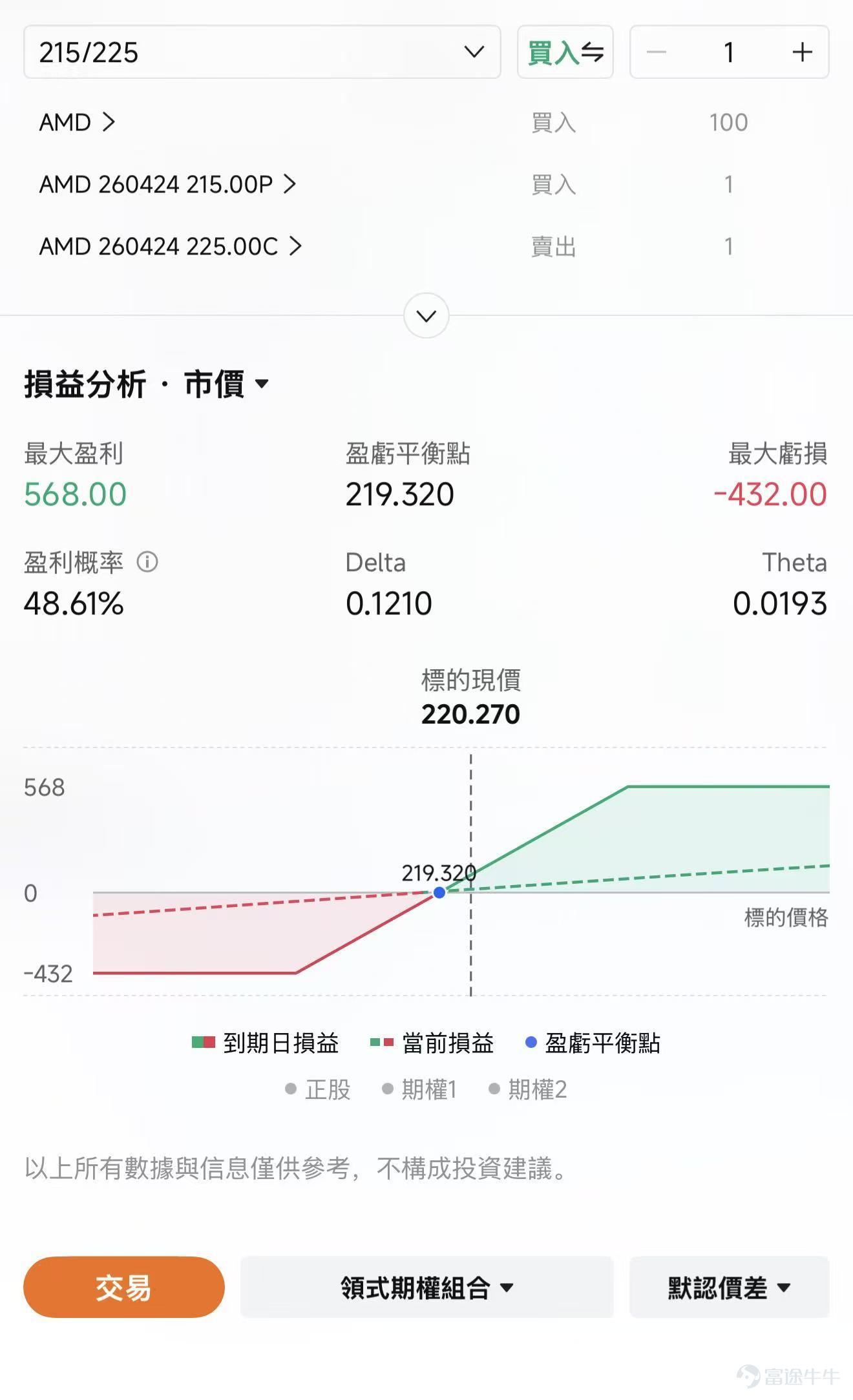
(1) If you already hold the underlying stock and are concerned about a pullback after a sharp rise
A long collar strategy could be considered, as this structure is suitable for holdings that are “bullish but unwilling to give back profits.” Since this round for AMD seems more like a “pricing power recovery” trade, it may not necessarily evolve into a one-sided trend. The core logic isn’t bearish on AMD, but rather concerns about the pace of the recent rally being too fast.
(The design images displayed on screen are for illustrative purposes only and do not constitute any investment advice or guarantees; market conditions fluctuate frequently, and the option prices shown do not represent real-world values.)
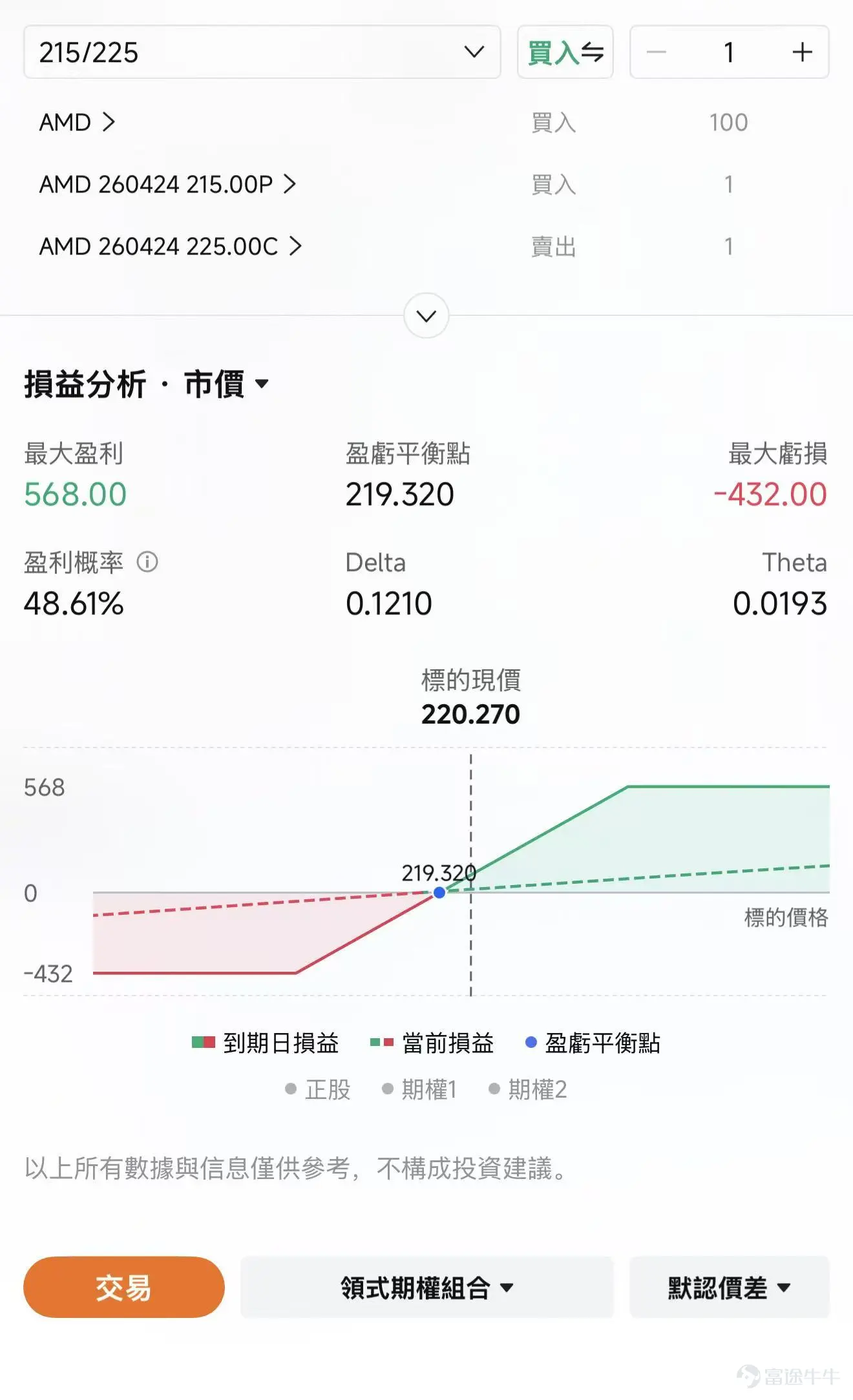
(2) If you already hold Intel shares and believe the upside momentum is limited, aiming to improve your position efficiency at current levels
(The design images displayed on screen are for illustrative purposes only and do not constitute any investment advice or guarantees; market conditions fluctuate frequently, and the option prices shown do not represent real-world values.)
Consider a covered call strategy, which involves continuing to hold the underlying shares while selling one out-of-the-money call option expiring in about a month. If you expect Intel to enter a high-range consolidation phase rather than a one-sided surge, this strategy is most appropriate — Intel’s key logic currently revolves around a trading recovery, with volatility likely during the upward movement. In this case, capturing short-term overpriced time value is more stable than leveraging unidirectionally.

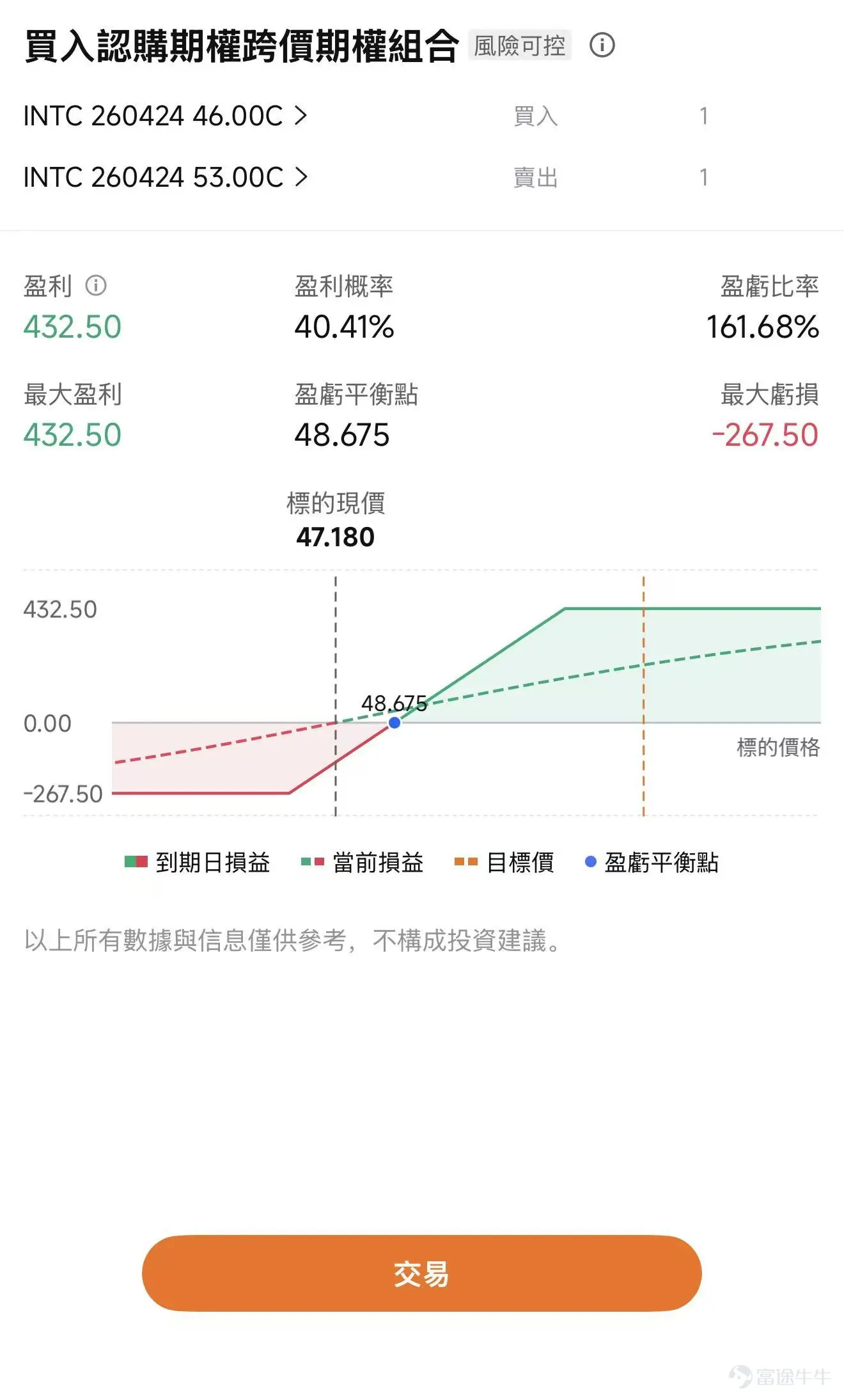
(3) If you’re optimistic about the short-term outlook and want to engage in event-driven trading
Prioritize structures like “call spreads,” which offer “visible maximum loss and limited cost.” This CPU sector catalyst isn’t purely sentiment-driven, and there may be follow-through, but with uncertainty surrounding the Middle East situation, the stock has already undergone significant repricing in a single day. Going forward, the market will likely transition from a “straight-line rally” to “high-level consolidation.” In this environment, naked call options are prone to issues of “correct direction but wrong timing,” so risk control is essential.
(The design images displayed on screen are for illustrative purposes only and do not constitute any investment advice or guarantees; market conditions fluctuate frequently, and the option prices shown do not represent real-world values.)
Finally, here's a small perk for fellow investors—welcome to claim it!Options Beginner Pack
This event is exclusively for invited HK users, click to learn moreDetailed event rules >>
Futu's simulated trading challenge is now open for registration! Zero cost, zero risk, and you could win stock cash vouchers!For more details, click here

Disclaimer
This content does not constitute any offer, solicitation, recommendation, opinion, or guarantee of any securities, financial products, or tools. The risk of loss in buying and selling options can be substantial. In some cases, your losses may exceed the initial margin amount deposited. Even if you set contingent orders, such as 'stop-loss' or 'limit' orders, these may not necessarily prevent losses. Market conditions may make these orders unexecutable. You might be required to deposit additional margin within a short period. If you fail to provide the required amount within the specified time, your open positions may be liquidated. However, you will still be responsible for any account deficit arising from this. Therefore, before trading, you should study and understand options and carefully consider whether such trading suits you based on your financial situation and investment objectives. If you trade options, you should be familiar with the procedures upon exercising options and at expiration, as well as your rights and obligations when exercising options and at expiration.
Risk Disclaimer: The above content only represents the author's view. It does not represent any position or investment advice of Futu. Futu makes no representation or warranty.Read more

Comments
to post a comment
11
12