

Seagate Technology and SK Hynix are set to report earnings—can they reignite confidence in the memor

Google's TurboQuant triggers massive shock in the storage sector! In-depth analysis: Is this a golden buying opportunity or a real negative factor?
Overnight, $Alphabet-C (GOOG.US)$ a major paper published caused a sharp decline in the memory chip sector.
The paper disclosed a highly efficient AI memory compression algorithm named TurboQuant, which created a sensation in Silicon Valley's tech circle. Google claims that this algorithm can reduce cache consumption for large language models by at least six times with zero loss of precision, while boosting performance up to eightfold.In short, this technology allows AI to process and retain vast amounts of information using significantly less memory.

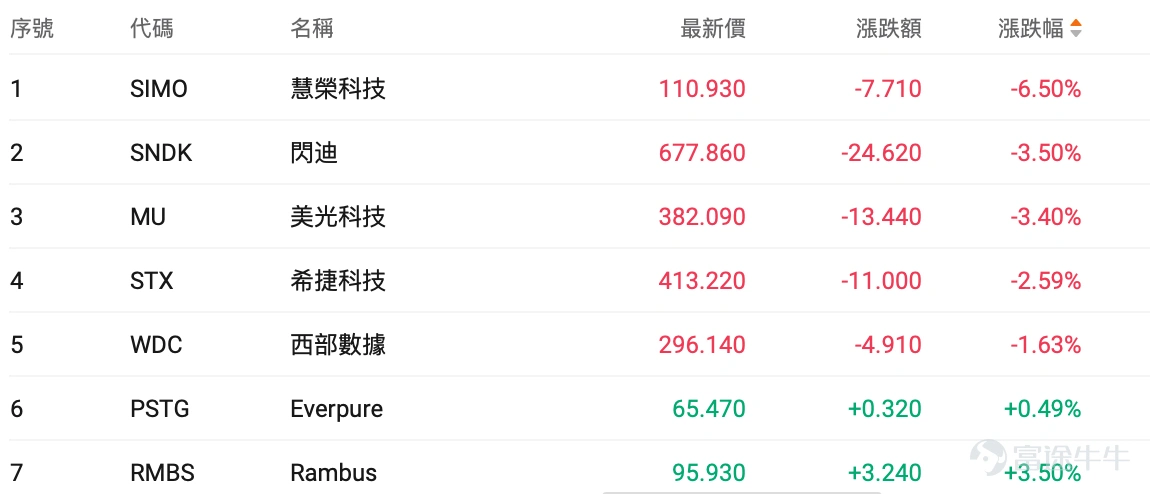
Following the announcement, overnight $SanDisk (SNDK.US)$ 、 $Micron Technology (MU.US)$ drops over 3%, $Seagate Technology (STX.US)$ dropped more than 2%, and $Western Digital (WDC.US)$ fell over 1%. Today, Hong Kong stocks $CSOP SK Hynix Daily (2x) Leveraged Product (07709.HK)$ plunged over 12%, while $CSOP Samsung Electronics Daily (2x) Leveraged Product (07747.HK)$ fell more than 10%.
This algorithm, once released, sparked heated discussions on Wall Street: Could the current memory chip shortage crisis troubling many tech giants finally come to an end? This article will help fellow investors understand what TurboQuant is and its impact on the industry.
What is TurboQuant?
First, let's talk about what this TurboQuant algorithm actually is. According to Google's official website, TurboQuant is a compression method that can significantly reduce model size without any loss of precision, making it highly suitable for supporting key-value cache (KV Cache) compression and vector search. It achieves this through two key steps:
1. High-quality compression:TurboQuant first randomly rotates data vectors. This clever step simplifies the geometric structure of the data, allowing high-quality quantizers to be easily applied to each part of the vector separately. The first phase utilizes most of the compression capability (the majority of bits) to retain the main concepts and features of the original vector.
2. Eliminate hidden errors:TurboQuant uses a small amount of remaining compression capability (just 1 bit) to apply the QJL algorithm to tiny errors left over from the first stage. The QJL phase acts as a mathematical error checker, eliminating bias and thereby achieving more accurate attention scores.
💡 By this point, many investors are still confused. To put it simply, when AI answers your long-winded questions (reasoning), it often forgets what was said earlier, so it needs to frantically 'take notes' while reading. This temporary notepad takes up a lot of space.TurboQuant is a 'god-level notepad compression technique' invented by Google.
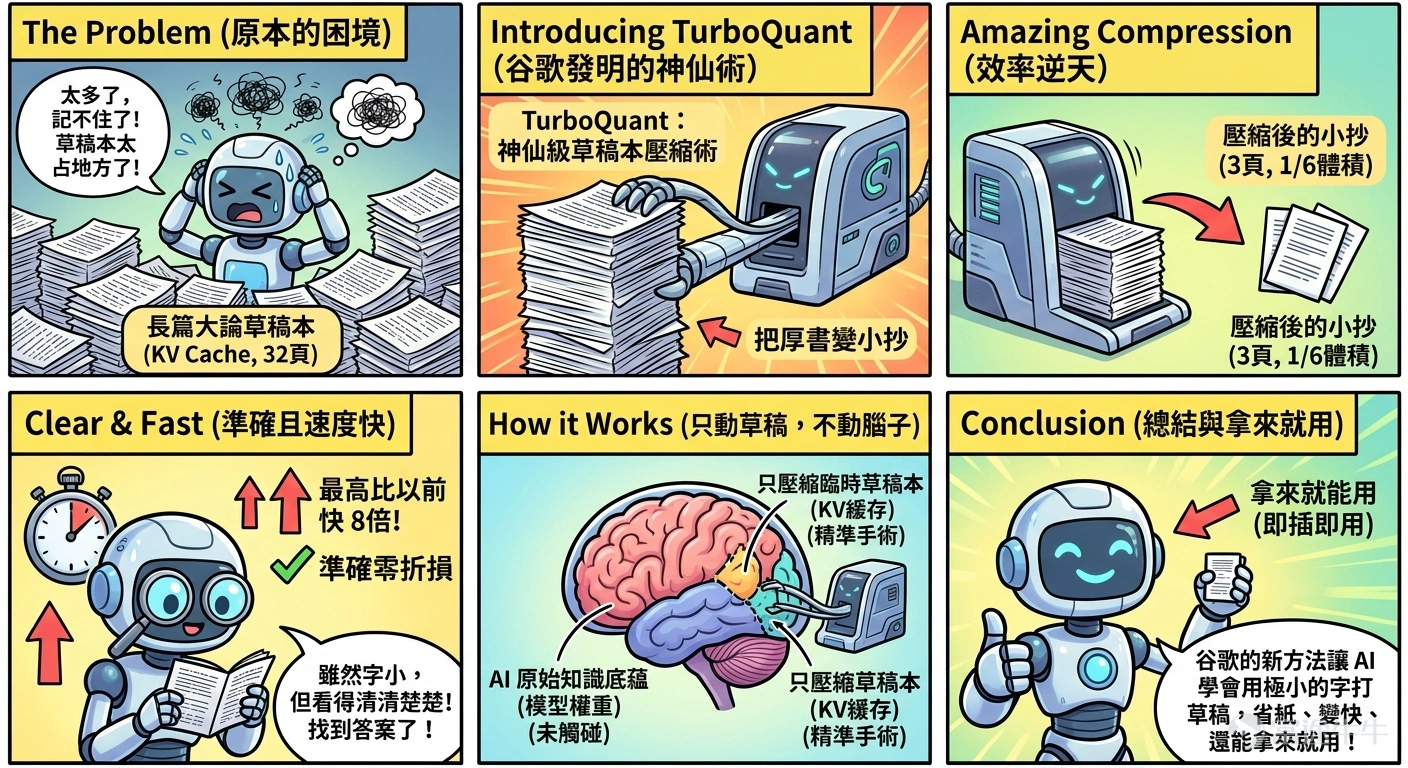
Amazing efficiency (turning thick books into cheat sheets):Previously, AI needed 32 pages to memorize one knowledge point; now, with this technology, it only needs 3 pages, reducing the thickness of the notepad sixfold. The most impressive part is that even though the text is compressed to such a small size, AI can still read it clearly without making any mistakes (zero accuracy loss). Moreover, AI's speed in flipping through this 'cheat sheet' for answers can be up to 8 times faster than before!
Only the notepad is touched, not the brain (precise surgery):This technology is very 'smart'; it only compresses that ever-growing 'temporary notepad' as you chat longer (technically called KV cache). It absolutely does not interfere with the foundational knowledge stored in the AI's 'brain' (model weights) or disrupt its initial learning process (training).
Ready-to-use (zero threshold):The best part is that you don't need to send the AI back to school for retraining to teach it how to use this new notepad. It’s like buying a new phone case—just slip it on and it works immediately (plug-and-play), extremely convenient.
To put it simply: Google has invented a new method that allows AI to suddenly learn how to draft using extremely small characters, saving more than half the paper, increasing problem-solving speed, and is ready to use right away.
Debunking the myth: Will hardware demand really plummet?
In response to market panic, Morgan Stanley provided a clear stance:This does not mean a sixfold reduction in storage or overall hardware demand, but rather a significant increase in the throughput of individual GPUs.
Jevons Paradox Effect:The report points out that in the long term, efficiency gains often stimulate an increase in overall demand.
From 'saving money' to 'spending wisely':Cloud giants are highly likely to reinvest these efficiency dividends into running larger models/longer context windows, handling higher query volumes, and improving latency service-level agreements (SLAs).
Conclusion: This means that efficiency improvements will unlock more AI application scenarios that were previously restricted by cost. The technology reshapes the cost curve for AI deployment, and its long-term impact on computing power and memory hardware is not bearish but instead shows a 'neutral to positive' signal.
Market Impact Deep Dive: Industry Winners and Losers
Morgan Stanley believes that the emergence of TurboQuant is comparable to 'another DeepSeek moment,' reshaping the cost curve for AI deployment.
1. The Biggest Winners - Cloud Service Giants and Large Model Platforms
This group is the first to benefit from the technological dividend, with a cliff-like drop in inference costs directly translating into improved profit margins.
$Alphabet-C (GOOG.US)$ :As the inventor of TurboQuant, it directly benefits from the efficiency improvement of its own cloud service (GCP), reduced AI search costs, and enhanced influence in the open-source model ecosystem.
$Microsoft (MSFT.US)$& $Amazon (AMZN.US)$: The world's largest cloud infrastructure providers (Azure, AWS). A reduction in large model inference costs means they can serve more customers with the same computing power clusters, achieving higher cloud leasing ROI.
$Meta Platforms (META.US)$: The leader in open-source large models. Lower inference barriers will help Llama models gain broader adoption in enterprise settings, further expanding its AI ecosystem footprint.
2. New Growth Pole - Edge Computing and Terminal AI
This sector has long been constrained by the 'memory bottleneck,' preventing large models from being perfectly implemented. TurboQuant makes models 'lighter,' which will greatly stimulate the explosion of edge-side devices.
$Apple (AAPL.US)$: Limited memory capacity has always been a pain point for Apple Intelligence's full rollout on the iPhone. Such extreme compression technology is a significant underlying benefit for Apple's edge AI strategy.
$Qualcomm (QCOM.US)$& $Arm Holdings (ARM.US)$: A core supplier of terminal device (smartphones, AI PCs) computing architectures and chips. When AI can run smoothly on-device with low power consumption, it will directly trigger an upgrade wave for AI PCs and AI smartphones.
3. Hardware and memory manufacturers (short-term neutral, long-term positive)
Although the market experienced panic selling at first, 'Jevons Paradox' suggests that efficiency improvements will trigger an explosion in total demand.
Core of computing power: $NVIDIA (NVDA.US)$/ $Advanced Micro Devices (AMD.US)$,TurboQuant achieved up to 8 times speed improvement on NVIDIA H100 GPUs. Efficiency dividends will be reinvested by cloud providers into larger models and longer contexts, ensuring that overall GPU demand is not weakened.
Memory giants: $Micron Technology (MU.US)$ / $CSOP SK Hynix Daily (2x) Leveraged Product (07709.HK)$ / $CSOP Samsung Electronics Daily (2x) Leveraged Product (07747.HK)$,The core of memory in the AI infrastructure supply chain. Although memory usage per task may decrease in the short term, the comprehensive adoption of AI applications and larger-scale concurrent processing will continue to drive the fundamentals of HBM (High Bandwidth Memory) and high-density DRAM in the long run.
4. Potential losers - Software middle layer
This sector mainly includes companies providing MLOps (Machine Learning Operations) and AI infrastructure optimization.
Database service providers: $Snowflake (SNOW.US)$ Because this underlying compression technology can be directly embedded into platform infrastructure. This means that third-party software companies which previously relied solely on providing 'model compression,' 'inference acceleration,' or 'external cache optimization' for profit may see their technical barriers and pricing power squeezed by cloud giants integrating these technologies for free.
Summary
In summary, TurboQuant does not disprove the boom in AI hardware but instead significantly reduces inference costs, accelerating application implementation.Although short-term technological breakthroughs may cause valuation fluctuations in the storage sector, based on the 'Jevons Paradox,' the ultimate extreme improvement in efficiency will eventually generate even greater overall computing power and memory demand.
Risk Disclaimer: The above content only represents the author's view. It does not represent any position or investment advice of Futu. Futu makes no representation or warranty.Read more


Comments (52)
to post a comment
175
1202