US-Iran tensions flare up again: How will Strait risks impact assets?

Middle East tensions trigger deviation in US bond pricing, market trading gripped by panic
The ongoing escalation of Middle East geopolitical tensions has caused a noticeable deviation in the pricing of US bonds, with market investors gripped by fear and anxiety.
Previously, we tracked how the Middle East conflict is prompting a repricing of global monetary policies, and currently, the market sentiment leans toward panic: equities have already retreated, while the 10-year US Treasury yield has been pushed to a high level in the fixed income market.
As of March 24, 2026, the yield on the US 10-year Treasury closed at 4.38%-4.39%. According to a CreditSights research report, the current price of US Treasuries is higher than the model-estimated fair value, with a residual of 44 basis points, approaching historical extreme levels and representing the second-highest record since 2007. Whether observed monthly or annually, the rise in yields has significantly outpaced the model's input parameters, indicating that this rally has been primarily driven by expectations for front-end interest rates.
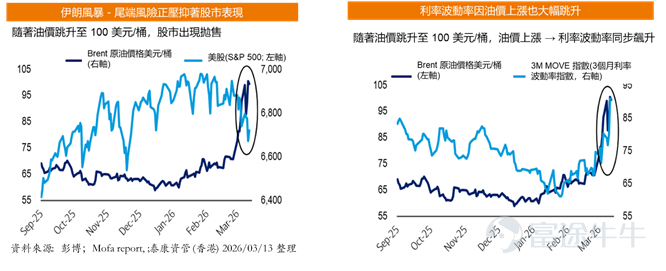
Moreover, since the outbreak of the conflict, crude oil prices have risen by about 40%, and the MOVE index, a bond market volatility indicator, has also jumped by approximately 40% (see chart below). At the same time, traders have begun pricing in the possibility of a small rate hike this year. These phenomena reflect heightened market concerns about inflation persistence and energy supply chain disruptions. Even though the dramatic shift 'from rate cuts to rate hikes' has not fully materialized yet, a reversal in investor sentiment is clearly visible.

Investment Strategy: Focus on short-term bonds as a core defensive position while keeping an eye on potential recovery in long-term bonds
This deviation in US Treasury pricing aligns with our previous analysis regarding high oil prices and the repricing of inflation, primarily stemming from stickier short-term inflation expectations and the market’s repricing of short-term risks. We see that rising long-term yields have created valuation repair potential for some long-duration bonds to return to fair value; however, given the current environment of elevated geopolitical uncertainty,
we recommend investors use short-term bonds as a safe haven and risk buffer in their portfolios. This approach helps manage interest rate volatility risks while allowing them to observe further clarity around future rate cut paths before making opportunistic allocations.
– Prioritize holding short-term bonds with higher coupon strategies: Considering that the path of rate cuts in the second half of 2026 may be affected by developments in the conflict and the post-war reorganization of the Middle East order, prioritizing the allocation of short-duration bonds can effectively secure relatively stable coupons while significantly reducing price risks caused by long-end interest rate fluctuations.
– Until information becomes fully clear, maintain a 'hold short and wait for changes' framework: Using short-bond strategies as the primary risk buffer will help manage interest rate volatility risks; simultaneously, we continue to monitor changes in long-term yields, awaiting clearer signals of easing geopolitical risks and weakening labor markets.
Disclaimer
Unless otherwise stated, all information contained in this document is current as of the publication date.
The above content is for reference purposes only and is intended for general review by clients of Taikang Asset Management (Hong Kong) Limited ('Taikang Hong Kong'). It does not consider any specific investment objectives, financial situation, or particular needs of any specific recipient and should not be considered as advice or an offer or solicitation to buy any investment products.
Any research or analysis used in the preparation of this document was acquired by Taikang Hong Kong for its own use and purposes, and is sourced from what is considered reliable as of the date of this document. However, no representation or warranty is made regarding the accuracy or completeness of information originating from third parties.
Any forecasts or other forward-looking statements regarding future events or performance may not be indicative and could differ from actual events or results. Any opinions, estimates, or predictions may be changed at any time without prior notice. Taikang Hong Kong shall not be liable for any losses arising from the use of this document.
The views, recommendations, advice, and opinions expressed in this document do not necessarily reflect the position of Taikang Hong Kong and may be changed at any time without notice. Taikang Hong Kong has no obligation to provide updates on any related information or opinions.
This document may not be reproduced, distributed, or transmitted to anyone without the prior written approval of Taikang Hong Kong. This document and the information contained herein may not be distributed or published in any jurisdiction where such distribution or publication is prohibited. If you are not the intended recipient of this document, please refrain from reading it further and destroy it immediately.
Investment involves risks. Past performance is not indicative of future results.
This document is issued by Taikang Hong Kong and has not been reviewed by the Securities and Futures Commission. You should consult your investment advisor before making any investment decision.
Risk Disclaimer: The above content only represents the author's view. It does not represent any position or investment advice of Futu. Futu makes no representation or warranty.Read more

Comment (1)
to post a comment
1