
Mediators have proposed a 10-day ceasefire—will the U.S. and Iran enter a 'cooling-off period'?

Geopolitical storm sweeps Wall Street! Is the S&P 500 breakout a golden opportunity or an abyss? Focus on these three key signals this week.
As the Middle East conflict escalates, international oil prices have surged over 40% in just a few weeks. This sudden geopolitical storm is triggering a strong domino effect on Wall Street: markets are increasingly concerned that inflation may resurface, potentially forcing the Fed to delay rate cuts or even hit the rate hike button again.
Against this macro backdrop, the suppressive impact of high interest rates has become fully apparent.Global capital is rapidly switching from 'offensive mode' to 'defensive mode.'
High pressure on the denominator: US Treasury yields approach the 'red line.'
In asset pricing models, the risk-free rate is the core 'denominator' that determines valuation. Currently, this yardstick that decides the fate of global assets is climbing rapidly, with bond market dynamics even influencing the duration of geopolitical conflicts.
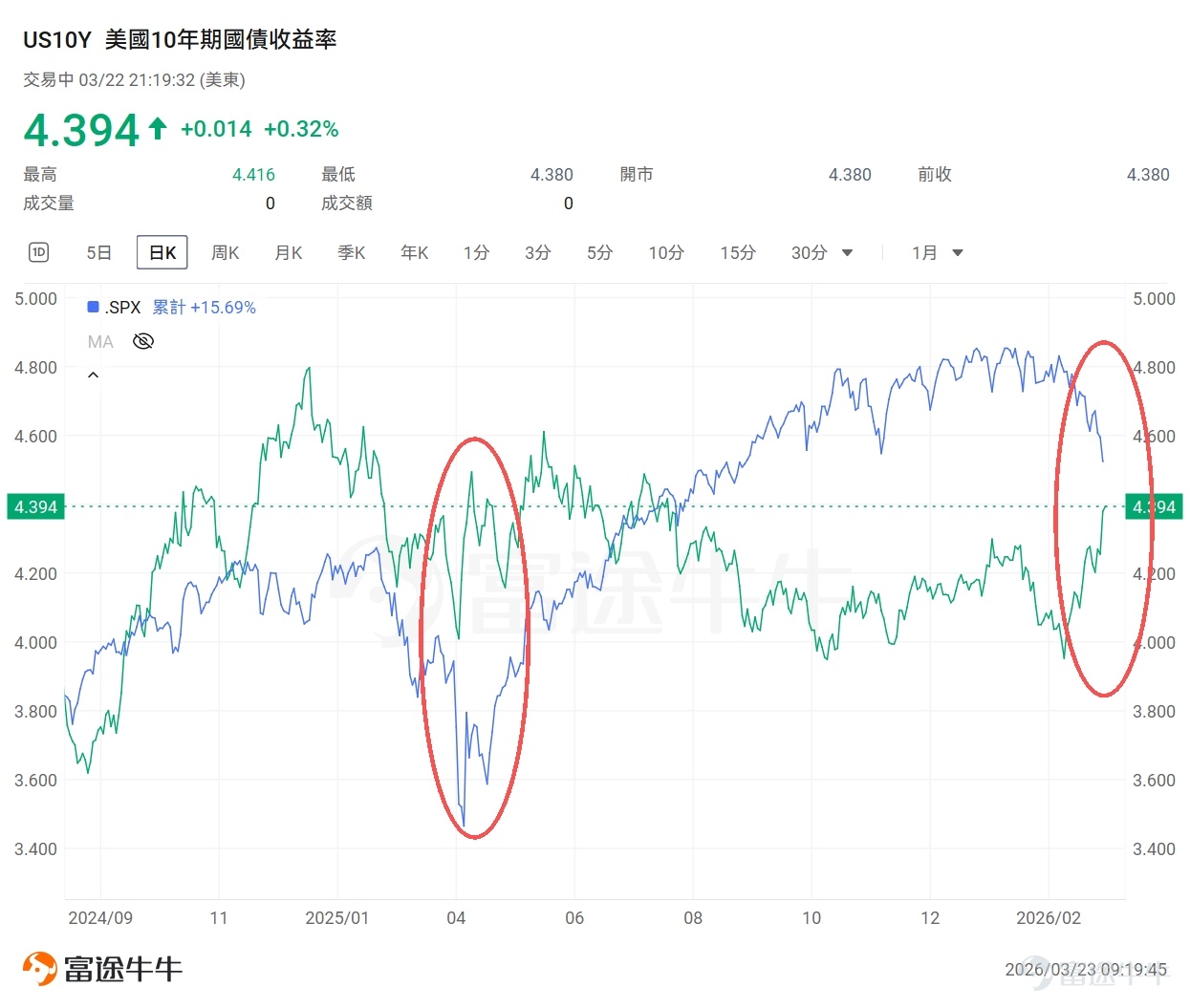
Long-term rates approaching the critical line:Since the outbreak of war on February 28, $U.S. 10-Year Treasury Notes Yield (US10Y.BD)$ it has risen by about 45 basis points. This aligns with the rapid surge trend seen around April 2025's 'Liberation Day.' Wall Street widely believes thatThe range of 4.50% to 4.60% will once again become an insurmountable 'red line'.The U.S. economy cannot withstand a 10-year Treasury yield reaching 5%.

Short-end rates break through the upper limit: Last week, the more policy-sensitive $U.S. 2-Year Treasury Notes Yield (US2Y.BD)$ broke through 3.75% — piercing the upper limit of the Federal Reserve’s current target range for the federal funds rate. As of last Friday's close, this maturity's Treasury yield settled at approximately 3.9% — the highest closing level since July of last year.

However, CICC's weekend research report also noted that the market no longer expects the Fed to cut interest rates. Put another way,this implies expectations that the conflict could persist into the third and fourth quarters with oil prices staying above $100. Unless this happens, there is still room for rate cuts, underscoring the pessimistic outlook in the bond market.On the contrary, the equity market should not have priced in this expectation, and may still be anticipating Trump's Taco under the pressure of the midterm elections, which could also explain the volatility in the US stock market and the AH growth sector last week.In other words, as long as we don't expect the conflict to remain unresolved in the third and fourth quarters, the expectations priced into bonds and gold are already overly pessimistic.
Overall, global capital is sensing signals of danger, with defensive strategies becoming the preferred choice at present.
The S&P 500 breaking below the 200-day moving average: Is it panic or a mispricing?
The sharp rise in the denominator directly transmitted to the stock market. Last week, it broke through the 200-day moving average, considered the 'bull-bear dividing line.'
On Wall Street, the 200-day moving average is a crucial risk control lifeline for numerous quantitative strategies, trend-following funds, and large institutional accounts. Once breached, a significant amount of algorithmic trading triggers liquidations, automatically shifting funds to a more conservative mode, exacerbating short-term market pain.
But beneath this layer of gloom,Mid-to-long term perspectives still reveal optimistic signals.
According to historical data from MarketWatch, when the S&P 500 index has stabilized above the 200-day moving average over the long term, and then suddenly falls back below due to unexpected negative news (similar to our current market situation), the market often hits a 'golden pit' amid panic.Data shows that, following such patterns, the median stock market return after 12 months reached 10%, with a success rate of up to 70% for gains.

This means that short-term technical breakdowns could be the result of extreme emotional and quantitative fund releases, but the core upward logic of the market has not been completely destroyed.
Looking ahead to this week: Keep a close eye on these 'three major events' and critical blind spots.
As the conflict enters its fourth week, the situation in the Middle East and its resulting energy inflation ripple effects remain a core focus for Wall Street.Can the global economy withstand this wave of shocks? This week's 'three major events' will provide initial answers:
1. The first 'health check report' on the global economy:This week will see the release of the first batch of key economic data following the outbreak of hostilities. The latest business surveys (such as PMI) from the US to the Eurozone will be released one after another.This is the first collective 'health check' on the global economy’s resilience, and the market will use it to assess whether the spike in energy prices has substantively caused an economic growth slowdown.

2. The Federal Reserve's 'crisis guidance':After last week’s decision to keep interest rates unchanged, Federal Reserve officials will make密集 statements this week. Investors need to analyze their comments word by word to explore how the Fed internally evaluates the 'economic consequences of the Iran war,' and where their tolerance底线 for inflation反弹 lies.

3. The '24-hour countdown' for geopolitical developments:On March 21 local time, US President Trump demanded that Iran fully open the Strait of Hormuz within 48 hours, otherwise the US would strike and destroy various power plants within Iran, 'starting with the largest one.'
As of pre-market today,Trump stated that the US and Iran held good and productive talks, and the military strike against Iran has been postponed.However,Iran denied having any direct or indirect communication with the US,The Office of the Israeli Prime Minister also did not comment on Trump’s statement.
Therefore, it is necessary to closely monitor the attitudes of both sides.Whether oil prices stabilize or further spiral out of control will be revealed in the coming days.
However,Goldman Sachs warned: The core variable at the heart of this epic crisis is no longer the firepower unleashed by the US military, but rather the navigation schedule of the Strait of Hormuz.
The impact of the energy shock on the global macroeconomy is becoming evident. Joseph Briggs, senior global economist at Goldman Sachs, proposed a key 'rule of thumb': For every 10% increase in oil prices, global GDP will fall by more than 0.1%, overall global inflation will rise by 0.2 percentage points (with some Asian countries and Europe being hit harder), and core inflation will rise by 0.03-0.06 percentage points.
As Goldman Sachs strategists pointed out incisively:The most fatal vulnerability in the current global market pricing structure lies in the fact that the market has completely failed to account for the risk of 'downside growth.'
Summary: Extreme tug-of-war under the shadow of stagflation
The global capital market is currently in a period of intense collision between geopolitics and macroeconomics. The surge in oil prices triggered by Middle East conflicts has reignited expectations of 'inflation resurgence' on Wall Street, prompting funds to quickly switch to defensive mode.
In the short term, the market will repeatedly fluctuate between 'panic over technical breakdowns' and 'optimism based on historical data'; but the real deciding factor lies in whether this oil shock will substantially drag the global economy into the quagmire of 'stagflation (stagnant growth + high inflation).' This week, it may be wise to observe more and act less, allowing the above three signals to guide the direction of the upcoming market trends.
Risk Disclaimer: The above content only represents the author's view. It does not represent any position or investment advice of Futu. Futu makes no representation or warranty.Read more


Comment (1)
to post a comment
41
58