
Pop Mart plans to launch new products! Can the IP giant capitalize on this opportunity?

Earnings Options Strategy | Pop Mart to release results on Wednesday! Focus on Q4 North American growth and guidance in the 'post-Labubu era'
$POP MART (09992.HK)$ Scheduled to announce Q4 and full-year 2025 earnings after the Hong Kong stock market closes on March 25 (this Wednesday).According to Wind consensus estimates, the total revenue for 2025 is projected at 37.9903 billion yuan, representing a year-on-year increase of 191.39%, with earnings per share at 9.4395 yuan.
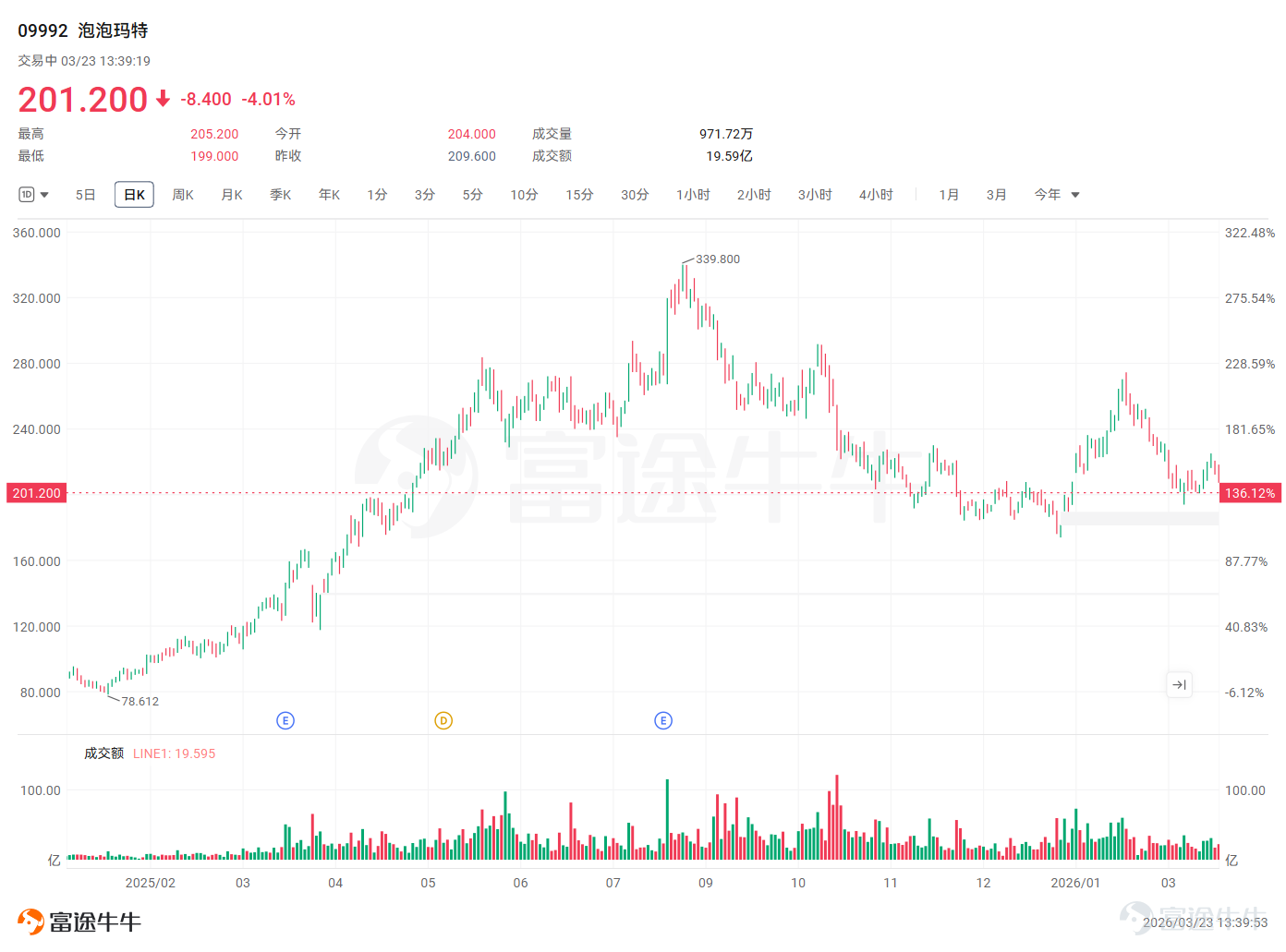
As one of the most talked-about consumer stocks in the Hong Kong market over the past two years, Pop Mart's share price has experienced significant volatility in the past six months—plummeting nearly 40% from its historical high in September 2025, rebounding by over 40% cumulatively by early 2026 after hitting bottom, and then hovering between 200-220 Hong Kong dollars since March.
Ahead of the earnings release, the market had already formed relatively full expectations regarding Pop Mart’s full-year performance for 2025.The focus was on three key areas: the real growth quality of overseas markets (especially North America), diversified revenue streams beyond the core IP Labubu, and management's guidance for 2026. In light of these results, what options strategies might be worth considering deploying?

Pop Mart December slowdown in North America? Institutions divided on Q4 growth; Morgan Stanley says it's noise
In December 2025, concerns arose as YipitData showed Pop Mart's North American sales fell by 25%-30% quarter-on-quarter and annual growth sharply dropped to 424%. In response, Morgan Stanley's January research report noted that this data did not cover offline stores, robot shops, or non-credit card channels like pre-sales, leading to systemic underestimation of sales. The bank estimated North American full-year sales at approximately 7.1 billion yuan, with Q4 figures roughly flat compared to Q3; subsequent quarterly growth naturally slowed due to high base effects from earlier quarters, rather than collapsing demand.
Regarding Pop Mart’s full-year 2025 performance, according to Wind data, institutional forecasts for revenue ranged between 30 billion and 43.5 billion yuan, with gross margins remaining at a high of 63%-67%. Disagreements mainly centered around Q4 growth projections. JPMorgan anticipated Q4 year-on-year growth of 184%, driven by capacity expansion and holiday demand. Bank of America Securities, optimistic about new product drivers, raised its earnings forecast by 14%. Bernstein, however, predicted weaker-than-expected results based on deteriorating high-frequency data.
Looking ahead to 2026, institutional expectations are notably divergent. Optimists project revenue growth of 30%-40% or even higher, with Morgan Stanley's optimistic scenario projecting up to 60 billion yuan. Cautious analysts expect growth to slow to around 20% amid high base effects. HSBC and UBS view 2026 as a “re-basing year,” predicting growth rates between 23%-30%.
The 'Post-Labubu Era': Focus on New IP Succession and Latest Guidance
Pop Mart faces the core issue of excessive reliance on the single IP Labubu. In 2024, THE MONSTERS series' revenue surged by 726.6% year-on-year, accounting for 23.3%. By the first half of 2025, THE MONSTERS series revenue further climbed to 4.8 billion yuan, representing 34.7% of total revenue and becoming Pop Mart’s largest contributor.
Labubu's popularity has significantly declined in the second half of 2025, with premiums on second-hand hidden editions shrinking by over 50%, and some models falling close to their original price. Bernstein previously reported that Q3 pre-sales had already exhausted Q4 demand, and the company actively limited orders. The market is concerned whether other IPs can pick up the slack to sustain growth if Labubu’s popularity continues to wane.
The official full-year sales data for 2025 released in February provided a preliminary answer: global total sales exceeded 400 million units, with THE MONSTERS surpassing 100 million. Several classic IPs (such as MOLLY, SKULLPANDA, etc.) also broke the 100 million mark, with 13 IP series achieving annual sales of over 100 million. The new IP 'Starman' showed strong initial performance, and Morgan Stanley predicts its China revenue in 2026 could reach over 50% of Labubu's; overseas attention on IPs like Hirono continues to rise, showing differentiation in regional IP preferences.
In terms of category structure, Pop Mart is accelerating its move away from blind boxes. In the first half of 2025, plush toys replaced blind boxes as the top category, generating revenue of 6.14 billion yuan, representing year-on-year growth of 1276% and accounting for 44.2% of revenue, while blind box figurines dropped to 37.3%.
This Wednesday's earnings report will also provide further insight into non-Labubu IP revenue breakdown and growth, changes in the proportion of plush categories in the second half of the year, income structure across overseas regions (Americas/Europe/Asia-Pacific), and 2026 revenue and store expansion guidance.
Technical analysis and options strategy
After experiencing a significant decline recently, Pop Mart has entered a technically oversold zone. Multiple oscillators are signaling 'oversold' or 'severely oversold' conditions, indicating that short-term downward momentum may be weakening. Technically, there is strong potential for a rebound, suggesting a technical recovery need, but major trend indicators suggest the stock is more likely in a weak consolidation phase.
In terms of short-term support and resistance levels, the previous high around HKD 194 forms a support zone below. Resistance above is layered, with rebounds facing a severe test in the HKD 215-230 range.

1. Bullish or stock-enhancing strategies
– Sell call options / Write covered calls: Covered Call
If investors hold the underlying stock and believe that the share price will not surge in the short term but are optimistic in the long run, they may consider opening a covered call position.
– In the event of a sharp rise in stock price: Although the excess return from the underlying stock's increase will be capped by the exercise price, investors can achieve dual profits through “gains from the underlying stock's price difference + full premium.” This is equivalent to locking in some profits in advance during the upward movement and reducing the holding cost.Investors need to be wary of being forced to sell their underlying stocks after a large increase when the options are exercised.
– If the stock price moves sideways or slightly declines: The value of the underlying stock remains unchanged or experiences minor shrinkage, but the premium collected from selling the option provides additional cash flow cushioning, effectively enhancing overall portfolio returns and acting as a “safety net.”
The profit and loss characteristics of this strategy upon expiration can be referenced in the chart below (showing only the profit and loss of the options portion, excluding profits or losses from previously held stock positions). This is for educational purposes only and does not constitute any investment advice:

– Sell Put Option / Short Put
Investors who do not currently hold positions but see long-term value can also deploy by selling out-of-the-money or at-the-money (below or equal to the current price) put options (Put).
– If the stock price continues to rise or moves sideways: The option expires worthless, and investors earn the premium for free, gaining risk-free cash income.
– If the stock price falls: Investors will be forced to buy the underlying stock at the agreed-upon strike price. Since the strike price is typically lower than the current market price, this effectively achieves the intention of “buying the dip at a discount.” Even if exercised, the actual holding cost after including the premium income will be lower than buying directly at the market price.
– Core advantage: Converts “passively waiting for a decline” into “actively collecting premiums while waiting to buy,” offering both offensive (earning premiums) and defensive (acquiring shares at low prices) benefits.
The profit and loss characteristics of this strategy upon expiration can be referenced in the chart below (showing only the profit and loss of the options portion, excluding profits or losses from previously held stock positions). This is for educational purposes only and does not constitute any investment advice:

2. Bearish or Risk Hedging Strategies
Investors holding the underlying stock who are concerned about a significant pullback in the future and wish to protect existing profits or limit losses may consider buying put options (Long Put).
– If the stock price plunges: The main stock account will face massive unrealized losses, but the value of the purchased put options will surge sharply due to the drop in stock price. The profits from the options can offset the losses in the main stock, thereby locking in the maximum loss amount.
– If the stock price rises: The main stock enjoys all the gains from the increase, with only a limited loss of premium (i.e., “insurance premium”), just like buying fire insurance for a house— if no fire occurs, you only lose the premium, but the appreciation of the house still belongs to you.
The profit and loss characteristics of this strategy upon expiration can be referenced in the chart below (showing only the profit and loss of the options portion, excluding profits or losses from previously held stock positions). This is for educational purposes only and does not constitute any investment advice:

3. Expected future volatility / Volatility trading strategy
If investors predict that the stock price will oscillate repeatedly within a certain range without significant one-sided surges or drops, and the current implied volatility (IV) is at a high level or in an upward trend, they may consider selling options on both sides (Short Strangle/Straddle).

– This strategy does not bet on direction but rather on “no significant volatility.” As long as the stock price after earnings falls between the two strike prices, both options will expire worthless, allowing investors to collect double premiums.
– Combined with a high IV environment: The current implied volatility (IV) in the market continues to rise, indicating that option prices are generally expensive. Selling options at this time is equivalent to “selling insurance at a high price.” Once the market returns to calm, the decline in IV coupled with the passage of time value will create a significant “Davis Double Play” effect.
– Risk: This strategy follows a “picking up coins” model, with limited gains but theoretically unlimited risk.In the event of extreme one-sided market movements, it is necessary to cut losses promptly or perform dynamic hedging (for example, by purchasing more distant options for protection).
The profit and loss characteristics of this strategy upon expiration can be referenced in the chart below (showing only the profit and loss of the options portion, excluding profits or losses from previously held stock positions). This is for educational purposes only and does not constitute any investment advice:

If you want more inspiration on options strategies, you can easily access it through the mobile app or the new desktop version by following the path below!
That’s all for today. WelcomeClick hereJoin the learning. If you have specific content suggestions, you are also highly encouraged to share them!
Finally, here's a small bonus for fellow investors. Fellow investors are welcome to claim it.Options Beginner Pack
Risk Disclaimer: The above content only represents the author's view. It does not represent any position or investment advice of Futu. Futu makes no representation or warranty.Read more


Comments (2)
to post a comment
9
32