
Verified from Podcast perspective: Hang Seng Index rebounds weakly, technical indicators confirm downtrend
As of March 23, 2026, the Hang Seng Index closed at 24,272 points, down 3.98%, with a turnover of 307.6 billion yuan. The market was active but selling pressure was heavy. From a technical structure perspective, the index has been falling continuously after peaking at 28,056 points and has broken below all major moving averages. Short-term moving averages MA10 and MA30 are located at 25,602.59 points and 26,156.03 points respectively, forming significant resistance, while MA60 is at 26,370.10 points, further confirming the weakening mid-term trend. In terms of market news, tech stocks, financial stocks, and resource stocks in Hong Kong were generally under pressure today (March 23). Weighted stocks such as Tencent and Alibaba saw significant declines, and insurance and banking stocks also performed weakly, exacerbating the index's decline. Southbound funds recorded net buying against the trend today but failed to reverse the overall market sentiment.
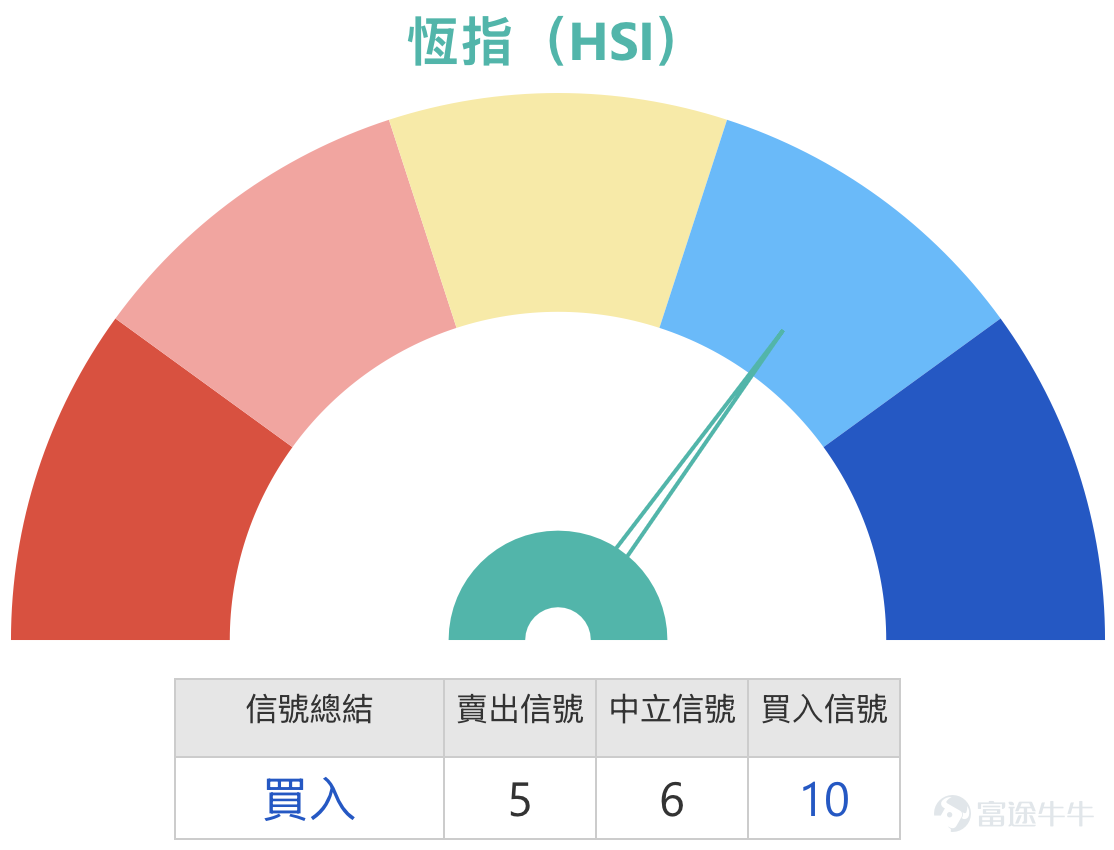
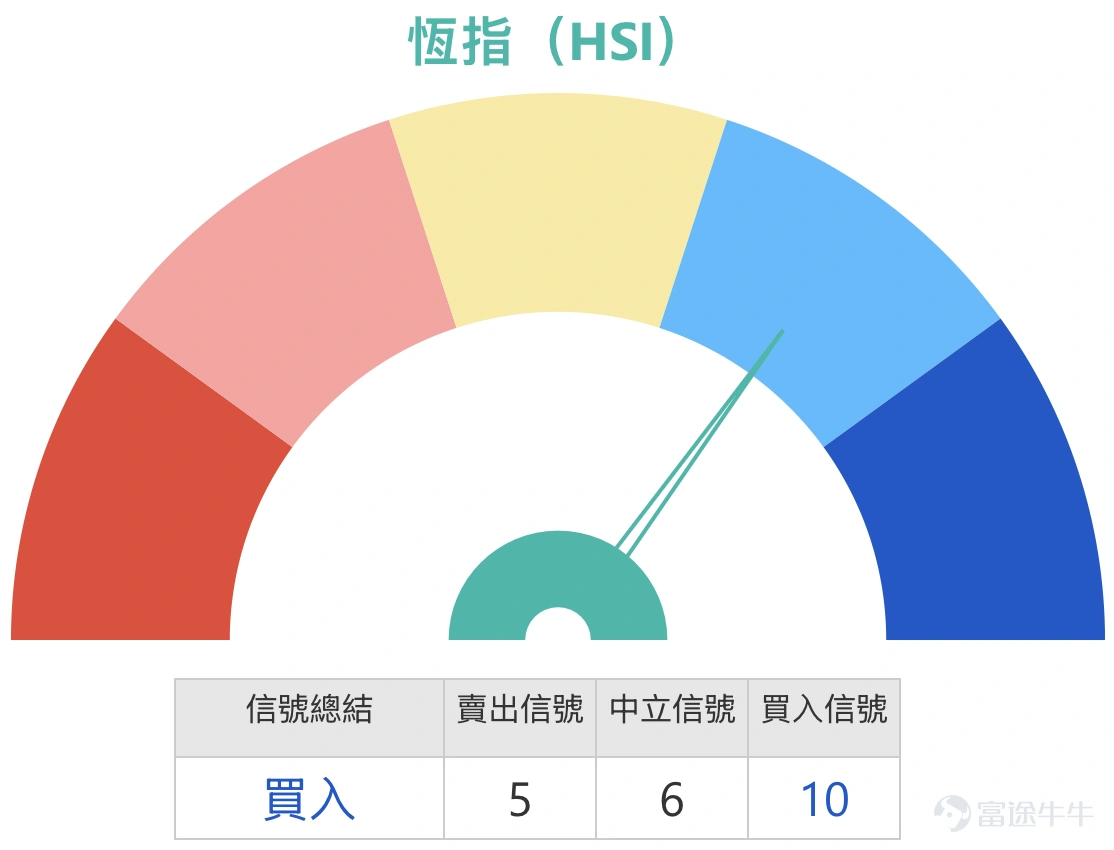
Based on multiple technical indicators, the system issued a 'Buy' signal with an intensity of 10. However, several oscillation indicators such as the Williams %R and Stochastic Oscillator show that the index is in an 'oversold condition,' while the CCI indicator issued a 'Buy' signal, indicating potential short-term rebound needs after a sharp decline. Nevertheless, MACD signals and Bollinger Bands both indicate 'Sell,' showing the overall structure remains weak. According to technical analysis data, short-term support levels are at 24,042 points and 23,330 points, while resistance levels are located at 25,347 points and 26,454 points. The probability of an upward move is 54%, with a 5-day volatility of 7.5%, reflecting significantly increased market volatility.
Integrating the March 20 [Hong Kong Stock Podcast] perspective, the program clearly stated that the Hang Seng Index closed at 25,277 points, in a weak recovery phase after retreating from its peak, with the rebound process failing to break through the overhead moving average pressure, facing repeated resistance near 25,800 points. The program analysis suggests that a preliminary support zone has formed between 24,900 and 25,200 points, while the first noticeable resistance above is at 25,800 points, followed by 26,300 points, which is a dense moving average area. If unable to break through, the overall trend will remain weak. Currently, the index has fallen below the preliminary support zone mentioned in the program, further testing more critical support at 24,042 points and 23,330 points, validating the program’s judgment of a 'weak pattern' and 'limited support.'
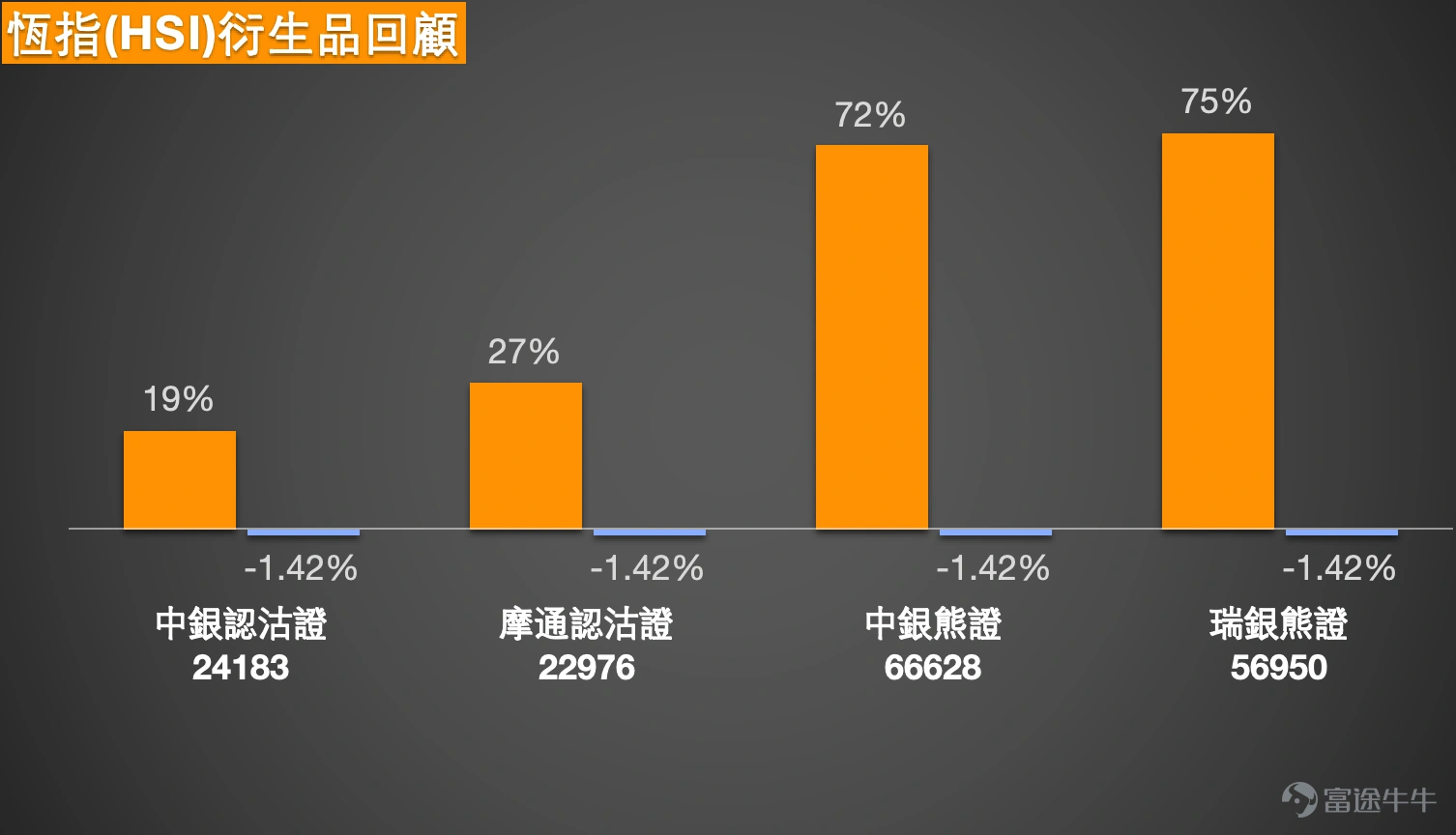
Reviewing the performance of the warrant market, according to the product review on March 17, the four products mentioned recorded significant increases over the following two days (as of March 19), successfully capturing the downward movement of the underlying stocks. UBS Group bear certificate (56950) surged by 75%, standing out; Bank of ** certificate (66628) also rose by 72%; Morgan Stanley put warrants (22976) and Bank of China put warrants (24183) recorded increases of 27% and 19%, respectively.
Based on technical analysis, market environment, and Podcast perspectives, the Hang Seng Index is in a weak short-term position, currently testing the support level at 24,042 points. Investors who believe the index can stabilize at this level and rebound may consider deploying bull certificates or call warrants; if expecting the index to further test support at 23,330 points, bear certificates or put warrants could be considered. Below are analyses of several clear warrant and bull/bear certificate products, whose strike prices and stop-loss levels closely relate to technical support and resistance:
For bullish strategies, consider Morgan Stanley call warrants (22978) and BNP Paribas call warrants (23939). Both have an exercise price of 26,600 points, higher than the second resistance level of 26,454 points, classified as out-of-the-money structures. The advantage of Morgan Stanley call warrants (22978) lies in having the highest leverage (17.4 times) and low implied volatility; BNP Paribas call warrants (23939) stand out with the lowest premium and implied volatility, suitable for investors anticipating the index breaking through resistance and returning to the 26,000-point threshold. For positions close to support, consider bull certificates with stop-loss around 24,000 points, such as Bank of China bull certificate (57739) and UBS Group bull certificate (57329). Their stop-loss levels are at 24,018 points and 24,028 points, respectively, slightly above the first support level of 24,042 points, making them aggressive deployments. The advantage of Bank of China bull certificate (57739) lies in relatively high leverage (45.2 times); UBS Group bull certificate (57329) offers a similarly high leverage option (48.9 times). Both have stop-loss levels close to the support area, providing high leverage effects if the index stabilizes, but note the stop-loss risk.
For bearish strategies, investors may consider BOC put warrants (24183) and JPMorgan put warrants (22976). The strike prices are 23,482 points and 23,400 points respectively, both below the first support level of 24,042 points, making them slightly out-of-the-money structures. The advantage of BOC put warrants (24183) is their relatively lower implied volatility, while JPMorgan put warrants (22976) offer the lowest premium with higher leverage (11.6x), suitable for investors expecting the index to test the second support at 23,330 points. For bear contracts, one may consider BOC bear contracts (61183) and BOC bear contracts (60639), with stop-loss levels of 25,979 points and 25,840 points respectively, both above the first resistance level of 25,347 points, providing a larger margin of safety. Both have the advantage of relatively high leverage, with BOC bear contract (60639) offering 16x leverage and BOC bear contract (61183) offering 14.2x leverage, ideal for bearish trend-following strategies.

Overall, the Hang Seng Index (HSI) is at a critical juncture in testing support in the short term. Investors should use 24,042 points as the short-term bullish-bearish dividing line. A breakdown below this level would target 23,330 points, while holding steady could lead to a rebound challenging the resistance at 25,347 points. When selecting derivative products, investors should balance leverage with the distance to stop-loss/strike prices based on their outlook for market direction and momentum, while also paying attention to the distribution of bull and bear contracts, which indicate potential trigger points.
Interactive Questions
Do you think the HSI can hold above the 24,000-point level in the short term?
A. Yes, oversold technical conditions could lead to a rebound
B. No, the downward trend remains intact, and it will test lower levels.
Feel free to leave your thoughts in the comments section and follow Jenny's HK Stock Warrants for more professional insights.
Reminder: This article does not constitute any investment advice. It is for reference only and does not constitute any investment advice. Market data, opinions, and analyses contained herein may change at any time without prior notice. We are not responsible for any loss or damage caused by reliance on the information in this article. Technical analysis only indicates whether certain technical conditions are met and should be used alongside other information to comprehensively assess asset performance; trading decisions should not be made solely based on this article. Please note that past performance is not indicative of future results. Follow Jenny’s HK warrants for more professional insights. $Hang Seng TECH Index (800700.HK)$$Hang Seng China Enterprises Index (800100.HK)$
#恒指 #HSI #技術分析 #支持位 #阻力位 #窩輪 #牛熊證 #認購證 #認沽證 #港股窩輪Jenny
Risk Disclaimer: The above content only represents the author's view. It does not represent any position or investment advice of Futu. Futu makes no representation or warranty.Read more

Comments
to post a comment
3
12