
【有獎】曬出你的AI交易官,贏積分及限定周邊!

Market Voice Weekly Call | The Era of Quantitative Equality: In-depth Analysis of Futu's AI Quantitative System
This Week's Market Outlook (Joe Yu)
Core view: Further delay in rate cuts, geopolitical risks not yet fully priced in, adjustment in US stocks may not be over.
The March FOMC delivered a clear hawkish signal. The dot plot indicates expectations for only about 0.7 rate cuts by 2026. Powell’s stance is clear – no rate cuts unless inflation improves. Meanwhile, Trump issued a 48-hour ultimatum to Iran demanding the opening of the Strait of Hormuz, causing a sharp rise in oil prices and intensifying inflation concerns. Two major pricing themes have now been established in the global market:Higher interest rates for longer + re-pricing of geopolitical conflicts.
US stocks: Maintain cautious bearishness.The forward PE ratio of the S&P 500 is approximately 20.5 times. Historically, major oil shocks have led to a median decline of about 12% in the S&P 500. In this round, the adjustment has been only about 6%, implying further downside potential. A high-interest-rate environment suppresses the valuation expansion of growth stocks, while energy and defensive sectors continue to outperform structurally.
Hong Kong stocks: Relative resilience remains, but a rebound requires catalysts.The forward PE ratio of the Hang Seng Index is about 11.67 times, with a low starting valuation. Notable marginal changes include feedback from institutions indicating that since March, demand for Middle Eastern sovereign funds and high-net-worth clients to allocate equities and bonds via Hong Kong has significantly increased. Hong Kong stocks are gradually becoming a destination for non-US dollar funds. However, without supportive domestic policies in the short term, rebound momentum will remain limited. Defensive allocation strategies prevail -High-dividend, energy, and core state-owned assets (e.g., hydropower).
China consumption: Maintain a neutral-to-optimistic view, with a focus on the second half of the year.Real estate data for January–February remains in a contraction cycle, but the economy is decoupling from real estate — household financial assets continue to accumulate, and total market value is expected to exceed the total value of urban residential properties by 2026, gradually reducing the wealth effect's drag on consumption. The first half of the year should be viewed as a mid-term allocation window rather than a short-term trading opportunity.
Key stock tracking:
$TENCENT (00700.HK)$ : Main business growth remains steady (up 12%-14% year-on-year), forward PE at approximately 14x, with prominent mid-to-long-term allocation value, though short-term performance is suppressed by global risk sentiment
$KUAISHOU-W (01024.HK)$ (Earnings release on 3/25): The key focus is on cash flow and the scale of buybacks. If AI investment is restrained, it could become a rare low-valuation, strong cash-flow asset within the tech sector
$BYD COMPANY (01211.HK)$ (Earnings release on 3/27): Pay close attention to the expansion progress of overseas distribution networks, especially in the Philippines market
$SMIC (00981.HK)$ (Earnings release on 3/26): Need to watch for potential diversion of some advanced process orders from Huawei's semiconductor business
$Intel (INTC.US)$ The yield rate for the 18A process has improved to around 70%, reaching the internal mass production qualification level. The logic for mid-term profit contribution through scaling is gradually being established
Core focus for next week: whether the situation in Iran escalates further and how the competitive landscape evolves after Meituan releases its earnings.
Futu AI and Algo integration product sharing (Ryan Su)
Algorithmic trading (Algo) has always seemed like an exclusive tool for professional institutions—strategy models, Python code, backtesting engines, live deployment; each step seems to tell ordinary investors, "You're not qualified."
But Futu is trying to change that. In a recent Weekly Call, Ryan, General Manager of Futu’s Frontend Product Department and initiator of the Algo project, systematically shared Futu’s innovative products, practical approaches, and future plans regarding the integration of AI and Algo. The core message boils down to just one sentence:The advent of the AI Agent era has turned Algo democratization from a vision into reality.
The four-step process of traditional Algo,Ordinary people get stuck in the last three steps.
Futu summarizes traditional Algo trading into four steps:Strategy research → Code implementation → Backtesting optimization → Live trading。
The first step has no barriers—any investor who pays attention to the market may have their own trading ideas.However, starting from the second step, the lack of programming skills, insufficient backtesting tools, complex live deployment, and difficult operation monitoring—all these technical barriers stack up, keeping the vast majority of people out. This was the core insight at the start of Futu's Algo project:Many people have ideas for investment strategies, but very few know how to execute Algo trading.The gap is not a difference in investment ability, but a difference in engineering capability.
The first innovation: Building trading strategies like assembling LEGO blocks.
Futu has created a key abstraction for trading strategies: no matter how complex the strategy is, it can essentially be broken down into a combination of "conditions" and "actions." Conditions can include technical indicator triggers (such as MACD golden cross, RSI oversold), changes in fundamental data, or even the appearance of a news update. Actions encompass placing orders, closing positions, stop-losses, profit-taking, and signal alerts. Futu encapsulates these conditions and actions into visual "building blocks," allowing investors to create strategies by simply dragging and assembling without needing to write any code.
To illustrate with a basic example: creating a strategy that "buys at full position on MACD death cross and clears holdings on golden cross" involves the following process — create a visual strategy → drag in the MACD block → set golden/death cross conditions → attach buy/sell actions → complete. Backtesting is equally intuitive: click a button, select the underlying asset and time range, and the strategy replays frame by frame on the candlestick chart, clearly showing buy/sell points and final returns. Deploying the strategy in live trading requires just one click, supporting local execution or cloud hosting. The core advantage of this Lego-like building block strategy lies inreadability and comprehensibility. Investors can easily determine whether the strategy logic is correct and where adjustments are needed, without facing a screen full of hard-to-review code.
The second innovation: natural language dialogue, where AI directly generates strategies based on the building blocks. Futu further enhances its capabilities by integrating AI.
An AI entry point is available next to the strategy editor, allowing investors to describe their requirements in natural language: "Help me create a strategy that buys on MACD golden cross and sells on death cross, with a 5% stop-loss line." The AI will automatically generate the corresponding Lego-like building block strategy (it also supports generating Python-coded strategies). The Futu product team specifically recommends prioritizing the generation of building block strategies — the reason is practical: if the AI generates a Python script, investors without programming backgrounds may struggle to verify whether the code is correct or if there are logical omissions. However, a building block strategy is visual, enabling investors to inspect each block after generation and make direct additions, deletions, or modifications when issues are identified.
Futu's Algo system consists of two product lines:
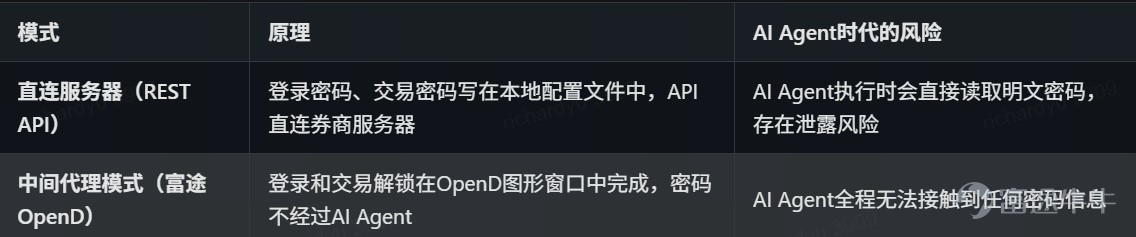
Open API (targeted at developers and AI Agent users)This is one of Futu’s earlier products, with interfaces covering core functions such as market data and trading, suitable for technically proficient investors to program and utilize independently. Note that subscribing to market data via Open API incurs an additional fee — this is a uniform requirement by exchanges for professional investors using API-based market data, collected by Futu on their behalf. In terms of technical architecture, Futu employsa middle proxy model: Users need to install a proxy application namedOpenDon their local machines. All communications are relayed through OpenD before connecting to Futu's servers. This design has demonstrated significant security advantages in the AI Agent era (details below).
Client-side Algo (for all investors)This refers to the previously introduced dual-mode product of Lego-block strategies and Python strategies, embedded within the Futubull desktop client, supporting one-click backtesting and one-click live trading (locally/cloud). Its core advantage lies insharing market data permissions with the client- Since the functionality is directly integrated into the client, Futu has reached an agreement with exchanges: this is considered a client function rather than a professional API call, thus eliminating the need to purchase additional market data permissions.
The Arrival of AI Agents: The True Inflection Point for Algo Democratization
Futu Product Manager Ryan openly admitted that the team deeply engaged withOpenClaw(Also known as "Lobster" in the industry), after adopting the latest generation of AI Agent, a judgment has been made: AI Agent has truly realized Algo equality.
What is an AI Agent? No need to overcomplicate it - Think of it as a real-life assistant who can help you perform tasks.You give it instructions, and it completes them: installing software, writing code, setting up environments, adjusting parameters, registering accounts, purchasing servers.
Futu recently releasedAISkills- essentially a set of structured work protocols that tell the AI Agent: when doing quantitative trading, call Futu's API; what interface to use for market data, what interface to use for placing orders, and what the rules are. The concept itself is not complex; it’s about setting up how the AI should 'use Futu’s tools to get the job done'.
A key issue that is easy to overlook: security
Throughout the entire presentation,Safeis a topic that Futu repeatedly emphasized. In the industry, brokers provide Open APIs through two technical approaches:

This distinction might have limited impact in traditional programming scenarios, but in the age of AI Agents, the risks are dramatically amplified. Futu’s assessment is clear: an AI Agent is essentially a third-party program that could be attacked, injected with malicious commands, or have its logic altered after passing authentication. If your login and trading passwords exist in plaintext within its execution environment, the consequences could be unimaginable.
Due to the presence of the OpenD middleware layer, Futu's security level is no different from using everyday apps. This makes Futu possiblythe only brokerage platform where AI Agents can safely execute live trading.。
Future Plans: From Tools to Infrastructure – Futu’s disclosed future plans span three levels:
(1.) Full expansion of Open API capabilities (expected to be completed within two months). Futu will engage in closed development of the Open API, aiming to cover the most comprehensive range of capabilities across the industry: expanding tradable products to include Crypto, options, and multi-leg strategies; covering financial data, stock screeners, short-selling analysis, and valuation metrics at the data level. The ultimate goal isto open up all functions within the app via APIs.This introduces a new possibility: investors can use AI Agents + Futu Open API without writing a single line of code,to build a fully customized investment tool of their own,— choosing what data to view, what layout to adopt, and what features to include, all defined by themselves. True personalization for every user.
(2.) Built-in closed-loop system for Futubull AI (expected to launch in two to three months). Current AI+Algo practices require external AI Agent tools (like OpenClaw, Claude Code, etc.), but Futu plans to integrate the same capabilities directly into both mobile and desktop versions of Futubull. At that point, there will be no need to install any third-party tools — all operations can be done within the app, which is safer, more efficient, and eliminates the need to pay for market data fees associated with the Open API.
(3.) Exploring the next-generation AI trading platform, Futu revealed that its team is exploring a "Next Generation Trading Platform" — an AI-based next-generation trading platform. The specific form has not been disclosed yet, but the direction is clear: if successful, Futu will gain a first-mover advantage in the competition among brokers in the AI era.
An industry insight worth noting
During the sharing session, Futu's product team presented a forward-looking perspective:
In the AI era, the importance of official apps will gradually decline.
The logic is straightforward: any brokerage firm only has one app, but customer demands are highly diverse — different market preferences, category inclinations, investment styles, capital levels, and information consumption habits. One app can only serve as the 'greatest common divisor' of all needs, destined to fail in precisely satisfying every individual.
However, when AI enables every investor to build their own customized tools without coding, the role of brokerages undergoes a fundamental transformation —Shifting from offering a standardized product to providing underlying data and trading capabilities, becoming like water, electricity, and gas — essential infrastructure for the investment industry.
This is not merely an iteration of product thinking; it could represent a paradigm shift for the entire brokerage industry in the AI era.
Want to try it now? From zero to live trading in just six steps
During the live broadcast, Futu demonstrated the complete process of AI Agent-driven Algo — from environment setup to live deployment, without writing a single line of code:
(1.) Install the AI Agent tool: OpenClaw (EasyClaw one-click installation version), Claude Code, Cursor, and others are all suitable.
(2.) One-sentence environment setup: Copy Futu's official website AI Skills installation guide to the AI Agent, which will automatically complete the OpenD download and installation, Python environment setup, and account login.
(3.) Create strategies and backtest using natural language: Tell the AI - "Buy full position on MACD golden cross, sell on death cross, take profit at 20% and stop loss at 5%, backtest with Tesla data from the past three years." The AI automatically pulls historical data, writes the backtesting logic, and outputs the results.
(4.) Parameter optimization using natural language: Specify parameter ranges and step sizes, and the AI automatically iterates through all combinations to find the optimal parameters. Set up the task before going to bed at night, and the results will be ready by morning.
(5.) Simulated trading verification: Be sure to thoroughly test in a simulated trading environment first. You can check execution status anytime in the Futubull app’s simulated trading feature.
(6.) Live trading deployment: After confirming that the strategy is correct, officially go live, either locally or in the cloud. AI will assist in completing the entire deployment – even if you don’t have a cloud server, the AI agent will guide you through registration, selection, and deployment, with only a final QR code payment required.
All you need to prepare is that trading idea in your mind.
Algorithmic equality was a vision five years ago. Today, it is already the first step that everyone can take.
Risk Disclaimer: The above content only represents the author's view. It does not represent any position or investment advice of Futu. Futu makes no representation or warranty.Read more

Comments
to post a comment
4
4