
AI and electric vehicles drive growth! Can Xiaomi's rebound momentum continue?

Xiaomi's new car is selling well, but its stock price has plummeted. Is this a good opportunity to invest or the start of a downturn?
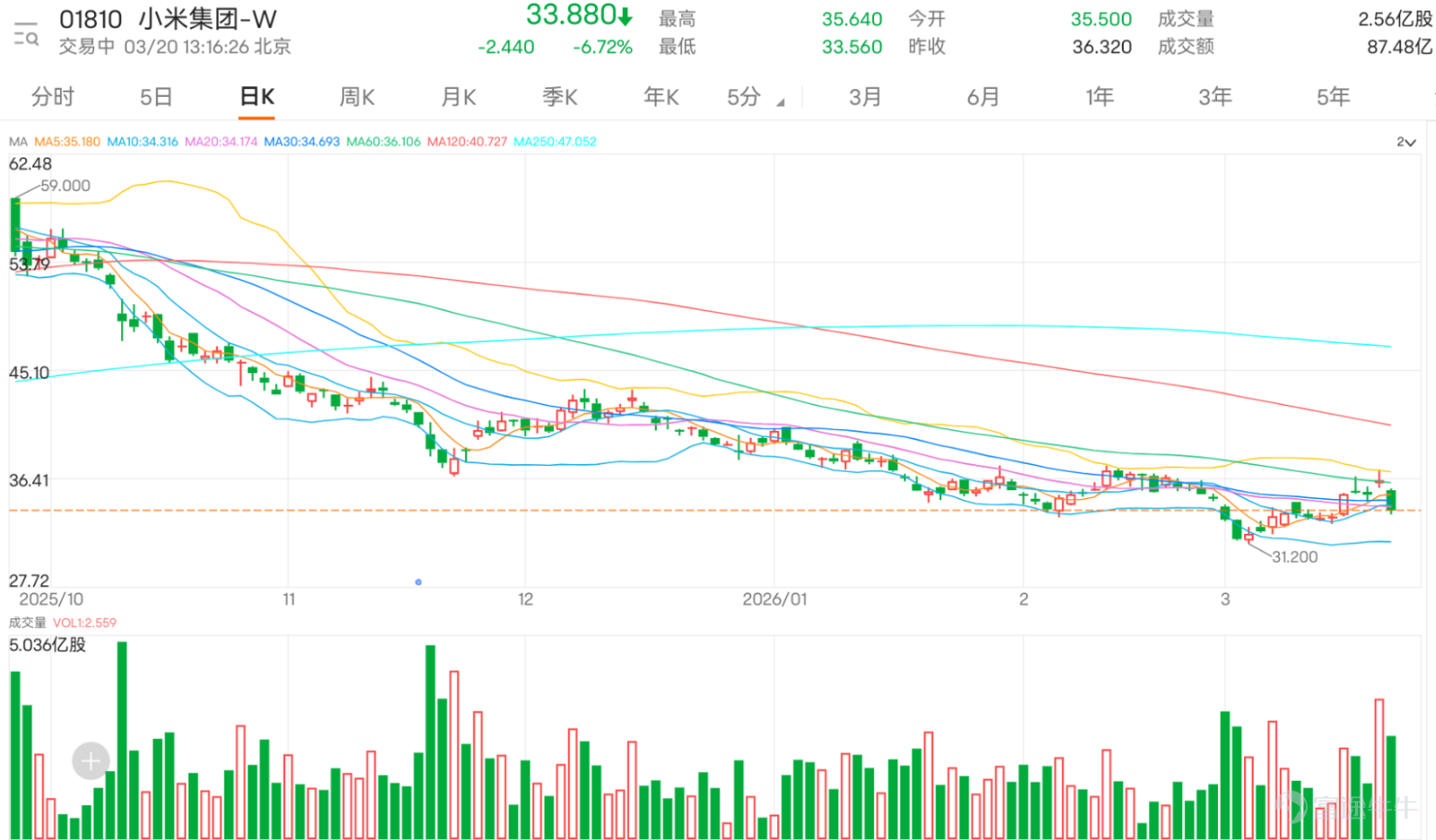
$XIAOMI-W (01810.HK)$ Yesterday, Xiaomi officially launched the new SU7 series models. Despite comprehensive upgrades in core configurations such as power performance, chassis control, battery life, smart cockpit, and assisted driving, the price increased by only 4,000 yuan compared to the first-generation model, highlighting its cost-performance advantage. Within just 34 minutes of sales opening, confirmed orders reached 15,000 units, indicating a strong market response. However, the positive news from the new car launch did not boost the stock price; Xiaomi’s share price came under significant pressure today, falling more than 7% at one point to a low of 33.68 yuan, making it the worst-performing blue-chip stock.
This decline caused Xiaomi's stock price to break through multiple important moving averages at once: the 10-day moving average (34.32 yuan), the 30-day moving average (34.69 yuan), and the 60-day moving average (36.11 yuan). Based on the arrangement of the moving average system, the short-to-medium-term trend has shifted to a bearish pattern, with the stock currently trading below all key moving averages, facing clear technical pressure. In terms of key price structure, the current stock price is approaching the first major support level of 32.7 yuan. If this level fails to hold, the next support will be around 30.2 yuan. The resistance above is also evident, with initial rebound resistance at 36.4 yuan (near the 60-day moving average) and stronger resistance around 37.7 yuan. Notably, the stock’s five-day volatility has reached 11.1%, showing significantly increased fluctuations, reflecting intense market competition between bulls and bears at the current price range.
At the technical indicator level, there is a complex situation with mixed bullish and bearish signals. Overall, although the comprehensive technical indicators give a 'buy' signal, the strength is only 11, indicating weak signal intensity. The Relative Strength Index (RSI) is at a neutral level of 48 and has not yet entered the oversold zone, suggesting that short-term downward momentum may not have been fully released. Both the Stochastic Oscillator and CCI are issuing 'sell' signals, further confirming short-term downward pressure. Meanwhile, MACD and Bollinger Bands provide 'buy' signals. This divergence in indicators usually means the market may be nearing the end of a sharp adjustment or the eve of a technical rebound during a downtrend. Additionally, the Ichimoku Cloud also shows a 'buy' signal, leaving room for optimism about a potential strengthening of the medium-term trend.


Investment bank views are clearly divided. Goldman Sachs has given Xiaomi a 'buy' rating with a target price of 41 yuan. The firm believes that due to stable delivery expectations, production capacity expansion, and improved delivery policies, the order momentum for the new SU7 will be more stable and sustainable compared to the previous YU7 model. The Pro version shows a significant improvement in cost-performance, and it is expected to become the best-selling model after the initial sales phase. The high upgrade benefits accompanying the Max version will help boost early order contributions. Regarding future product timelines, Goldman Sachs expects Xiaomi to launch the YU7 GT in mid-2026 and release a full-size extended-range electric SUV by the end of the third quarter, with new cars launching every 2-3 months throughout the year, which should help maintain brand热度. In the AI sector, Xiaomi announced a cumulative investment of 60 billion yuan over the next three years. Goldman Sachs believes that Xiaomi’s “people-car-home” ecosystem combined with multi-modal AI capabilities holds long-term growth potential. UBS Group maintains a 'neutral' rating with a target price of 38 yuan, acknowledging the competitive pricing of the new car, early bird discounts, and delivery assurance policies. They also noted that Lei Jun, Xiaomi’s founder, reiterated plans to invest over 16 billion yuan in AI this year and 60 billion yuan cumulatively over three years, but progress on AI implementation still needs further tracking and validation.
Reviewing March 18, Xiaomi's stock fell a cumulative 3.47% over the following two trading days, corresponding to the linked $HSXIAMI@EP2607A.P (23111.HK)$ 、 $JP#XIAMIRP2810G.P (60434.HK)$ 、 $UB#XIAMIRP2810E.P (59592.HK)$and$BIXIAMI@EP2607B.P (23123.HK)$ The respective increases of 20%, 30%, 30%, and 23% during the period fully demonstrate the leverage characteristics of the relevant derivatives in hedging against downside risks in stock prices.

If you are optimistic about Xiaomi's rebound, $BIXIAMI@EC2612A.C (13186.HK)$ offering approximately 4.4 times leverage with a strike price of 37.15 yuan, stands out for its relatively high leverage, making it suitable for investors who expect a strong rebound. Another option $HSXIAMI@EC2612C.C (22791.HK)$ has a strike price of 37.12 yuan and provides about 4.5 times leverage. Its main advantage is that both the premium and implied volatility are the lowest among similar products, effectively reducing holding costs and time decay.
For investors who are bearish on the market outlook or wish to hedge, put warrants and bear certificates can be considered. Regarding put warrants, $BIXIAMI@EP2608A.P (26045.HK)$ with a strike price of 28.16 yuan and approximately 5.8 times leverage, is also characterized by the lowest premium and implied volatility, offering better defensive qualities. $UBXIAMI@EP2608A.P (26121.HK)$ with the same strike price of 28.16 yuan and about 5.3 times leverage, achieves a relatively ideal balance between leverage and implied volatility levels. Among bear certificate products, $MS#XIAMIRP2812B.P (68998.HK)$ has a recovery price of 40.5 yuan, providing about 5.8 times actual leverage, making it the bear certificate with the highest actual leverage and lower premium, suitable for investors who are bearish and can tolerate higher risk. $UB#XIAMIRP2812A.P (69732.HK)$ has a recovery price of 40 yuan and an actual leverage of about 6.3 times, with the lowest premium in its category, making its terms quite attractive.
For investors who believe that the stock price will rebound within a range but face resistance from bull-bear certificate recovery prices, bull certificates offer a high-leverage option. $UB#XIAMIRC2608A.C (60038.HK)$ and $HS#XIAMIRC2608J.C (69041.HK)$The recovery price is also at HKD31, very close to the second support level below. The actual leverage is as high as approximately 9.2 times, with low premiums, making it an efficient tool for betting on a rebound. Investors should note that callable bull/bear contracts have a recovery mechanism. If the underlying stock price touches the recovery price, the product will be immediately suspended from trading and may result in the loss of the entire investment.

Xiaomi’s new car is selling well, but its stock price has plummeted. Do you think this is mainly due to profit-taking or insufficient market confidence in subsequent sales? Over the next year, Xiaomi plans to roll out multiple new car models. Do you believe this could act as a mid-term catalyst for its stock price? Feel free to share your thoughts in the comment section. For more market analysis, stay tuned to 'HK Warrants Jenny' for daily updates!
Friendly reminder: This article does not constitute any investment advice. $Hang Seng Index (800000.HK)$$Hang Seng TECH Index (800700.HK)$
This article is for reference only and does not constitute any investment advice. The market data, opinions, and analysis contained herein may change at any time without prior notice. We are not responsible for any loss or damage caused by reliance on the information in this article. Technical analysis only shows whether certain technical conditions are met; a comprehensive assessment of asset performance should be conducted using additional data. Decisions to trade should not be based solely on this article. Please note that past performance is not indicative of future results.
#HongKongStocks #HangSengIndex #RealTimeAnalysis #WarrantsSelection #WarrantsStrategy #DerivativesHedging #HongKongWarrantsJenny #Xiaomi #01810 #TechStocks #HangSengIndexTrends
Risk Disclaimer: The above content only represents the author's view. It does not represent any position or investment advice of Futu. Futu makes no representation or warranty.Read more

Comments
to post a comment
2