
Dividend Income Cheat Sheet: June Dividend Season Is Here—Earn Up to HK$1,596 Per Lot!

Tri-market Insights: Why Are Asia-Pacific REITs Becoming the New Focus for Global Capital?
In early 2026, the global real estate market is undergoing a profound structural divergence. Australia faces the dual challenges of interest rate hikes and oil price shocks, Japan demonstrates resilience in its rental market amid interest rate normalization, and Singapore continues to attract capital due to its robust fundamentals and strong demand. In this 'same world, different landscapes' scenario, investing in Australia, Japan, Singaporethese three major markets $Samsung S&P High Dividend APAC ex NZ REITs ETF (03187.HK)$ precisely captures the diverse opportunities within this regional rotation.
Australia: Value Opportunities Amid Interest Rate Hikes
After experiencing an 11.6% surge in housing prices in 2025, Australia’s real estate market is entering an adjustment phase. Analysts predict that housing price growth will slow to around 5.0% in 2026, primarily due to pressure on borrowing capacity caused by the Reserve Bank of Australia resuming interest rate hikes. [1]
However, opportunities arise even amidst adjustments. An Oliver Hume report reveals a surprising reversal: Melbourne, once one of the most expensive cities in Australia five years ago, has now become the cheapest major city for land prices nationwide, attracting a large number of interstate investors 'heading south to buy the dip,' with industry forecasts predicting a potential 20% surge in transaction volumes. [2] The Commonwealth Bank of Australia predicts that Perth could still see a strong 15% growth this year, while Brisbane may reach 12%. [3] For REITs, this means some high-quality properties have fallen to attractive levels, providing long-term holders with a buying opportunity.
Japan: Rent Growth Offsetting Interest Rate Pressures
Although the Bank of Japan has initiated an interest rate hike cycle, its economy is moving towards a 'wage-inflation' virtuous cycle, with commercial real estate conditions continuing to improve. A CBRE report highlights that the homeownership rate in Tokyo's 23 wards is below 50% and declining. As interest rates rise, the threshold for home purchases increases further, prompting more households to opt for rental housing, which provides structural demand support for the rental market.
The inflow of foreign populations is injecting new momentum into rental demand. In 2024, the number of foreigners entering Japan reached 660,000, with approximately 40% moving into 21 major cities, and 60% aged between 15 and 39 years old, showing a leasing rate of over 50%. With Japan’s ongoing labor shortage, the trend of attracting foreign talent is expected to continue, leading to steady growth in rental demand. For Japanese REITs holding large amounts of rental properties, this represents an important fundamental positive.
Singapore: Strong Sales of New Developments Reflect Market Vitality
In 2025, Singapore’s private residential market performed remarkably, with new property sales surpassing 10,000 units for the first time since 2021. Strong demand continued into 2026, with the first-quarter launch of River Modern achieving 90% sold at launch; Coastal Cabana EC and Newport Residence also sold 66% and 57%, respectively.
According to an ERA Real Estate report,22 new private residential projects are expected to be launched in 2026,providing over 11,800 units (including 2,300 Executive Condominium units), with about 71% located outside the Central Region (OCR), catering to the upgrading housing needs of homebuyers. The National University of Singapore (NUS) Real Estate Sentiment Index shows developers remain optimistic about both the high-end residential and suburban housing markets, with more than half of respondents expecting moderate price increases in newly launched properties.
Samsung Asia Pacific High Dividend Real Estate Investment Trust ETF (excluding New Zealand) (3187.HK) $Samsung S&P High Dividend APAC ex NZ REITs ETF (03187.HK)$: One-Stop Access to Opportunities Across Three Markets
![In early 2026, the global real estate market is undergoing a profound structural divergence. Australia faces the dual challenges of interest rate hikes and oil price shocks, Japan demonstrates resilience in its rental market amid interest rate normalization, and Singapore continues to attract capital due to its robust fundamentals and strong demand. In this 'one world, different landscapes' pattern, investing in Australia, Japan, and Singaporethese three major markets $Samsung S&P High Dividend APAC ex NZ REITs ETF (03187.HK)$ captures the diverse opportunities presented by this regional rotation. Australia: A Value Low Amid Rising Interest Rates After experiencing an 11.6% surge in housing prices in 2025, Australia’s real estate market is entering a period of adjustment. Analysts predict that housing price growth will slow to around 5.0% in 2026, mainly due to pressure on borrowing capacity caused by the Reserve Bank of Australia's renewed interest rate hikes. [1] However, opportunities lie within this adjustment. An Oliver Hume report reveals a surprising reversal: Melbourne, once one of the most expensive cities in Australia five years ago, has now become the cheapest major city in terms of land prices nationwide, attracting a large number of interstate investors 'moving south to pick up bargains.' Industry forecasts suggest this could lead to a transaction volume increase of up to 20%. [2] The Commonwealth Bank of Australia predicts that Perth could still achieve a strong growth of 15% this year, while Brisbane is expected to reach 12%. [3] For REITs, this means some high-quality properties have become attractive, providing long-term holders with an entry window. Japan: Rent Growth Offsetting Interest Rate Pressures The Bank of Japan...](https://nnqimage.futunn.com/sns_client_feed/40001013/20260320/web-1773978904974-WzCoxHDWs4.jpeg/big?area=2&is_public=true&imageMogr2/ignore-error/1/format/webp)
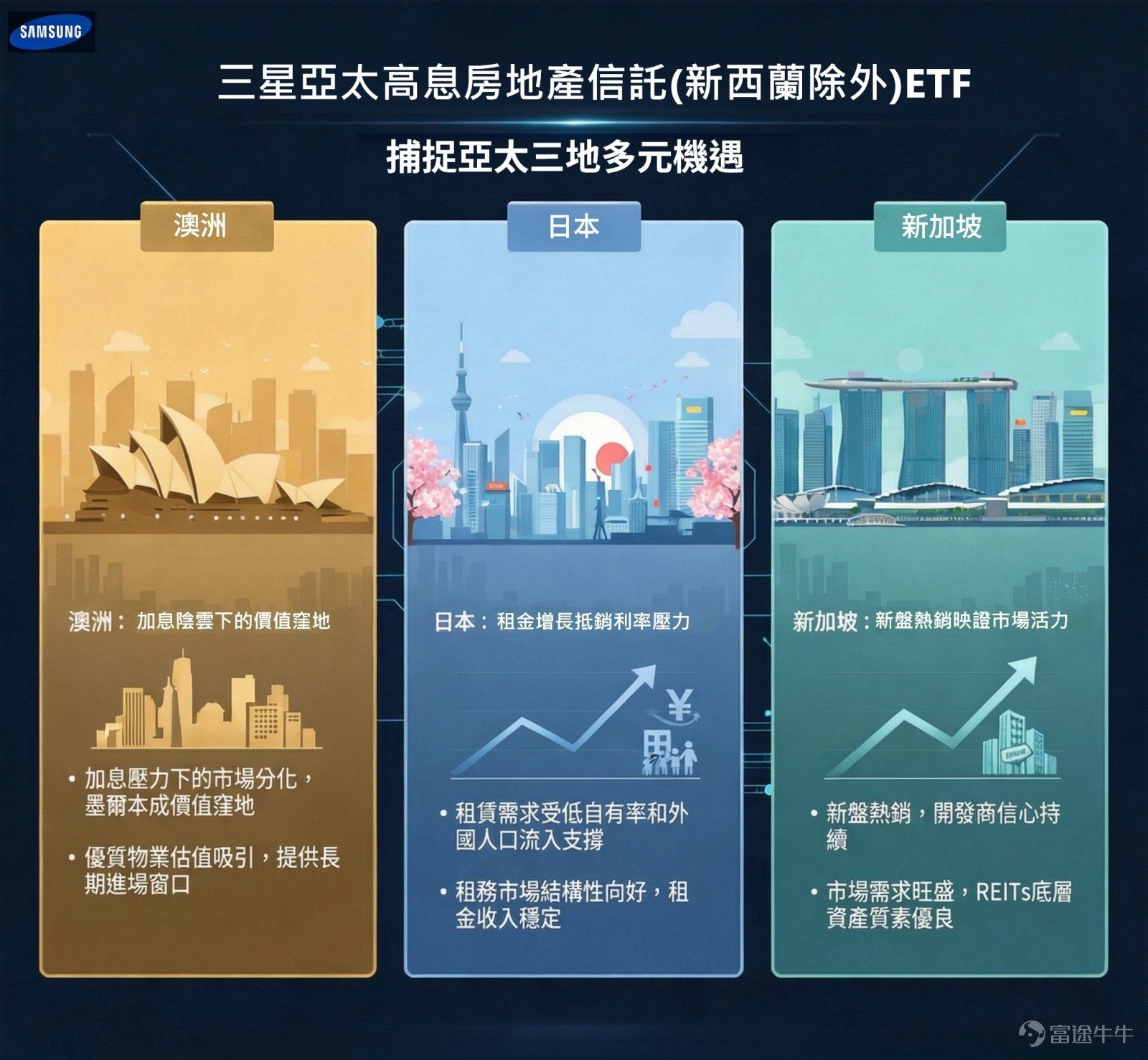
Through a single transaction, the fund allows investors to diversify across three key Asia-Pacific markets, capturing stable income and potential capital appreciation opportunities across different cycles:
Australia (Approx. 30%)
The market is gradually adapting to the rising interest rate environment, showing structural divergence. Valuations in prime locations such as Melbourne have retreated to attractive levels, providing a value window for long-term positioning.
Japan (Approx. 30%)
Benefiting from low home ownership rates and an influx of foreign residents, rental demand enjoys strong support. Real estate trusts offer stable returns, with rental income displaying defensive characteristics.
Singapore (Approx. 26%)
Robust sales performance in new developments reflects strong market confidence. An active property market provides REITs with high-quality underlying assets, supporting long-term growth potential.
$Samsung S&P High Dividend APAC ex NZ REITs ETF (03187.HK)$ Allows you to simultaneously seize opportunities in Australia's valuation recovery, Japan’s rigid rental demand, and Singapore's market vibrancy — one trade, three regional opportunities.
Source:
[1] CAFIS Futures Financial Network (17/3/2026)
[2] HouGarden (17/3/2026)
[3] The Nightly (9/3/2026)
[4] CBRE (2/3/2026)
[5] ERA Real Estate (12/3/2026)
Disclaimer and Important Notices
• Investment involves risks; past performance is not indicative of future results. Fund prices can go up as well as down, and investors may suffer all or significant losses. Investors should not make any investment decisions based solely on this material.
• The Samsung Asia Pacific High Dividend REIT (excluding New Zealand) ETF is a sub-fund of Samsung ETF Trust II. Its investment objective is to provide investment performance that closely tracks the S&P High Yield Asia Pacific ex-New Zealand REIT Select Index ("Index") before fees and expenses.
• The main risk factors faced by the Samsung Asia Pacific High Dividend REIT (excluding New Zealand) ETF include general investment risks; currency risks; concentration risks in the Asia-Pacific real estate market; risks associated with investing in real estate funds (including real estate market risks, operational and management risks, interest rate risks, liquidity risks, regulatory risks, leverage risks, etc.); Asia-Pacific market risks; securities lending transaction risks; new index risks; multi-counter risks; other currency distribution risks; risks of distributions from capital or effectively from capital; passive investment risks; tracking error risks; trading risks; risks of trading differences; termination risks; reliance on market makers and liquidity risks, among others. Please note that the above list of investment risks is not exhaustive. Investors should carefully read the product prospectus, product key facts statement, and related sales documents before making any investment decisions to fully understand details such as product features, risk factors, and distribution policies.
• The above fund has been recognized by the Hong Kong Securities and Futures Commission (SFC). Recognition does not imply official endorsement of the product. This material is for reference only and does not constitute an offer or solicitation to any person to buy, sell, or adopt any investment strategy.
• The manager may, at their discretion, make cash distributions to unit holders from capital or gross income (while charging all or part of the product’s fees and expenses to the capital or paying them out of the product's capital), thereby increasing distributable income for making distributions, which effectively constitutes a return of capital.
• Distributions paid or effectively paid out of capital equate to investors receiving a return of part of their original investment or withdrawing part of their initial investment or capital gains attributable to that original investment. Any practice involving distributions paid out of the product's capital or effectively out of the product’s capital may result in an immediate reduction in the net asset value per unit.
• This document has been prepared by Samsung Asset Management (Hong Kong) Limited (SAMHK) and has not been reviewed by the SFC or any other regulatory authority. Investors should determine whether any investment product or strategy is suitable based on their personal financial situation, investment experience, and objectives. If you have any questions regarding the relevant information, you should seek advice from professional advisors as needed.
• Certain information contained in this content is compiled from third-party sources. SAMHK has made efforts to ensure that such information is accurate, complete, and up-to-date, and appropriate measures have been taken to verify the accuracy of the reproduced data. However, no responsibility or liability is assumed for the accuracy, use, or reliance on such information. This content may contain forward-looking statements based on SAMHK’s opinions, expectations, and projections. SAMHK has no obligation to update or revise any forward-looking statements, and actual results may differ materially from those anticipated in the forward-looking statements. All copyrights of the content herein (including all data, images, computer codes, text, logos, and designs) are owned by SAMHK. No reproduction or redistribution of the information provided in this content is allowed without SAMHK’s consent.
Risk Disclaimer: The above content only represents the author's view. It does not represent any position or investment advice of Futu. Futu makes no representation or warranty.Read more


Comments
to post a comment
4
1