
Alpha Call | C-Suite Dialogue: AI Industry and Asian Markets Amid Geopolitical Shifts Summary Report
I. Geopolitical Analysis: The Trajectory of US-Iran Conflict and Investment Framework
(1) Core Framework: Technological Industrial Revolution Takes Priority Over Geopolitical Conflicts.The guest explicitly pointed out,From a historical perspective, geopolitical conflicts have had brief and extremely limited impacts in the face of industrial revolutions.Taking the Internet revolution of the 1990s as an example, during that period, multiple crises occurred such as the Asian financial crisis, Russia's bond default, NATO airstrikes against Yugoslavia, and the collapse of Long-Term Capital Management, but their impact on the development of the Internet industry was measured in weeks, with recovery taking at most two to three months. The guest cited an example stating that Russia's bond default had the strongest impact on Wall Street that year, yet Microsoft doubled over the year, Nasdaq rose more than 30% for the year, and rebounded from the bottom within two to three months, rising by 46%.
The guest emphasized:The investment framework must prioritize technological industrial revolutions, while geopolitical shocks and various crises should be placed in secondary positions.In human history, there have only been three or four instances that could be called technological industrial revolutions, whereas conflicts between nations and economic crises occur every few years, even several times a year, essentially being 'ripples in the long river of history'.
(II) Conflict Analysis Methodology: Ontology and First Principles.Guest appliedOntology and First Principlesto deconstruct and analyze the key decision-makers of the US-Iran conflict from three perspectives:
United States (Trump): Quick in and quick out, constrained by the midterm election timetable
Core demands:Winning the midterm elections dictates that the war must be swift, with high oil prices being unsustainable (the transmission cycle of oil prices to CPI is 6-8 weeks).Exit window:To appoint Kevin Walsh as the Federal Reserve Chairman in May, initiate easing, and create a bull market before November to win the midterms, the exit window lies inearly April to at the latest late April。Highest strategic goal:Advance regime change in Iran, following the Venezuela model – find collaborators within the system to take over the government and reach cooperation agreements with the US (increase oil production, consolidate the US dollar, reduce inflation).Lowest strategic goal:Eliminate Iran's navy, remove ballistic missile capabilities, and dismantle nuclear enrichment abilities --Currently, the basics have been largely completed。The 'Trump Ten-Step Model':The guest has constructed a ten-step discourse model for Trump in major geopolitical events. On March 9, Trump made his first statement: 'We’ve pretty much won,' which aligns with the context of the seventh step (de-escalation, declaring victory, and finding an exit ramp). The market bottom generally appears around the seventh step. Based on this, the guest’s team went all-in at that point, fully repurchasing all positions, including Korean assets.
Israel (Netanyahu): Political survival hinges on a presidential pardon
Core demands:Obtain a presidential pardon to dismiss three major charges, win the election, return the Likud party to power, and secure a sixth term as prime minister.Implementation path:It is essential to resolve Israel’s major adversaries, achieve generational peace, and become a national hero to secure an indisputable presidential pardon. Currently, Herzog (the Israeli president) still refuses to grant the pardon, leaving Netanyahu with a strong impetus to pursue higher strategic goals.Highest strategic goal:Eliminate the Islamic Republic of Iran and establish a pro-US and pro-Israel regime.Lowest strategic goal:Significantly weaken Iran's warfighting capability and post-war reconstruction capacity (elimination of ballistic missiles and nuclear programs).Plan B:If regime change cannot be achieved, shift the goal to the long-term - severely undermining the Iranian regime’s internal repression and ability to maintain power, causing it to decline and implode under 'cold peace.' Simultaneously, focus on eliminating or significantly weakening Hezbollah in Lebanon and establishing a northern buffer zone.
Iran (the core leadership of the IRGC): Regime survival is the top priority.
Power structure:After Khamenei Senior and his inner circle are eliminated, the actual control of the regime falls to the core leadership of the IRGC (collective military leadership), with Mojtaba Khamenei (Khamenei Junior) being pushed to the forefront as a puppet. Agah Alireza, as the secretary of the National Security Council, plays the role of coordinator.
Three core objectives of the IRGC:① Ensure the continuity of the Islamic Republic system; ② Ensure personal safety; ③ Ensure the IRGC maintains long-term control over Iran without being sacrificed by a civilian government during negotiations.
Fatal Dilemma - Financial and Material Crisis: Depletion of Foreign Exchange Reserves:The original 100 billion foreign exchange fund was depleted in December last year, the cancellation of living subsidies led to skyrocketing prices, currency collapse, and widespread unrest. The remaining approximately 15 billion USD in foreign reserves includes 6 billion lost in Venezuela due to U.S. actions, and around 4-5 billion frozen in the UAE.Food Crisis:Sixty percent of food is dependent on maritime transport; the only land route is through Baku (Russian road delivery with extremely limited capacity). Currently, there are only enough stockpiles for 180 days.Fuel Crisis:Oil refineries and storage facilities have largely been destroyed by Israel; annual civilian demand for one billion liters of fuel relies on imports. After the sea route was blocked, only underground reserve oil depots from the navy, air force, and IRGC remain (limited quantities available).If the blockade is not lifted within a month, emergency fuel control will be forced into effect. Military Crisis:The Revolutionary Guards and Basij Militia have not been paid for two consecutive months, with high rates of absenteeism and desertion, and reservist mobilization has been extremely unsuccessful.
(III) Key Evidence Chain for Conflict De-escalation
The guest proposed several observation points, constructing an evidence chain for conflict de-escalation:
Analysis of the Discourse System in Mujtaba's National Address
The guest compared the speech of the newly appointed Supreme Leader, Mujtaba, with the discourse system of his father, Khamenei, and found four unprecedented changes: no use of terms like 'Holy War,' 'Jihad,' or 'An eye for an eye' (even in matters of national survival); special emphasis on friendship with neighboring Muslim Brotherhood countries (unprecedented in Iran's official narrative);For the first time, the concept of 'the enemy must compensate us for our losses' was proposed—there has never been a precedent for compensation in Shia doctrine; the last mention of compensation was during the Iran-Iraq War.The guest believes that Mujtaba not only established a negotiation framework but also prepared an exit ramp to declare victory—'I have inflicted equal losses on the enemy, and anti-aggression can be considered a victory.'At this point, it is almost certain that negotiations and a ceasefire are just a matter of time.
Iran Did Not Escalate After Trump’s Maximum Pressure on Kharg Island
Last Friday after market close, Trump carefully tweeted the announcement of destroying all military facilities on Kharg Island (where 90% of Iran's oil exports are shipped). The guest analyzed that this pressure had reached its limit, but Trump chose not to destroy the oilfield infrastructure, preserving the basis for negotiations.
Iran’s Response Observation (72 Hours): No substantial escalation of the situation; retaliation against the UAEAdvance notice and maps were issued, deliberately avoiding casualties—indicating that Iran understands causing significant US casualties would force Trump to escalate to regime change.
Neither side has crossed the 'point of no return'
The flag indicating a point of no return set by the guest in the model:US point of no return:Bombing Iran's power plants, oil terminals, and oil field infrastructure (directly destroying the foundation for regime survival) - did not occur.Iran's point of no return:Laying mines in the Strait of Hormuz (irreversible, causing paralysis of shipping lanes for over one to two months) - did not occur.
Resumption of navigation in the Strait and RMB settlement arrangements
The guest observed an increasing number of vessels navigating through the strait recently; the latest news on the same day showed that eight countries reached an arrangement with Iran to settle oil transactions in RMB via the strait.
Key observation time window: Persian New Year and Eid al-Fitr (March 21)
The guest pointed out that this weekend (March 21) marks both the Persian New Year (the Persian calendar's new year) and the overlapping Muslim festival of Eid al-Fitr. The Persian New Year symbolizes 'darkness departing and light returning,' while Eid al-Fitr signifies 'gratitude to God for strength, forgiveness, and peace.'
The guest predicted: If the new supreme leader declares victory on this day, it would be equivalent to a formal coronation; possible substantive de-escalation moves may include (for example) issuing a statement saying 'In response to requests from Muslim brother nations, we have decided not to attack vessels passing through the strait within 12 hours' or 'Vessels meeting conditions can pass freely after registration.' After the deadline, extensions will gradually be issued with mediation from various countries. By the end of the month, Western and Gulf state vessels will resume normal passage under U.S. military escort, marking the substantial end of the conflict.
Confirmation of internal dynamics within the IRGC
Wasidi’s (IRGC Commander) resignation request was rejectedHe was angered by the death of Agali and believed that it was due to intentional leniency towards Israel by Mokhetaba and insiders within the IRGC.The guest provided a profile analysis of Wasidi:Master’s degree in electronics, science prodigy, skilled in calculations,Loyal only to the system rather than religious martyrdomDuring the later stages of the Iran-Iraq War, he once withdrew his troops without authorization (nearly facing execution by a military court), but was later spared by Rafsanjani—indicating his ability to rationally exit situations. Mokhetaba appointed Rezaei (former IRGC Commander during the Iran-Iraq War) as a military advisor. The guest pointed out that Rezaei’s most famous incident involved writing a letter listing impossible battle conditions (350 brigades, 3500 tanks, 300 aircraft, and nuclear weapons) during the later stages of the war, essentially expressing 'we can’t continue fighting' using 'revolutionary discourse'—a typical communication style within the IRGC system, where they remain defiant until the last moment while potentially already negotiating.
(4) Summary of geopolitical analysis
The guest believes the conflict represents a short-term, one-off shock, with the main focus being the technological industrial revolution. Based on Trump's and Iran’s rhetoric and actual actions, reaching negotiations within a specific timeframe is highly likely. Trump is constrained by the CPI transmission cycle and his political promise of 'quick in, quick out,' leading to a relatively optimistic forecast. However, the guest also emphasized that anything can happen in war, and the above is the result of probability and logical deduction.
II. Semiconductor and Memory Industry: Limited War Impact, Strengthening Supply-Demand Dynamics
(1) War Poses a Tailwind Rather Than Headwinds for Asian Semiconductors
The guest presented a counterintuitive viewpoint: the war benefits rather than harms the Asian semiconductor industry.
No Damage on the Demand Side:AI technology revolution demand resides in North America/the United States, where energy is largely self-sufficient with slight exports, leaving the demand side unaffected.
Supply Contraction Drives Price Increases:For memory products with commodity attributes, a 5-point drop in demand and a 5-point expansion in the supply-demand gap could lead to price increases of 50% or more, far exceeding the earnings impact caused by reduced supply.From the performance perspective, the impact is positive.
Limited Supply Chain Impact from Helium and Others:While South Korea does import a significant proportion of crude helium from Qatar, reviewing the period during the Russia-Ukraine war when Russian natural gas and rare gases (such as argon) supplies were disrupted, there was almost no substantial impact. Supply chain resilience exceeded expectations, with all parties holding strategic reserves for over 180 days. As long as the crisis is resolved within a certain timeframe, there will be almost no impact, and the anticipation of supply disruptions may even benefit commodity price increases.
(II) Memory Industry: A Valuation Paradigm Shift from Cyclical to Growth
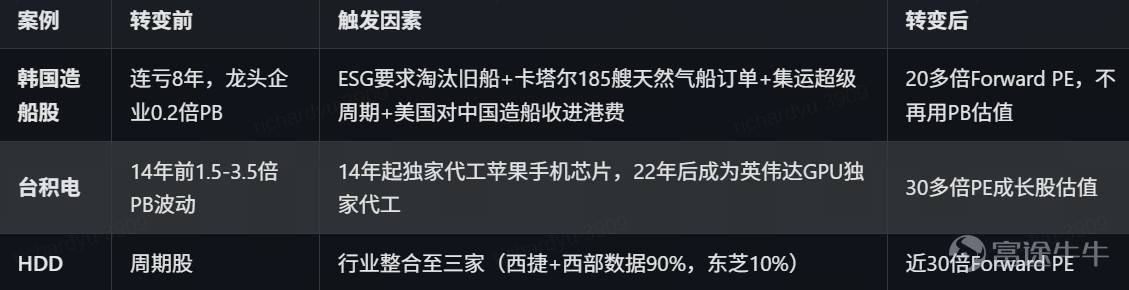
The guest believes that memory is undergoinga valuation paradigm shift from cyclical stocks to growth stocks (Valuation Paradigm Shift).:Core rationale:Traditionally, the supply and demand curve of memory classified it as a cyclical stock, but the super-industry cycle brought by generative AI has transformed the demand curve into super-linear or even exponential (a clear S-curve), while the supply curve remains linear.
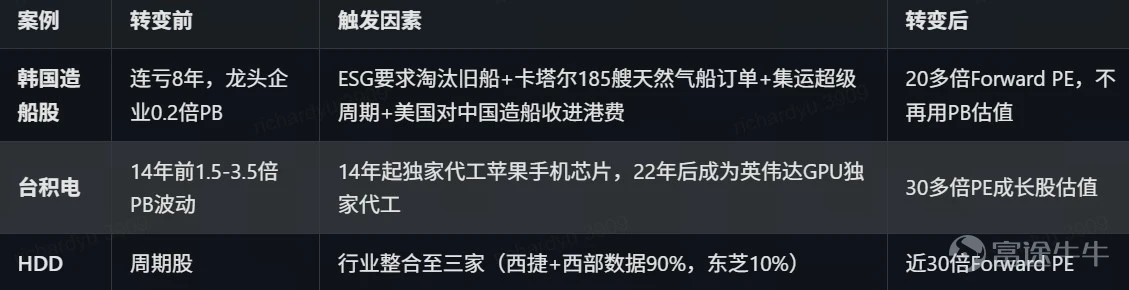
Historical Analogy
(III) Memory becomes the biggest bottleneck in AI systems, wielding the strongest pricing power
The guest vividly explained with a metaphor:GPUs are like automatic cooking machines, while memory serves as the material conveyor belt (bandwidth) and warehouse (capacity).The speed of material supply and warehouse capacity must match the speed of the cooking machine.
Key Contradiction:
NVIDIA updates every half year and releases a major generation every two years, with each generation improving efficiency more than fivefold;Memory is the only component in the entire AI data center that does not follow Moore's Law.—Bandwidth and capacity increase by just over one-fold per decade (less than two-fold), far behind the pace of GPU advancements; memory has become the shortest plank in the entire system,determining the upper limit of AI system performance.Therefore, the strongest pricing power lies with memory, as investments directed toward the weakest link yield the best returns.
(4) Supply side: Five barriers lock out new entrants
The guest systematically outlined the entry barriers in the memory industry:Equipment barrier (EUV lithography machines):Current DRAM 1C processes already require EUV, while the next-generation DRAM 1D will need High-NA EUV, and subsequent generations will all depend on High-NA EUV.Equipment requirements now surpass Taiwan Semiconductor's latest process.EUV production capacity for the coming years has been locked down by the three major memory IDM companies along with Taiwan Semiconductor and Intel.
Intellectual property barrier:Memory technology, which has evolved from the 70s and 80s to the present, is now controlled by only a few companies with complete IP intellectual property libraries. The only potential re-entrant could be Intel (originally specializing in storage, with an IP library intact until 2023), but its mass production of CIM technology in collaboration with Japan Academy isn't expected untilafter 2031。
Know-how barriers:The three surviving companies are all over 40-year-old established enterprises (Micron founded 48 years ago, Samsung and SK Hynix both established in 1983), possessing extremely deep non-public proprietary technological accumulations.
Talent and supply chain barriers:A complex supply chain system and top-tier talent pool make replication impossible in the short term.
Capital barriers:After this supercycle, Samsung’s net profit this year will exceed $200 billion, while SK Hynix’s will surpass $140 billion. Even if they allocate half for shareholder returns, the remaining capital accumulated over several more years makes it suicidal for any new entrant trying to compete via price wars.
Industry concentration: CR3 market share exceeds 94%, comparable to the advanced process concentration in logic wafer foundries (Taiwan Semiconductor, Samsung, and Intel).
(Five) EUV industrial chain constraints: Patel Paradox
The guest cited an important interview with Dylan Patel, founder of Semi Analysis, arguing thatthe three core bottlenecks of AI are: EUV lithography machines, Taiwan Semiconductor's advanced processes, and high-speed memory (such as HBM). The root cause of the difficulty in expanding production for all three lies in the production capacity of EUV lithography machines.
The 'bottleneck within a bottleneck' for EUV expansion — Carl Zeiss lenses:ASML Holding's EUV has over 8,000 suppliers, making coordinated and synchronized production expansion extremely challenging; the production system for Carl Zeiss lenses is highly complex, with approximately 1,000 of the world's top optical engineering experts concentrated here;by the second half of 2027, Carl Zeiss lens production capacity will only be able to expand by a maximum of 25%.
Patel’s 'Diminishing Faith Paradox':
Faith and understanding of AGI exponentially decrease along the industry chain from bottom to top: frontier large model developers (Sam Altman, Amodei of Anthropic) have the strongest understanding → NVIDIA one level lower → memory companies another level lower → semiconductor core equipment one to two levels further down.
Upstream players always remain in a state of cognitive lag and skepticism, with production expansion consistently delayed, becoming slower the further upstream you go.Result:The entire industry’s supply perpetually lags far behind demand, leading to significantly prolonged boom cycles, with profits shifting mainly to upstream bottleneck segments that are difficult to expand.
(6) HBM Outlook and Pricing Strategy
HBM will maintain extremely high profit margins, with a long-term pricing inclination towards gross margins above 70%.The visibility of HBM demand is extremely high (on-chip memory packaged with GPU/AI ASIC can estimate shipment volumes through advanced packaging capacity at foundries like Taiwan Semiconductor). This year’s growth rate is at least 80%-100%, and for the next few years, it will be at least 50%-60%, but the actual demand growth may far exceed these numbers.The bottleneck lies on the supply side:Wafer production capacity expansion is constrained by cleanroom space and EUV equipment. Before new cleanrooms are completed, the capacity is likely already locked in by long-term customer orders.Long-term contract pricing trend:Samsung and SK Hynix are preparing to sign 3-5 year long-term contracts with AI data center customers, locking in prices (setting a minimum floor price, adjustable upward quarterly), irrevocable, with substantial prepayments. Once prices rise to a certain level (weaker pricing sectors such as consumer electronics could lose over 25% volume), companies will stabilize earnings through long-term contracts.
(7) Summary of Memory Investment Views
The guest mentioned that since last September-October, they have been heavily investing in memory stocks, and their views have continued to strengthen rather than change. The memory industry is undergoing a fundamental shift from cyclical to growth: demand is growing exponentially with the AI industry, while supply is constrained by a highly concentrated industrial structure and disciplined expansion strategies, showing low linear growth. The supply-demand gap will continue to widen rather than close automatically.
III. South Korean Stock Market Investment Logic: K-Value Up Reforms Unlock Structural Value
(1) The Path to Discovering Opportunities in Korea
The guest discovered that Korea began learning from Japan to implement "Value Up" (stock market revaluation) while researching storage (Samsung, Hynix).
(2) The Root Causes of Long-Term Discounts in the Korean Stock Market
The guest systematically analyzed the institutional roots of the "Korea Discount":
Institutional closed loop under chaebol control: Korean commercial law is formulated according to the demands of chaebols, with the core principle being "minimization of director liability"; high inheritance tax + high dividend tax (dividend tax as high as 45%) → companies have no motivation to pay dividends; chaebols have a strong incentive to suppress stock prices during generational transitions to reduce inheritance taxes → low-price transfers → repurchase at lows using corporate funds to defend against hostile takeovers → treasury shares are never canceled (in some companies, treasury shares reach 20-30%);A closed loop is formed: there is a strong incentive to keep stock prices low, and almost no incentive to raise them.
Typical characteristics:The Lee family of Samsung holds only 21% directly and indirectly, and SK Corporation holds only 20.4% of Hynix — both just above the 20% controlling stake line; low holding ratios, no reduction financing, and continuous capital operations such as spin-offs and acquisitions to exploit retail investors.
Severe capital outflows: 65% of Korea's National Pension Fund is invested in foreign stocks, with only 14.5% in domestic stocks (the proportion of domestic stocks has been continuously reduced each year, but this year it increased by 0.5% for the first time); retail investors heavily trade US stocks (about $170 billion in positions, concentrated in Tesla, NVIDIA, etc.).
(III) Lee Jae-myung's reform system:The guest pointed out that the systemic resolution of the Korea Discount issue lies in Lee Jae-myung (who became president in May of last year), who already had extensive stock trading experience in the 1990s and is well aware of the problems facing the Korean stock market. His ruling coalition controls 192 votes in the National Assembly (only 185 votes are needed to veto).All reforms can be implemented.。
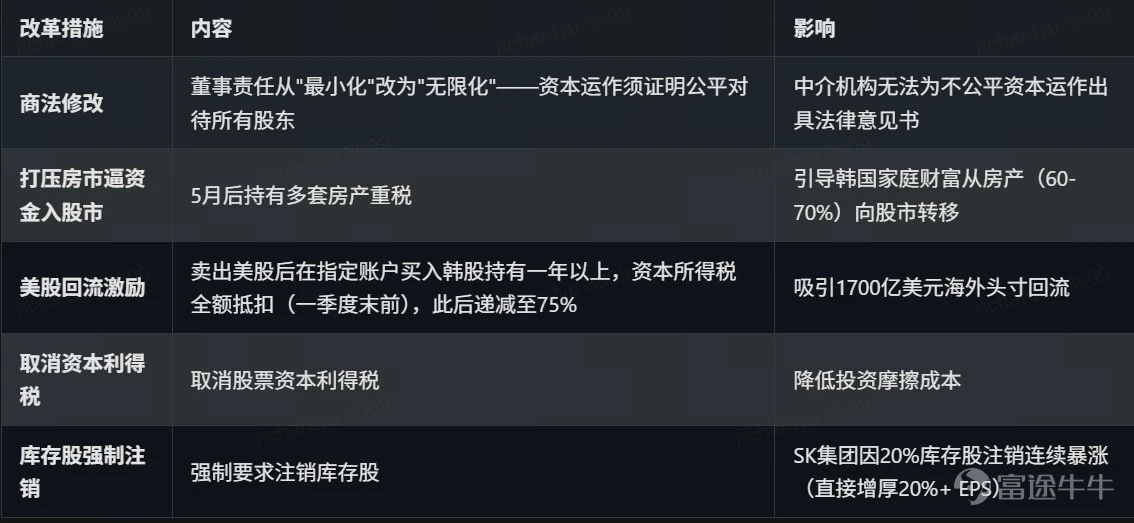
Core reforms already implemented
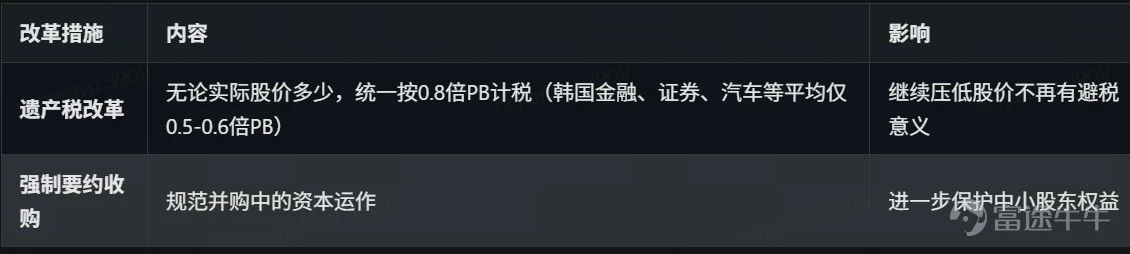
Reforms to be implemented soon
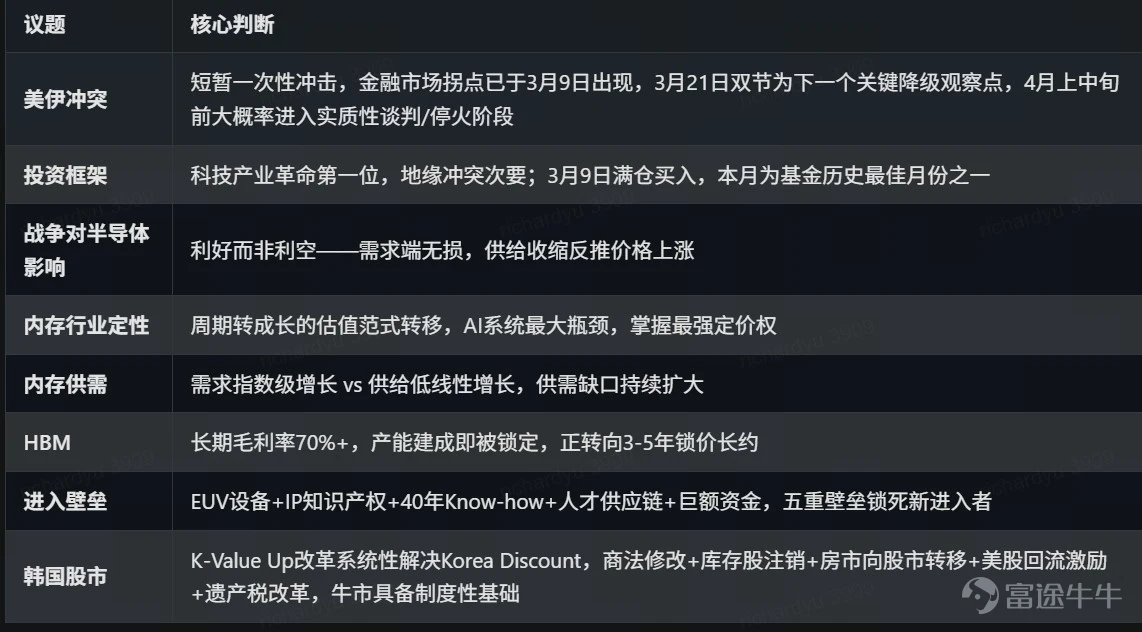
IV. Overview of the guest's core viewpoints.
Risk Disclaimer: The above content only represents the author's view. It does not represent any position or investment advice of Futu. Futu makes no representation or warranty.Read more

Comments
to post a comment
7
22