Passive funds are heavily buying SanDisk! Will the super cycle in memory chips continue?

AI ignites "memory chip frenzy": Micron's market cap surpasses $500 billion. Is it still worth chasing now? This signal deserves attention!
A wave of AI-driven demand for memory chips is propelling the entire sector to new heights.
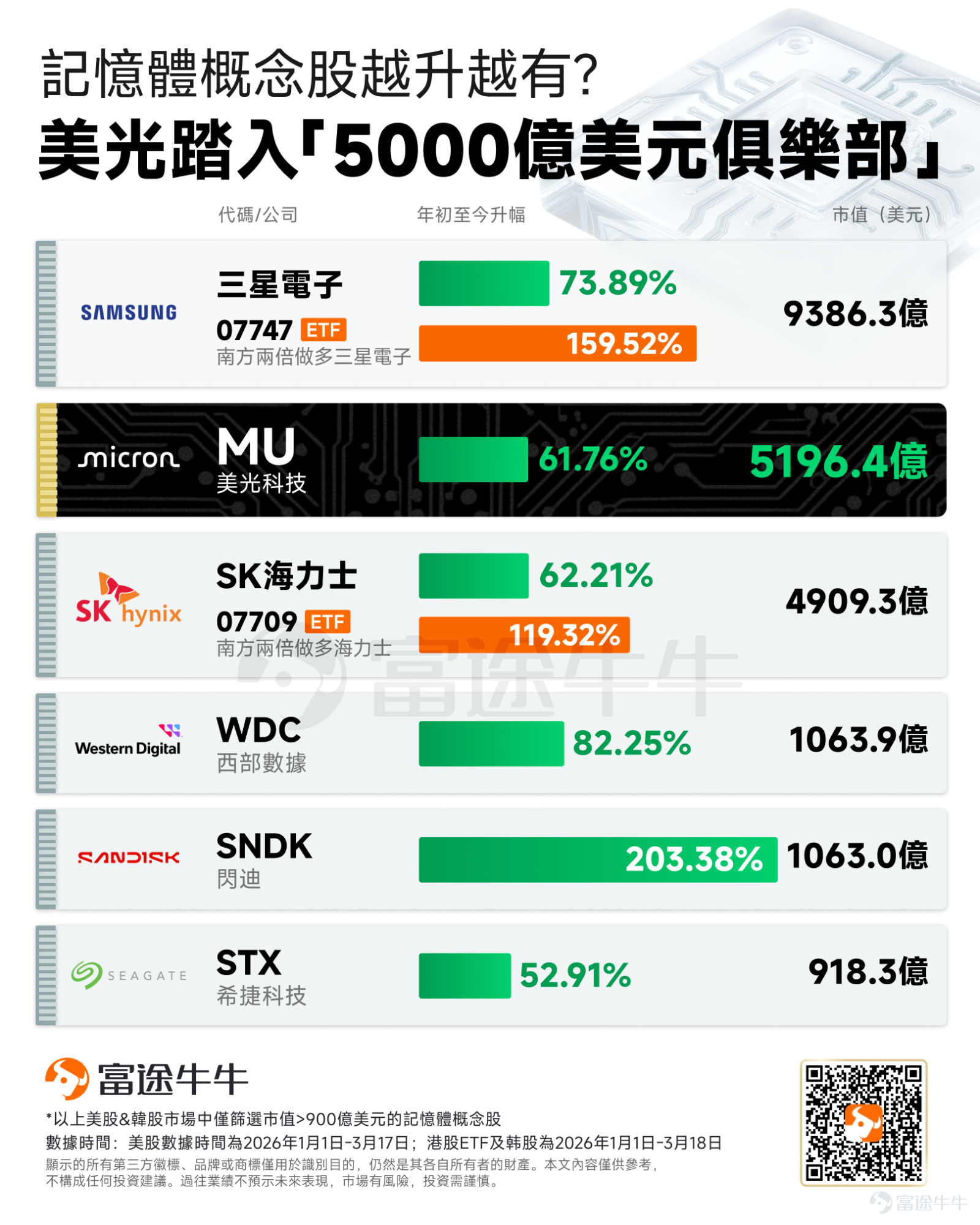
Overnight, storage-related stocks surged across the board, $Micron Technology (MU.US)$ with market capitalization breaking through the $500 billion mark for the first time,officially ranking among the top 16 largest companies in the S&P 500 index by market value; meanwhile, $SanDisk (SNDK.US)$ 、 $Western Digital (WDC.US)$and$Seagate Technology (STX.US)$ other individual stocks also hit new highs. This wave of enthusiasm has spread to the Asian markets today,with South Korea's Samsung and SK Hynix delivering strong performances, rising as much as 7% and 8%, respectively.
Overall, driven by the AI wave, these concept stockshave recorded astonishing gains ranging from 50% to 203% year-to-date.Meanwhile, shares listed in Hong Kong $CSOP Samsung Electronics Daily Max (2x) Leveraged Product (07747.HK)$ have soared over 159% year-to-date, $CSOP SK Hynix Daily Max (2x) Leveraged Product (07709.HK)$ Up over 119%.

Is it still possible to invest in this wave of the 'memory boom'? This article will provide fellow investors with an in-depth breakdown of the core catalysts behind this surge and offer key indicators for determining when the market has peaked.
What is the catalyst for this round of increase?
The driving force behind the indiscriminate rise of the sector recently mainly comes from the followingthe third largest,dimensions:
1. Industry side: HBM4 mass production and shortage expectations
– Micron officially announced: After-hours on Monday, Micron announced that its HBM4 high-bandwidth memory, specifically designed for NVIDIA's next-generation Vera Rubin AI platform, has entered the mass production stage, completely dispelling market doubts about whether it could maintain a stable position in the supply chain.
– SK Hynix stated: Group Chairman Choi Tae-won frankly stated,The global chip wafer shortage is expected to continue until 2030, with the shortfall potentially exceeding 20%.This was accompanied by hints of a new plan to stabilize DRAM prices, which greatly boosted market bullish sentiment.
2. Institutional Perspective: Wall Street calls it the 'strongest supercycle in history.'
Top-tier investment banks such as Goldman Sachs and Morgan Stanley have recently made密集 statements with a highly consistent core consensus: driven by massive demand for AI servers and constrained supply expansion, significant gaps have emerged in DRAM, NAND, and HBM.
– Goldman Sachs strongly advocates: SK Hynix and Samsung's target prices were raised to 1.35 million and 260,000 Korean won respectively. Goldman Sachs expects SK Hynix’s average DRAM price to increase by 243% annually by 2026, with ROE surpassing 80%; Samsung's operating profit will also see an explosive growth of more than fivefold. Even with significantly increased capital expenditures by these two major manufacturers, current valuations remain highly attractive.
– Morgan Stanley highlights NAND expectation gap: Morgan Stanley specifically noted that demand from AI inference is rapidly consuming NAND capacity, coupled with manufacturers’ tacit understanding to prioritize technological upgrades over capacity expansion, predicting that the actual price increase for NAND will significantly exceed market expectations.
3. Policy Aspect: South Korea’s ‘Corporate Value Enhancement’ Boost
In addition to the industry cycle, South Korea's government-driven"Corporate Value Enhancement Program"(Value-up Program) has also provided a strong boost. Through tax incentives, strengthened corporate governance (protecting minority shareholders), and the launch of related ETFs, it successfully attracted both domestic and international capital, significantly alleviating the long-standing "Korea Discount" issue. Additionally, South Korea’s financial regulators have stated that,if necessary, they will expand the 100 trillion won market stabilization plan,providing strong support for liquidity.
When will the memory frenzy peak? Here's the most effective 'leading indicator'
As stock prices continue to rise, the market's main concern is no longer "how much more can it grow," but rather "what signals should we monitor to predict turning points." UBS Group’s answer is:Operating Profit (OP).
Why operating profit?Because it not only reflects price fluctuations but also integrates core variables such as bit growth and cost reduction per bit, making it the "final value" most closely aligned with the true state of the industry.
The report analysis shows that,Over the past 20 years, stock prices have peaked either simultaneously with or ahead of operating profits in90%situations where operating profits peaked.

UBS Group expects the memory industry’s operating profits to peak in the third quarter of 2027. All else being equal,this implies that the rally in memory stocks could last until the second quarter of 2027.
However, UBS Group also cautions investors that predicting when operating profits will peak is no easy task. The reason lies in the structural supply and demand changes brought by AI, which may make profit rhythms harder to predict. Especially as HBM continues to crowd out DRAM production capacity, the interplay between price, supply, and profits becomes more complex, causing the 'estimated timing' of peak profits to potentially shift rapidly.
Therefore,Operating profits can serve as an important indicator, but they are by no means a 'cure-all.'
Tonight’s showdown! The market holds its breath awaiting Micron's earnings test
As Micron is set to release its Q2 2026 financial results after today’s market close, bullish sentiment toward the memory sector has already begun to build. According to FactSet data, the market has set extremely high expectations: estimated quarterly revenue at $19.8 billion, representing approximately 145% year-over-year growth, with net profit expected to reach $10.3 billion, reflecting a staggering 489% year-over-year increase, underscoring the explosive power of the supercycle.
However, analysis firms point out that the real focus of this earnings call lies in two core issues:First, whether Micron can continue to uphold pricing terms within long-term supply agreements with customers while expanding wafer production capacity; second, whether high memory prices have started to trigger demand contraction, i.e., some customers delaying purchases or seeking alternatives due to excessive costs.
Moreover, Micron has made significant progress in its capacity expansion, officially announcing on Sunday the acquisition of the P5 plant area of Taiwan's Powerchip Semiconductor in Tongluo. This move aims to quickly secure ready-to-use cleanroom resources, providing strong support for the expansion of advanced DRAM product lines such as HBM. This will also be a key factor in the management’s future guidance to be released during tonight’s earnings call.
Risk Disclaimer: The above content only represents the author's view. It does not represent any position or investment advice of Futu. Futu makes no representation or warranty.Read more


Comments
to post a comment
51
95