US-Iran tensions flare up again: How will Strait risks impact assets?

Hormuz, Term Structure and USO: Navigating the Energy Storm
The conflict in the Middle East has entered its third week, with the Strait of Hormuz — the channel known as the global energy 'jugular vein' — still yet to regain its normal pulse.
This unprecedented scale of shipping disruption has caused systemic shocks to the global energy market. About 20% of global oil trade depends on this route, and currently, the volume of oil transported through the strait is less than 10% of pre-war levels. Brent crude prices have continued to rise since the end of February, repeatedly testing the crucial $100 mark.
On March 17 local time, Ali Larijani, Secretary of Iran's Supreme National Security Council, was killed in an attack.After the former Supreme Leader Khamenei was killed in an attack on February 28, Larijani was regarded as Iran’s de facto wartime leader and the core of top decision-making.The Middle East crisis is sliding into a more chaotic unknown territory. At this moment, every ripple in the Strait of Hormuz is being repriced by the global financial markets.
In this article, we will dissect the navigation situation in Hormuz and the complex power struggle surrounding this eye of the storm.Going further, Sir will guide you through the surface fluctuations of oil prices to decode the fundamental reason for the long-term deviation of mainstream crude oil investment tools from oil prices: $United States Oil Fund LP (USO.US)$the term structure of the futures market.

In the current extreme environment of backwardation (futures discount), this is not only key to understanding USO's 'structural dividend,' but also opens a door to the world of financial arbitrage.Transforming geopolitical risks into precise plays on futures spreads and options portfolios.
Some fellow investors may not be familiar with these concepts, finding them somewhat 'sophisticated.' Don't worry, it's actually quite simple—let the Futubull Classroom explain step by step.
Shipping standstills, oil price transmission, and Trump's dilemma
Iran’s official stance on navigation rights through the Strait of Hormuz has shown subtle differences; the Revolutionary Guard once claimed they would attack all vessels attempting passage, while administrative officials stated they would only ban ships from 'aggressor nations' (the U.S. and some European countries).
Trump earlier proposed a combination of 'U.S. official insurance and potential naval escorts,' and recently requested that allies, including China, provide naval escorts—but so far, none have materialized.The risk in the Strait of Hormuz remains high enough to deter most shipowners.

Bloomberg data shows that since the outbreak of conflict on February 28, traffic through the Strait of Hormuz has rapidly declined.By the start of this week, traffic remained at an extremely low level.There were even instances of zero daily traffic, with slightly more ships leaving the port than entering the strait.

The current blockade has lasted for more than two weeks, and if it extends beyond a month, oil prices may face systemic revaluation.
As of the end of February, global commercial crude oil inventories (excluding strategic reserves) were only about 700 million barrels. For each day the Strait of Hormuz remains closed, global inventory decreases by 10 to 15 million barrels. This means that if the closure persists for an extended period, the likelihood of a 'physical oil shortage' globally increases significantly — where no oil is available in the market regardless of how high the price goes.This situation has never occurred in modern oil history.
The blockade has forced Middle Eastern oil producers (Saudi Arabia, UAE, Kuwait, etc.) to shut down wells due to overflowing storage tanks.After an oilfield is shut down, restarting it can take weeks or even months, and some older fields may never return to their previous production levels once they are closed.This implies that the potential production capacity on the supply side will be permanently weakened.
The strategic reserves coordinated for release by the IEA (International Energy Agency) have a limited daily release capacity and finite total volume. After continuous release for one month, national reserves will drop to dangerously low levels, leaving them unable to respond to any new shocks.
In recent weeks, gasoline prices in the US have surged, rising to approximately $3.79 per gallon.This is the highest level since October 2023, putting immense pressure on the government ahead of the November midterm elections.
Faced with the energy crisis and domestic inflation, President Trump is attempting to break the deadlock through military and diplomatic means. His core action is forming a multi-national escort coalition called the 'Hormuz Alliance,' which he claims has garnered support from 'seven countries,' with expectations to publicly announce the list soon. However, this 'selective participation' coalition call has been met with widespread indifference internationally. As of March 18, not a single country has made a public commitment.
Ray Dalio, founder of Bridgewater Associates, the world's largest hedge fund, published a lengthy article on the 16th, stating that the Strait of Hormuz is not only a core node in geopolitical games but could also determine the future global power structure, with the situation potentially escalating further.
If the US fails to completely deprive Iran of its control or threat over the strait and allows Tehran to retain even the bargaining chip of 'selective passage,' then in the eyes of outsiders, the US will be deemed to have lost this war. This would demonstrate that the US is unable to protect its key allies or ensure the security of the world’s most critical energy channel, putting its core commitment as the guarantor of the world order at risk of collapse.
Dalio warned that this might become America’s 'Suez Canal moment.'The 1956 Suez Canal crisis exposed the military and financial weaknesses of the British Empire, leading to the accelerated collapse of its global hegemony.
USO Mystery: Why can't this 'pure oil' ETF faithfully track oil prices?
Amidst a surge in oil prices driven by geopolitical risks, substantial funds have flowed into crude oil-related assets. $United States Oil Fund LP (USO.US)$ As one of the largest and most liquid crude oil commodity ETFs in the US market, it has once again become a popular tool for investors chasing oil price fluctuations.
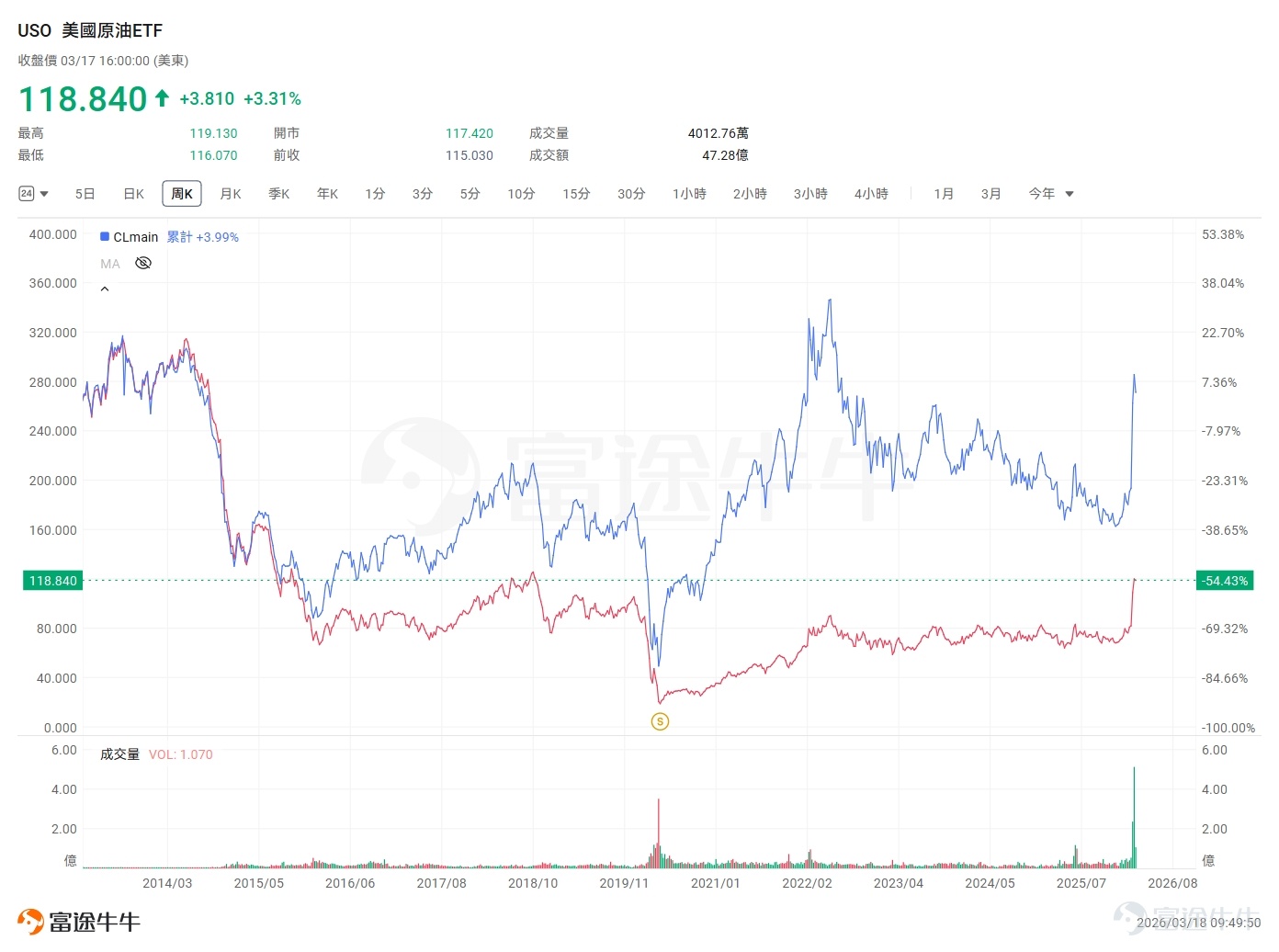
However, a rarely noticed puzzle among investors is: why does USO consistently deviate from the benchmark it tracks? $Crude Oil Futures (NOV6) (CLmain.US)$ price?
By contrast, gold-tracking $SPDR Gold ETF (GLD.US)$ or track silver $iShares Silver Trust (SLV.US)$ , their price movements align much more closely with spot gold and silver prices. The key difference lies in the physical attributes of the underlying assets and the trading structure of the financial contracts.

Gold and silver are ultimate physical assets that are easy to store and do not degrade easily. GLD and SLV funds actually hold physical gold and silver bars stored in vaults in London. Therefore, their net asset value directly reflects spot prices plus a small management fee and storage fee, without structural depreciation.
Crude oil, on the other hand, is a commodity with a lower unit value compared to precious metals. Crude oil ETFs typically do not purchase and store crude oil directly because high storage costs make it economically unfeasible.
USO holds WTI crude oil futures contracts traded on the New York Mercantile Exchange (NYMEX). The manager of USO attempts to simulate crude oil price movements by continuously rolling over near-month futures contracts. It is this 'rolling over' process that introduces significant structural variables, the performance of which depends entirely on the term structure of the futures market - Contango or Backwardation.
Contango: Ongoing Bleeding
Contango refers to a market structure where forward futures prices are higher than near-term futures prices. This typically occurs during periods of oversupply and high inventory, such as when the 2020 pandemic caused a collapse in demand.
Under this structure, when the near-month contracts held by USO approach expiration, it must sell the cheaper expiring contracts and simultaneously buy the more expensive next-month contracts.This 'buy high, sell low' rolling operation generates a fixed cash loss each time, known as the 'rolling cost.'
Assuming the April WTI contract price is $70 and the May contract is $72. USO sells the April contract at $70 before it expires and buys the May contract at $72. Even if the spot price of crude oil remains unchanged, the holding cost for USO passively increases by $2 per barrel.
This type of loss continues to occur with each monthly contract roll, and over the long term, it accumulates, causing USO's net asset value to consistently underperform the rise in WTI spot prices, or even decline steadily when oil prices are range-bound.This is why, in the deep contango seen in 2020, although oil prices rebounded from their lows, the magnitude of USO’s rebound was far weaker than that of oil prices.

Backwardation: Additional Gains
Backwardation refers to a market structure where forward futures prices are lower than near-term futures prices. This typically occurs during periods of tight supply, low inventories, and strong immediate demand driven by geopolitical conflicts, such as after the outbreak of the Russia-Ukraine conflict in 2022 and the current 2026 U.S.-Iran conflict.
At this point, the futures curve slopes downward. When USO rolls over its contracts, it sells the higher-priced near-month contracts and buys the lower-priced far-month contracts, effectively turning into 'sell high, buy low.'
Assuming the April WTI contract price is $95 and the May contract is $93 (a backwardation structure). USO sells the April contract for $95 and buys the May contract for $93, gaining $2 per barrel as a 'roll yield' in one rollover.
Therefore, in a strong backwardation environment like the current one, USO can not only benefit from rising oil prices but also earn additional 'dividends' brought by the structure of the futures curve, potentially outperforming the increase in WTI spot prices.This is precisely part of what makes USO attractive right now—it is not just a tool for being long on oil prices, but also a structured product capable of profiting from tight spot markets.

On Futubull, you can easily view and analyze the term structure of crude oil.Click on Market > Futures, scroll down to find WTI crude oil under the 'Energy and Chemicals' category. On the quote page, click on futures on the right to see all WTI contracts across different maturities.
You can also click on 'Calendar Spread' on the right, and the system will automatically calculate the price difference between the selected contract and various maturities.


(The illustration is for explanatory purposes only and does not constitute any investment advice or guarantee.)
We can clearly see that the current crude oil market is in a backwardation structure.The front-month contract is priced at $94 per barrel, with prices for subsequent months decreasing gradually; the December contract is priced at $76 per barrel.
It is worth noting that the record inflow of funds into USO recently reflects a frenzy of 'everyone jumping on the bandwagon.' Many investors may not have thoroughly understood what they were buying.As a highly volatile and complex financial instrument, USO’s recent outstanding performance is precisely based on the current extreme spot premium structure. Once supply and demand pressures ease and the term structure reverses, previous gains could turn into losses.
Joint strategy of futures curves and options
Understanding that the deviation in USO's performance stems from futures roll gives us a key toconduct an in-depth analysis of the market mechanisms behind its spread with WTI and uncover clear arbitrage opportunities.。This is no longer a simple directional bet, but a precise play on the term structure of the market itself.
Recognizing that the current market is in a strong backwardation and that USO has the advantage of earning positive roll yield, the trading direction gains fundamental support. Options tools provide multiple ways to participate.
Strategy One: Participate in the direction, but optimize costs – Bull Call Spread
If you believe that oil prices have yet to fully reflect the long-term impact of the Hormuz blockade, it's time to take a position. In the currently expensive environment with implied volatility (IV) surging sharply, simply buying call options is too costly. A bull call spread is a better choice. This is suitable for a moderately bullish scenario where USO will rise but is unlikely to break through extremely high levels driven by market sentiment.

(The illustration is for explanatory purposes only and does not constitute any investment advice or guarantee.)
Buy a near-term call option with a lower strike price while simultaneously selling a call option with a higher strike price of the same expiration.
Pay the net premium to lock in the maximum loss. If USO rises due to an increase in oil prices and positive roll yield, the maximum gain is the difference between the strike prices minus the net cost. Essentially, this uses the income from selling the higher strike price option to offset the cost of buying the call option, providing leveraged returns when correct in direction while hedging against the risk of value decay caused by a sharp drop in IV.

(The design images displayed on screen are for illustrative purposes only and do not constitute any investment advice or guarantees; market conditions fluctuate frequently, and the option prices shown do not represent real-world values.)
Strategy Two: Spot-month spread-based option combinations (for crude oil futures options)
If you believe that the blockade of the strait will persist in the long term and the strength of the near-term contract (backwardation structure) will continue.
Buy call options on near-term WTI futures while selling call options on far-term WTI futures. This forms a bullish calendar spread option combination. If oil prices rise and the near-term contract rises faster (wider spread), this strategy will capture dual gains (direction + spread). The cost is lower than directly holding a futures spread, but the profit potential is capped by the sold options.
The core of these strategies lies in converting geopolitical risks (whether the Hormuz Strait remains navigable) into precise judgments on the term structure of the futures market (Contango/Backwardation slope) and using options tools to define risks and enhance returns.It requires investors to not only focus on the 'battle situation' in the headlines but also closely monitor the subtle price spread changes between futures contracts in the exchange.
Apart from USO, what other options do investors have?
The crude oil investment landscape extends far beyond USO. Based on risk appetite, investment horizon, and familiarity with tools, investors have a rich toolkit at their disposal.
(1) Other crude oil commodity ETFs:
$United Sts Brent Oil Fd Lp Unit (BNO.US)$ : Tracks Brent crude oil futures. Currently, as the global pricing benchmark, Brent is more sensitive to Middle Eastern tensions. Like USO, it faces roll yield decay issues.
$Powershares Db Multi-Sector Commodi Powershares Db Oil Fund (DBO.US)$ : Employs an optimized rolling strategy (dynamically selecting contracts based on the term structure), aiming to reduce losses under Contango, potentially offering better long-term tracking than USO.
Leveraged/Inverse Products: Such as $ProShares Ultra Bloomberg Crude Oil ETF (UCO.US)$ (ProShares Ultra Bloomberg Crude Oil, 2x Long) , $ProShares UltraShort Bloomberg Crude Oil ETF (SCO.US)$ (2x Short).These are intraday trading instruments. Due to compounding leverage and volatility decay, they are absolutely unsuitable for long-term holding and are only appropriate for experienced short-term traders.
(2) Oil and gas stocks and industry ETFs:
This is an indirect but logically richer way to participate. Stock prices not only reflect oil prices but also corporate operations, cost control, dividend policies, and industry cycles.
Upstream exploration and production (E&P) companies: Such as $Exxon Mobil (XOM.US)$ 、 $Chevron (CVX.US)$ 、 $ConocoPhillips (COP.US)$ . These companies are the most sensitive to oil price fluctuations, with high oil prices directly translating into surging profits. In the current environment, companies with production in secure regions are particularly benefiting.
Oilfield service companies: Such as $SLB Ltd (SLB.US)$ 、 $Halliburton (HAL.US)$ . High oil prices will stimulate global capital expenditures in the oil and gas sector, leading to order growth. Their stock price cycles tend to lag slightly behind oil prices.
Integrated national oil companies: such as the 'Big Three' in A-shares (PetroChina, Sinopec, CNOOC). They combine upstream profits with downstream stability and generally offer high dividend yields, making them a more defensive energy allocation choice.
Industry ETF: $Energy Select Sector SPDR Fund (XLE.US)$ This is a broad-based ETF for the US energy sector. Investing in such an ETF diversifies individual stock risks while capturing industry beta.
(3) More specialized instruments (high threshold, high risk):
Crude oil futures and options: Direct trading on the NYMEX and ICE exchanges. High leverage, high professionalism, suitable for institutions and seasoned investors. Can most directly express any view on price and spreads.
At present, every ripple in the Strait of Hormuz is transformed through complex financial channels into a sharp turn on the futures curve and a precise game in the options market. For investors, moving beyond the binary narrative of 'oil price rises and falls,' gaining an in-depth understanding of the endogenous structure of tools like USO, and mastering the skills of using futures spreads and options combinations for multi-dimensional trading are key to achieving excess returns and risk management in this geopolitically driven energy storm.
Finally, here's a small perk for fellow investors—welcome to claim it!Options Beginner Pack
This event is exclusively for invited HK users, click to learn moreDetailed event rules >>
Futu's simulated trading challenge is now open for registration! Zero cost, zero risk, and you could win stock cash vouchers!For more details, click here

Disclaimer
This content does not constitute any offer, solicitation, recommendation, opinion, or guarantee of any securities, financial products, or tools. The risk of loss in buying and selling options can be substantial. In some cases, your losses may exceed the initial margin amount deposited. Even if you set contingent orders, such as 'stop-loss' or 'limit' orders, these may not necessarily prevent losses. Market conditions may make these orders unexecutable. You might be required to deposit additional margin within a short period. If you fail to provide the required amount within the specified time, your open positions may be liquidated. However, you will still be responsible for any account deficit arising from this. Therefore, before trading, you should study and understand options and carefully consider whether such trading suits you based on your financial situation and investment objectives. If you trade options, you should be familiar with the procedures upon exercising options and at expiration, as well as your rights and obligations when exercising options and at expiration.
Risk Disclaimer: The above content only represents the author's view. It does not represent any position or investment advice of Futu. Futu makes no representation or warranty.Read more


Comments (201)
to post a comment
348
93