
English
Back
Open Account
Focus on GTC 2026! What signals did Jensen Huang's speech send?

牛牛Insights
joined discussion · Mar 17 10:06 ·

Why did a staggering $1 trillion positive surprise only result in NVIDIA's short-lived rally?

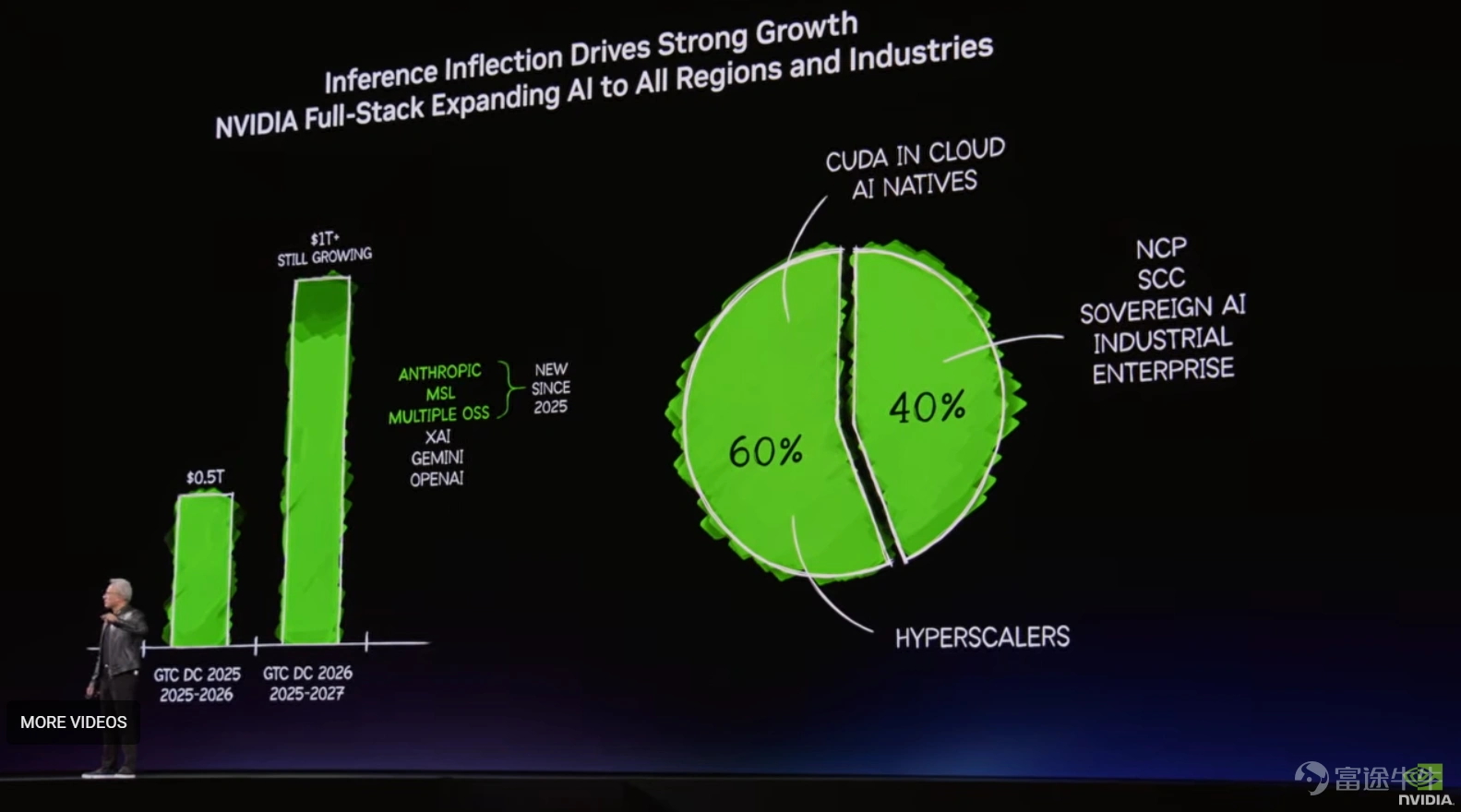
Author | Eric $NVIDIA (NVDA.US)$ The stock price performance during the GTC conference once again followed a familiar pattern. The initial surge was driven by storytelling, while the subsequent pullback was due to serious number crunching. Why did the stock price surge quickly? The initial spike at the opening was mainly due to Huang presenting an astonishing figure on the screen, directly revealing that the revenue opportunity for data centers and AI infrastructure between 2025 and 2027 would exceed $1 trillion. In that very moment, the market immediately viewed it as a super blockbuster surprise. The message conveyed to investors was straightforward. NVIDIA is now discussing far more than just market expansion. It outlined a growth curve driven by inference demand, with its customer base broadening comprehensively, encompassing hyperscale cloud providers, cloud-native AI companies, sovereign AI projects, industrial applications, and various enterprise-level use cases. This grand narrative naturally supported higher long-term revenue expectations, perfectly explaining why the stock price surged right after the presentation began. Why did the rally then fade? The subsequent pullback was also expected. When investors calmed down and compared this eye-catching figure with Wall Street’s already well-established models, the sense of surprise quickly diminished. According to Bloomberg consensus estimates, NVIDIA's total data center revenue for fiscal years 2026 to 2028 had already been projected at roughly$969.6 billion. This figure, along with the newly announced...
Author | Eric
$NVIDIA (NVDA.US)$ The stock price performance during NVIDIA's GTC conference once again followed a familiar pattern. The initial surge was driven by storytelling, while the subsequent pullback was due to investors doing the math.
Why did the stock price rise so quickly?
The sharp rise at the opening was mainly due to Huang presenting an astonishing figure on screen, projecting revenue opportunities for data centers and AI infrastructure between 2025 and 2027 to exceed $1 trillion. At that moment, the market immediately viewed it as a major surprise.
Author | Eric $NVIDIA (NVDA.US)$ The stock price performance during the GTC conference once again followed a familiar pattern. The initial surge was driven by storytelling, while the subsequent pullback was due to serious number crunching. Why did the stock price surge quickly? The initial spike at the opening was mainly due to Huang presenting an astonishing figure on the screen, directly revealing that the revenue opportunity for data centers and AI infrastructure between 2025 and 2027 would exceed $1 trillion. In that very moment, the market immediately viewed it as a super blockbuster surprise. The message conveyed to investors was straightforward. NVIDIA is now discussing far more than just market expansion. It outlined a growth curve driven by inference demand, with its customer base broadening comprehensively, encompassing hyperscale cloud providers, cloud-native AI companies, sovereign AI projects, industrial applications, and various enterprise-level use cases. This grand narrative naturally supported higher long-term revenue expectations, perfectly explaining why the stock price surged right after the presentation began. Why did the rally then fade? The subsequent pullback was also expected. When investors calmed down and compared this eye-catching figure with Wall Street’s already well-established models, the sense of surprise quickly diminished. According to Bloomberg consensus estimates, NVIDIA's total data center revenue for fiscal years 2026 to 2028 had already been projected at roughly$969.6 billion. This figure, along with the newly announced...
The message conveyed to investors was very straightforward. NVIDIA is now discussing much more than just market expansion. It outlined a growth curve driven by inference demand, with its customer base expanding significantly to include hyperscale cloud providers, cloud-native AI companies, sovereign AI projects, industrial applications, and various enterprise-level solutions. Such grand storytelling naturally supported higher long-term revenue expectations, perfectly explaining why the stock price surged as soon as the presentation began.
Why did the rally reverse?
The subsequent pullback was also predictable. When investors calmed down and compared this eye-catching figure with Wall Street’s pre-existing models, the sense of surprise diminished significantly.
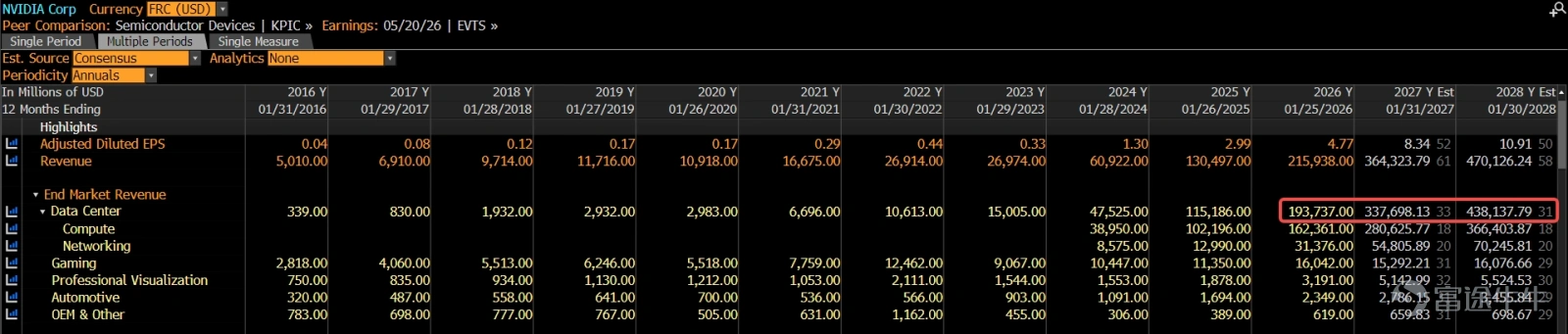
According to Bloomberg consensus estimates, NVIDIA's total data center revenue from fiscal year 2026 to 2028 had already been projected at approximately$969.6 billion. This figure, alongside the newly announced1 trillion U.S. dollars, the difference between the two is only about30.4 billion US dollars, which translates to an increase of approximately3%.
Author | Eric $NVIDIA (NVDA.US)$ The stock price performance during the GTC conference once again followed a familiar pattern. The initial surge was driven by storytelling, while the subsequent pullback was due to serious number crunching. Why did the stock price surge quickly? The initial spike at the opening was mainly due to Huang presenting an astonishing figure on the screen, directly revealing that the revenue opportunity for data centers and AI infrastructure between 2025 and 2027 would exceed $1 trillion. In that very moment, the market immediately viewed it as a super blockbuster surprise. The message conveyed to investors was straightforward. NVIDIA is now discussing far more than just market expansion. It outlined a growth curve driven by inference demand, with its customer base broadening comprehensively, encompassing hyperscale cloud providers, cloud-native AI companies, sovereign AI projects, industrial applications, and various enterprise-level use cases. This grand narrative naturally supported higher long-term revenue expectations, perfectly explaining why the stock price surged right after the presentation began. Why did the rally then fade? The subsequent pullback was also expected. When investors calmed down and compared this eye-catching figure with Wall Street’s already well-established models, the sense of surprise quickly diminished. According to Bloomberg consensus estimates, NVIDIA's total data center revenue for fiscal years 2026 to 2028 had already been projected at roughly$969.6 billion. This figure, along with the newly announced...
However, it cannot be said that this guidance is not impressive. Objectively speaking, when you put the old and new data side by side for comparison, you will find that this round of expected upward revisions is indeed slightly less striking than the initial shock of seeing that trillion-dollar headline.The new data has indeed exceeded expectations, but the extent of the outperformance was not as exaggerated as the market's first reaction might have suggested.
Why is NVIDIA always treated differently?
The deeper reason lies in the fact that the outside world now views NVIDIA with a completely different perspective. As the world's largest company by market capitalization, merely strong performance is no longer enough to satisfy investors' appetites. What everyone is really watching is whether it can continue to push its ceiling infinitely higher.
The same trillion-dollar positive headline, if placed on any other semiconductor company, would absolutely be an explosive event akin to a nuclear bomb, but for NVIDIA, it only brings a brief market rally. At present, NVIDIA enjoys the valuation treatment of being the top-performing student in the entire market. The current passing grade has long surpassed the simple expectation of beating earnings. The market demands that it deliver a report card that thoroughly disrupts long-term profitability forecasts.
Similarly, this explains why NVIDIA's future growth story remains highly promising. Assuming the demand for inference continues to grow exponentially, and assuming sovereign AI and enterprise-level AI keep aggressively expanding the customer base, with NVIDIA successfully monetizing its full-stack AI solutions while moving completely away from the standalone chip sales model, then $1 trillion will absolutely not be the final ceiling.
Risk Disclaimer: The above content only represents the author's view. It does not represent any position or investment advice of Futu. Futu makes no representation or warranty.Read more
Thumbs Up
15
Heart
2
Lol
1
88K Views
Report
Comments (18)
Write a Comment...
18
18
56