
Hong Kong stocks are rebounding—what sectors deserve attention?

BYD's breakout targets 110.4 HKD; be mindful of the Bollinger Bands sell signal.
$BYD COMPANY (01211.HK)$ BYD (01211.HK) has recently demonstrated a strong breakout pattern in its stock price movement, becoming a market focal point. As of March 16, 2026, BYD closed at 104.8 HKD, surging by 7.89%, with an intraday high of 104.8 HKD, successfully breaking through and stabilizing above the psychological threshold of 100 HKD. The stock gradually rebounded from around 94 HKD, near the early-March low, showing a clear short-term breakout pattern. As of the noon session on March 16, BYD shares rose nearly 8%, driving overall strength in the new energy vehicle sector, including Nio-SW (09866). $NIO-SW (09866.HK)$ Up over 5%, Xiaomi Group (01810) $XIAOMI-W (01810.HK)$ Up over 5%, Seres (09927) $SERES (09927.HK)$ , Li Auto (02015) $LI AUTO-W (02015.HK)$ , Geely Auto (00175) $GEELY AUTO (00175.HK)$ and other stocks followed the upward trend.
Technical Analysis Summary
From a technical perspective, BYD's share price started rebounding from near the low of 94 yuan in early March, with a significant breakout observed recently. Based on technical data as of March 16, BYD’s first support level is around 95.8 yuan, close to the rebound starting point in early March and near the 10-day moving average; a more critical second support level is at 94.2 yuan, equivalent to the top of the consolidation range in late February. If the stock price can stabilize above the current level and move higher, the first resistance will be seen at 108.2 yuan, which was the top of the previous high-density trading range; if it breaks through successfully, the next resistance level will be targeted at 110.4 yuan, followed by the mid-term resistance zone near 115 yuan.
The moving average structure shows that the short-term 5-day moving average has crossed above the 10-day moving average to form a golden cross, while the 10-day line has also started turning upwards, reflecting increasing short-term rebound momentum. The share price is currently standing firmly above all short-term moving averages, with the 20-day, 30-day, and 60-day lines showing an upward divergence pattern, indicating a gradual strengthening of the medium-term trend. In terms of technical indicators, the overall signal suggests “sell,” with eight sell signals present, but RSI stands at 53, multiple oscillation indicators are neutral, and the stochastic oscillator is issuing a buy signal. Meanwhile, trend-following indicators like the bull-bear power indicator and Ichimoku Cloud show a buy signal, MACD indicates buy, while Bollinger Bands suggest sell. Overall, the current technical signals indicate an “early breakout” pattern, with short-term trends strengthening, but beware of potential short-term overbought pressure.
Market News Summary
On the institutional views front, Citi issued a report on March 16 stating that they expect BYD’s exports and domestic sales in March to expand month-over-month, totaling approximately 220,000 to 250,000 units. They reiterated their “buy” rating for the company with a target price of 174 Hong Kong dollars. Citi believes that BYD is likely to reduce inventory in March and April, controlling production ahead of the new product cycle expected to start in mid-April. In terms of products, BYD recently launched the FANGCHENG Leopard Ti3 Flash Charge Edition, and Citi estimates that once sales mature, monthly volumes could reach 8,000 to 9,000 units; the Leopard 7 will officially launch in April.
Regarding sales data, according to information from the China Passenger Car Association (CPCA), during January-February 2026, Volkswagen and its two joint ventures with First Automotive Works and SAIC Motor collectively held a market share of 13.9%, reclaiming the top spot in new car sales; Geely Auto ranked second with a 13.8% market share; Toyota Motor had a combined market share of 7.8%, ranking third; BYD, affected by China’s reduction in subsidies for new energy vehicles, saw its market share fall to 7.1% during January-February, dropping to fourth place, with February sales recording the largest decline since the COVID-19 pandemic. However, institutions generally believe that with the start of a new product cycle and ongoing technological advantages, BYD's subsequent sales are expected to gradually recover.
Review of Warrant Products
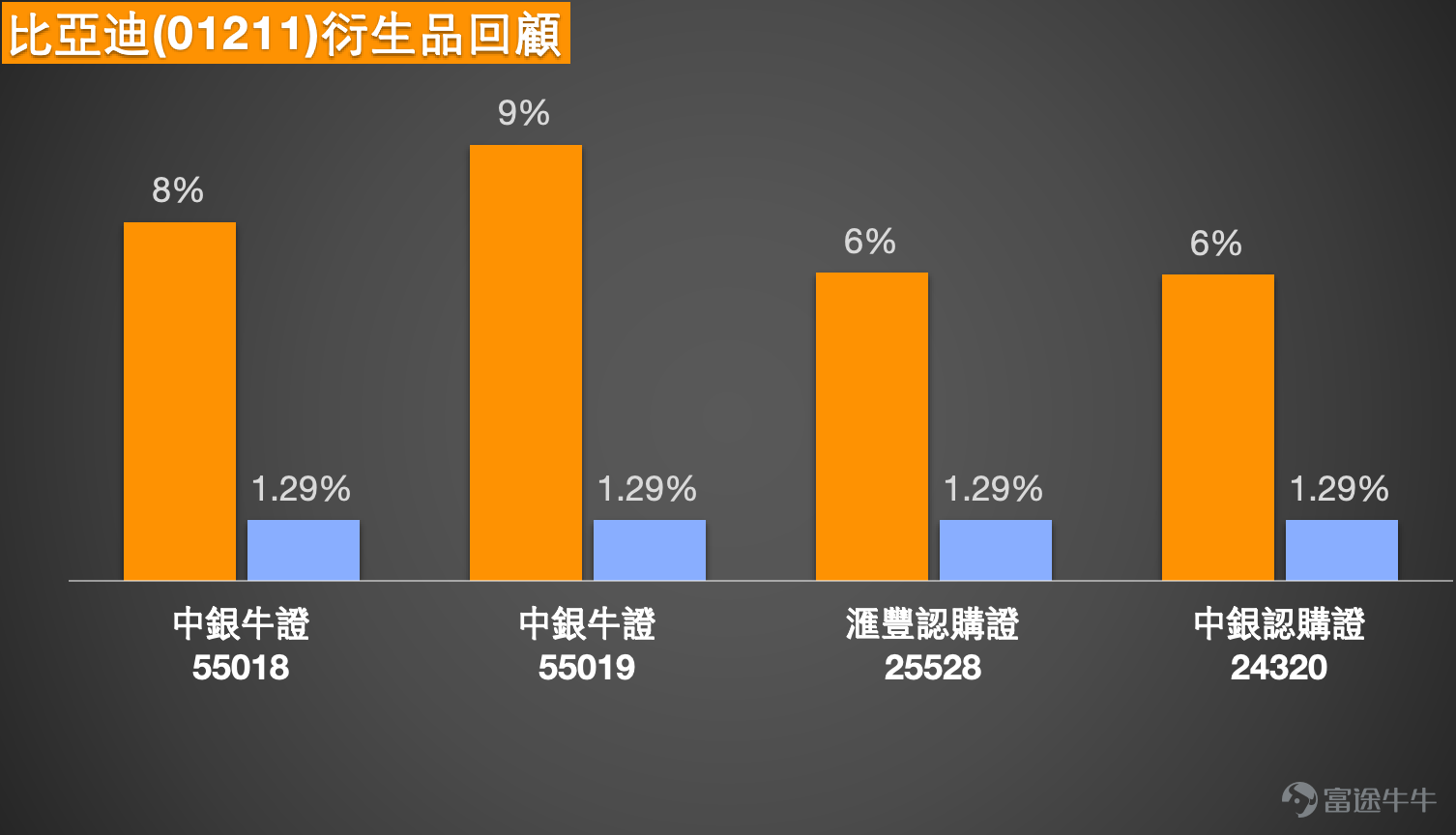
In terms of warrant products, several BYD-related derivatives mentioned on March 10, 2026, showed significant performance in the following two trading days (up to March 12). During this period, the underlying BYD stock rose 1.29%, while related bullish products demonstrated strong leverage effects: HSBC Call Warrant (25528) $HS-BYD @EC2608A.C (25528.HK)$ and BOC call warrant (24320) $BI-BYD @EC2611A.C (24320.HK)$ both rose by 6%, BOC bull certificate (55019) $BI#BYD RC2612E.C (55019.HK)$ increased by 9%, BOC bull certificate (55018) rose by 8%. The data shows that although the upside of the underlying stock was limited, the increase in related derivatives significantly outpaced the stock's performance. This is precisely the core feature of leveraged products — they amplify returns when there is volatility in the underlying stock.

With BYD’s current share price at HK$102.3, combined with the aforementioned support levels of HK$95.8 and HK$94.2, as well as resistance levels at HK$108.2 and HK$110.4, investors can choose suitable CBBCs (Callable Bull/Bear Contracts) or warrants based on their own views.
For investors optimistic about BYD holding above the HK$100 mark and breaking upwards, two call warrant products can be considered. HSBC call warrant (25528) has a strike price of HK$106.98, offering approximately 5.8x leverage, making it the product with the lowest premium and implied volatility, ideal for cost-effective bullish strategies. Based on the current share price, this slightly out-of-the-money product has an OTM degree of around 4.6%, close to the first resistance level of HK$108.2, suitable for investors expecting the stock to break through HK$108.2. Another option is the BOC call warrant (24320), which has a strike price of HK$104.1, providing 4.4x leverage. This warrant offers the highest leverage and low implied volatility, with an OTM degree of about 1.8%, making it more sensitive to stock price increases and better suited for those expecting moderate upward movement.
For bearish investors who believe BYD shares will remain capped below the HK$108.2 resistance or even retreat towards support levels, two put warrant options are available. HSBC put warrant (22409) has a strike price of HK$81.83, offering 5.5x leverage, and features the lowest premium and implied volatility, making it appropriate for bearish strategies. Alternatively, BOC put warrant (22386) also has a strike price of HK$81.83, with 5.3x leverage, relatively higher than its peers. Note that the strike price of HK$81.83 is lower than the current stock price, classifying these as out-of-the-money products. If the share price falls below the HK$95.8 support, such products would perform optimally.
Regarding CBBC deployment, bullish investors may consider two bull contracts. BOC bull contract (55018) has a stop-loss level at HK$85, providing actual leverage of 6.5x with relatively low premium. Another choice is BOC bull contract (55019), with a stop-loss level at HK$84 and actual leverage of 6.1x, the highest among the options, with a similarly low premium. When selecting bull contracts, ensure the stop-loss level is below the support levels of HK$95.8 and HK$94.2 to provide sufficient safety buffer; the stop-loss levels of HK$85 and HK$84 are far below both supports, ensuring ample margin of safety, making them suitable for conservative strategies. Reviewing past warrant performance, the BOC bull contracts (55019) and (55018) deployed on March 10 recorded gains of 8% to 9% during the underlying stock's rise, demonstrating the leverage effect of bull contracts.
Bearish investors may consider two bear contracts. UBS bear contract (63979) has a stop-loss level at HK$106, offering actual leverage of 10.1x, with the lowest premium and relatively high leverage. An alternative is Societe Generale bear contract (57764), also with a stop-loss level at HK$106, providing 10.1x leverage, with high leverage and low premium. When choosing bear contracts, ensure the stop-loss level exceeds the resistance levels of HK$108.2 and HK$110.4; the HK$106 stop-loss is slightly below the first resistance level of HK$108.2, representing a closer strategic option with good leverage effects, but note that if the share price quickly breaks through HK$108.2, there is a risk of the product being called back. More conservative investors might opt for bear contracts with a stop-loss level above HK$110.

Overall, BYD's stock is currently in a strong breakout phase, successfully reclaiming the HK$100 level, with the HK$108.2 resistance set to determine short-term direction. Fundamentally, positive factors like the launch of second-generation blade batteries and fast-charging technology, accelerated construction of fast-charging stations, and Citi's optimistic sales outlook are converging. However, the decline in market share for Jan-Feb sales and changes in subsidy policies still need monitoring. Investors should strictly manage risks when deploying positions, select appropriate derivatives based on key support levels at HK$95.8 and HK$94.2 and resistance levels at HK$108.2 and HK$110.4, and take into account the impact of OTM degrees on product performance, as well as the crucial role of implied volatility levels on warrant prices.
Interactive Question:
Dear readers, do you think BYD (01211) can successfully break through the HK$108.2 resistance in the short term and further test HK$110.4?
A) Yes, benefiting from the release of new technology and Citi's positive outlook, the strong performance will continue.
B) No, the resistance at HK$108.2 is heavy, requiring consolidation and a retest of support at the HK$100 level.
Feel free to share your views in the comments section. This article is for reference only and does not constitute any investment advice. The market data, opinions, and analysis contained herein may change at any time without prior notice. We are not responsible for any loss or damage resulting from reliance on the information in this article. Technical analysis only shows whether certain technical conditions are met; a comprehensive evaluation of asset performance should combine other information, and trading decisions should not be made solely based on this article. Please note that past performance is not indicative of future results. Follow Jenny's Hong Kong Warrants for more professional insights.
Risk Disclaimer: The above content only represents the author's view. It does not represent any position or investment advice of Futu. Futu makes no representation or warranty.Read more


Comments
to post a comment
5
12