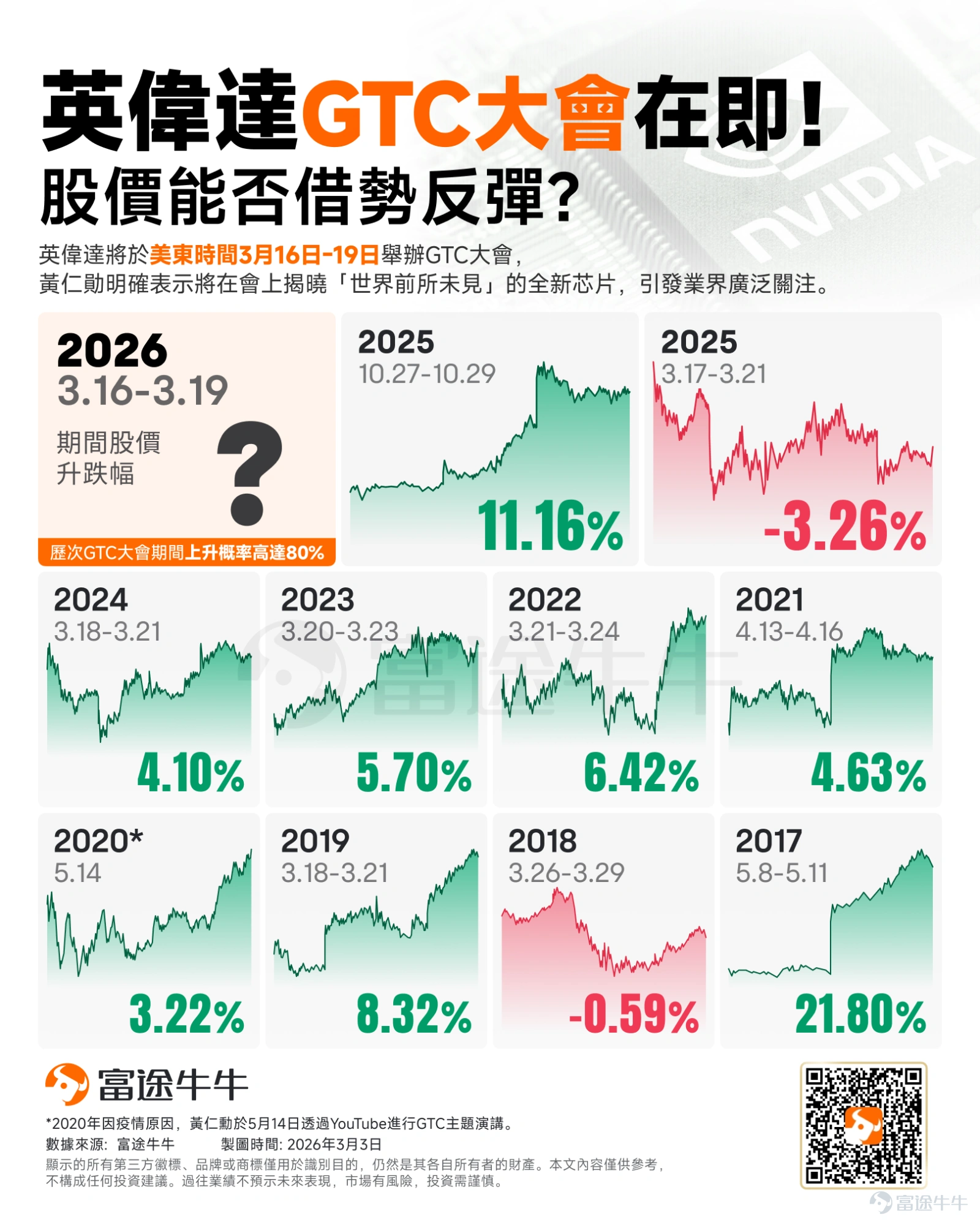

Focus on GTC 2026! What signals did Jensen Huang's speech send?

Option Sir Breaks Down Hot Topics | With GTC Approaching, Is NVIDIA Still a Worthy Bet? — Examining Trading Opportunities in the NVIDIA Supply Chain Amid Oil Price Shocks and Declining Risk Appetite
Next week, $NVIDIA (NVDA.US)$ NVIDIA GTC 2026 will be held from March 16 to 19, Jensen Huang's keynote speech is scheduled for March 16 (2:00 AM Beijing time on March 17).
Over the past ten annual GTC events, NVIDIA’s stock has risen 80% of the time, with price changes ranging between -0.59% and 21.80%.However, the biggest difference this year compared to previous years is that it is not taking place in a favorable macro environment.Recently, the market's main trading theme has clearly shifted from “growth” to “geopolitical conflict + rising oil prices + recurring inflation.”

On March 12, the three major US stock indexes plummeted significantly, $Dow Jones Industrial Average (.DJI.US)$ 、 $S&P 500 Index (.SPX.US)$ 、 $Nasdaq Composite Index (.IXIC.US)$ dropping by 1.56%, 1.52%, and 1.78% respectively; on the same day, WTI and Brent crude oil surged by 9.7% and 9.2% respectively, with oil prices once again nearing $100 per barrel. Entering the Asian trading session on March 13, risk appetite did not show significant recovery, and Asian stock markets continued to weaken.
This means the real question now is no longer 'Will GTC bring positive news?', but rather:Against the backdrop of rising macro risks and shifting interest rate expectations, can the positive news from GTC still translate into stock performance?
1. Under the concerns of Middle East conflicts and inflation, is it still worth betting on GTC?
The macro environment is placing new constraints on highly-valued growth stocks. Based on the published data, US inflation in February was not out of control. According to the BLS, the year-over-year CPI for February was 2.4%, while core CPI was up 2.5% year-over-year; month-over-month, overall CPI increased by 0.3%, and core CPI rose by 0.2%. If we only look at this data set, the market would have been more inclined to retain hopes for interest rate cuts.
The issue is that February's data has yet to reflect the new wave of oil price shocks following the escalation of the Middle East conflict in mid-March.Therefore, what the market currently faces is a typical dislocation:The published inflation data looks acceptable, but inflation expectations for the next month are rising again. For AI assets whose valuations are already high, this macro dislocation will significantly increase short-term volatility.
In terms of investor behavior, JPMorgan's latest retail radar report shows that, unlike the record bottom-fishing response of retail investors after the 'equivalent tariff' shock last April, overall buying power has noticeably contracted.However, there remains a significant preference for AI and technology sectors, indicating that buying pressure for tech stocks has not dissipated.

So, returning to the question most investors are concerned about:Is it still worth betting on the positive catalysts for GTC? It remains the industry event to watch next week, but it is more like a repricing within the AI theme, likely presenting structural opportunities rather than being a key that can immediately reverse the entire market’s risk appetite.
From an industry logic perspective,GTC is still likely to remain positive, further solidifying NVIDIA's central role in the AI infrastructure cycle.It will also bring capital attention back to high-growth areas such as optical interconnects, server systems, AI cloud, and liquid cooling power.
But from a macro constraint perspective,The GTC coincides almost perfectly with the FOMC meeting held on March 17th to 18th.This will lead to a very real market outcome: even if the GTC releases positive information, capital may not immediately provide smooth follow-up feedback because risk appetite at the macro level will also be tested by the Federal Reserve and oil prices at the same time.
Short-term odds may not focus on NVIDIA itself but are more likely to concentrate on sectors with higher elasticity in the value chain.If the market chooses to trade based on the GTC, the sectors that often show performance first tend to be those with more direct relevance and greater elasticity, such as optical modules, optical components, high-speed connectivity, server systems, and power/liquid cooling. The probability of such 'internal rotation within the main theme' is higher than that of 'a comprehensive rise across the entire platform.'
For specific stocks, you can refer to the list of potentially benefiting companies in the image below.

Secondly, what will the market actually trade during this GTC?
Let’s start with NVIDIA itself. Its fundamentals are solid and remain extremely strong.
NVIDIA's FY2026 earnings report released at the end of February indicated that the company's revenue guidance for the next quarter reached $78 billion. Management continued to emphasize that agentic AI is driving a new wave of computing demand expansion. In other words, NVIDIA isn’t lacking growth or orders—it lacks providing 'new incremental evidence' on top of already high expectations.
Precisely because expectations are already high, the market needs the conference to provide more compelling incremental information. Whether the stock price can continue to rise will depend on whether GTC can clarify the 'next phase of growth' more explicitly.Which parts of the roadmap NVIDIA has already disclosed will be elaborated on more specifically and made more actionable.。
As for what content will be announced at GTC, according to official sources, the theme of GTC 2026 has clearly pointed towards AI factories, agentic AI, inference, and physical AI.The market's most central speculations at present include the following:
1. What the market is most certain to focus on is still Rubin.
In January this year, NVIDIA officially launched the Rubin platform and clearly stated that Rubin has entered full production, with partner products set to be released in the second half of 2026. The company also provided a series of strong performance claims, such as the Rubin platform achieving a reduction in inference token costs by up to 10 timesand the number of GPUs required to train MoE models decreasing. 4 times。
Therefore, what the market wants to hear at GTC is Specific details on how Rubin will sell, who goes first, when volume will be released, and which customers have already placed orders。
Looking more closely, the market's focus on Rubin isn't just about the GPU itself but rather rack-level systems。
As the AI industry shifts from 'buying cards' to 'buying systems,' if GTC further emphasizes the deployment methods of NVL72, liquid cooling, rack density, and customer adoption, the market will interpret this as NVIDIA's continued evolution from a chip company to an 'AI factory general contracting platform.'
2. Networking and optical interconnects may be the product line most likely to exceed expectations at this conference
If GPUs are what everyone expects to hear about, then networking and optical interconnects are the areas at this GTC most likely to bring an 'expectation gap.'
Because NVIDIA's recent pre-conference actions have been highly concentrated: On March 2, it successively announced strategic cooperation agreements with Coherent and Lumentum to promote next-generation data center optical technology and U.S.-based manufacturing capabilities; as GPU clusters grow in scale, the true limiting factors are often not the chips themselves but bandwidth, latency, power consumption, and system stability, so the importance of networking and optical interconnects is rising significantly.
If Jensen Huang continues to reinforce the system value of Spectrum-X, Ethernet, silicon photonics, and optical interconnects at GTC, then the market will further upgrade its expectations for optical modules, optical components, high-speed connectivity, and switching chains.
3. At the software and model level, the market expects the narrative of 'agentic AI' to be strengthened.
Over the past two years, the market has mainly priced AI based on training-side expansion; however, starting from 2026, the inference side is becoming a new source of growth. NVIDIA has officially listed inference and agentic AI as core themes for GTC 2026.
Just before the event, NVIDIA also released Nemotron 3 Super, an open model focused on agentic reasoning, emphasizing its ability to achieve higher throughput in agentic AI scenarios.
If NVIDIA only talks about hardware, the market will see it as the old logic;but if it also demonstrates that it is establishing standards in the agent software stack, inference optimization, and open-source models, then the valuation logic will be elevated from 'selling GPUs' to 'defining AI infrastructure platforms.'。
4. There is also a speculation: could Feynman be announced ahead of time?
This part currently still belongs to Market rumors and sell-side expectations, not officially confirmed by NVIDIA. According to Barron’s pre-event coverage today, analysts are looking forward to NVIDIA updating on network and system scalability, while also expecting the company to provide more details on the Feynman architecture following Vera Rubin . The same report also mentioned that the market expects NVIDIA might showcase a chip that is more optimized for AI inference .
This expectation exists, but it cannot yet be treated as confirmed news.
Thirdly, how to use options to participate in GTC opportunities?
For conservative clients, GTC can be seen as a window to execute 'expectation gap trading' around NVIDIA's main theme, but due to the weak external environment, aggressive positions should be avoided. It is currently more suitable to make tiered allocations around the strongest certainty themes rather than emotionally chasing highs.
For aggressive clients, it is advisable to focus on whether there are any unexpected new statements during the conference,especially regarding Rubin's rhythm, the implementation of optical interconnects, the commercialization of inference, and the visibility of AI factory orders. If these details exceed expectations, the high-elasticity sectors within the NVIDIA supply chain still have the potential to deliver excess returns;
however, if the conference does not bring significant new developments and the Fed continues to signal caution, the market may experience a 'lively conference but no stock price increase' scenario.
We will use NVIDIA and a recent representative from the NVIDIA supply chain $Lumentum (LITE.US)$ as an example to illustrate:
As of March 12, $NVIDIA (NVDA.US)$ the stock price is in a critical oscillation range, with various technical indicators showing neutral-to-weak signals. The short-term technical direction remains unclear, requiring attention to support at the lower Bollinger Band (around $176) and whether the moving average system can converge upwards again. The options market shows balanced bullish and bearish forces, with the Implied Volatility Percentile (IV Percentile) at 51%, placing IV at a historically moderate level.
$Lumentum (LITE.US)$ The technical picture reveals a pattern of high volatility followed by consolidation at elevated levels. The moving average system above has shown signs of short-term weakness, while main funds flowed in against the trend on down days, indicating fierce competition between bulls and bears; signals from the options market show extremely high implied volatility, reaching 106.06%, with a relatively high Put/Call Ratio reflecting cautious market sentiment.
Buying far out-of-the-money naked Calls during conference week, whether for NVDA or LITE, is not currently the most cost-effective choice.The biggest risk for near-term event options is not being wrong about the direction but rather being right about the direction yet seeing insufficient price movement, ultimately losing to both time decay and a drop in volatility.
1. If you are currently out of the market or holding a light position and want to participate in the upside opportunity driven by GTC catalysts, consider using a bull call spread strategy.
The reason is that this GTC falls underevent-driven anticipated trading,rather than a trend scenario that can be extrapolated infinitely. Before such event windows, the option pricing of relevant underlying assets is usually already expensive; buying naked Calls directly could easily result in the issue of 'correct direction but insufficient upside, with time value eroding first.' A call spread, on the other hand, significantly lowers premium costs, locks in risks in advance, and keeps overall drawdown more controllable.
(The design images displayed on screen are for illustrative purposes only and do not constitute any investment advice or guarantees; market conditions fluctuate frequently, and the option prices shown do not represent real-world values.)

2. If clients already hold a heavy position, they might consider using a collar for protection. Instead of continuing with an uncovered position, it's better to apply a collar to the current long position:
For example, clients who already hold NVDA the underlying stock can retain the spot position while buying a slightly out-of-the-money Put to hedge against a pullback after the conference; if looking to reduce hedging costs, they can simultaneously sell a Call with a higher strike price. For LITE , the same approach applies, though due to LITE’s higher volatility and stronger price elasticity, the range of strike prices can be appropriately widened, but the core idea remains:Preserve participation eligibility while clearly defining the drawdown boundary.
In terms of rationale, the most common risk in event trading is not 'information asymmetry' but rather 'the news isn't bad, yet the stock price has already priced it in.' NVIDIA is the leading stock in the main theme, whereas LITE is a highly elastic second-tier diffusion play, which moves more sharply during rallies but is also more prone to rapid pullbacks once expectations are realized. This way, if there is 'good news realization' post-conference or the market shifts back to macro-risk trading, your position won’t be exposed to completely unprotected downside risk.
(The design images displayed on screen are for illustrative purposes only and do not constitute any investment advice or guarantees; market conditions fluctuate frequently, and the option prices shown do not represent real-world values.)

Finally, here's a small perk for fellow investors—welcome to claim it!Options Beginner Pack
This event is exclusively for invited HK users, click to learn moreDetailed event rules >>
Futu's simulated trading challenge is now open for registration! Zero cost, zero risk, and you could win stock cash vouchers!For more details, click here

Disclaimer
This content does not constitute any offer, solicitation, recommendation, opinion, or guarantee of any securities, financial products, or tools. The risk of loss in buying and selling options can be substantial. In some cases, your losses may exceed the initial margin amount deposited. Even if you set contingent orders, such as 'stop-loss' or 'limit' orders, these may not necessarily prevent losses. Market conditions may make these orders unexecutable. You might be required to deposit additional margin within a short period. If you fail to provide the required amount within the specified time, your open positions may be liquidated. However, you will still be responsible for any account deficit arising from this. Therefore, before trading, you should study and understand options and carefully consider whether such trading suits you based on your financial situation and investment objectives. If you trade options, you should be familiar with the procedures upon exercising options and at expiration, as well as your rights and obligations when exercising options and at expiration.
Risk Disclaimer: The above content only represents the author's view. It does not represent any position or investment advice of Futu. Futu makes no representation or warranty.Read more


Comments (4)
to post a comment
15
39