
Google and Tesla join forces to drive the 'Grid Utilization Revolution'! JPMorgan Chase calls for making the grid strong again—how can we get ahead of the wave in infrastructure upgrades?
US tech giants, plagued by 'power shortages,' are now focusing on how to maximize the use of existing power grids.
On Tuesday Eastern Time, $Alphabet-C (GOOG.US)$ 、 $Tesla (TSLA.US)$ joined hands with $Carrier Global (CARR.US)$ five other companies from the power equipment and data center supply chain to jointly announce the establishment of the 'Grid Utilization Alliance' (Utilize). This alliance aims to comprehensively improve the efficiency of the US power grid to achieve goals such as reducing electricity costs and significantly increasing load capacity.
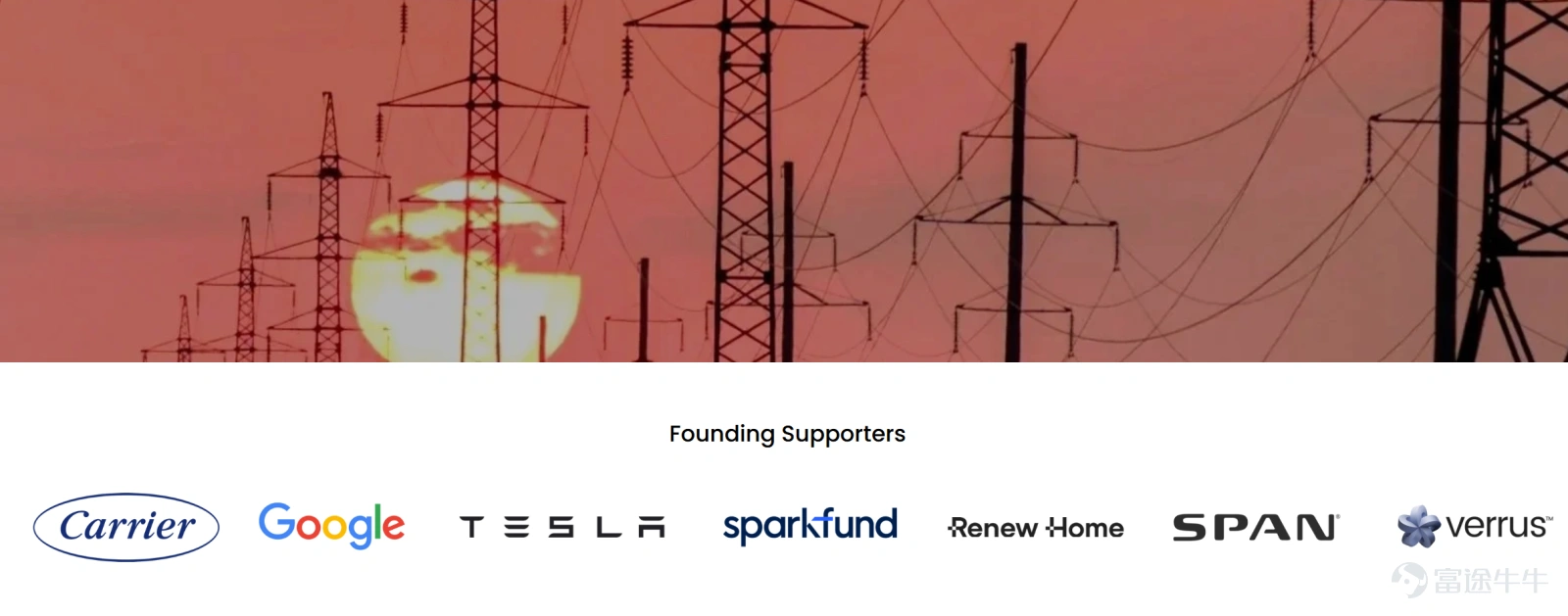
The seven founding members of the alliance each play a specialized role within the grid system.On the supply side, $Tesla (TSLA.US)$ Tesla sells batteries and solar equipment, SpanSmart distribution panels that can adjust according to load changes are provided, $Carrier Global (CARR.US)$ producing heat pump equipment, whileSparkfund and Renew Homeare responsible for constructing and aggregating distributed energy resources.On the demand side, $Alphabet-C (GOOG.US)$and data center developer Verrushave huge electricity demands to keep their servers running continuously.
In fact, tech giants such as Musk, Huang Renxun, and OpenAI CEO Sam Altman have all expressed concerns about power shortages. J.P. Morgan's latest research report also stated,Insufficient grid investment is becoming a key bottleneck in meeting energy needs:Globally, there are currently more than 2,500 gigawatts of renewable energy, data centers, and energy storage projects waiting to be connected to the grid. Therefore, making the grid strong again is an investment idea.
This article will break down the investment logic behind grid upgrades and infrastructure for fellow investors and explore related beneficiary stocks.
Why should we pay attention to grid investment now? What is the growth outlook for the grid?
Make the Grid Great Again——This line, imitating Trump's tone, comes from J.P. Morgan's latest research report. J.P. Morgan believes that grid investment and related infrastructure present significant growth opportunities, driven by the acceleration of electrification in construction, manufacturing, transportation, and data centers, as well as rising energy demand.
Why should we pay attention to grid investment now?Simply put, this is a huge investment opportunity driven by multiple factors.
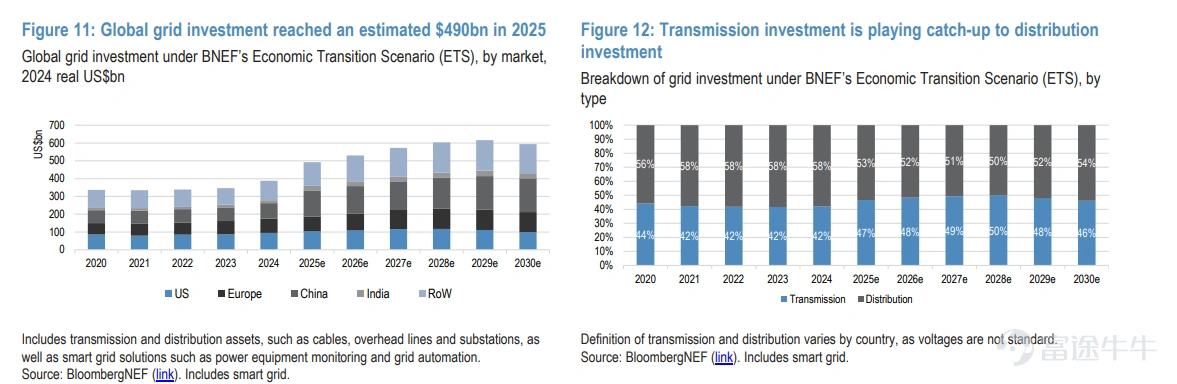
1. Clear growth opportunities:Grid investment is substantial, with global grid investment projected to reachUSD 490 billionby 2025, with a compound annual growth rate (CAGR) of 4% over the next five years. Among this, the CAGR for smart grids and cybersecurity is 9%, while energy storage systems (ESS) are as high as 20%.
2. Existing grids are a bottleneck:Globally, there are more than2,500 GWRenewable energy, data centers, and energy storage projects are lining up for grid connection. In the US, the average waiting time is 5 years; in parts of Europe, it even exceeds 10 years. This severely hampers the energy transition and economic development.
3. Mitigating future risks:Aging power grids make them exceptionally vulnerable to cyberattacks and extreme weather, potentially causing enormous economic losses (GDP loss of up to 6%). Investing in grid resilience now could save $6 in losses for every $1 invested in the future.
4. Foundation for energy transition and national security:Without a robust power grid, successful energy transition cannot be achieved. Moreover, a stable and reliable grid is crucial for national security.
What is the growth prospect for the power grid?According to BNEF forecasts, under the Economic Transition Scenario (ETS), annual global grid investment will reachUSD 590 billion, with a compound annual growth rate of 4% between 2025-2030.
Currently, China accounts for 30% of global annual grid investment,The US and Europe account for 21% and 17%, respectively. Distribution networks typically make up 55%-60% of total grid investment, but transmission capital expenditure has grown by nearly 60% over the past two years (mainly driven by the expansion of renewable energy projects, which are often far from load centers). In the future, the share of transmission investment is expected to be slightly higher than in the past.
Global investment in smart grid solutions is estimated at $43 billion in 2025, accounting for 9% of total grid investment. According to BNEF's Economic Transition Scenario, annual smart grid investment will reach $95 billion by 2050, with half of it allocated to automation.The industry will experience its fastest growth phase before 2030 (with a compound annual growth rate of approximately 9%).Automation and monitoring segments will see a compound annual growth rate of 10%, with smart meter investments reaching $21 billion.
Where are the specific investment opportunities?
Morgan believes that investment opportunities span the entire grid value chain, with varying growth rates across different segments.
Traditional grid assets:This is currently the largest market, accounting for 91% of the total annual grid investment (approximately $490 billion). It mainly includes 'picks and shovels' businesses such as cables, transformers, and substations.
Smart grids and cybersecurity:Although starting from a smaller base, growth is rapid. By 2030, the compound annual growth rate (CAGR) of smart grid investments is expected to reach 9%.
Energy Storage System (ESS):This is the fastest-growing sector. The report forecasts that the CAGR of global annual energy storage installations will reach 20% by 2030, noting this could be a conservative estimate. China is the leading player in this market.
Based on this, JPMorgan screened 132 companies related to grid 'infrastructure' (cables, transformers, equipment, etc.), smart grids, energy storage systems, and distributed and off-grid power generation services, spanning industries such as utilities, industrials, information technology, materials, and consumer sectors. Fellow investors may find these useful for stock-picking.Rated as neutral and overweightfor reference by investors:
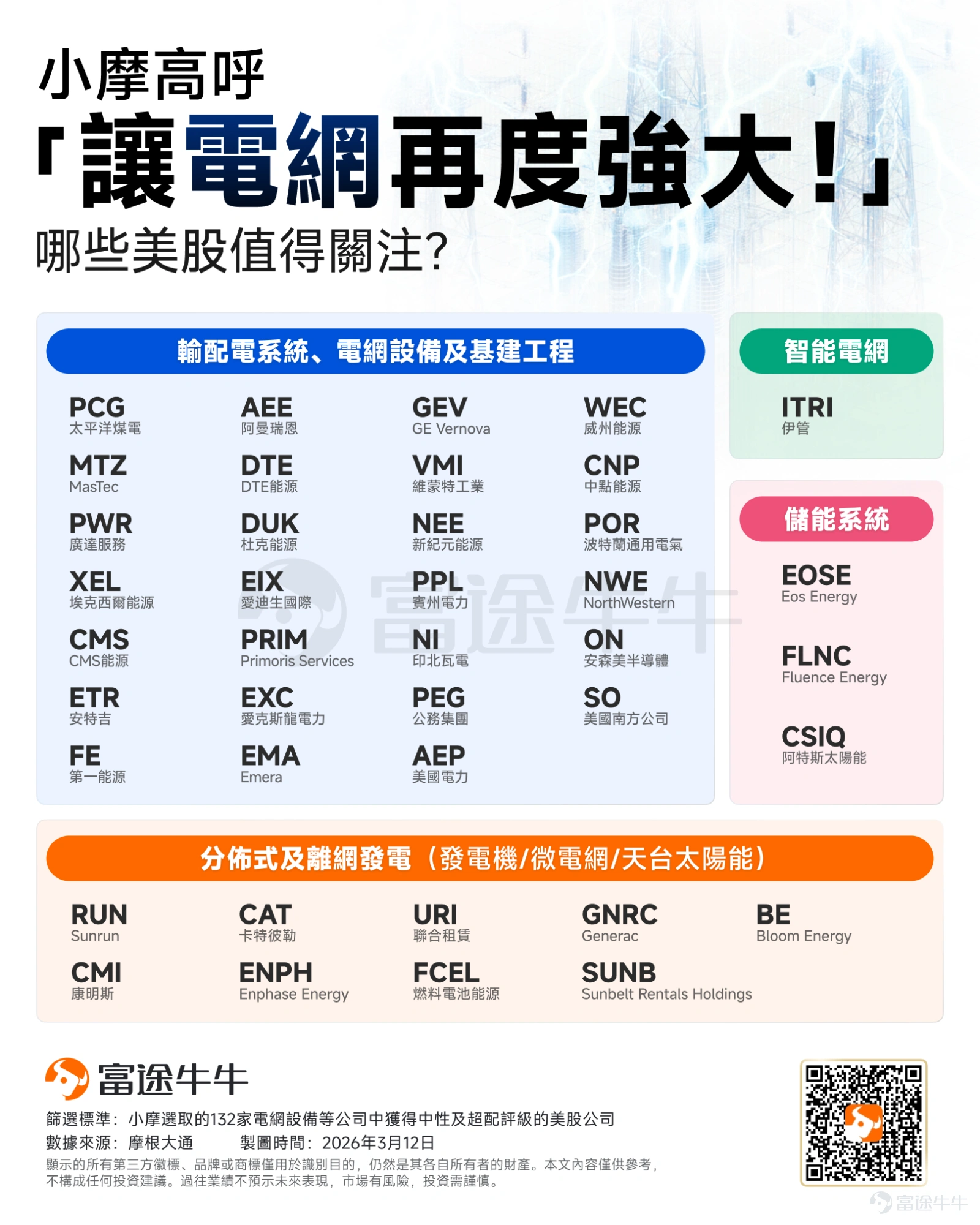
Power transmission and distribution systems, grid equipment, and infrastructure projects include: $PG&E Corp (PCG.US)$ 、 $GE Vernova (GEV.US)$ 、 $MasTec (MTZ.US)$ 、 $Valmont Industries (VMI.US)$ 、 $Quanta Services (PWR.US)$ 、 $NextEra Energy (NEE.US)$ 、 $Xcel Energy (XEL.US)$ 、 $PPL Corp (PPL.US)$ 、 $CMS Energy (CMS.US)$ 、 $NiSource (NI.US)$ 、 $Entergy (ETR.US)$ 、 $Public Service Enterprise Group (PEG.US)$ 、 $FirstEnergy (FE.US)$ 、 $Ameren (AEE.US)$ 、 $WEC Energ Group Inc (WEC.US)$ 、 $DTE Energy (DTE.US)$ 、 $CenterPoint Energy (CNP.US)$ 、 $Duke Energy (DUK.US)$ 、 $Portland General Electric (POR.US)$ 、 $Edison International (EIX.US)$ 、 $NorthWestern (NWE.US)$ 、 $Primoris Services (PRIM.US)$ 、 $ON Semiconductor (ON.US)$ 、 $Exelon (EXC.US)$ 、 $Southern (SO.US)$ 、 $Emera (EMA.US)$ 、 $American Electric Power (AEP.US)$ ;
Smart grids include: $Itron (ITRI.US)$ ; energy storage systems $Eos Energy (EOSE.US)$ 、 $Fluence Energy (FLNC.US)$ 、 $Canadian Solar (CSIQ.US)$ ; distributed and off-grid power generation (generators/microgrids/rooftop solar): $Sunrun (RUN.US)$ 、 $Caterpillar (CAT.US)$ 、 $United Rentals (URI.US)$ 、 $Generac (GNRC.US)$ 、 $Bloom Energy (BE.US)$ 、 $Cummins (CMI.US)$ 、 $Sunbelt Rentals Holdings (SUNB.US)$ 、 $FuelCell Energy (FCEL.US)$ 、 $Enphase Energy (ENPH.US)$
Among them, the most noteworthy are,JPMorgan analysts rated $GE Vernova (GEV.US)$as 'overweight' and added it to the 'Analyst Focus List'primarily based on the following core investment rationales:
Core assets in electrification trends with scarcity value:Analysts consider GEV a core holding for investors looking to capitalize on the 'electrification trend,' suggesting it should be held long-term. GEV’s focus on the U.S. market and the diversification of its end markets provide the company with a scarce value proposition in the marketplace.
Significantly higher earnings growth potential than peers:Although GEV currently trades at a higher multiple than its peers, J.P. Morgan considers this reasonable given expectations that the company will deliver significantly above-average earnings growth potential in the coming years.
Recent catalysts driven by AI-related electricity demand:An increase in orders for power and electrification equipment, overall growth in grid load, and positive news related to AI-driven demand are all potential near-term catalysts that could support upward revisions in earnings expectations and boost market sentiment.
Strong market leadership and margin advantage:GEV holds a leading market share in the U.S. gas turbine market. J.P. Morgan believes that GEV's large installed base will allow it to achieve higher margins than its peers.
Significant expansion in electrification orders:GEV’s Q4 order performance exceeded expectations, primarily driven by its electrification and wind energy businesses.
In addition, J.P. Morgan assigned a higher valuation multiple to its electrification division, precisely due to expectations of significant backlog expansion. In summary,J.P. Morgan believes that GEV, as a global leader in the power industry (its equipment generates about a quarter of the world's electricity), is perfectly positioned to capture the grid infrastructure boom driven by AI and electrification in the U.S. market.
Besides, yesterday'Follow the Titans | Jensen Huang Presents the "Five-Layer Cake Theory"! In the Era of Trillions in AI Infrastructure, Which Companies Are Worth Watching?'also mentioned that Jensen Huang stated that although the U.S. is 'several generations ahead' in chip technology,China has twice the energy resources of the U.S.。
Elon Musk similarly believes thatChina’s decisive advantage in the AI race lies in its ability to supply massive amounts of electricity.He estimates that by 2026, China's power generation may reach about three times that of the United States, thereby possessing the capability to support high-energy-consuming AI data centers.
Therefore, amidst the North American electricity shortage, Chinese companies, especially those closely linked to the North American market, have become highly sought-after in the capital markets. Previously,North America's Power Shortage Creates New Opportunities! Which Hong Kong-listed Companies Could Benefit?relevant concept stocks in the Hong Kong stock market were also analyzed for investors' reference:

Summary
In summary, the second half of the AI race is fundamentally a competition over 'power and infrastructure.'As 'making the grid strong again' becomes an inevitable trend, rapid iteration and embracing probability are key to positioning early for this massive wave of AI infrastructure.
Risk Disclaimer: The above content only represents the author's view. It does not represent any position or investment advice of Futu. Futu makes no representation or warranty.Read more


Comments (6)
to post a comment
90
227