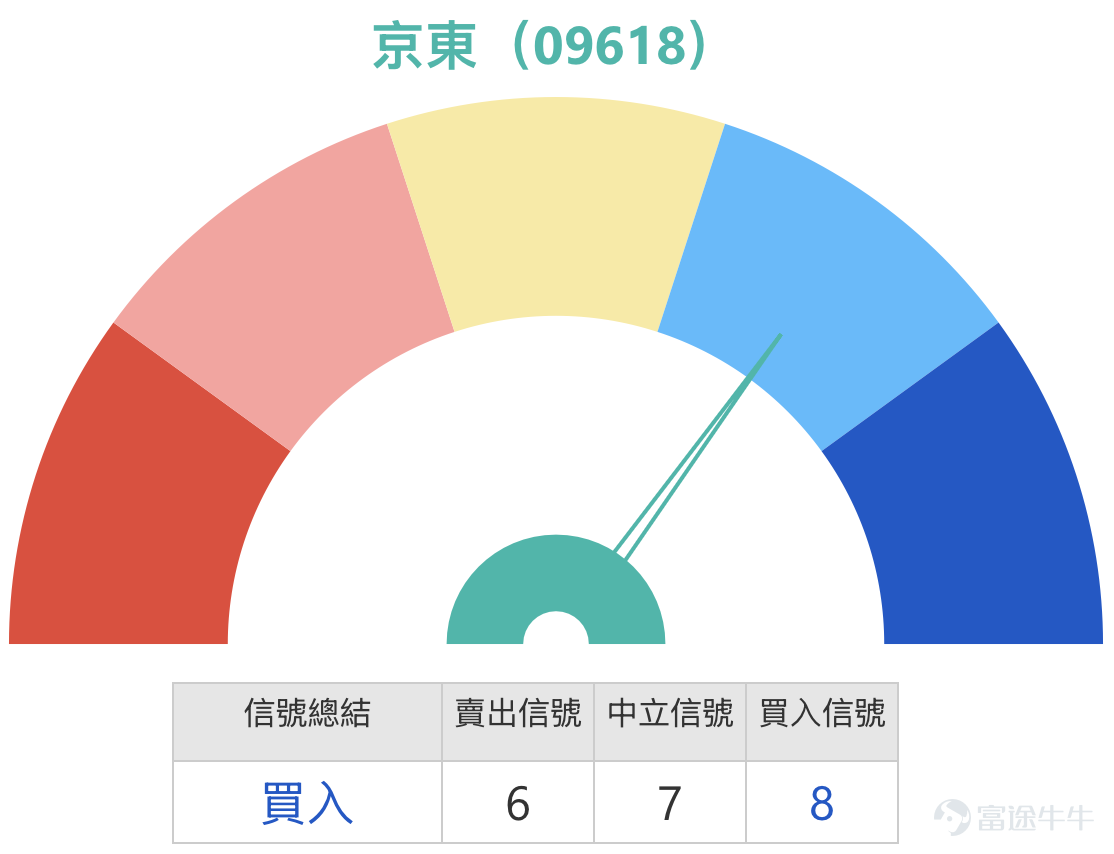

JD.com (09618) technical indicators show a buy signal; should we wait for a pullback or a breakout?
JD.com (09618) is trading at HKD 109.6, up 0.92% slightly, with a turnover of HKD 638 million. The five-day volatility is 11.1%, and the intraday high and low are HKD 110.6 and HKD 108.3 respectively. In market news, today (the 12th), JD.com announced at AWE2026 that it has initiated AI technology integration with nearly a hundred home appliance and furniture brands, and partnered with AWE for fifteen years to distribute HKD 1 billion in subsidies to users. Meanwhile, JD.com recently established a new information technology company in Shanxi with a registered capital of HKD 5 million, continuing to ramp up its technological layout. From an institutional perspective, a research report from SPDB International pointed out that JD.com's food delivery business continues to reduce losses, with profits expected to gradually recover.
From a technical perspective, JD.com’s share price is currently trading at HKD 109.6, having stabilized above the 10-day moving average (HKD 103.91), but still fluctuating between the 30-day moving average (HKD 107.22) and the 60-day moving average (HKD 110.46). The Relative Strength Index (RSI) stands at 57, indicating a neutral-to-strong level, suggesting there is still room for upward movement. It is worth noting that multiple technical indicators such as the VR turnover ratio and bull-bear strength index are signaling a buy, raising expectations for a short-term rebound. On the support side, the primary level to watch is HKD 103.3. If this is breached, the next support will be tested at HKD 99.7. On the resistance side, levels to watch are HKD 113.3 and HKD 117.9, with HKD 113.3 being the key short-term breakout point. The current stock price is consolidating around HKD 108. If supported by sufficient trading volume, it may attempt to challenge the resistance level.

Reviewing the performance of the warrant products, the four JD.com long position products mentioned on March 9 performed well in capturing the underlying stock's upward movement over the following two days. Societe Generale Bull Certificate (54200) recorded an 18% increase over the two days after being mentioned, while the underlying stock rose 2.94%; BNP Paribas Bull Certificate (69657), CMB Warrant (26504) $CIJDCOM@EC2609A.C (26504.HK)$ and Bank of China Warrant (26757) $BIJDCOM@EC2609B.C (26757.HK)$ recorded gains of 13% respectively.

In terms of deploying warrant and bull-bear certificate products, investors can choose from the following products based on their own risk preferences, in conjunction with the current support and resistance levels.
In terms of call warrants, Huatai Call Warrant (22618) has an exercise price of 122 yuan and provides leverage of approximately 8.1 times; BOC Call Warrant (22826) $BIJDCOM@EC2606B.C (22826.HK)$ has an exercise price of 122.1 yuan and provides leverage of about 8.3 times. This exercise price is linked to the key resistance level of 117.9 yuan above the current stock price, making it suitable for investors who expect the share price to break through resistance and challenge the 122-yuan level. Comparing the two, Huatai Call Warrant (22618) offers the highest leverage and the lowest implied volatility, providing stronger downside protection for valuation-sensitive investors; while BOC Call Warrant (22826) has more ideal leverage and implied volatility, making it more attractive to investors seeking magnification effects.
In terms of put warrants, Huatai Put Warrant (22446) has an exercise price of 106.08 yuan and provides leverage of approximately 5.5 times; HSBC Put Warrant (18613) $HSJDCOM@EP2606A.P (18613.HK)$ has an exercise price of 106.18 yuan and provides leverage of about 4.7 times. This exercise price is linked to the key support levels of 103.3 yuan and 99.7 yuan, making it suitable for investors who expect the stock price to be constrained by resistance and retreat to test support. Comparing the two, Huatai Put Warrant (22446) has the lowest premium and implied volatility, offering a cost advantage to investors focused on cost control; while HSBC Put Warrant (18613) has the highest leverage and low implied volatility, making it more appealing to investors seeking amplification effects.

For bull contracts, HSBC Bull Contract (61566) has a stop-loss price of 94 yuan and offers actual leverage of approximately 7.1 times with the lowest premium; Societe Generale Bull Contract (54199) has a stop-loss price of 93.8 yuan and provides about 7 times actual leverage, with the highest actual leverage and relatively low premium. This stop-loss price is below the primary support level of 103.3 yuan, offering sufficient buffer space, making it suitable for investors expecting the stock price to stabilize and rebound at the 103.3-yuan support level. Comparing the two, HSBC Bull Contract (61566) offers better premium control, while Societe Generale Bull Contract (54199) has slightly higher actual leverage.
For bear contracts, UBS Group Bear Contract (56284) and J.P. Morgan Bear Contract (54827) both have a stop-loss price of 124 yuan and provide actual leverage of about 5.2 to 5.3 times. This stop-loss price is linked to the key resistance levels of 117.9 yuan and 122 yuan, making it suitable for investors who expect the stock price rebound to be capped by resistance. Comparing the two, UBS Group Bear Contract (56284) has the lowest premium and relatively high actual leverage; while J.P. Morgan Bear Contract (54827) has the highest actual leverage and low premium, providing options for investors pursuing different risk preferences in bearish strategies.
In summary, investors optimistic about JD.com's further rebound may consider BOC Call Warrant (22826) to capture breakout opportunities or Societe Generale Bull Contract (54199) for higher-leverage deployment; while bearish investors may opt for Huatai Put Warrant (22446) to hedge downside risks or UBS Group Bear Contract (56284) to capture pullback opportunities with higher leverage.
Interactive Questions:
Dear readers, JD.com (09618) is benefiting from AWE subsidies and expectations of reduced losses in its food delivery business. Do you think it can successfully break through the 113.3-yuan resistance in the short term?
A) Yes, positive business catalysts are concentrated, and it may challenge the 117.9-yuan level.
B) No, S&P downplays new business losses, and consolidation between 103 yuan and 113 yuan is needed first.
C) Will first observe the performance at the $110 mark, and follow up after a breakout.
Feel free to leave a comment and share your trading strategy!
Reminder: This article does not constitute any investment advice.
This article is for reference only and does not constitute any investment advice. The market data, opinions, and analysis contained herein may change at any time without prior notice. We are not responsible for any loss or damage caused by reliance on the information in this article. Technical analysis only shows whether certain technical conditions are met; a comprehensive assessment of asset performance should combine other data and should not solely rely on this article to make trading decisions. Please note that past performance is not indicative of future results. Follow Jenny's insights on Hong Kong stock warrants for more professional analysis.
#JD #09618 #HongKongStocks #TechnicalAnalysis #SupportAndResistance #Warrants #BullBearCertificates #CallOptions #PutOptions #E-commerceSector
Risk Disclaimer: The above content only represents the author's view. It does not represent any position or investment advice of Futu. Futu makes no representation or warranty.Read more
Comments
to post a comment