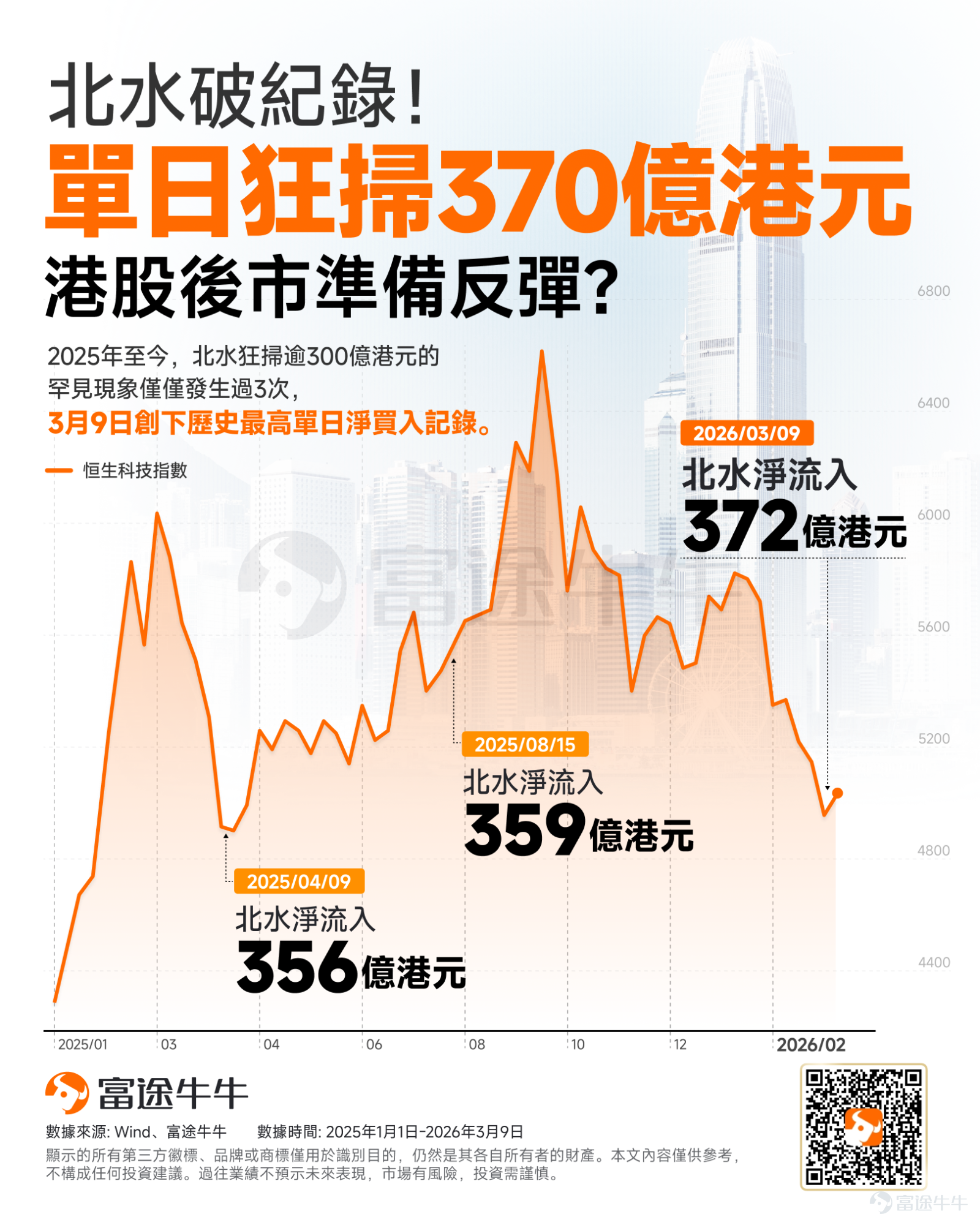

Northbound capital breaks records! Over HKD 37 billion swept in a single day, can Hong Kong stocks stage a rebound?
On March 9, Northbound capital flooded into Hong Kong stocks with purchases exceeding HKD 37 billion, setting a new historical record for single-day net inflow.
Reviewing the data since 2025, the rare phenomenon of Northbound capital inflows surpassing HKD 30 billion has only occurred three times. Historical experience shows that whenever funds have poured in on such a large scale, the Hang Seng Tech Index often subsequently embarked on a strong upward trend.
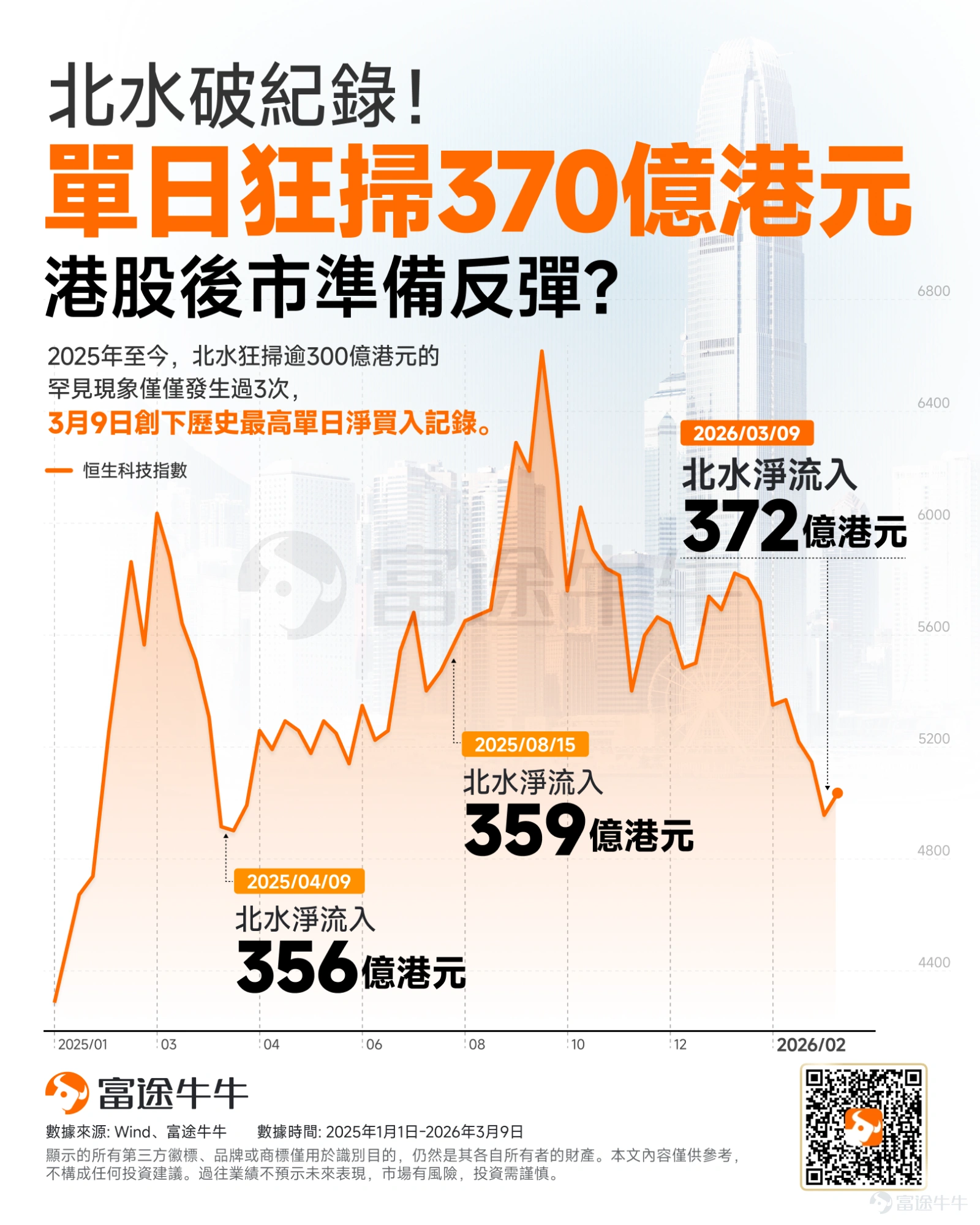
In response to the strong signals from the funding side, the market is highly focused on whether the Hang Seng Tech Index is now poised for a rebound after bottoming out. This article quickly decodes for fellow investors: What is the logic behind the explosive buying by Northbound capital? Which core assets are being aggressively snapped up?
What is the logic behind the explosive buying by Northbound capital?
According to China Securities Journal, industry insiders mentioned that yesterday’s significant net purchase by Southbound funds might be related to the large-scale adjustment of eligible stocks under the Shanghai-Hong Kong Stock Connect program. On March 6, the Shanghai and Shenzhen stock exchanges announced adjustments to the list of eligible stocks for the Stock Connect program. According to the announcement, the relevant adjustments to the list will take effect starting from March 9. Specifically, this includes 42 stocks such as Bank of East Asia, Guofu Quantum, Lead Intelligent Equipment, and Chow Tai Fook.
Additionally, Lei Jun, General Manager of the Quantitative and Index Investment Department at Great Wall Fund, believes that as one of the core representatives of growth assets in Hong Kong stocks, Hang Seng Tech exhibits higher elasticity. From a valuation perspective, the Hang Seng Tech Index's PE-TTM is around 20x, placing it at approximately the 20th percentile of its historical range over the past year, offering a valuation advantage.If we accept the logic of an 'upward fundamental trend,' now is a good time to actively pay attention.
"In the past, the market may have hesitated about Hang Seng Tech, worrying that it was merely driven by policy or sentiment; but now, more and more capital is viewing it as the most representative allocation anchor for Chinese tech assets in Hong Kong stocks," said Lei Jun. "Especially against the backdrop of continued policy emphasis on innovation, high-end manufacturing, digital economy, and artificial intelligence, Hang Seng Tech represents one of the core themes of our era."
He also emphasized the risk factors: First, if geopolitical tensions overseas escalate again, it will still affect Hong Kong stocks through oil prices, the US dollar, and global risk appetite. Second, if domestic economic recovery remains weak, it could impact the pace of valuation recovery for tech assets. Third, given that Hong Kong stocks are still an offshore market, volatility in funding flows and shifts in foreign investor risk appetite will continue to bring periodic fluctuations. In other words, the direction is positive, but we must still accept some volatility in the rhythm.
Guangfa Securities strategist Liu Chenming stated that if we shift our focus to the medium-term horizon and project throughout 2026, one fairly certain judgment is that, considering the context of the US 'mid-term elections,' it is not advisable to assume a baseline scenario of 'ongoing deterioration in geopolitical tensions and oil price crises.' The Trump administration would likely find it difficult to tolerate persistently high inflation. With a higher probability, the logic of a bull market for global non-US assets in 2026 is unlikely to be overturned by geopolitical conditions.In the near term, we remain optimistic about Chinese stocks, which could continue the 'Davis Double Play' with non-US markets. Once short-term geopolitical uncertainties are resolved, the market may present the best buying opportunity of the year.
Which core assets are being aggressively bought?
Looking at yesterday’s northbound capital flows, $TRACKER FUND OF HONG KONG (02800.HK)$ 、 $Hang Seng H-Share Index ETF (02828.HK)$ 、 $CSOP Hang Seng TECH Index ETF (03033.HK)$ Net purchases reached HK$12.567 billion, HK$5.324 billion, and HK$4.13 billion respectively.
Extending the timeline to year-to-date, northbound capital deployment has shown strong directionality, specifically:
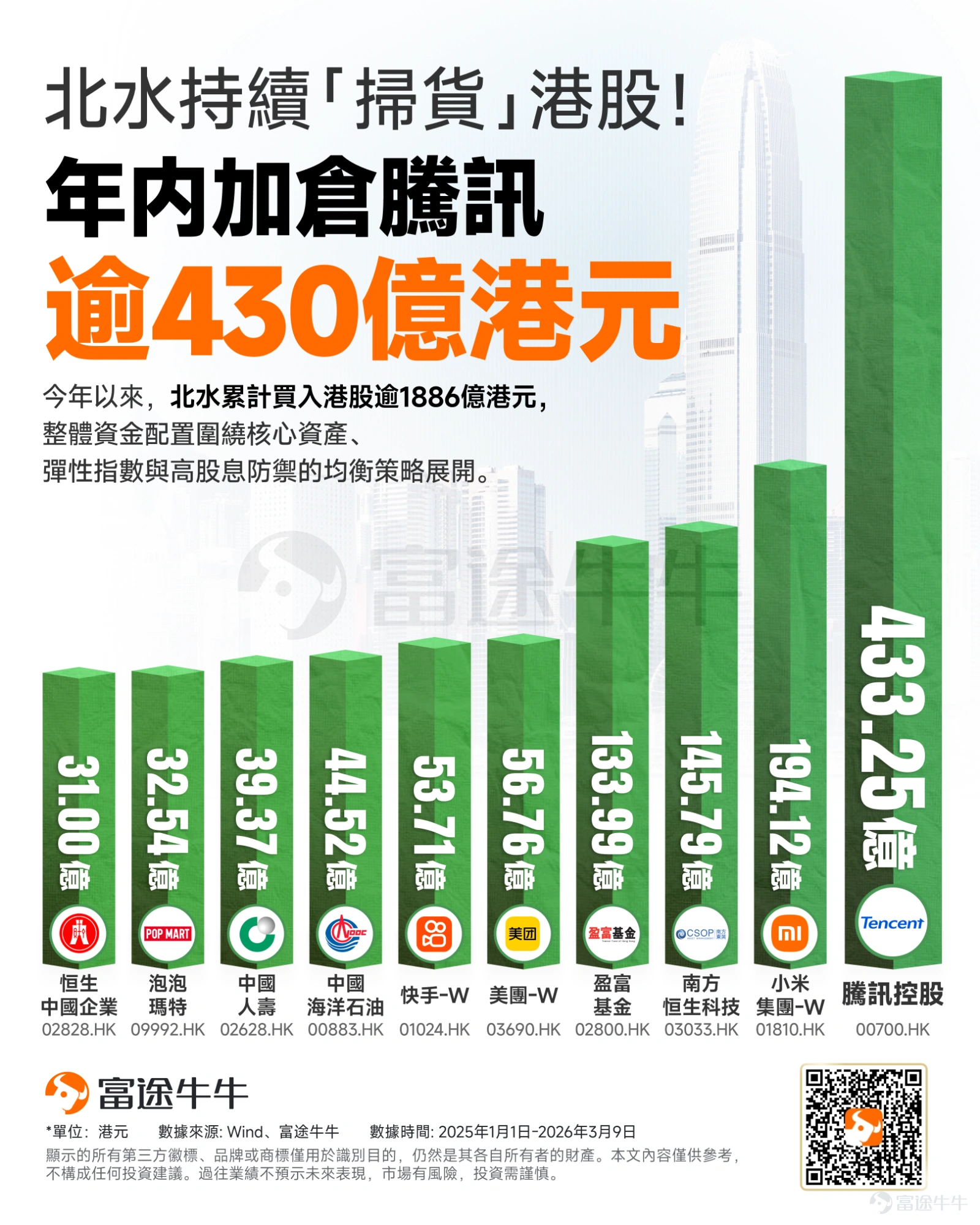
1. Tencent takes the lead by a wide margin, with tech giants regaining favor
The most eye-catching name on the list is $TENCENT (00700.HK)$ . In just over two months this year, northbound funds have net purchased HK$43.325 billion worth of Tencent stock, firmly placing it at the top. Following closely behind, $XIAOMI-W (01810.HK)$has also attracted over HK$19.4 billion. Combined with $MEITUAN-W (03690.HK)$ and $KUAISHOU-W (01024.HK)$ , it shows that investors have high expectations for leading internet companies with strong earnings visibility and robust competitive advantages.
2. Leveraging ETFs for precise bottom-fishing, betting on a rebound in the broader market and technology
In addition to selecting individual stocks, significant capital is flowing into the broader market through ETFs. $CSOP Hang Seng TECH Index ETF (03033.HK)$and $TRACKER FUND OF HONG KONG (02800.HK)$ Both garnered net inflows exceeding HKD 10 billion. This aligns with our previous analysis: Northbound capital is betting on a rebound in Hong Kong stocks using broad-based ETFs to capture this potential Beta return.
3. 'Barbell Strategy' Emerges: Balancing High Dividend Yields with Quality Growth
While aggressively targeting the technology sector, the defensive and diversified allocation of Northbound capital also deserves attention. The list includes representatives of high dividend yields and traditional value sectors, $CNOOC (00883.HK)$and $CHINA LIFE (02628.HK)$ as well as those representing new consumption with strong overseas growth logic. $POP MART (09992.HK)$ This shows that while pursuing aggressive upside, funds are also stabilizing their base through resource and financial stocks.
Overall, Northbound capital is not blindly diversifying but is precisely targeting 'core assets + flexible indices + high-dividend defenses.'
Risk Disclaimer: The above content only represents the author's view. It does not represent any position or investment advice of Futu. Futu makes no representation or warranty.Read more


Comments (15)
to post a comment
62
176