English
Back
Open Account
[Prize] The Secret to Stop-Profit and Stop-Loss! Let Your Orders Make Money for You

牛牛課堂
joined discussion · Mar 10 11:01 ·

Why do you always earn less than others? It might come down to the use of these orders!

Have you ever experienced this: with the same stock, you see fellow investors earning 30% and exiting gracefully while you sold too early and only made 5%? Or maybe the stock you bought dropped, and although you could have cut your losses earlier, you ended up losing 20%? Or perhaps a stock that was initially profitable turned into a roller coaster ride, ending in a loss?
If you’ve encountered similar situations, besides setting stricter trading rules for yourself and adhering to them,We strongly recommend unlocking Futubull’s 13 order types.Honestly, sometimes when you can't execute properly on your own, using the right type of order might be a great help!
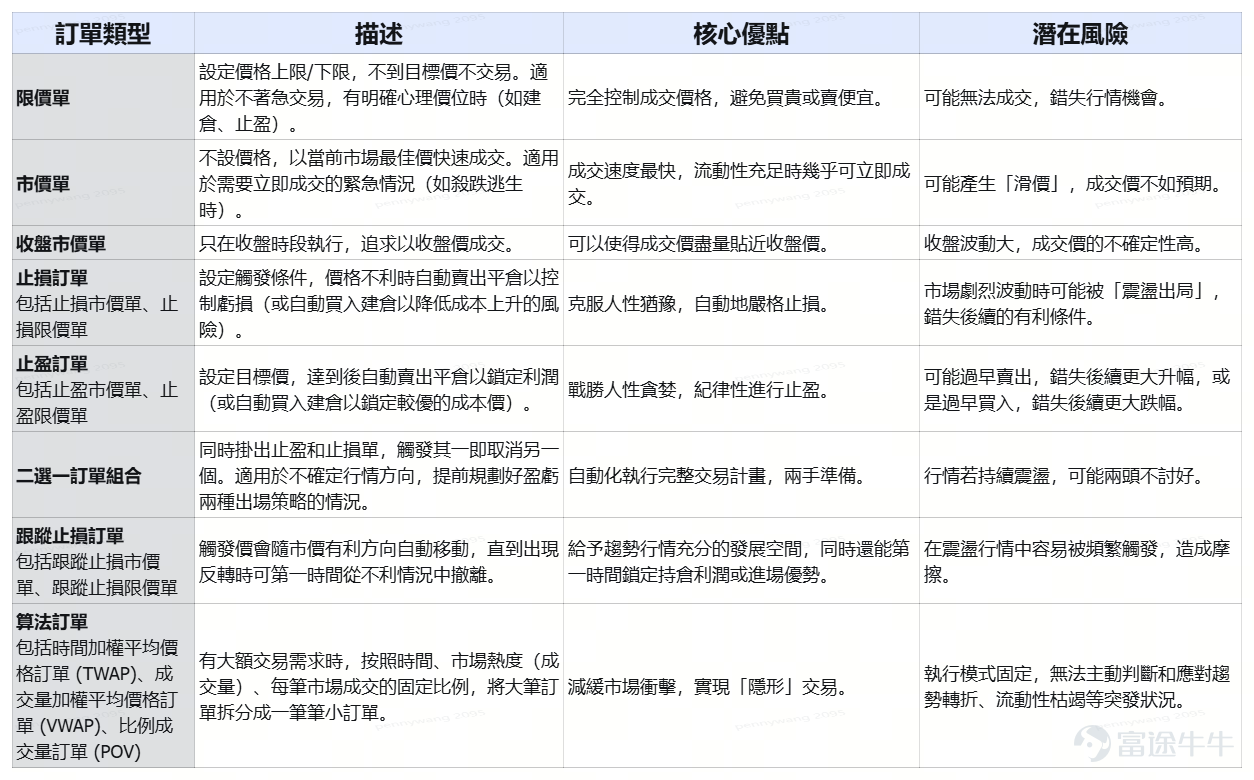
Have you ever had this experience: the same stock, you see fellow investors earning 30% and gracefully exiting, but you sold too early and only made 5%? Or maybe the stock you bought dropped in value, and although you could have cut your losses earlier, you ended up losing 20% because you held on too long? Or perhaps a stock that was profitable turned into an unrecoverable roller coaster ride, ending in a loss?  If you’ve encountered similar situations, besides setting stricter trading rules for yourself and sticking to them,I strongly recommend unlocking Futubull’s 13 order types.Honestly, sometimes when you can’t execute trades perfectly on your own, using the right type of order might be a big help! 1. Trading Basics: Regular Orders – The Two Foundational Keys to Market Trading No matter how complex a trading strategy is, it’s built on two basic types of orders: market orders and limit orders. 1、A market order aims for immediate execution with a ‘lightning-fast’ tactic,without specifying a particular price, buying or selling at the current best market price. ● Usage Scenarios:Only operable during market trading hours; suitable for stocks with good liquidity, and useful when you urgently need to make a trade. For example, if a stock suddenly receives positive news and its price starts rising rapidly, you may want to jump on board immediately to avoid missing out on further gains. Alternatively, if a stock you hold experiences a sudden negative event, and you're worried about a sharp decline, you'd want to sell quickly to minimize losses. ● Special Note:You can also submit a conditional order, setting the price or time at which this market order becomes valid. You can also simultaneously submit an attached...
1. Trading Basics: Regular orders, the two fundamental keys to market trading
No matter how complex a trading strategy is, it is built upon two basic types of orders: market orders and limit orders.
1、Market orders aim for 'immediate execution' with a lightning-fast tactic,not specifying an exact price but buying or selling at the current best market price.
● Operating Scenario:Only available during intraday trading hours, suitable for highly liquid stocks and situations where you urgently need to trade. For instance, if a stock suddenly receives positive news and its price begins to surge rapidly, you may want to immediately buy in to avoid missing out on further gains. Alternatively, if a stock you hold encounters unexpected bad news and you fear it might plummet further, you can quickly sell to cut your losses.
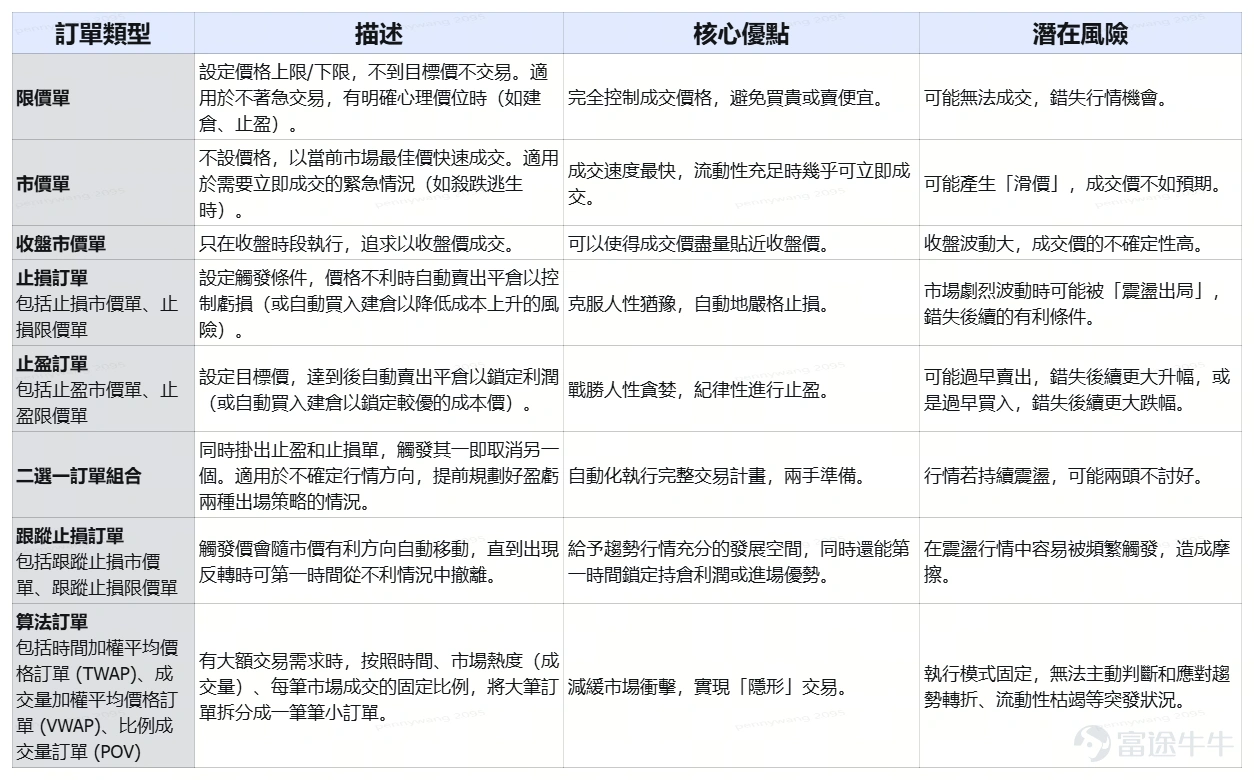
Have you ever had this experience: the same stock, you see fellow investors earning 30% and gracefully exiting, but you sold too early and only made 5%? Or maybe the stock you bought dropped in value, and although you could have cut your losses earlier, you ended up losing 20% because you held on too long? Or perhaps a stock that was profitable turned into an unrecoverable roller coaster ride, ending in a loss?  If you’ve encountered similar situations, besides setting stricter trading rules for yourself and sticking to them,I strongly recommend unlocking Futubull’s 13 order types.Honestly, sometimes when you can’t execute trades perfectly on your own, using the right type of order might be a big help! 1. Trading Basics: Regular Orders – The Two Foundational Keys to Market Trading No matter how complex a trading strategy is, it’s built on two basic types of orders: market orders and limit orders. 1、A market order aims for immediate execution with a ‘lightning-fast’ tactic,without specifying a particular price, buying or selling at the current best market price. ● Usage Scenarios:Only operable during market trading hours; suitable for stocks with good liquidity, and useful when you urgently need to make a trade. For example, if a stock suddenly receives positive news and its price starts rising rapidly, you may want to jump on board immediately to avoid missing out on further gains. Alternatively, if a stock you hold experiences a sudden negative event, and you're worried about a sharp decline, you'd want to sell quickly to minimize losses. ● Special Note:You can also submit a conditional order, setting the price or time at which this market order becomes valid. You can also simultaneously submit an attached...
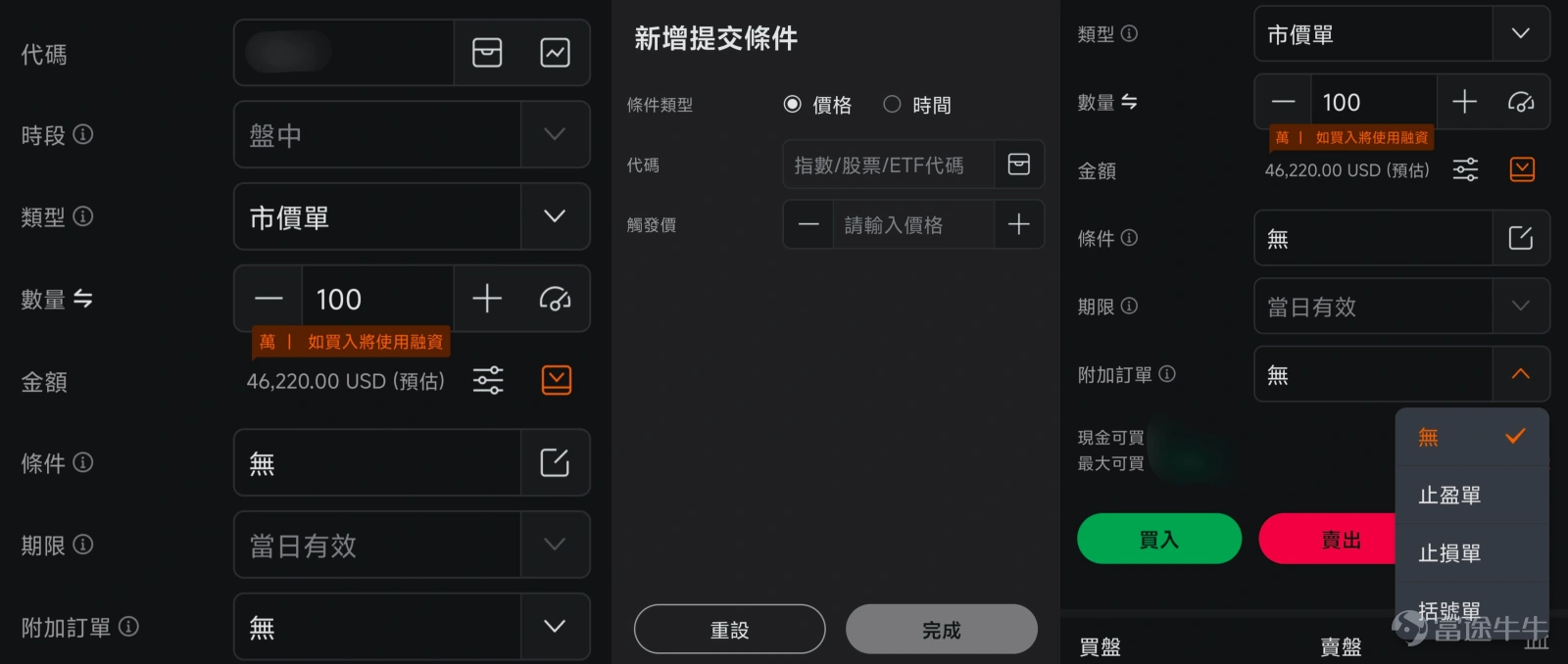
● Special Notes:You can simultaneously submit a conditional order, which will only become valid once triggered by a certain price or time condition. You can also place an additional closing order (used for exiting the position), such as setting take-profit orders, stop-loss orders, or bracket orders (which include both take-profit and stop-loss prices). This additional order will be submitted after your opening order is fully executed and the triggering conditions are met.
● Core Advantages:Fastest execution speed, with nearly guaranteed execution when liquidity is sufficient.
● Potential Risks:You may encounter “price slippage,” meaning the final execution price could be much worse than expected, especially under volatile market conditions.
2、A limit order acts like your price gatekeeper,similar to the mindset and practice of saying 'I won't buy if it exceeds XXX amount' while shopping. The principle is that you set a specific desired execution price, and it will only execute if the market reaches that price or better.
● Usage Scenario:Can be used at any time, suitable when you have a reasonable expected buy or sell price and are making non-urgent trades (e.g., building a position or taking profits). For instance, if stock X is currently priced at $300 and you believe $280 is a fair price, you place a limit order to buy at $280. If the stock price falls to $280 or lower within your specified time frame, the order will execute automatically; if the price doesn't reach this level, or there's insufficient liquidity when it does, the trade won't go through.
Have you ever had this experience: the same stock, you see fellow investors earning 30% and gracefully exiting, but you sold too early and only made 5%? Or maybe the stock you bought dropped in value, and although you could have cut your losses earlier, you ended up losing 20% because you held on too long? Or perhaps a stock that was profitable turned into an unrecoverable roller coaster ride, ending in a loss?  If you’ve encountered similar situations, besides setting stricter trading rules for yourself and sticking to them,I strongly recommend unlocking Futubull’s 13 order types.Honestly, sometimes when you can’t execute trades perfectly on your own, using the right type of order might be a big help! 1. Trading Basics: Regular Orders – The Two Foundational Keys to Market Trading No matter how complex a trading strategy is, it’s built on two basic types of orders: market orders and limit orders. 1、A market order aims for immediate execution with a ‘lightning-fast’ tactic,without specifying a particular price, buying or selling at the current best market price. ● Usage Scenarios:Only operable during market trading hours; suitable for stocks with good liquidity, and useful when you urgently need to make a trade. For example, if a stock suddenly receives positive news and its price starts rising rapidly, you may want to jump on board immediately to avoid missing out on further gains. Alternatively, if a stock you hold experiences a sudden negative event, and you're worried about a sharp decline, you'd want to sell quickly to minimize losses. ● Special Note:You can also submit a conditional order, setting the price or time at which this market order becomes valid. You can also simultaneously submit an attached...
● Special Notes:Similarly, you can choose to submit a conditional order or an additional order alongside.
● Core Advantages:Full control over execution price; avoids buying too high or selling too low, and helps prevent impulsive trading to some extent.
● Potential Risks:You may miss opportunities, fail to execute, especially during strong one-way movements in stock price or when liquidity is insufficient.
3. Building on that, there’s also a special type of market order: the closing market order.
The special feature is that it executes only at the close, attempting to fill the order as close as possible to the closing price. The order must be submitted at least 15 minutes before the market closes.
Such orders are not commonly used, but their application scenarios include: a fund manager needing to establish or adjust positions at the closing price near the market close to minimize tracking error. Individual investors wanting their trading price to align with the day's net asset value calculation benchmark for funds; or having a strong reason to complete the trade before the market closes on the same day rather than leaving it until the next day; or believing that the closing price best represents the stock’s value for the day, and so on.
It shares the same advantages and risks as regular market orders, but because price volatility may be higher during the closing phase and brokers might need to ensure execution within a very limited time, the final executed price could be even harder to guarantee.
Have you ever had this experience: the same stock, you see fellow investors earning 30% and gracefully exiting, but you sold too early and only made 5%? Or maybe the stock you bought dropped in value, and although you could have cut your losses earlier, you ended up losing 20% because you held on too long? Or perhaps a stock that was profitable turned into an unrecoverable roller coaster ride, ending in a loss?  If you’ve encountered similar situations, besides setting stricter trading rules for yourself and sticking to them,I strongly recommend unlocking Futubull’s 13 order types.Honestly, sometimes when you can’t execute trades perfectly on your own, using the right type of order might be a big help! 1. Trading Basics: Regular Orders – The Two Foundational Keys to Market Trading No matter how complex a trading strategy is, it’s built on two basic types of orders: market orders and limit orders. 1、A market order aims for immediate execution with a ‘lightning-fast’ tactic,without specifying a particular price, buying or selling at the current best market price. ● Usage Scenarios:Only operable during market trading hours; suitable for stocks with good liquidity, and useful when you urgently need to make a trade. For example, if a stock suddenly receives positive news and its price starts rising rapidly, you may want to jump on board immediately to avoid missing out on further gains. Alternatively, if a stock you hold experiences a sudden negative event, and you're worried about a sharp decline, you'd want to sell quickly to minimize losses. ● Special Note:You can also submit a conditional order, setting the price or time at which this market order becomes valid. You can also simultaneously submit an attached...
II. Risk Management: Conditional Orders, Your Automated Trading Guardian System
When you need to implement strategies like taking profits or stopping losses, various conditional orders act as smart guardians by setting rules and letting the system execute them automatically. They are mainly divided into the following types:
1. Stop-Loss Orders (The Gatekeeper of Risk Management)
Including: Stop-Limit Orders, Stop-Market Orders
The concepts of limit and market orders are the same as described earlier; here, the focus can be on understanding the concept of 'stop-loss.'
Simply put, a trigger price is set in advance, and when the stock price falls to that level (in the context of selling to close a position) or rises to that level (in the context of buying to open a position), it automatically triggers either a limit order or a market order to complete the trade.The purpose is to control position losses, or avoid entering trades at worse prices.
Have you ever had this experience: the same stock, you see fellow investors earning 30% and gracefully exiting, but you sold too early and only made 5%? Or maybe the stock you bought dropped in value, and although you could have cut your losses earlier, you ended up losing 20% because you held on too long? Or perhaps a stock that was profitable turned into an unrecoverable roller coaster ride, ending in a loss?  If you’ve encountered similar situations, besides setting stricter trading rules for yourself and sticking to them,I strongly recommend unlocking Futubull’s 13 order types.Honestly, sometimes when you can’t execute trades perfectly on your own, using the right type of order might be a big help! 1. Trading Basics: Regular Orders – The Two Foundational Keys to Market Trading No matter how complex a trading strategy is, it’s built on two basic types of orders: market orders and limit orders. 1、A market order aims for immediate execution with a ‘lightning-fast’ tactic,without specifying a particular price, buying or selling at the current best market price. ● Usage Scenarios:Only operable during market trading hours; suitable for stocks with good liquidity, and useful when you urgently need to make a trade. For example, if a stock suddenly receives positive news and its price starts rising rapidly, you may want to jump on board immediately to avoid missing out on further gains. Alternatively, if a stock you hold experiences a sudden negative event, and you're worried about a sharp decline, you'd want to sell quickly to minimize losses. ● Special Note:You can also submit a conditional order, setting the price or time at which this market order becomes valid. You can also simultaneously submit an attached...
● Application Scenarios:For example, if a stock you hold starts falling below your cost basis and you're concerned about mounting losses, you can set a maximum loss threshold of -10%. If the current stock price is $100, you could submit a stop-loss limit order or stop-loss market order with a trigger price of 100 * (1-10%) = $90. If it's a stop-loss limit order, you'll also need to set an expected execution price.
If you don't set this order, as the stock price falls, you may struggle to overcome human hesitation and strictly enforce stop-loss discipline, which might eventually lead to small losses turning into significant ones due to侥幸 (wishful thinking) or procrastination.
Of course, if you do set this order, it's possible that after you stop out, the stock price rebounds. But we can never fully and accurately predict the market — even if it rebounds this time, next time it might continue to plummet.
● Key Advantages:Transforming risk management strategies from manual execution to automated processes enables “overcoming human nature and safeguarding discipline.” It removes decision paralysis caused by fear,侥幸 (wishful thinking), or procrastination when traders face losses, ensuring that preset risk thresholds are strictly followed. Additionally, it allows for instant response to market fluctuations without constant monitoring, fostering good trading habits like “planning before executing.”
● Potential Risks:During volatile or disorderly market movements, prices may briefly touch the stop-loss level before quickly reversing. So if the stop-loss is set too close or rigidly, false alarms can easily be triggered, leading to premature exits or entries due to normal market fluctuations, resulting in unnecessary losses. Also, the inherent risks of limit orders and market orders remain applicable here.
2. Take-profit Orders (a safety net for locking in profits)
Including: Trigger Limit Orders (Take-profit), Trigger Market Orders (Take-profit)
The operational logic is similar to stop-loss orders but with opposite objectives. In short, you predefine a target price; when the stock price rises to that level (in the case of selling to close a position) or drops to that level (in the case of buying to close a position), it automatically triggers a limit order or market order to complete the transaction.The purpose is to automatically lock in paper profits or enter at a relatively better price.
Have you ever had this experience: the same stock, you see fellow investors earning 30% and gracefully exiting, but you sold too early and only made 5%? Or maybe the stock you bought dropped in value, and although you could have cut your losses earlier, you ended up losing 20% because you held on too long? Or perhaps a stock that was profitable turned into an unrecoverable roller coaster ride, ending in a loss?  If you’ve encountered similar situations, besides setting stricter trading rules for yourself and sticking to them,I strongly recommend unlocking Futubull’s 13 order types.Honestly, sometimes when you can’t execute trades perfectly on your own, using the right type of order might be a big help! 1. Trading Basics: Regular Orders – The Two Foundational Keys to Market Trading No matter how complex a trading strategy is, it’s built on two basic types of orders: market orders and limit orders. 1、A market order aims for immediate execution with a ‘lightning-fast’ tactic,without specifying a particular price, buying or selling at the current best market price. ● Usage Scenarios:Only operable during market trading hours; suitable for stocks with good liquidity, and useful when you urgently need to make a trade. For example, if a stock suddenly receives positive news and its price starts rising rapidly, you may want to jump on board immediately to avoid missing out on further gains. Alternatively, if a stock you hold experiences a sudden negative event, and you're worried about a sharp decline, you'd want to sell quickly to minimize losses. ● Special Note:You can also submit a conditional order, setting the price or time at which this market order becomes valid. You can also simultaneously submit an attached...
● Application Scenario:For example, you bought a stock at $80, and the current share price has risen to $100, generating substantial paper profits. You anticipate that $120 will be a key resistance level and want to secure at least some of your gains. At this point, you can place a take-profit limit order or market order with a trigger price of $120 (the former requires an additional specified desired execution price). When the stock price reaches $120, the system will automatically execute the order for you, locking in profits.
● Core Advantages:Primarily focused on 'overcoming greed and disciplined exits,' it helps you overcome the desire to chase higher returns and avoid missing optimal profit-taking points due to over-optimism—like riding a roller coaster, where profits shrink significantly or even turn into losses—or missing favorable entry points. Like stop-loss orders, its automation also frees you from constantly monitoring the market for ideal prices.
● Potential Risks:The primary risk is exiting too early and missing out on subsequent significant profits. If the target price is set too conservatively or mechanically, you may sell prematurely just as a strong trend begins, failing to let profits run fully, or buy too early, preventing costs from being reduced further. Additionally, the inherent risks of limit and market orders are equally applicable here.
3. Either/Or Order Combination (Dual Protection Strategy)
Stop-loss orders protect capital, take-profit orders safeguard profits, and the either/or order combination ties these two order types together (one stop-loss order + one take-profit order). Once one of the orders is triggered and executed, the other will automatically be canceled. Using this order type allows youto simultaneously plan for the worst-case scenario (stop-loss) and the ideal target (take-profit), automating a complete exit strategy within a single trade instruction.
● Application Scenario:For example, before uncertain events such as earnings releases or interest rate decisions, if you are unsure whether the stock price will break upward or downward, you can consider setting both a take-profit level and a stop-loss level to let the market determine the direction and automatically execute one of them. Alternatively, when the stock price is fluctuating within a range, and you anticipate an imminent breakout in one direction that could initiate a trend, this order combination can capture the breakout movement and automatically manage risk.
For instance, you buy a stock at $100. After analysis, you decide to cut losses if the stock price falls by 7% to $93 and take profits if it rises by 15% to $115. At this point, you can place a one-cancels-the-other (OCO) order: a sell stop-loss order with a trigger price of $93 + a sell take-profit order with a trigger price of $115.
Have you ever had this experience: the same stock, you see fellow investors earning 30% and gracefully exiting, but you sold too early and only made 5%? Or maybe the stock you bought dropped in value, and although you could have cut your losses earlier, you ended up losing 20% because you held on too long? Or perhaps a stock that was profitable turned into an unrecoverable roller coaster ride, ending in a loss?  If you’ve encountered similar situations, besides setting stricter trading rules for yourself and sticking to them,I strongly recommend unlocking Futubull’s 13 order types.Honestly, sometimes when you can’t execute trades perfectly on your own, using the right type of order might be a big help! 1. Trading Basics: Regular Orders – The Two Foundational Keys to Market Trading No matter how complex a trading strategy is, it’s built on two basic types of orders: market orders and limit orders. 1、A market order aims for immediate execution with a ‘lightning-fast’ tactic,without specifying a particular price, buying or selling at the current best market price. ● Usage Scenarios:Only operable during market trading hours; suitable for stocks with good liquidity, and useful when you urgently need to make a trade. For example, if a stock suddenly receives positive news and its price starts rising rapidly, you may want to jump on board immediately to avoid missing out on further gains. Alternatively, if a stock you hold experiences a sudden negative event, and you're worried about a sharp decline, you'd want to sell quickly to minimize losses. ● Special Note:You can also submit a conditional order, setting the price or time at which this market order becomes valid. You can also simultaneously submit an attached...
● Core Advantages:It allows for the pre-setting and automated execution of a complete trading plan, moving from single-point risk control to systematic strategy management. It eliminates the need to manually place separate stop-loss and take-profit orders and prevents oversight or emotional fluctuations from only setting one of them. Moreover, it requires you to think through and establish clear profit targets and loss thresholds before trading begins, helping reinforce the concept of disciplined, planned trading.
● Potential Risks:You may miss unexpected trending moves. If the price continues to rise significantly after triggering the take-profit sale or reverses strongly right after a stop-loss sale, the order would have already been executed, leaving you out of subsequent price movements. Similarly, improper placement of take-profit or stop-loss points might lead to premature triggers during volatile markets. The risks of slippage with market orders and non-execution of limit orders remain as well.
4. Trailing Stop Order (An intelligent assistant that lets profits run and reduces cost)
Includes: Trailing Stop Limit Order, Trailing Stop Market Order
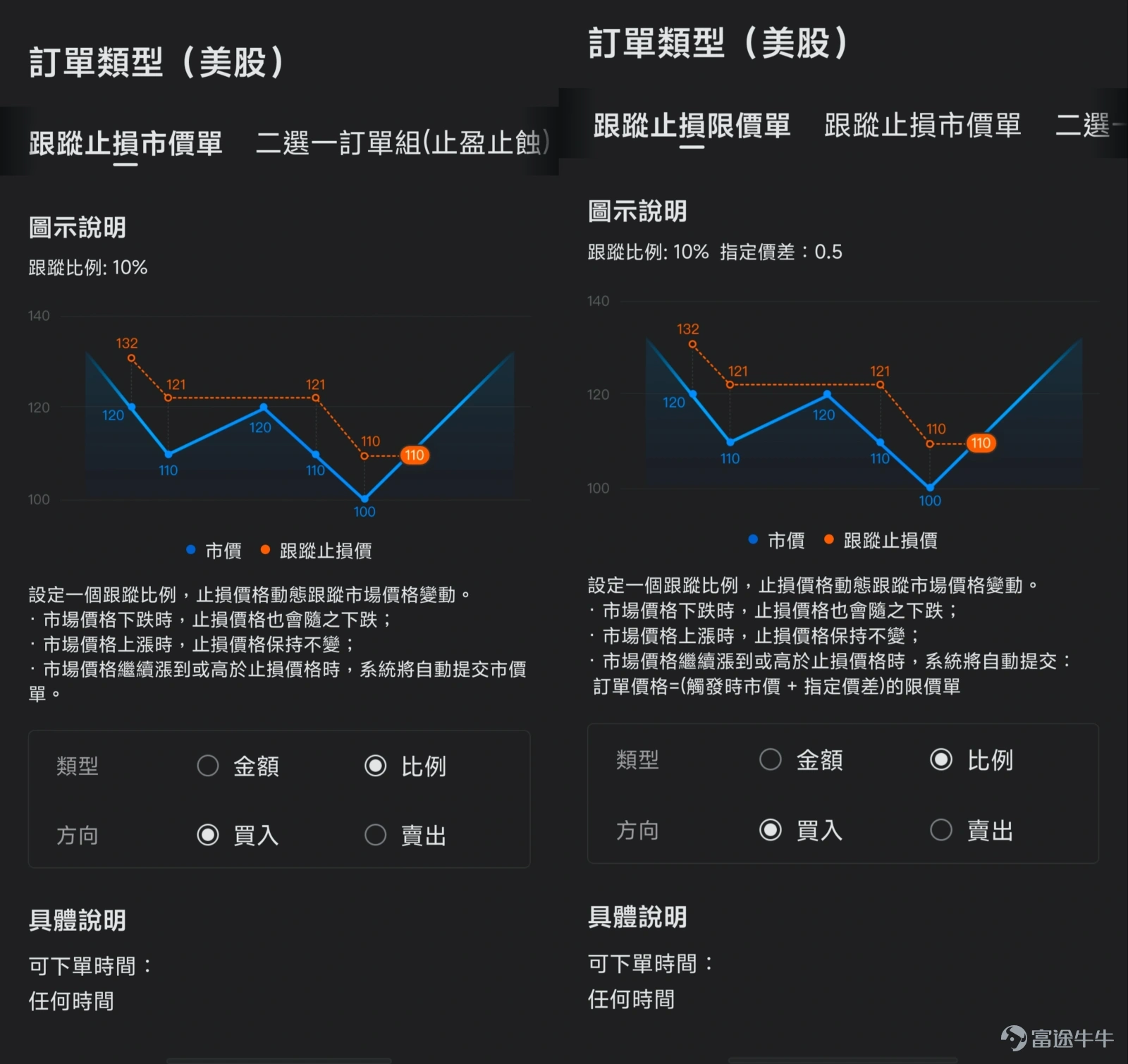
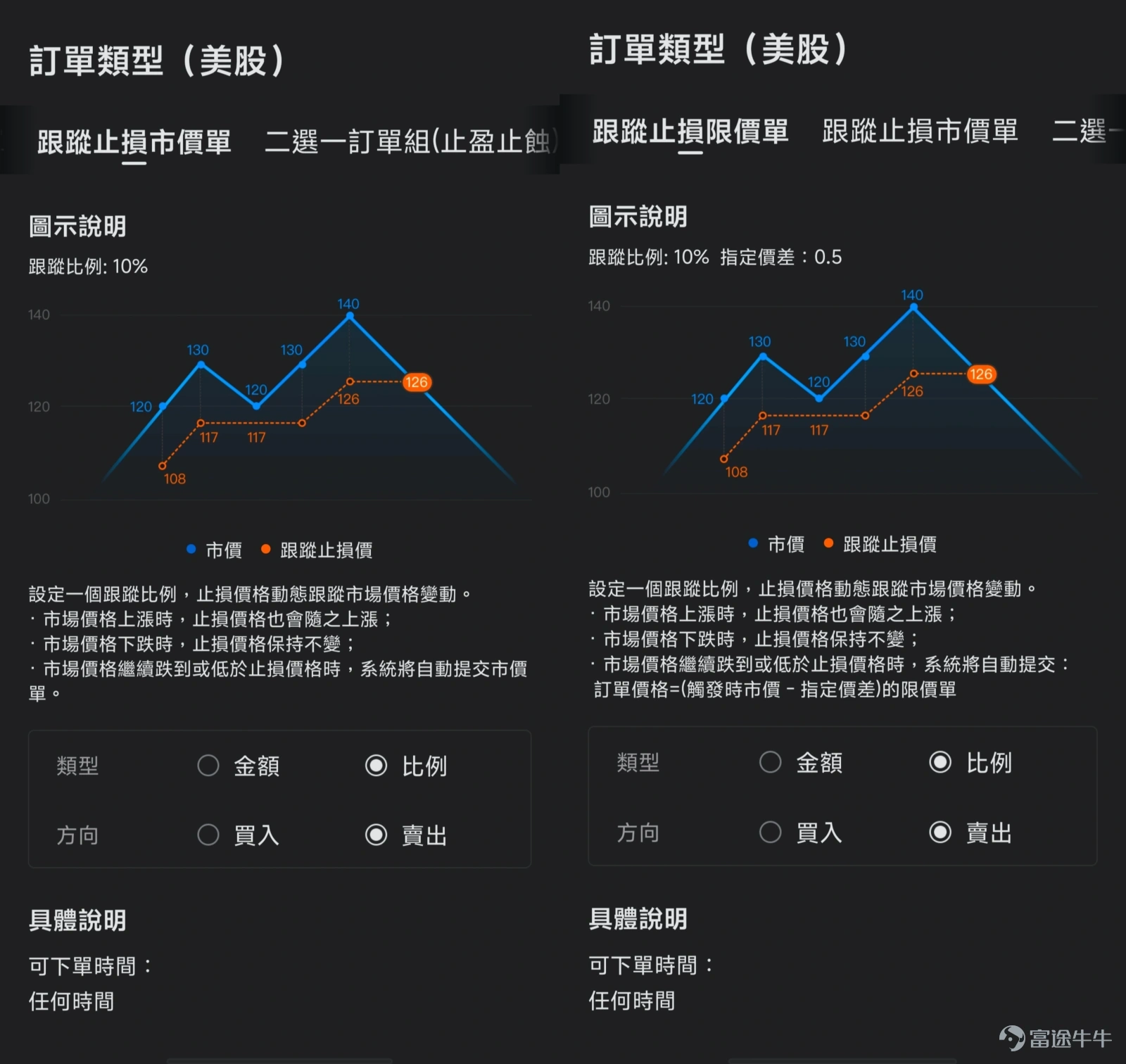
Set a dynamic trailing condition that maintains a distance from the market price (set either proportionally or numerically). Whether protecting existing holding profits or seeking better entry points, it allows the trigger price to automatically follow the market price in a favorable direction. Once the price reverses and meets the trigger condition, the order executes automatically.The purpose is to provide sufficient room for the trend to develop while promptly locking in holding profits or entry advantages.
Have you ever had this experience: the same stock, you see fellow investors earning 30% and gracefully exiting, but you sold too early and only made 5%? Or maybe the stock you bought dropped in value, and although you could have cut your losses earlier, you ended up losing 20% because you held on too long? Or perhaps a stock that was profitable turned into an unrecoverable roller coaster ride, ending in a loss?  If you’ve encountered similar situations, besides setting stricter trading rules for yourself and sticking to them,I strongly recommend unlocking Futubull’s 13 order types.Honestly, sometimes when you can’t execute trades perfectly on your own, using the right type of order might be a big help! 1. Trading Basics: Regular Orders – The Two Foundational Keys to Market Trading No matter how complex a trading strategy is, it’s built on two basic types of orders: market orders and limit orders. 1、A market order aims for immediate execution with a ‘lightning-fast’ tactic,without specifying a particular price, buying or selling at the current best market price. ● Usage Scenarios:Only operable during market trading hours; suitable for stocks with good liquidity, and useful when you urgently need to make a trade. For example, if a stock suddenly receives positive news and its price starts rising rapidly, you may want to jump on board immediately to avoid missing out on further gains. Alternatively, if a stock you hold experiences a sudden negative event, and you're worried about a sharp decline, you'd want to sell quickly to minimize losses. ● Special Note:You can also submit a conditional order, setting the price or time at which this market order becomes valid. You can also simultaneously submit an attached...
● Operational Scenarios:
For example, after you buy a stock at $100 and the stock price keeps rising, you set a trailing stop market order with a tracking percentage of 5%. The initial trigger price would be $95. As the stock price rises, the trigger price will rise accordingly. For instance, when the stock price increases to $120, the trigger price automatically adjusts to $114. As long as the price retracement does not exceed 5%, you can continue to hold; once the stock price retraces by 5% from its highest point and hits the latest trigger price, a sell order will automatically execute, locking in profits.
In another case, if you believe that a certain stock might reverse after a decline, you may want to buy it when it breaks through the downward trend. Assuming the current market price is $100, you set a trailing stop buy order with a tracking amount of $5. The initial trigger price is $105. If the stock price continues to fall to $95, your trigger price will automatically adjust down to $100. If the stock price continues to drop, the trigger price will keep following downward; once the stock price rebounds by $5 from its lowest point and hits the latest trigger price, a buy order will automatically trigger.
Have you ever had this experience: the same stock, you see fellow investors earning 30% and gracefully exiting, but you sold too early and only made 5%? Or maybe the stock you bought dropped in value, and although you could have cut your losses earlier, you ended up losing 20% because you held on too long? Or perhaps a stock that was profitable turned into an unrecoverable roller coaster ride, ending in a loss?  If you’ve encountered similar situations, besides setting stricter trading rules for yourself and sticking to them,I strongly recommend unlocking Futubull’s 13 order types.Honestly, sometimes when you can’t execute trades perfectly on your own, using the right type of order might be a big help! 1. Trading Basics: Regular Orders – The Two Foundational Keys to Market Trading No matter how complex a trading strategy is, it’s built on two basic types of orders: market orders and limit orders. 1、A market order aims for immediate execution with a ‘lightning-fast’ tactic,without specifying a particular price, buying or selling at the current best market price. ● Usage Scenarios:Only operable during market trading hours; suitable for stocks with good liquidity, and useful when you urgently need to make a trade. For example, if a stock suddenly receives positive news and its price starts rising rapidly, you may want to jump on board immediately to avoid missing out on further gains. Alternatively, if a stock you hold experiences a sudden negative event, and you're worried about a sharp decline, you'd want to sell quickly to minimize losses. ● Special Note:You can also submit a conditional order, setting the price or time at which this market order becomes valid. You can also simultaneously submit an attached...
If you place a market order, you only need to set the tracking percentage/amount and quantity. However, if you place a limit order, you also need to set a specified spread. Assuming you set the specified spread at $0.5, the sell order will attempt to execute at (the market price at the time of triggering minus the specified spread of $0.5), and the buy order will attempt to execute at (the market price at the time of triggering plus the specified spread of $0.5).
● Core Advantages:Achieves dynamic discipline that balances offense and defense. For holding and selling, it can automatically protect and lock in expanding paper profits, overcoming human weaknesses that lead to premature profit-taking and profit erosion. For buying into positions, it helps capture trend confirmation signals with discipline, avoiding premature bottom-fishing or chasing prices too high. In both cases, there's no need for frequent manual adjustments to orders; it can automatically adapt to trends and optimize entry and exit points.
● Potential Risks:The main risk is that it may become ineffective during non-trending, volatile markets. Whether used for selling or buying, in range-bound fluctuating prices, trailing stop orders may get repeatedly triggered due to frequent price reversals, leading to premature exits or incorrect entries, accumulating friction costs. Additionally, like all conditional orders, one must be mindful of slippage risks with market orders and non-execution risks with limit orders. Setting the width of the trailing distance requires full consideration of the underlying asset's volatility and market characteristics.
III. Advanced Strategy: Algorithmic Orders, Institutional-Level Trading Intelligence
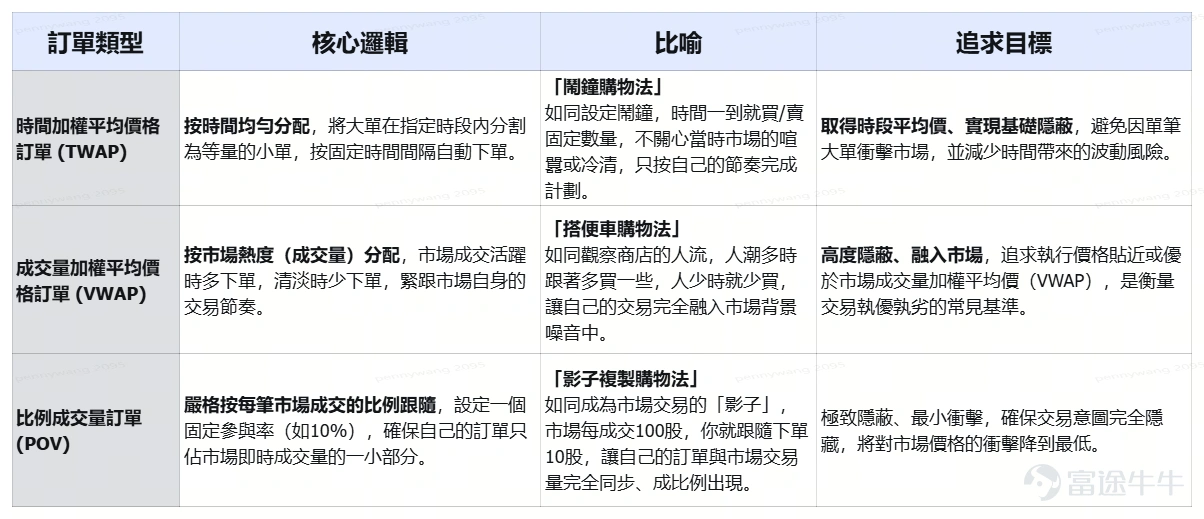
Finally, let's briefly discuss several types of algorithmic orders. When your trading volume is relatively large and you're concerned about impacting the market price, algorithmic orders can help break down large orders, reducing market impact and enabling 'invisible' trades.
Have you ever had this experience: the same stock, you see fellow investors earning 30% and gracefully exiting, but you sold too early and only made 5%? Or maybe the stock you bought dropped in value, and although you could have cut your losses earlier, you ended up losing 20% because you held on too long? Or perhaps a stock that was profitable turned into an unrecoverable roller coaster ride, ending in a loss?  If you’ve encountered similar situations, besides setting stricter trading rules for yourself and sticking to them,I strongly recommend unlocking Futubull’s 13 order types.Honestly, sometimes when you can’t execute trades perfectly on your own, using the right type of order might be a big help! 1. Trading Basics: Regular Orders – The Two Foundational Keys to Market Trading No matter how complex a trading strategy is, it’s built on two basic types of orders: market orders and limit orders. 1、A market order aims for immediate execution with a ‘lightning-fast’ tactic,without specifying a particular price, buying or selling at the current best market price. ● Usage Scenarios:Only operable during market trading hours; suitable for stocks with good liquidity, and useful when you urgently need to make a trade. For example, if a stock suddenly receives positive news and its price starts rising rapidly, you may want to jump on board immediately to avoid missing out on further gains. Alternatively, if a stock you hold experiences a sudden negative event, and you're worried about a sharp decline, you'd want to sell quickly to minimize losses. ● Special Note:You can also submit a conditional order, setting the price or time at which this market order becomes valid. You can also simultaneously submit an attached...
Fourth, final thoughts.
The market never lacks opportunities; what it lacks is the patience and wisdom to seize them with the right tools.
From basic limit and market orders, to automated conditional orders, and even invisible algorithmic orders, Futubull offers you a complete toolkit. Once you master the use of these order types, you'll find your control over the market significantly enhanced.
However, you don’t need to be an expert at every single type of order. Mastering just a few that suit your investment goals and style will allow you to outperform a large portion of market participants!
Lastly, here’s a small reminder: pay attention to the validity period of your orders. Don't forget to modify or cancel orders that no longer align with your objectives, otherwise untimely executions might occur. Also, remember to re-enter orders after their validity period has expired—otherwise, you may think a trade should have been executed when in reality it wasn't.
Risk Disclaimer: The above content only represents the author's view. It does not represent any position or investment advice of Futu. Futu makes no representation or warranty.Read more
Thumbs Up
121
Heart
6
Respect
1
Lol
1
771K Views
Report
Comments (2)
Write a Comment...
2
129
125