
What are the differences between public and private quant strategies?
Since last year, quant funds in the A-share market have demonstrated a strong money-making effect, with more extreme structural market conditions than in previous years.
Whether it’s the relatively mysterious private quant funds to outsiders or publicly available quant funds that anyone can buy, both delivered excellent returns last year. This was also the year when private quant funds on average outperformed subjective equity funds.
Why did this happen?
Simply put, the subjective public equity funds in the A-share market over the past decade have seen their average returns decline in recent years. One reason is that the A-share market has reduced occurrences of抱团 behavior like the big白马 rallies between 2020-2021 and the电新 sector leading the market in 2022. With fewer instances of抱团 behavior, stock-picking research in the A-share market is becoming increasingly challenging for subjective long-only strategies. Moreover, most subjective long-only managers failed to capture last year's rapidly rising AI leader stocks.
On the contrary, quant funds entered a favorable period over the past two years. One factor is the improvement in market liquidity; last year, trading volume hovered around 2 trillion yuan during most trading sessions, and the rise in turnover provided quant funds with more opportunities. Secondly, the Shanghai Composite Index rose from 3,350 to 4,000 points, nearly a 20% increase, with structural market movements generating higher beta for quant funds.
Looking back at the top-performing private and public quant funds last year, multiple institutions predict that quant funds will also perform well in volatile markets this year.
Private Quant vs Public Quant
Firstly, in terms of product structure, although both private quant and public quant are called 'quant,' they are not the same thing.
Private quant strategies offer greater flexibility in design, commonly including index enhancement, market neutrality, long-short strategies, CTA, and others running in parallel, with goals more focused on absolute and excess returns.
Public quant products, on the other hand, are more concentrated in broad-based index enhancement, industry-focused enhancement, and quantitative stock selection. While aiming for excess returns, they must also consider liquidity, subscription-redemption experiences, and investor acceptance, resulting in more overall constraints.
If we only look at the report card for 2025, the top two private quant funds are relatively clear.
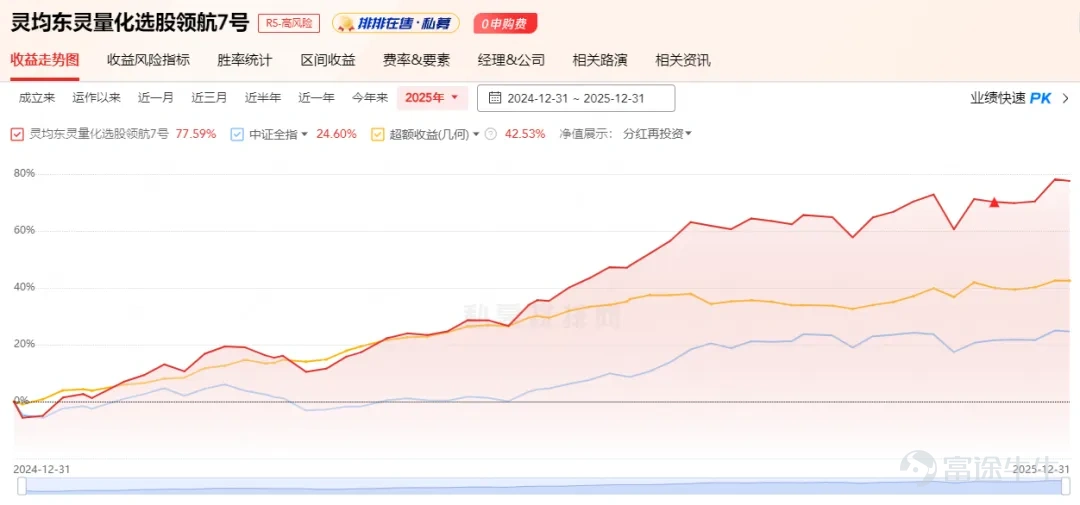
Public data shows that among the hundred-billion-yuan quant hedge funds, Lingjun Investment and Huanfang Quantitative rank at the top, with average returns of approximately 73% and 56% in 2025. Moreover, it's not just the leading institutions that are rising; the entire quantitative hedge fund sector performed strongly in 2025. The average return of billion-yuan quant hedge funds was significantly higher than that of subjective hedge funds, with quantitative long-only and index enhancement strategies particularly standing out.
Behind this is actually a market style that has given quant strategies an excellent stage. In 2025, the A-share market showed a clear structural-based rally, with significant volatility in small and medium-cap stocks, active trading, and fast style rotation.
In 2025, the average return of private quant index enhancement funds reached 46.43%, with the CSI 1000 index enhancement performing particularly well, achieving an average return of nearly 50%, significantly outperforming the CSI 500 and CSI 300 index enhancements. The reasons boil down to a few key factors: high turnover, small-cap style, beta, and small market cap factors all being advantageous simultaneously.
In other words, 2025 wasn't a market driven solely by a few heavyweight stocks lifting the index; instead, it was more suitable for quant models to consistently extract excess returns from a broader pool of stocks.
Let’s first look at Lingjun Quantitative, which ranked first among private funds.
Lingjun's official website explains its strategy quite straightforwardly. It mainly focuses on four areas: quantitative stock selection, index enhancement, long-short multi-strategy, and market neutrality. At its core are multi-factor stock selection and index enhancement. Its definition of index enhancement is also typical: under the premise of controlling risk exposures such as industry and scale, it tracks the index while trying to achieve some additional excess returns.
A key reason why Lingjun performed exceptionally well in 2025 lies in its strong performance in index enhancement products like CSI 1000 and CSI 300, especially with its CSI 1000 enhancement yielding over 36% returns mid-year. This indicates that it captured the opportunities presented by the small and medium-cap, high-volatility market very accurately.
More specifically, Lingjun benefited not from a single theme but from a combination of broad-spectrum stock selection capabilities and the dividend of small-cap style.

The second-ranked quant private fund last year was Huanfang Quantitative, which many are also familiar with. Deepseek originated from this company, and Huanfang's strategy places greater emphasis on deep learning, computing power platforms, and data processing capabilities.
By 2025, its average return is expected to reach 56.55%, and the market has a unified understanding of it—it tends to excel in a market environment characterized by diversified styles, active trading, and continuous thematic rotation. In short, Huanfang does not bet on a specific sector but is better at generating consistent relative returns in a large-sample, high-frequency updating market environment.
When comparing the two, Lingjun represents the execution power of broad-spectrum multi-factor and index enhancement, while Huanfang embodies AI modeling and computing power-driven model platforms. Both benefited from last year’s market conditions, but their sources of advantage are different.
Next, let's look at two representative public offering quantitative products.
First, take a look at Zhang Xu from Huaan Fund, whose managed Huaan Event-Driven Quantitative Strategy achieved a 38% return last year, significantly outperforming the 17% gain of the CSI 300 and also surpassing the average 27% return of flexible allocation funds. This fund has beaten both the CSI 300 and the Wind Equity Fund Index for six consecutive years.

According to the CICC Quantitative Research Team, they believe that under complex market conditions, quantitative strategies capable of effectively combining 'depth' with 'breadth' may have greater potential. This refers to understanding market trends through alternative data and machine learning methods, as well as systematically capturing rotation opportunities and diversifying risks via algorithms and models.
This type of product pays attention to fundamental clues such as improvements in corporate earnings as well as periodic trading hotspots in the market, which made them particularly stand out in last year's A-share market. The Huaan Event-Driven Quantitative Strategy is one of the more typical examples.
More specifically, Huaan Event-Driven overweights relatively favorable industries on a monthly basis. At the micro level, it selects individual stocks using a multi-factor framework (covering fundamental, capital flow, technical, and risk factors) combined with an event-driven model, dynamically adjusting factor weights under different market conditions.
With this continuously iterated quantitative model, Huaan Event-Driven has demonstrated a relative advantage over actively managed equity funds in most market phases.

As shown in the chart below, among nine semi-annual reports, Huaan Event-Driven's top holdings aligned with the top three performing industries five times. This can be said to be the greatest advantage of quantitative funds over actively managed equity funds.

According to CICC’s view, the likelihood of a rapid unilateral increase in market concentration continuing into 2026 is low. Given the current divergence in the internal structure and preferences of institutional incremental funds, it will be difficult to form a 'herd effect' similar to that seen between 2019 and 2021. Thus, any future increase in market concentration will likely be a limited clustering rather than a global centralization.
In 2026, A-share earnings growth is expected to exhibit a 'dual-driver' pattern, driven by both technology growth and the recovery of traditional industries, rather than relying on a single main theme.
This means that this year’s market concentration is unlikely to rise sharply, but the 'complexity' of the market will increase. This benefits strategies that effectively combine 'depth' (understanding key themes through alternative data and machine learning) with 'breadth' (capturing opportunities and diversifying risks through price-volume data, algorithms, and models), making them more adaptive.
Based on CICC's above-mentioned view, quantitative strategies like the Huaan Event-Driven strategy, which aligns with market trends, are still expected to achieve good returns this year because the market environment remains within Huaan Event-Driven’s 'comfort zone.'

Now let’s turn to Sun Meng from China AMC, a fund manager who stands out in public offering quant strategies due to his distinctive framework.
Public information shows that by the end of 2025, Sun Meng's managed China AMC CSI A500 Index Enhanced Fund and China AMC An Tai Quantitative Hedge Fund both ranked first in their respective categories. Moreover, China AMC’s quarterly reports clearly indicate that his underlying strategy is a multi-factor quantitative investment approach, supplemented by participating in new share offerings on the STAR Market and ChiNext to enhance returns.

More interestingly, many of Sun Meng’s products intentionally maintain market-cap neutrality and style neutrality, while employing deep learning and other artificial intelligence methods to capture patterns that traditional factors might miss.
This approach particularly showed its benefits in Q4 2025. During this quarter, the A-share market shifted from high-growth stocks to sectors like upstream cyclicals, communications, petrochemicals, and defense, where low valuation, profitability, and reversal factors performed better. Sun Meng’s strategy of 'not over-concentrating on a single style but relying more on models for balanced enhancement' happened to avoid being disrupted during the style rotation.
Sun Meng isn’t the type of quantitative manager who easily tops quarterly rankings, but he is one who performs well during style rotations. Such fund managers may not always be the most aggressive in the short term, but they often provide a better long-term holding experience.
Therefore, when comparing these two public offering quant managers, you realize they are fundamentally different.
Zhang Xu represents a composite quantitative approach combining sector rotation, event-driven strategies, and multi-factor stock selection, emphasizing finding excess returns amid complex themes and style shifts. This kind of strategy tends to perform better in markets like A-shares, where themes frequently change and events often act as catalysts.
Sun Meng, on the other hand, adopts a multi-factor, more balanced broad-based enhancement and hedging strategy, focusing on market-cap neutrality, style neutrality, and consistent long-term performance.
Conclusion
In fact, 2025 was an exceptionally good year for quantitative investing because the market’s structural characteristics provided ample room for quant strategies to shine—what was referred to at the beginning as the tailwind zone.
Among private equity quant funds, Lingjun and Huanfang are two representative firms, representing broad-spectrum stock selection and AI modeling capabilities respectively. On the public side, Zhang Xu stands out with his sector rotation style, while Sun Meng focuses on balance.
Though all are called quant strategies on the surface, the real difference doesn’t lie in whether models are used, but rather in what the models capture, in which market environment they operate, and how signals are translated into portfolio decisions.
The gains this time in 2025 are not essentially due to anyone suddenly becoming a genius, but rather whose strategy happened to align better with that year's market style. Looking ahead, as long as the A-share market remains highly active, key themes keep rotating, and individual stocks continue to diverge, quantitative strategies will most likely remain within their comfort zone.
Risk Disclaimer: The above content only represents the author's view. It does not represent any position or investment advice of Futu. Futu makes no representation or warranty.Read more

Comments
to post a comment
1
3