English
Back
Open Account
The US-Iran peace talks present conflicting narratives! What’s next for oil prices?

牛牛Insights
joined discussion · ·

ETF Toolbox Amid Ongoing Volatility: How to Choose Between Betting on Oil Prices, Oil Stocks, or Oil Transportation?

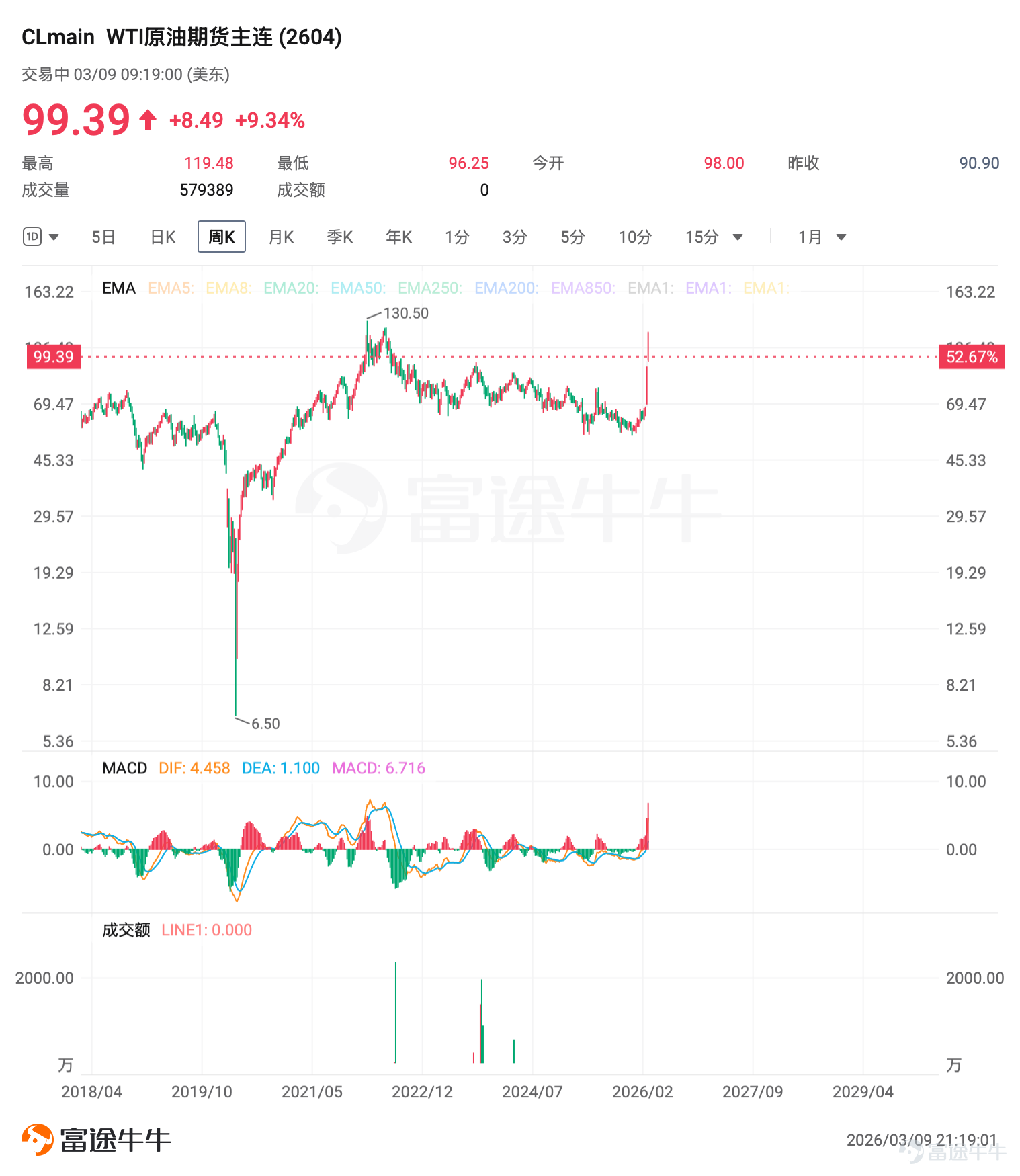
Over the past 72 hours, crude oil continued its volatile trading: the narrative of 'heading towards 150' accelerated, briefly reaching 119.48 USD, but after an emergency G7 meeting announced a potential release of 300 million barrels from reserves and reports emerged from the White House suggesting a possible halt to military action, prices plunged back to around 105 USD.
The subsequent movement of crude oil is likely to remain highly volatile.Looking short-term, geopolitical tensions in the Middle East and expectations of production cuts could continue to push prices higher; looking lower, expectations of the reopening of the Strait of Hormuz and policy-driven reserve releases may suppress sentiment. Oil prices are likely to remain in a wide range with sharp fluctuations.
In the medium to long term, the supply landscape for 2026 has been reshaped, along with the depletion of strategic reserves, meaning that the mid-point of oil prices may stabilize in the range of $75-$85 for the long haul.The global economy is entering a prolonged cycle characterized by 'high inflation, high interest rates, and moderately high oil prices.'
Over the past 72 hours, crude oil continued its volatile trading: the narrative of 'heading towards 150' accelerated, briefly reaching 119.48 USD, but after an emergency G7 meeting announced a potential release of 300 million barrels from reserves and reports emerged from the White House suggesting a possible halt to military action, prices plunged back to around 105 USD. The subsequent movement of crude oil is likely to remain highly volatile.Looking short-term, geopolitical tensions in the Middle East and expectations of production cuts could continue to push prices higher; looking lower, expectations of the reopening of the Strait of Hormuz and policy-driven reserve releases may suppress sentiment. Oil prices are likely to remain in a wide range with sharp fluctuations. In the medium to long term, the supply landscape for 2026 has been reshaped, along with the depletion of strategic reserves, meaning that the mid-point of oil prices may stabilize in the range of $75-$85 for the long haul.The global economy is entering a prolonged cycle characterized by 'high inflation, high interest rates, and moderately high oil prices.' This article provides an in-depth review of the major oil and gas ETFs currently available, helping users choose tools that match their style and strategy. First Layer: The most straightforward approach—betting on oil prices themselves Such as directly tracking crude oil futures prices: $United States Oil Fund LP (USO.US)$、 $United Sts Brent Oil Fd Lp Unit (BNO.US)$、 $ProShares Ultra Bloomberg Crude Oil ETF (UCO.US)$、 $ProShares UltraShort Bloomberg Crude Oil ETF (SCO.US)$ 。 Among them,USOCorresponding to WTI,B...
This article provides an in-depth review of the major oil and gas ETFs currently available, helping users choose tools that match their style and strategy.
First Layer: The most straightforward approach—betting on oil prices themselves
Among them,USOCorresponding to WTI,BNOcorresponding to Brent,UCO/SCOwhich are daily leveraged instruments for 2x long and short positions. These ETFs are suitable for betting on one-way movements in oil prices or pairing with options to go long/short volatility.
Their downside lies in the fact that the underlying assets are futures, which will be affected byroll yield lossandfutures curve structureand thus are not ideal as long-term holdings or 'alternatives to oil stocks'.
Over the past 72 hours, crude oil continued its volatile trading: the narrative of 'heading towards 150' accelerated, briefly reaching 119.48 USD, but after an emergency G7 meeting announced a potential release of 300 million barrels from reserves and reports emerged from the White House suggesting a possible halt to military action, prices plunged back to around 105 USD. The subsequent movement of crude oil is likely to remain highly volatile.Looking short-term, geopolitical tensions in the Middle East and expectations of production cuts could continue to push prices higher; looking lower, expectations of the reopening of the Strait of Hormuz and policy-driven reserve releases may suppress sentiment. Oil prices are likely to remain in a wide range with sharp fluctuations. In the medium to long term, the supply landscape for 2026 has been reshaped, along with the depletion of strategic reserves, meaning that the mid-point of oil prices may stabilize in the range of $75-$85 for the long haul.The global economy is entering a prolonged cycle characterized by 'high inflation, high interest rates, and moderately high oil prices.' This article provides an in-depth review of the major oil and gas ETFs currently available, helping users choose tools that match their style and strategy. First Layer: The most straightforward approach—betting on oil prices themselves Such as directly tracking crude oil futures prices: $United States Oil Fund LP (USO.US)$、 $United Sts Brent Oil Fd Lp Unit (BNO.US)$、 $ProShares Ultra Bloomberg Crude Oil ETF (UCO.US)$、 $ProShares UltraShort Bloomberg Crude Oil ETF (SCO.US)$ 。 Among them,USOCorresponding to WTI,B...
Second Layer: Integrated Energy Stocks -- Betting on a higher oil price center and who is more profitable
This layer is essentially 'Big Oil equity exposure.'XLE and VDE are more concentrated in Exxon and Chevron, while IXC is more global, covering major energy giants in the US, Canada, UK, France, and others.Compared to directly buying oil prices, these ETFs typically exhibit less extreme volatility, making them more suitable for expressing the logic of 'improved profitability in the energy sector.'
These ETFs are closer to the profit elasticity of oil prices. When oil prices rise,upstream companies' earnings expectations often increase more rapidly.However, once oil prices fall, they usually come under pressure earlier.
Downstream refining can be monitored, $VanEck Vectors Oil Refiners ETF (CRAK.US)$ but this logic is more complex. If oil prices rise too quickly, it may squeeze refining profits, so it’s not simply a target that benefits from rising oil prices.
Over the past 72 hours, crude oil continued its volatile trading: the narrative of 'heading towards 150' accelerated, briefly reaching 119.48 USD, but after an emergency G7 meeting announced a potential release of 300 million barrels from reserves and reports emerged from the White House suggesting a possible halt to military action, prices plunged back to around 105 USD. The subsequent movement of crude oil is likely to remain highly volatile.Looking short-term, geopolitical tensions in the Middle East and expectations of production cuts could continue to push prices higher; looking lower, expectations of the reopening of the Strait of Hormuz and policy-driven reserve releases may suppress sentiment. Oil prices are likely to remain in a wide range with sharp fluctuations. In the medium to long term, the supply landscape for 2026 has been reshaped, along with the depletion of strategic reserves, meaning that the mid-point of oil prices may stabilize in the range of $75-$85 for the long haul.The global economy is entering a prolonged cycle characterized by 'high inflation, high interest rates, and moderately high oil prices.' This article provides an in-depth review of the major oil and gas ETFs currently available, helping users choose tools that match their style and strategy. First Layer: The most straightforward approach—betting on oil prices themselves Such as directly tracking crude oil futures prices: $United States Oil Fund LP (USO.US)$、 $United Sts Brent Oil Fd Lp Unit (BNO.US)$、 $ProShares Ultra Bloomberg Crude Oil ETF (UCO.US)$、 $ProShares UltraShort Bloomberg Crude Oil ETF (SCO.US)$ 。 Among them,USOCorresponding to WTI,B...
The third layer: The picks-and-shovels layer - betting on capital expenditure expansion.
The essence of these types of investments is a bet on the expansion of demand for drilling, equipment, well completion, and oilfield services. Rising oil prices do not necessarily lead to benefits, but if the industry chain starts to increase investment, oil services often demonstrate higher operating leverage.If the current conflict in the Middle East further damages oil and gas facilities, subsequent repair and reconstruction needs could strengthen this logic.
These assets are more like 'toll booths' in the energy chain, with profits mainly coming from channel fees, processing fees, and long-term contracts. Their upside is typically not as strong as oil services, but they are also less vulnerable during downturns, making them suitable for more conservative energy-themed allocations.
Over the past 72 hours, crude oil continued its volatile trading: the narrative of 'heading towards 150' accelerated, briefly reaching 119.48 USD, but after an emergency G7 meeting announced a potential release of 300 million barrels from reserves and reports emerged from the White House suggesting a possible halt to military action, prices plunged back to around 105 USD. The subsequent movement of crude oil is likely to remain highly volatile.Looking short-term, geopolitical tensions in the Middle East and expectations of production cuts could continue to push prices higher; looking lower, expectations of the reopening of the Strait of Hormuz and policy-driven reserve releases may suppress sentiment. Oil prices are likely to remain in a wide range with sharp fluctuations. In the medium to long term, the supply landscape for 2026 has been reshaped, along with the depletion of strategic reserves, meaning that the mid-point of oil prices may stabilize in the range of $75-$85 for the long haul.The global economy is entering a prolonged cycle characterized by 'high inflation, high interest rates, and moderately high oil prices.' This article provides an in-depth review of the major oil and gas ETFs currently available, helping users choose tools that match their style and strategy. First Layer: The most straightforward approach—betting on oil prices themselves Such as directly tracking crude oil futures prices: $United States Oil Fund LP (USO.US)$、 $United Sts Brent Oil Fd Lp Unit (BNO.US)$、 $ProShares Ultra Bloomberg Crude Oil ETF (UCO.US)$、 $ProShares UltraShort Bloomberg Crude Oil ETF (SCO.US)$ 。 Among them,USOCorresponding to WTI,B...
Fourth layer: The most elastic — offshore oil shipping
Offshore Oil Shipping ETF: Tracks crude oil maritime freight futures $BREAKWAVE TANKER SHIPPING ETF (BWET.US)$
The core variable it trades is not oil prices, butshipping rates, driven by factors such as vessel supply, rerouting distances, fleet utilization, and capacity tightness caused by geopolitical conflicts. Under expectations of 'freight rate shocks,' BWET has delivered a performance of over 200% year-to-date. $The Limestone Boat Co Ltd (BOAT.CA)$ and $Seabridge Gold Inc (SEA.CA)$ It is broader, covering more shipping/freight targets, not equal to pure oil transportation.
Over the past 72 hours, crude oil continued its volatile trading: the narrative of 'heading towards 150' accelerated, briefly reaching 119.48 USD, but after an emergency G7 meeting announced a potential release of 300 million barrels from reserves and reports emerged from the White House suggesting a possible halt to military action, prices plunged back to around 105 USD. The subsequent movement of crude oil is likely to remain highly volatile.Looking short-term, geopolitical tensions in the Middle East and expectations of production cuts could continue to push prices higher; looking lower, expectations of the reopening of the Strait of Hormuz and policy-driven reserve releases may suppress sentiment. Oil prices are likely to remain in a wide range with sharp fluctuations. In the medium to long term, the supply landscape for 2026 has been reshaped, along with the depletion of strategic reserves, meaning that the mid-point of oil prices may stabilize in the range of $75-$85 for the long haul.The global economy is entering a prolonged cycle characterized by 'high inflation, high interest rates, and moderately high oil prices.' This article provides an in-depth review of the major oil and gas ETFs currently available, helping users choose tools that match their style and strategy. First Layer: The most straightforward approach—betting on oil prices themselves Such as directly tracking crude oil futures prices: $United States Oil Fund LP (USO.US)$、 $United Sts Brent Oil Fd Lp Unit (BNO.US)$、 $ProShares Ultra Bloomberg Crude Oil ETF (UCO.US)$、 $ProShares UltraShort Bloomberg Crude Oil ETF (SCO.US)$ 。 Among them,USOCorresponding to WTI,B...
The last spillover direction: agricultural products and agrochemicals
Over the past 72 hours, crude oil continued its volatile trading: the narrative of 'heading towards 150' accelerated, briefly reaching 119.48 USD, but after an emergency G7 meeting announced a potential release of 300 million barrels from reserves and reports emerged from the White House suggesting a possible halt to military action, prices plunged back to around 105 USD. The subsequent movement of crude oil is likely to remain highly volatile.Looking short-term, geopolitical tensions in the Middle East and expectations of production cuts could continue to push prices higher; looking lower, expectations of the reopening of the Strait of Hormuz and policy-driven reserve releases may suppress sentiment. Oil prices are likely to remain in a wide range with sharp fluctuations. In the medium to long term, the supply landscape for 2026 has been reshaped, along with the depletion of strategic reserves, meaning that the mid-point of oil prices may stabilize in the range of $75-$85 for the long haul.The global economy is entering a prolonged cycle characterized by 'high inflation, high interest rates, and moderately high oil prices.' This article provides an in-depth review of the major oil and gas ETFs currently available, helping users choose tools that match their style and strategy. First Layer: The most straightforward approach—betting on oil prices themselves Such as directly tracking crude oil futures prices: $United States Oil Fund LP (USO.US)$、 $United Sts Brent Oil Fd Lp Unit (BNO.US)$、 $ProShares Ultra Bloomberg Crude Oil ETF (UCO.US)$、 $ProShares UltraShort Bloomberg Crude Oil ETF (SCO.US)$ 。 Among them,USOCorresponding to WTI,B...
Historically, a significant rise in oil prices often draws attention to certain agricultural products as well. This is because energy costs increase transportation and fertilizer expenses, which also boosts parts of the agricultural product and biofuel chains.Therefore, if oil prices remain high for a longer period, agricultural products will likely start receiving more trading attention; but if the oil price surge is only short-term, agriculture may not independently become the main focus.
To reflect the prices of agricultural products themselves, the most commonly used index is $Invesco DB Agriculture Fund (DBA.US)$ , representing 'a basket of agricultural product prices'; and reflecting the profitability of companies in the agricultural supply chain is $Moon River Moly Ltd (MOO.CA)$ , which covers sectors such as fertilizers, seeds, agricultural machinery, irrigation, and agricultural product trading. A broader perspective extending into agrochemicals and materials would include $Materials Select Sector SPDR ETF (XLB.US)$ , serving as a wider entry point for trading.
Over the past 72 hours, crude oil continued its volatile trading: the narrative of 'heading towards 150' accelerated, briefly reaching 119.48 USD, but after an emergency G7 meeting announced a potential release of 300 million barrels from reserves and reports emerged from the White House suggesting a possible halt to military action, prices plunged back to around 105 USD. The subsequent movement of crude oil is likely to remain highly volatile.Looking short-term, geopolitical tensions in the Middle East and expectations of production cuts could continue to push prices higher; looking lower, expectations of the reopening of the Strait of Hormuz and policy-driven reserve releases may suppress sentiment. Oil prices are likely to remain in a wide range with sharp fluctuations. In the medium to long term, the supply landscape for 2026 has been reshaped, along with the depletion of strategic reserves, meaning that the mid-point of oil prices may stabilize in the range of $75-$85 for the long haul.The global economy is entering a prolonged cycle characterized by 'high inflation, high interest rates, and moderately high oil prices.' This article provides an in-depth review of the major oil and gas ETFs currently available, helping users choose tools that match their style and strategy. First Layer: The most straightforward approach—betting on oil prices themselves Such as directly tracking crude oil futures prices: $United States Oil Fund LP (USO.US)$、 $United Sts Brent Oil Fd Lp Unit (BNO.US)$、 $ProShares Ultra Bloomberg Crude Oil ETF (UCO.US)$、 $ProShares UltraShort Bloomberg Crude Oil ETF (SCO.US)$ 。 Among them,USOCorresponding to WTI,B...
Risk Disclaimer: The above content only represents the author's view. It does not represent any position or investment advice of Futu. Futu makes no representation or warranty.Read more
Thumbs Up
72
Heart
8
Nice
1
Lol
1
252K Views
Report
Comments (2)
Write a Comment...
2
82
158