Simultaneous pressure on the Red Sea and the Strait of Hormuz drives international oil prices higher

Weekly Options Strategy 0309 | Panic sentiment spreads, is it time to buy the dip now? Inflation data and Oracle earnings report are coming up, let’s preview the scenarios
This article is from the "Weekly Options Strategy" column, which brings fellow investors a review of last week's market, the hot topics of the week, and an analysis of potential options trading opportunities. Welcome!Click hereJoin the learning session, and you will receive notifications when new updates to the column are available.
Dear fellow investors, happy Monday~
A new week begins with geopolitical risks and AI as the two main themes intertwining, injecting new variables into the market. This issue will focus on three core topics: the ongoing tug-of-war in oil prices and its impact on global markets, the policy expectation game amid key inflation data releases, and the evolution of Oracle's earnings report and the AI narrative. We will continue to systematically outline the pathways of core events and explore potential options trading strategies.
Additionally, starting this week, the US stock market trading hours have officially been adjusted for the end of daylight saving time.The pre-market, opening, and closing times are all moved forward by one hour (pre-market trading starts at 4:00 PM Beijing time, opening at 9:30 PM, and closing at 4:00 AM the next day).Dear fellow investors, please be mindful of the changes in trading hours.
Oil prices have become the central contradiction determining market direction. What should the subsequent strategy be?
The Middle East conflict has entered its second week, with the latest news being that Mojtaba, son of Khamenei, has officially taken over, strengthening expectations of a hardline stance from Iran.The market interprets his rise as meaning that the hardline faction within Iran and the Revolutionary Guard system is more stable, reducing the likelihood of rapid de-escalation through compromise in the short term.
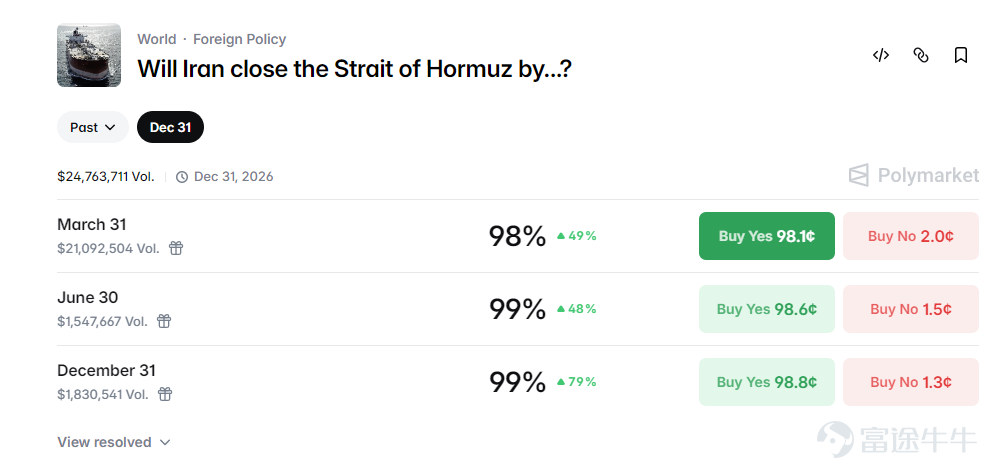
Crude oil prices surged to their highest level since July 2022 during Asian trading hours today. Brent crude, $Crude Oil Futures (NOV6) (CLmain.US)$ rose by approximately 20% in a single day, with some periods showing even higher gains; US stock futures came under significant pressure, the dollar strengthened, and global risk assets fell in tandem.According to current prediction data on Polymarket, bets that Iran will block the Strait of Hormuz before December 31 have reached 99%.
![This article is from the "Weekly Options Strategy" column, which brings fellow investors a review of last week's market, the hot topics of the week, and an analysis of potential options trading opportunities. Welcome![Share Link: Click here]Join the learning session, and you will receive notifications when new updates to the column are available. Dear fellow investors, happy Monday~ A new week begins with geopolitical risks and AI as the two main themes intertwining, injecting new variables into the market. This issue will focus on three core topics: the ongoing tug-of-war in oil prices and its impact on global markets, the policy expectation game amid key inflation data releases, and the evolution of Oracle's earnings report and the AI narrative. We will continue to systematically outline the pathways of core events and explore potential options trading strategies. Additionally, starting this week, the US stock market trading hours have officially been adjusted for the end of daylight saving time.The pre-market, opening, and closing times are all moved forward by one hour (pre-market trading starts at 4:00 PM Beijing time, opening at 9:30 PM, and closing at 4:00 AM the next day).Dear fellow investors, please be mindful of the changes in trading hours. Oil prices have become the central contradiction determining market direction. What should the subsequent strategy be? The Middle East conflict has entered its second week, with the latest news being that Mojtaba, son of Khamenei, has officially taken over, strengthening expectations of a hardline stance from Iran.The market interprets his rise as meaning that the hardline faction within Iran and the Revolutionary Guard system is more stable, reducing the likelihood of rapid de-escalation through compromise in the short term. Crude oil prices surged during Asian trading hours today, reaching as high as 2022...](https://nnqimage.futunn.com/sns_client_feed/999908/20260309/web-1773050094003-E5E2cHCe3K.png/big?area=2&is_public=true&imageMogr2/ignore-error/1/format/webp)
At this stage, it is an intense but not yet fully uncontrollable energy shock.。Capital is shifting from 'loosening expectation trades' to 'stagflation defense trades,' but the most critical variable in the current market remains not demand collapse, but how long transportation disruptions and regional production cuts will last.
As long as there is no clear easing of the risks in Hormuz, it will be difficult for oil prices to quickly return to the pre-event pricing range; conversely, as long as transportation resumes, inventory is released, and policy interventions are in place, market panic may also recede in stages. In other words,The current situation more closely resembles a 'high-volatility reversible shock' rather than the eve of an irreversible financial crisis.
Opportunity Analysis
The complexity of this round of developments has exceeded expectations; the actual trajectory of the war might surpass not only the US side's expectations but also the market's previous mainstream judgment.The origin of market fluctuations naturally lies in the duration, intensity, and scope of the conflict, but all of these involve significant uncertainties. For investors, within the graspable range:
1) In the short term,Following the initial panic selling, focus on the 'policy repricing' after the release of the US February CPI data this Wednesday and core PCE data on Friday. If inflation figures coincide with high oil prices, it will exacerbate 'stagflation' concerns, influencing the next phase of market trends.
2) In the medium to long term,Oil prices will become the key pricing contradiction in the subsequent market. One must be wary of the chain reactions brought about by the 'prolongation of the conflict.' The evolution pace of the Russia-Ukraine conflict in 2022 holds important implications for the present situation.。If oil prices continue to rise subsequently, it will disrupt the weak dollar pattern and might even force policies back into tightening, significantly suppressing the market, especially growth-oriented styles.
At present, although Trump has publicly expressed his intention to stabilize oil price expectations, and with the upcoming US mid-term elections in the second half of the year showing low tolerance for a resurgence in inflation, his actual ability and determination to control the situation and oil prices remain to be seen.
Options strategy
From a technical perspective, major US stock indices have retreated to near-term support levels but have not broken below the lows of late last year, indicating significant short-term correction pressures, though the medium to long-term structure remains intact.Crude oil has broken through the upper bound of its recent trading range, while gold has reached a key resistance level, offering short-term profit-taking opportunities, although the overall trend remains bullish.
(1) Investors heavily weighted in stocks (technology/growth) - Hedge risks and manage drawdowns.
Suitable for investors with large positions who hold physical assets and don't want to sell, prioritizing drawdown control.
This week is filled with risk events, and the inflation data released mid-week increases market uncertainty. Given the currently high put option premiums, directly buying puts could be vulnerable to a drop in implied volatility (IV), so short-term strategies might be considered.Collar Option Strategy, which involves holding the position while selling call options and using the premium received to buy out-of-the-money put options, thereby locking in downside risk below a critical support level to prevent erosion from short-term panic fluctuations. This approach sacrifices some upside potential in exchange for protection against sharp declines, making it suitable for guarding against 'pessimistic scenarios'.
(The design images displayed on screen are for illustrative purposes only and do not constitute any investment advice or guarantees; market conditions fluctuate frequently, and the option prices shown do not represent real-world values.)
![This article is from the "Weekly Options Strategy" column, which brings fellow investors a review of last week's market, the hot topics of the week, and an analysis of potential options trading opportunities. Welcome![Share Link: Click here]Join the learning session, and you will receive notifications when new updates to the column are available. Dear fellow investors, happy Monday~ A new week begins with geopolitical risks and AI as the two main themes intertwining, injecting new variables into the market. This issue will focus on three core topics: the ongoing tug-of-war in oil prices and its impact on global markets, the policy expectation game amid key inflation data releases, and the evolution of Oracle's earnings report and the AI narrative. We will continue to systematically outline the pathways of core events and explore potential options trading strategies. Additionally, starting this week, the US stock market trading hours have officially been adjusted for the end of daylight saving time.The pre-market, opening, and closing times are all moved forward by one hour (pre-market trading starts at 4:00 PM Beijing time, opening at 9:30 PM, and closing at 4:00 AM the next day).Dear fellow investors, please be mindful of the changes in trading hours. Oil prices have become the central contradiction determining market direction. What should the subsequent strategy be? The Middle East conflict has entered its second week, with the latest news being that Mojtaba, son of Khamenei, has officially taken over, strengthening expectations of a hardline stance from Iran.The market interprets his rise as meaning that the hardline faction within Iran and the Revolutionary Guard system is more stable, reducing the likelihood of rapid de-escalation through compromise in the short term. Crude oil prices surged during Asian trading hours today, reaching as high as 2022...](https://nnqimage.futunn.com/sns_client_feed/999908/20260309/web-1773050093822-T0QsKDkAsB.jpeg/big?area=2&is_public=true&imageMogr2/ignore-error/1/format/webp)
(2) Investors who wish to participate in benefiting sectors such as energy and commodities but fear chasing highs - Engage with small positions while controlling downside risks.
If investors are short-term bullish on crude oil or the energy sector ETF, they should be cautious as crude oil prices have already reached historical highs with extremely high volatility; consensus equals risk, and any easing signals may trigger a stampede-like pullback. Participation can be achieved by purchasing call options or constructing a Bull Call Spread to reduce capital commitment.
Risk control: It is recommended to deploy positions in batches, avoiding heavy positions at price spike peaks while setting profit-taking/stop-loss conditions.
(The design images displayed on screen are for illustrative purposes only and do not constitute any investment advice or guarantees; market conditions fluctuate frequently, and the option prices shown do not represent real-world values.)
![This article is from the "Weekly Options Strategy" column, which brings fellow investors a review of last week's market, the hot topics of the week, and an analysis of potential options trading opportunities. Welcome![Share Link: Click here]Join the learning session, and you will receive notifications when new updates to the column are available. Dear fellow investors, happy Monday~ A new week begins with geopolitical risks and AI as the two main themes intertwining, injecting new variables into the market. This issue will focus on three core topics: the ongoing tug-of-war in oil prices and its impact on global markets, the policy expectation game amid key inflation data releases, and the evolution of Oracle's earnings report and the AI narrative. We will continue to systematically outline the pathways of core events and explore potential options trading strategies. Additionally, starting this week, the US stock market trading hours have officially been adjusted for the end of daylight saving time.The pre-market, opening, and closing times are all moved forward by one hour (pre-market trading starts at 4:00 PM Beijing time, opening at 9:30 PM, and closing at 4:00 AM the next day).Dear fellow investors, please be mindful of the changes in trading hours. Oil prices have become the central contradiction determining market direction. What should the subsequent strategy be? The Middle East conflict has entered its second week, with the latest news being that Mojtaba, son of Khamenei, has officially taken over, strengthening expectations of a hardline stance from Iran.The market interprets his rise as meaning that the hardline faction within Iran and the Revolutionary Guard system is more stable, reducing the likelihood of rapid de-escalation through compromise in the short term. Crude oil prices surged during Asian trading hours today, reaching as high as 2022...](https://nnqimage.futunn.com/sns_client_feed/999908/20260309/web-1773050093899-sWo8dIiRh5.jpeg/big?area=2&is_public=true&imageMogr2/ignore-error/1/format/webp)
3) Betting on the decline of risk premium - High-risk speculation
In panic, markets are prone to indiscriminate selloffs with impulsive price movements, creating extreme implied volatility (IV) levels in the short term. A short OTM option strategy can be particularly effective when IV is high, capturing both returns and cushioning portfolio fluctuations. If one believes that after a rapid surge in oil prices, the US will intervene to 'suppress' them, they can speculate on 'oil price decline → recovery of rate-cut expectations → US stock rebound.' With the VIX index spiking sharply, strategies such as shorting volatility (e.g., Iron Condor or selling strangles) can capture premiums amidst wide-ranging volatility.
Risk control: In extreme IV scenarios, sellers have limited gains and must adhere to strict stop-loss measures.
(The design images displayed on screen are for illustrative purposes only and do not constitute any investment advice or guarantees; market conditions fluctuate frequently, and the option prices shown do not represent real-world values.)
![This article is from the "Weekly Options Strategy" column, which brings fellow investors a review of last week's market, the hot topics of the week, and an analysis of potential options trading opportunities. Welcome![Share Link: Click here]Join the learning session, and you will receive notifications when new updates to the column are available. Dear fellow investors, happy Monday~ A new week begins with geopolitical risks and AI as the two main themes intertwining, injecting new variables into the market. This issue will focus on three core topics: the ongoing tug-of-war in oil prices and its impact on global markets, the policy expectation game amid key inflation data releases, and the evolution of Oracle's earnings report and the AI narrative. We will continue to systematically outline the pathways of core events and explore potential options trading strategies. Additionally, starting this week, the US stock market trading hours have officially been adjusted for the end of daylight saving time.The pre-market, opening, and closing times are all moved forward by one hour (pre-market trading starts at 4:00 PM Beijing time, opening at 9:30 PM, and closing at 4:00 AM the next day).Dear fellow investors, please be mindful of the changes in trading hours. Oil prices have become the central contradiction determining market direction. What should the subsequent strategy be? The Middle East conflict has entered its second week, with the latest news being that Mojtaba, son of Khamenei, has officially taken over, strengthening expectations of a hardline stance from Iran.The market interprets his rise as meaning that the hardline faction within Iran and the Revolutionary Guard system is more stable, reducing the likelihood of rapid de-escalation through compromise in the short term. Crude oil prices surged during Asian trading hours today, reaching as high as 2022...](https://nnqimage.futunn.com/sns_client_feed/999908/20260309/web-1773050094198-aIdBHZNigM.jpeg/big?area=2&is_public=true&imageMogr2/ignore-error/1/format/webp)
CPI and PCE data are released in the same week; could a stagflation scenario emerge following the disappointing non-farm payrolls report?
Last Friday (March 6), the US Labor Department released a disappointing employment report for February. Data showed that non-farm payroll jobs unexpectedly fell by 92,000 in February, far below market expectations of a near 60,000 increase, with downward revisions of 69,000 for the previous two months combined. At the same time, the unemployment rate edged up to 4.4%. This 'shocking' report reversed market perceptions that the US labor market was 'stabilizing.'
However, market concerns are not limited to a single factor.On the geopolitical front, Iran's disruption of shipping through the Strait of Hormuz has caused global energy prices to soar.Brent crude oil prices surged from around $70 per barrel to near $120 per barrel. The sharp rise in oil prices directly ignited 'inflation trading' in the markets, bringing two major risks into focus simultaneously: 'economic slowdown' and 'inflationary pressures.'‘Stagflation’ – the coexistence of stagnant economic growth and inflation – a specter from the 1970s, has once again become a focal point of market concern.
Against this backdrop, the upcoming flurry of key US inflation data releases this week will serve as an important window to assess the risk of 'stagflation.' The US February CPI data will be released onWednesday, March 11 at 20:30 Beijing time, while the US January core PCE data will be released onFriday, March 13 at 20:30 Beijing time.
As per惯例, PCE data is usually released at the end of the following month. However, due to the government shutdown at the start of the year, the January PCE data was delayed until mid-March, creating a rare situation where CPI and PCE are released in the same week.
Opportunity Analysis
The market broadly anticipates that the year-on-year growth rate for US February CPI will be 2.5%, slightly up from the previous 2.4%; and the January PCE year-on-year figure will remain unchanged at 2.9%.
Scenario One: Inflation data is mild or even below expectations
If the CPI and core PCE figures meet or fall below market expectations, it will temporarily ease the market's extreme fear of 'secondary inflation.'This means that despite the shock from oil prices, core inflation pressures remain manageable. Combined with the previously disappointing non-farm payroll data, the market may strengthen expectations that 'the Fed will prioritize addressing the economic slowdown,' thereby boosting rate cut expectations.
In this scenario, interest-rate-sensitive assets will benefit, with US stocks, particularly in the technology sector, likely to see a rebound, while the US Dollar Index may come under pressure due to rising rate cut expectations.
Scenario Two: Inflation data rebounds more than expected
This is the market's most feared 'stagflation' scenario. If existing inflation data significantly exceeds expectations and combines with the recent rise in oil prices’ transmission effect, the future inflation outlook would be far from optimistic.
This will confirm market concerns about stagflation and also place the Federal Reserve in a 'dilemma': On one side, a rapidly cooling job market calls for policy easing, while on the other, inflation risks constrain the room for easing.
In such a situation, stock markets will face pressure as corporate earnings prospects are squeezed by both weak demand (stagnation) and rising costs (inflation). Bond yields may rise due to inflation expectations, but recession risks will limit their upside, leading to heightened volatility.
Options strategy
Current$SPDR S&P 500 ETF (SPY.US)$ and $Invesco QQQ Trust (QQQ.US)$are both in a short-term technically oversold condition, and implied volatility (IV) has risen to high levels, reflecting cautious market sentiment. In this environment,selling strategies under high volatility or combination strategies aimed at capturing technical rebounds are directions worth considering.
As of last Friday, SPY’s IV percentile was at 95%, and QQQ’s percentile was at 92%, with implied volatility remaining elevated, making option contract prices relatively expensive.
(1) Look for opportunities to buy the dip
While maintaining sufficient cash, sell put options near the desired price (Cash Secured Put) to collect premiums. If the market rebounds, the premium becomes profit; if the market falls to the target price, the position is passively taken over, achieving a low-cost setup. It is important to note that investors need to reserve enough capital—unexpected sharp declines could lead to forced liquidation risks if cash reserves are insufficient.
(The design images displayed on screen are for illustrative purposes only and do not constitute any investment advice or guarantees; market conditions fluctuate frequently, and the option prices shown do not represent real-world values.)
![This article is from the "Weekly Options Strategy" column, which brings fellow investors a review of last week's market, the hot topics of the week, and an analysis of potential options trading opportunities. Welcome![Share Link: Click here]Join the learning session, and you will receive notifications when new updates to the column are available. Dear fellow investors, happy Monday~ A new week begins with geopolitical risks and AI as the two main themes intertwining, injecting new variables into the market. This issue will focus on three core topics: the ongoing tug-of-war in oil prices and its impact on global markets, the policy expectation game amid key inflation data releases, and the evolution of Oracle's earnings report and the AI narrative. We will continue to systematically outline the pathways of core events and explore potential options trading strategies. Additionally, starting this week, the US stock market trading hours have officially been adjusted for the end of daylight saving time.The pre-market, opening, and closing times are all moved forward by one hour (pre-market trading starts at 4:00 PM Beijing time, opening at 9:30 PM, and closing at 4:00 AM the next day).Dear fellow investors, please be mindful of the changes in trading hours. Oil prices have become the central contradiction determining market direction. What should the subsequent strategy be? The Middle East conflict has entered its second week, with the latest news being that Mojtaba, son of Khamenei, has officially taken over, strengthening expectations of a hardline stance from Iran.The market interprets his rise as meaning that the hardline faction within Iran and the Revolutionary Guard system is more stable, reducing the likelihood of rapid de-escalation through compromise in the short term. Crude oil prices surged during Asian trading hours today, reaching as high as 2022...](https://nnqimage.futunn.com/sns_client_feed/999908/20260309/web-1773050093943-TfLN1aEQ3K.png/big?area=2&is_public=true&imageMogr2/ignore-error/1/format/webp)
(2) Moderately bearish
If there are still concerns about market risks, consider deployinga Bear Call Spread.This is a vertical spread strategy suitable for market conditions where the underlying asset price is expected to decline or at least not rise. The core operation involves selling a call option with a lower strike price while simultaneously buying a call option with the same expiration date but a higher strike price.
In a high volatility environment, options premiums are very expensive. Selling call options allows investors to earn time value and reduce opening costs. This aligns with expectations of weak upward momentum or potential downward pressure due to higher-than-expected inflation data amid stagflation concerns.
Oracle earnings report: Ongoing market financing concerns; focus on guidance and impact on AI narratives
$Oracle (ORCL.US)$The latest quarterly results will be released after the market close on March 10 Eastern Time. Wall Street expects revenue of approximately $16.9 billion, with adjusted earnings per share (EPS) between $1.70 and $1.71.The market broadly anticipates revenue growth of nearly 20% and EPS growth of about 15%.
The core issue now is whether Oracle can quickly convert massive demand into recognized revenue while controlling costs, and maintain a clear and manageable path for financing and capital expenditures.
Opportunity Analysis
As Oracle released its earnings report, it terminated the plan to expand its flagship data center with OpenAI. The cancellation of the Abilene, Texas AI data center expansion was due to stalled financing negotiations and changes in OpenAI's requirements.This campus, part of the "Stargate" project announced during the Trump era, is partially operational. Oracle and OpenAI had planned to expand the campus capacity from 1.2 gigawatts to 2.0 gigawatts, while their previously agreed 4.5 gigawatt collaboration reached last year is still moving forward.
Following the announcement, Oracle's stock price fell slightly by 1.18% on the day, outperforming the broader market. This stock performance reflects that the market's focus on Oracle has shifted from 'how many deals were signed' to 'how much capacity can actually be deployed and monetized.' It also highlights the importance of keeping cost, capital expenditure, and financing pace within acceptable limits, as well as the critical question of whether such high Capex will yield sufficient returns. As of the end of the last quarter, Oracle's total Remaining Performance Obligations (RPO) stood at $523.3 billion, with the portion expected to be recognized within the next 12 months increasing by 40% year-on-year.
![This article is from the "Weekly Options Strategy" column, which brings fellow investors a review of last week's market, the hot topics of the week, and an analysis of potential options trading opportunities. Welcome![Share Link: Click here]Join the learning session, and you will receive notifications when new updates to the column are available. Dear fellow investors, happy Monday~ A new week begins with geopolitical risks and AI as the two main themes intertwining, injecting new variables into the market. This issue will focus on three core topics: the ongoing tug-of-war in oil prices and its impact on global markets, the policy expectation game amid key inflation data releases, and the evolution of Oracle's earnings report and the AI narrative. We will continue to systematically outline the pathways of core events and explore potential options trading strategies. Additionally, starting this week, the US stock market trading hours have officially been adjusted for the end of daylight saving time.The pre-market, opening, and closing times are all moved forward by one hour (pre-market trading starts at 4:00 PM Beijing time, opening at 9:30 PM, and closing at 4:00 AM the next day).Dear fellow investors, please be mindful of the changes in trading hours. Oil prices have become the central contradiction determining market direction. What should the subsequent strategy be? The Middle East conflict has entered its second week, with the latest news being that Mojtaba, son of Khamenei, has officially taken over, strengthening expectations of a hardline stance from Iran.The market interprets his rise as meaning that the hardline faction within Iran and the Revolutionary Guard system is more stable, reducing the likelihood of rapid de-escalation through compromise in the short term. Crude oil prices surged during Asian trading hours today, reaching as high as 2022...](https://nnqimage.futunn.com/sns_client_feed/999908/20260309/web-1773050093901-wJ16hF2Wl0.png/big?area=2&is_public=true&imageMogr2/ignore-error/1/format/webp)
In the previous quarter, the company delivered nearly 400 megawatts of data center capacity, with GPU delivery capabilities growing 50% quarter-over-quarter. Additionally, Oracle deployed over 96,000 NVIDIA GB200 GPUs in the Abilene, Texas supercomputing cluster.
On the other hand,The stalled financing negotiations between Oracle and OpenAI also reflect Oracle’s extremely high capital intensity and the resulting cash flow pressures.Its operating cash flow over the past 12 months was $22.296 billion, while capital expenditures reached $35.477 billion, leading to negative free cash flow of $13.181 billion.
![This article is from the "Weekly Options Strategy" column, which brings fellow investors a review of last week's market, the hot topics of the week, and an analysis of potential options trading opportunities. Welcome![Share Link: Click here]Join the learning session, and you will receive notifications when new updates to the column are available. Dear fellow investors, happy Monday~ A new week begins with geopolitical risks and AI as the two main themes intertwining, injecting new variables into the market. This issue will focus on three core topics: the ongoing tug-of-war in oil prices and its impact on global markets, the policy expectation game amid key inflation data releases, and the evolution of Oracle's earnings report and the AI narrative. We will continue to systematically outline the pathways of core events and explore potential options trading strategies. Additionally, starting this week, the US stock market trading hours have officially been adjusted for the end of daylight saving time.The pre-market, opening, and closing times are all moved forward by one hour (pre-market trading starts at 4:00 PM Beijing time, opening at 9:30 PM, and closing at 4:00 AM the next day).Dear fellow investors, please be mindful of the changes in trading hours. Oil prices have become the central contradiction determining market direction. What should the subsequent strategy be? The Middle East conflict has entered its second week, with the latest news being that Mojtaba, son of Khamenei, has officially taken over, strengthening expectations of a hardline stance from Iran.The market interprets his rise as meaning that the hardline faction within Iran and the Revolutionary Guard system is more stable, reducing the likelihood of rapid de-escalation through compromise in the short term. Crude oil prices surged during Asian trading hours today, reaching as high as 2022...](https://nnqimage.futunn.com/sns_client_feed/999908/20260309/web-1773050094028-gJ6NzRFSQm.png/big?area=2&is_public=true&imageMogr2/ignore-error/1/format/webp)
To fund construction, Oracle plans to raise $45 billion to $50 billion in financing (split evenly between equity and debt) in the 2026 calendar year to meet customer demands including those from AMD, Meta, OpenAI, TikTok, and xAI.
Options strategy
Oracle's current IV has risen significantly, with an absolute value of 80.56%, placing it at the 100th percentile over the past year.The options market pricing suggests a potential ±11.47% fluctuation in the stock price following the earnings report. Historical data indicates that, out of the last 10 earnings reactions, Oracle's share price exceeded expectations in 8 instances.For the nearest four expiration dates, the open interest in options is mainly concentrated at $180 (call) / $140 (put), potentially forming resistance/support levels.
(1) If the downside risk for the current stock price is considered limited: Cash-Secured Put
According to the assumptions and related calculations presented in Bernstein's report, they evaluated Oracle’s 'worst-case scenario' and attempted to answer a key question:If all major AI data center contracts signed by Oracle with clients like OpenAI were canceled, how much would Oracle's stock be worth? Their conclusion was $137 per share, implying less than an 11% downside from the current price ($152.96).。
The premise of this assumption is that Oracle’s core businesses, including traditional databases, SaaS, and non-AI cloud services, remain unaffected and continue to grow. On the other hand, the data centers leased for AI clients and the purchased hardware can be repurposed or sublet to other clients, while Oracle will still need to bear all long-term lease obligations for the data centers and the interest on debt incurred for construction financing.
If investors believe that Oracle’s downside risk at this level is limited,and are willing to buy at a lower price, while also hoping to profit in a volatile or rising market, they may consider selling medium-term, out-of-the-money put options (for example, near the support level or at a 10-15% discount to the current price) to collect substantial premiums due to high implied volatility (IV). If the stock price does not fall after the earnings report, the entire premium is retained; if the stock price falls below the strike price, shares can be acquired at the target price. The current technical indicators suggest an oversold condition with support below, making it relatively unlikely for the price to drop significantly below the strike price.
(The design images displayed on screen are for illustrative purposes only and do not constitute any investment advice or guarantees; market conditions fluctuate frequently, and the option prices shown do not represent real-world values.)
![This article is from the "Weekly Options Strategy" column, which brings fellow investors a review of last week's market, the hot topics of the week, and an analysis of potential options trading opportunities. Welcome![Share Link: Click here]Join the learning session, and you will receive notifications when new updates to the column are available. Dear fellow investors, happy Monday~ A new week begins with geopolitical risks and AI as the two main themes intertwining, injecting new variables into the market. This issue will focus on three core topics: the ongoing tug-of-war in oil prices and its impact on global markets, the policy expectation game amid key inflation data releases, and the evolution of Oracle's earnings report and the AI narrative. We will continue to systematically outline the pathways of core events and explore potential options trading strategies. Additionally, starting this week, the US stock market trading hours have officially been adjusted for the end of daylight saving time.The pre-market, opening, and closing times are all moved forward by one hour (pre-market trading starts at 4:00 PM Beijing time, opening at 9:30 PM, and closing at 4:00 AM the next day).Dear fellow investors, please be mindful of the changes in trading hours. Oil prices have become the central contradiction determining market direction. What should the subsequent strategy be? The Middle East conflict has entered its second week, with the latest news being that Mojtaba, son of Khamenei, has officially taken over, strengthening expectations of a hardline stance from Iran.The market interprets his rise as meaning that the hardline faction within Iran and the Revolutionary Guard system is more stable, reducing the likelihood of rapid de-escalation through compromise in the short term. Crude oil prices surged during Asian trading hours today, reaching as high as 2022...](https://nnqimage.futunn.com/sns_client_feed/999908/20260309/web-1773050095711-AfknJ7w94v.png/big?area=2&is_public=true&imageMogr2/ignore-error/1/format/webp)
(2) Going with the trend
The implied volatility (IV) for the current earnings is at an absolute high, with option prices already fully reflecting high volatility expectations.However, historical data shows that there is an 80% probability Oracle's stock price will fluctuate beyond expectations after the earnings report, providing statistical support for a bullish strategy on the day of the report.
Investors can position themselves before the release of the earnings report by purchasing call or put options according to their own analysis for directional exposure. It should be noted that this strategy carries relatively high risks and requires precise timing and strong risk management skills.
Futu Securities Analyst Xu Anyu
CE: BWS681
(The author is a licensed person regulated by the SEC, and neither they nor their associates hold any financial interest in the recommended stock issuer.)
Finally, here's a small perk for fellow investors—welcome to claim it!Options Beginner Pack
Disclaimer
This content does not constitute any offer, solicitation, recommendation, opinion, or guarantee of any securities, financial products, or tools. The risk of loss in buying and selling options can be substantial. In some cases, your losses may exceed the initial margin amount deposited. Even if you set contingent orders, such as 'stop-loss' or 'limit' orders, these may not necessarily prevent losses. Market conditions may make these orders unexecutable. You might be required to deposit additional margin within a short period. If you fail to provide the required amount within the specified time, your open positions may be liquidated. However, you will still be responsible for any account deficit arising from this. Therefore, before trading, you should study and understand options and carefully consider whether such trading suits you based on your financial situation and investment objectives. If you trade options, you should be familiar with the procedures upon exercising options and at expiration, as well as your rights and obligations when exercising options and at expiration.
Risk Disclaimer: The above content only represents the author's view. It does not represent any position or investment advice of Futu. Futu makes no representation or warranty.Read more


Comments (112)
to post a comment
161
36