English
Back
Open Account
In Collaboration with Amazon! OpenAI Ecosystem Expansion Continues

Futubull Options Sir
joined discussion · Mar 9 17:53 ·

Earnings and Options Strategy | Oracle's Big Bet on AI Cloud: Is It Time for a Turnaround?

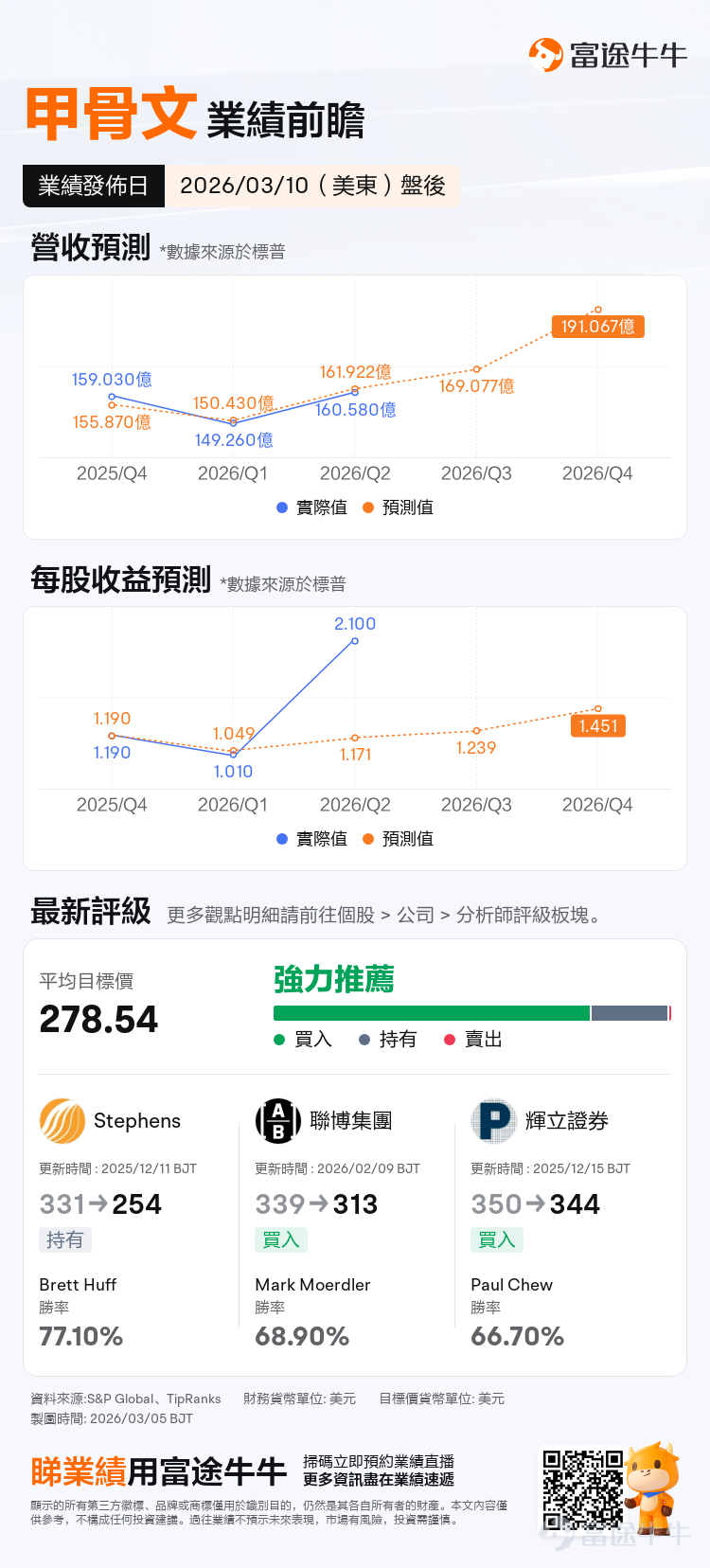
$Oracle (ORCL.US)$ On March 10/Tuesday after the US stock market closed, Oracle announced its fiscal 2026 third-quarter results.
Current consensus market expectations show that for this quarter, Oracle's projected revenue is $16.8077 billion, with earnings per share of $1.239, still showing significant growth compared to the same period last year. However, under the current AI narrative, simply beating expectations no longer satisfies market appetite. The market cares more about the financial cost behind this growth and whether the lingering concerns about cash flow from the previous quarter can be resolved.
$Oracle (ORCL.US)$ Oracle is set to announce its fiscal 2026 third-quarter earnings after the US stock market closes on Tuesday, March 10. Current market consensus data shows that Oracle's revenue for this quarter is expected to be $16.8077 billion, with earnings per share of $1.239, which still represents a significant increase compared to the same period last year. However, under the current AI narrative, merely beating expectations is no longer enough to satisfy market appetite. The market is more concerned about the financial cost behind this growth and whether the lingering concerns over cash flow from the previous quarter can be addressed. Earnings Review: Guidance and Capital Expenditure Controversy Looking back at Oracle’s Q2 FY2026 earnings report, the company found itself in the awkward position of delivering better-than-expected growth but failing to win over the market. Despite OCI/cloud business revenue surging 68% and RPO reaching an astonishing $523 billion, the stock plummeted 10% post-earnings, revealing deep cracks in the bullish thesis. Underlying Concerns Behind the Plunge: 1. Concerns Stemming from Poor Guidance: The guidance provided by management for Q3 revenue growth (16%-18%) and EPS ($1.64-$1.68) both fell below market consensus. This"exploding backlog of long-term orders, weak short-term execution"The gap has raised strong doubts in the market about the speed at which AI orders are being converted into revenue. 2. Capital expenditure continues to expand at a high rate: The company raised its annual capital expenditure forecast from...
Earnings Review: Guidance and Capital Expenditure Controversy
Looking back at Oracle’s FY26 Q2 earnings report, the company found itself in the awkward position of delivering better-than-expected growth but failing to win market approval. Despite OCI/cloud business revenue surging 68% and RPO reaching an astonishing $523 billion, the stock plummeted 10% post-results, revealing deep cracks in the bullish thesis.
Underlying concerns behind the crash:
1. Doubts stemming from weak guidance: Management's Q3 revenue growth guidance (16%-18%) and EPS guidance ($1.64-$1.68) both fell short of market consensus expectations. This"Overflowing forward orders but weak short-term realization"has sparked strong market skepticism about the speed at which AI orders are converting into revenue.
2. Capital expenditure continues to expand at a high speed: The company has sharply raised its annual capital expenditure forecast from $35 billion to $50 billion, an aggressive expansion pace that makes investors worry Oracle is transforming from a profit-stable software company into ahigh-risk, asset-heavy 'AI infrastructure company',which will be severely penalized in a fragile market.
$Oracle (ORCL.US)$ Oracle is set to announce its fiscal 2026 third-quarter earnings after the US stock market closes on Tuesday, March 10. Current market consensus data shows that Oracle's revenue for this quarter is expected to be $16.8077 billion, with earnings per share of $1.239, which still represents a significant increase compared to the same period last year. However, under the current AI narrative, merely beating expectations is no longer enough to satisfy market appetite. The market is more concerned about the financial cost behind this growth and whether the lingering concerns over cash flow from the previous quarter can be addressed. Earnings Review: Guidance and Capital Expenditure Controversy Looking back at Oracle’s Q2 FY2026 earnings report, the company found itself in the awkward position of delivering better-than-expected growth but failing to win over the market. Despite OCI/cloud business revenue surging 68% and RPO reaching an astonishing $523 billion, the stock plummeted 10% post-earnings, revealing deep cracks in the bullish thesis. Underlying Concerns Behind the Plunge: 1. Concerns Stemming from Poor Guidance: The guidance provided by management for Q3 revenue growth (16%-18%) and EPS ($1.64-$1.68) both fell below market consensus. This"exploding backlog of long-term orders, weak short-term execution"The gap has raised strong doubts in the market about the speed at which AI orders are being converted into revenue. 2. Capital expenditure continues to expand at a high rate: The company raised its annual capital expenditure forecast from...
This quarter's core focus: Can AI order conversion outpace financing pressure?
In this earnings report, the market will evaluate Oracle’s resilience through the following three dimensions:
1. Stability of OCI growth rate
Last quarter, OCI growth reached 68%, serving as the "anchor point" supporting Oracle's valuation. Market sources previously revealed that Oracle has a multi-year cloud partnership with Meta worth approximately $20 billion and is also a key participant in the OpenAI & Stargate projects. The market needs to see these long-term contracts translating into tangible quarterly revenue.
2. RPO/Recognition Rate of Remaining Performance Obligations
The current RPO stands at a high of $523 billion. Investors are no longer satisfied with looking at the total amount of 'backlog orders'; they are more concerned about the 'monetization timeline' of these orders. If the RPO continues to grow but revenue conversion remains sluggish, the market will question the actual digestion rate of AI demand.
3. $50 Billion Financing Plan and Layoff Controversy
In February, Oracle announced plans to raise up to $50 billion through debt and equity financing, potentially including a $20 billion at-the-market (ATM) offering. At the same time, amid cost pressures from data center expansion, rumors of thousands of layoffs have been swirling.In this earnings call, management's explanation of cash flow pressures will directly determine whether the stock price can recover.
$Oracle (ORCL.US)$ Oracle is set to announce its fiscal 2026 third-quarter earnings after the US stock market closes on Tuesday, March 10. Current market consensus data shows that Oracle's revenue for this quarter is expected to be $16.8077 billion, with earnings per share of $1.239, which still represents a significant increase compared to the same period last year. However, under the current AI narrative, merely beating expectations is no longer enough to satisfy market appetite. The market is more concerned about the financial cost behind this growth and whether the lingering concerns over cash flow from the previous quarter can be addressed. Earnings Review: Guidance and Capital Expenditure Controversy Looking back at Oracle’s Q2 FY2026 earnings report, the company found itself in the awkward position of delivering better-than-expected growth but failing to win over the market. Despite OCI/cloud business revenue surging 68% and RPO reaching an astonishing $523 billion, the stock plummeted 10% post-earnings, revealing deep cracks in the bullish thesis. Underlying Concerns Behind the Plunge: 1. Concerns Stemming from Poor Guidance: The guidance provided by management for Q3 revenue growth (16%-18%) and EPS ($1.64-$1.68) both fell below market consensus. This"exploding backlog of long-term orders, weak short-term execution"The gap has raised strong doubts in the market about the speed at which AI orders are being converted into revenue. 2. Capital expenditure continues to expand at a high rate: The company raised its annual capital expenditure forecast from...
The 'Double-Edged Sword' of Capital Intensity and Free Cash Flow Warning Signs
From a fundamental deep dive, Oracle is currently in a phase of significant financial model volatility, often referred to as the 'bleeding period.' This explains why, after a 35% single-day surge last year, Oracle's stock has continued to correct, and is now down by half from its historical high last year.
$Oracle (ORCL.US)$ Oracle is set to announce its fiscal 2026 third-quarter earnings after the US stock market closes on Tuesday, March 10. Current market consensus data shows that Oracle's revenue for this quarter is expected to be $16.8077 billion, with earnings per share of $1.239, which still represents a significant increase compared to the same period last year. However, under the current AI narrative, merely beating expectations is no longer enough to satisfy market appetite. The market is more concerned about the financial cost behind this growth and whether the lingering concerns over cash flow from the previous quarter can be addressed. Earnings Review: Guidance and Capital Expenditure Controversy Looking back at Oracle’s Q2 FY2026 earnings report, the company found itself in the awkward position of delivering better-than-expected growth but failing to win over the market. Despite OCI/cloud business revenue surging 68% and RPO reaching an astonishing $523 billion, the stock plummeted 10% post-earnings, revealing deep cracks in the bullish thesis. Underlying Concerns Behind the Plunge: 1. Concerns Stemming from Poor Guidance: The guidance provided by management for Q3 revenue growth (16%-18%) and EPS ($1.64-$1.68) both fell below market consensus. This"exploding backlog of long-term orders, weak short-term execution"The gap has raised strong doubts in the market about the speed at which AI orders are being converted into revenue. 2. Capital expenditure continues to expand at a high rate: The company raised its annual capital expenditure forecast from...
1. Continuously widening cash flow gap: Last quarter’s financial statements showed that over the past 12 months, Oracle’s operating cash flow ($22.296 billion) could no longer cover its aggressive capital expenditures ($35.477 billion), leading to free cash flow dropping to -$13.181 billionIn the current environment of high interest rates and unstable rate-cutting pace due to Middle East conflicts, relying on external financing to fill a funding gap exceeding tens of billions of dollars will undoubtedly increase financial expenses.
2. Balance Sheet Under Maximum Pressure: Unlike Microsoft or Google, which have abundant cash flow, Oracle has relatively limited cash on hand. In a financing plan as high as 500 billion dollars, if the proportion of debt is too high, it will increase leverage and may trigger credit rating warnings; if the proportion of equity financing (ATM) is too high, significant earnings per share (EPS) dilution will occur.
3. A Paradigm Shift in Valuation Logic: Some market observers believe that Oracle is transitioning from being a 'light-asset, high-cash-flow software provider' to a 'heavy-asset, long-return-cycle AI infrastructure builder.' This means the market will be more selective about its price-to-earnings (P/E) ratio – investors not only demand high growth rates for OCI but also want to see increasing marginal returns on capital expenditures: will every dollar spent on hardware bring in more cloud revenue than the previous quarter?
Options Strategy: Elevated Volatility
According to the latest pricing in the options market, there is an expectation that Oracle’s stock price could fluctuate by more than 11% after earnings. Considering that Oracle's stock price has shown significant volatility over the past three quarters, this estimate is not unreasonable.
$Oracle (ORCL.US)$ Oracle is set to announce its fiscal 2026 third-quarter earnings after the US stock market closes on Tuesday, March 10. Current market consensus data shows that Oracle's revenue for this quarter is expected to be $16.8077 billion, with earnings per share of $1.239, which still represents a significant increase compared to the same period last year. However, under the current AI narrative, merely beating expectations is no longer enough to satisfy market appetite. The market is more concerned about the financial cost behind this growth and whether the lingering concerns over cash flow from the previous quarter can be addressed. Earnings Review: Guidance and Capital Expenditure Controversy Looking back at Oracle’s Q2 FY2026 earnings report, the company found itself in the awkward position of delivering better-than-expected growth but failing to win over the market. Despite OCI/cloud business revenue surging 68% and RPO reaching an astonishing $523 billion, the stock plummeted 10% post-earnings, revealing deep cracks in the bullish thesis. Underlying Concerns Behind the Plunge: 1. Concerns Stemming from Poor Guidance: The guidance provided by management for Q3 revenue growth (16%-18%) and EPS ($1.64-$1.68) both fell below market consensus. This"exploding backlog of long-term orders, weak short-term execution"The gap has raised strong doubts in the market about the speed at which AI orders are being converted into revenue. 2. Capital expenditure continues to expand at a high rate: The company raised its annual capital expenditure forecast from...
Bullish: It is recommended to construct a 'Bull Call Spread.' Oracle’s current risk lies in management’s statements—if they are not transparent, the stock price may decline even with good earnings. A spread strategy can effectively mitigate losses caused by a drop in IV (implied volatility) and provide some premium coverage from selling calls if the directional view is incorrect.
Bearish: Consider a 'Bear Put Spread.' This is aimed at potential negative impacts from the disclosure of financing plan details, moderate pullbacks, and market concerns about Oracle’s subsequent equity financing and other issues.
Expecting high volatility but without betting on direction: Given the currently high IV premium, consider using straddles or strangles closer to earnings reports to capture extreme volatility scenarios. However, be aware that if the stock price moves less than expected after earnings, this strategy could face a dual impact from IV Crush.
$Oracle (ORCL.US)$ Oracle is set to announce its fiscal 2026 third-quarter earnings after the US stock market closes on Tuesday, March 10. Current market consensus data shows that Oracle's revenue for this quarter is expected to be $16.8077 billion, with earnings per share of $1.239, which still represents a significant increase compared to the same period last year. However, under the current AI narrative, merely beating expectations is no longer enough to satisfy market appetite. The market is more concerned about the financial cost behind this growth and whether the lingering concerns over cash flow from the previous quarter can be addressed. Earnings Review: Guidance and Capital Expenditure Controversy Looking back at Oracle’s Q2 FY2026 earnings report, the company found itself in the awkward position of delivering better-than-expected growth but failing to win over the market. Despite OCI/cloud business revenue surging 68% and RPO reaching an astonishing $523 billion, the stock plummeted 10% post-earnings, revealing deep cracks in the bullish thesis. Underlying Concerns Behind the Plunge: 1. Concerns Stemming from Poor Guidance: The guidance provided by management for Q3 revenue growth (16%-18%) and EPS ($1.64-$1.68) both fell below market consensus. This"exploding backlog of long-term orders, weak short-term execution"The gap has raised strong doubts in the market about the speed at which AI orders are being converted into revenue. 2. Capital expenditure continues to expand at a high rate: The company raised its annual capital expenditure forecast from...
Overall, for Oracle’s upcoming earnings report, under high growth expectations, if management can clearly define the boundaries of financing and capital expenditures while providing a clear timeline for converting RPO into revenue and profit, Oracle is likely to undergo a valuation recovery with increased certainty. Otherwise, even with rapid AI cloud growth, it risks being bogged down by a heavy balance sheet.
Risk Disclaimer: The above content only represents the author's view. It does not represent any position or investment advice of Futu. Futu makes no representation or warranty.Read more
Thumbs Up
12
Emm
1
Heart
1
78K Views
Report
Comments (4)
Write a Comment...
4
14
39