
The US-Iran peace talks present conflicting narratives! What’s next for oil prices?

The US-Iran conflict has triggered massive volatility in global assets! What's the next step? This playbook and investment guide is worth collecting.
The latest developments in the Middle East's geopolitical situation are profoundly reshaping global asset pricing logic, with crude oil prices surging past the $100 mark,directly triggering deep investor concerns about inflation rebounding and economic growth slowing,causing a substantial selloff in global risk assets.
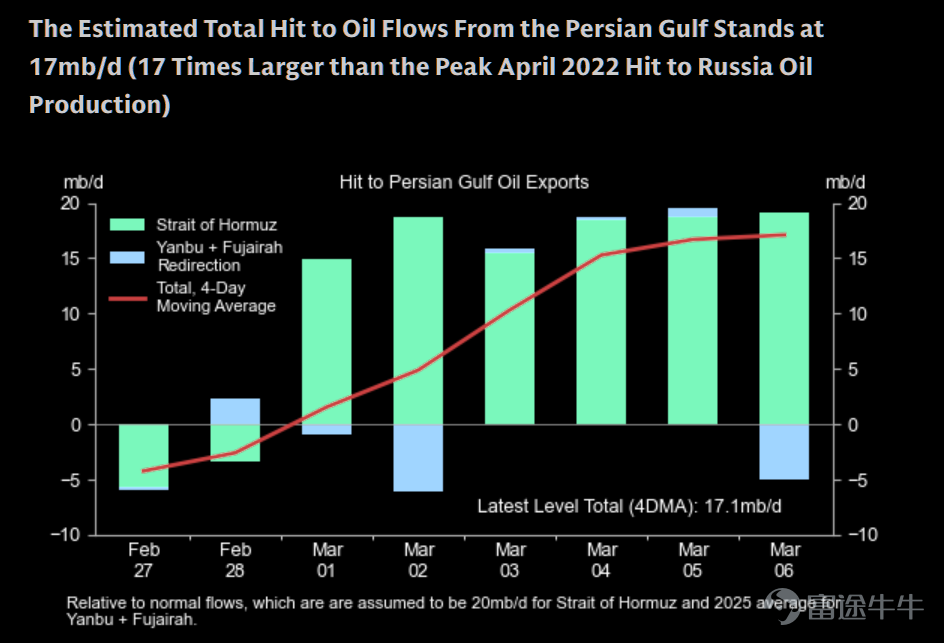
In fact, as tanker shipping through the Strait of Hormuz has abruptly halted, some 'doomsday scenarios' that oil analysts previously thought would never happen are becoming a reality.
According to Goldman Sachs statistics, current Persian Gulf oil exports have decreased by 17.1 million barrels per day, a figure nearly 17 times the drop in Russia’s oil production from its peak following the Russia-Ukraine conflict in April 2022.

It can be said that, about a week after President Trump waged war on Iran, the most severe energy market shock since the 1970s is spreading across the global economy.
Looking at the present situation, reviewing oil price trends during past Middle East wars and recent major geopolitical conflicts can provide an important reference for predicting the direction of this crisis. History may not repeat itself exactly, but the logic of the game surrounding geopolitics and energy security has shown remarkable continuity.
This article will analyze for fellow investors how historical Middle East conflicts have influenced major asset classes, which developments to focus on in subsequent scenarios, which events to watch this week, and how to manage positions effectively.
How will historical Middle East conflicts affect major asset classes?
According to research by CITIC Securities, the situation in the Middle East may not cool down quickly; in the short term, various assets may repeat their instinctive reactions to sudden events, while subsequent developments will heavily rely on scenario assumptions.
To provide a reference for analyzing potential market impacts, CITIC Securities reviewed the market effects of eight major conflicts in the Middle East since 1970, summarizing the following patterns:Safe-haven asset gold outperforms the US dollar, oil prices in the long term still depend on supply and demand, US stock performance is directly related to the extent of US military involvement and battle progress, and there is no significant impact on Chinese assets.

Source of information: CITIC Securities Research Department
The direct impact of Middle East wars on crude oil prices often occurs in the early stages of the conflict,and over time, its impact effect gradually weakens.

Data source: Wind, CITIC Securities Research Department
In wars where the US is directly involved,US stocks often decline in the initial stages of the war due to risk aversion, until the situation becomes clear and recovery is achieved.

Data source: Wind, CITIC Securities Research Department. Note: The vertical axis in the chart represents the S&P 500 Index level.
What changes should subsequent analysis focus on?
CITIC Securities Research stated that the situation in Iran is still evolving rapidly, with the severity surpassing that of the 'Twelve-Day War' period in June 2025. It may be difficult for global markets to speculate all at once and follow the ultimate scenario.It is more likely to continue fluctuating following key signals.
The bank believes it is necessary to monitorUS military movements, changes in Iran’s political situation, and the scope of conflict spilloverthree important signals.Whether potential changes could lead to more extreme scenarios.If there are no significant changes in the three signals, the market impact could be seen as an amplified version of the June 2025 'Twelve-Day War' period.

The Cai Xin Securities Research Institute believes that there are three possible future scenarios:
Scenario One: A quick resolution within a month, but with low probability.
In this scenario, the conflict lasts 2-4 weeks, classified as a high-intensity limited war. The US and Israel will quickly carry out precision strikes, ceasing fire after destroying Iran's key nuclear and missile facilities, while Iran’s retaliation will remain controllable. Iran may blockade the Strait of Hormuz as a deterrent, followed by both sides reaching a temporary agreement through third-party mediation. The US and Israel achieve short-term denuclearization goals, while Iran preserves its regime core, temporarily calming the conflict. The essence of this scenario is that the Trump administration seeks a 'quick victory' for the 2026 midterm elections, and after suffering heavy damage to its core facilities, Iran opts for moderate compromise to ensure regime survival.
Scenario Two: A protracted war lasting 1-6 months, currently the most likely scenario.
The conflict will gradually escalate into a regional mid-scale war. Iran will launch a strong counterattack, blockading the Strait of Hormuz and activating its full proxy network, mobilizing Hezbollah, the Houthis, and Iraqi militias to fully strike Israel’s mainland and US military bases in the Middle East. This forces the US and Israel to expand their strikes, spreading the fighting to surrounding areas like Lebanon and Yemen, leading to a medium-term deadlock. Global energy prices will experience periodic volatility. The core logic here is Iran showing extraordinary resilience, with proxy wars fully activated, leaving the US trapped in a 'victory paradox'—withdrawing troops would mean admitting defeat, while increasing troop levels risks a second 'Iraq quagmire,' making it difficult to end the conflict quickly. To win the midterms, Trump needs to show 'victory' within six months, while Israel’s paralyzed economy triggers domestic anti-war sentiment, becoming a key variable pushing for negotiations.
Scenario Three: Long-term confrontation lasting over six months, with a lower probability.
In this scenario, the situation reflects a stalemate in regime competition, potentially evolving into a prolonged low-intensity conflict. The US and Israel fail to overthrow Iran’s current regime, while Iran cannot fully repel the strikes from the US and Israel, resulting in a 'fighting without resolution, exhausting without stopping' long-term stalemate. The focus shifts to information warfare, economic sanctions, and proxy attrition, prolonging the war and continuously destabilizing the global energy landscape and Middle Eastern geopolitics, ultimately forming a long-term confrontation.

What should we watch for this week?
Overall, the current VIX (Volatility Index) has approached the critical level of 30, with market risk aversion sentiment significantly increasing.This week enters a crucial period of market dynamics as the Middle East situation, key CPI data, and tech giants' earnings reports will collectively determine the next market direction.We suggest focusing on the following three core themes:
1. Macroeconomic risks: Geopolitical conflict ➔ oil price surge ➔ impact on rate cuts The geopolitical situation is currently the biggest inflation catalyst, exerting pressure on the macroeconomic front through the crude oil market. If the conflict escalates and does not ease, it will inevitably hinder disinflation progress—should inflation rebound, expectations for rate cuts within the year could face a complete reassessment.
2. Core market focus: CPI showdown ➔ rate cut expectations ➔ interest-rate sensitive stocks Market bets on a rate cut starting in June are hovering around 60%. Given the solid performance of previous data, this Wednesday’s CPI release is crucial. The bottom line is that core CPI must stabilize; considering recent geopolitical disruptions, the energy component should be analyzed separately to strip out short-term fluctuations.
3. Tech sector focus: AI earnings validation ➔ faith in tech stocks Beyond macroeconomic headwinds, the independent performance of tech stocks relies on earnings support. This week, companies like Oracle will release their earnings, and the market will scrutinize how well they deliver on 'AI capital expenditure and commercial returns.' This will directly test the robustness of the current AI investment thesis.
Based on this week's market movements, we can outline two potential scenarios:
1. Best-case scenario:A mild cooling in CPI, better-than-expected earnings from Oracle, and no escalation in geopolitical tensions would stabilize rate cut expectations, with large-cap tech stocks leading a recovery in market sentiment.
2. Worst-case scenario:Higher-than-expected CPI readings, Oracle missing earnings expectations, and a continued surge in oil prices could bring back stagflation fears, and investors may need to be wary of the risk of a simultaneous sell-off in stocks and bonds.

How should investors respond?
In the early stages of this conflict,,The article 'Middle East Tensions Boost Safe-Haven Sentiment: How Have Stock Markets Reacted During Past Geopolitical Conflicts? These Three "Modern Warfare Investment Themes" Are Worth Watching!'Previously noted that during geopolitical conflicts, investors should watch defense stocks, energy stocks, and gold stocks; for the detailed core logic, click on the article to view.

However, at this point, Xingye Securities notes that U.S.-Iran tensions may persist in the short term, with both risk aversion and supply disruptions contributing to a geopolitical risk premium that will continue to support oil prices. In the medium term, although the geopolitical risk premium may ease as tensions cool, real geopolitical risks are likely to increase insurance costs for crude oil transportation and boost reserve demand, which could push the overall price level of crude oil higher.Therefore, elevated oil prices are likely to remain a key variable driving industry allocation in the near future.
Therefore, it is recommended to focus on two lines of thinking:One includes sectors whose prices can be linked to oil prices and are expected to benefit from rising oil prices; the other includes sectors with independent cyclical strength that are less affected by rising oil prices.
First, industries whose prices or profits may move in tandem with rising oil prices will become an important clue in the 'price increase chain' for some time to come.Reviewing the correlation between absolute/relative returns of various industries and oil prices since 2010, the industries with the highest positive correlations are mainly concentrated in: non-ferrous metals, coal, petrochemicals, chemicals, steel, machinery, new energy, agriculture, etc.
Among these, the logic behind benefiting from rising oil prices can be summarized into the following three categories:
Direct profit boost: Rising oil prices directly increase the profits of upstream energy-related industries such as crude oil extraction, oilfield services equipment, and oil transportation, providing earnings elasticity.
Energy substitution: Under high oil prices, the economics of other energy sources such as coal, natural gas, coal chemicals, new energy, and biofuels (e.g., soybeans) become prominent, benefiting from increased demand due to energy substitution logic.
Cost-driven price increases: Rising crude oil prices push up the production costs of fertilizers and pesticides, which then affect agricultural product planting costs and lead to price increases.
Secondly, seek out sectors with independent cyclical strength and fundamentals that are less affected by rising oil prices.
AI and advanced manufacturing, supported by industry trends and favorable policies, remain the most typical fields. After pricing in short-term geopolitical risks, these sectors, being less affected by oil prices, may later rely on their independent strengths to become relatively advantageous areas under a geopolitically risky environment. Screening sub-sectors based on upward revisions to earnings forecasts since the beginning of the year reveals the main focus areas.
AI: Hardware (consumer electronics, components, computer equipment, communication devices, electronic chemicals), software (gaming, digital media, IT services);
Advanced manufacturing: New energy (batteries, motors, photovoltaic equipment, wind power equipment), defense (marine equipment, aerospace equipment), machinery (rail transit equipment, specialized equipment, construction machinery), home appliance components, commercial vehicles, healthcare services.
Overall,Investors are currently advised to focus on defensive strategies: strictly controlling risks, reducing leverage, and retaining sufficient cash reserves, avoiding blindly chasing gains or cutting losses amid volatility.Rather than betting in extreme sentiment, it is better to patiently wait for the market to naturally clear after a downturn. When panic recedes, return to valuation and fundamentals for phased investments — this is the more prudent path to success. Remember, the market never lacks crises, but true quality assets and prime investment opportunities often emerge from periods of extreme pessimism and chaos.
Risk Disclaimer: The above content only represents the author's view. It does not represent any position or investment advice of Futu. Futu makes no representation or warranty.Read more


Comments (5)
to post a comment
78
198