
Alibaba (09988) Short-term Technical Analysis: Oversold Area Awaits Rebound, Key Support at 119.8
As of March 9, 2026, Alibaba (09988) closed at 127.7, down 2.3%, with a 5-day volatility of 11.2%, showing significant price fluctuations. In market news, Hong Kong-listed technology stocks were broadly under pressure on March 9, with Tencent, Meituan, and others also falling more than 2%.
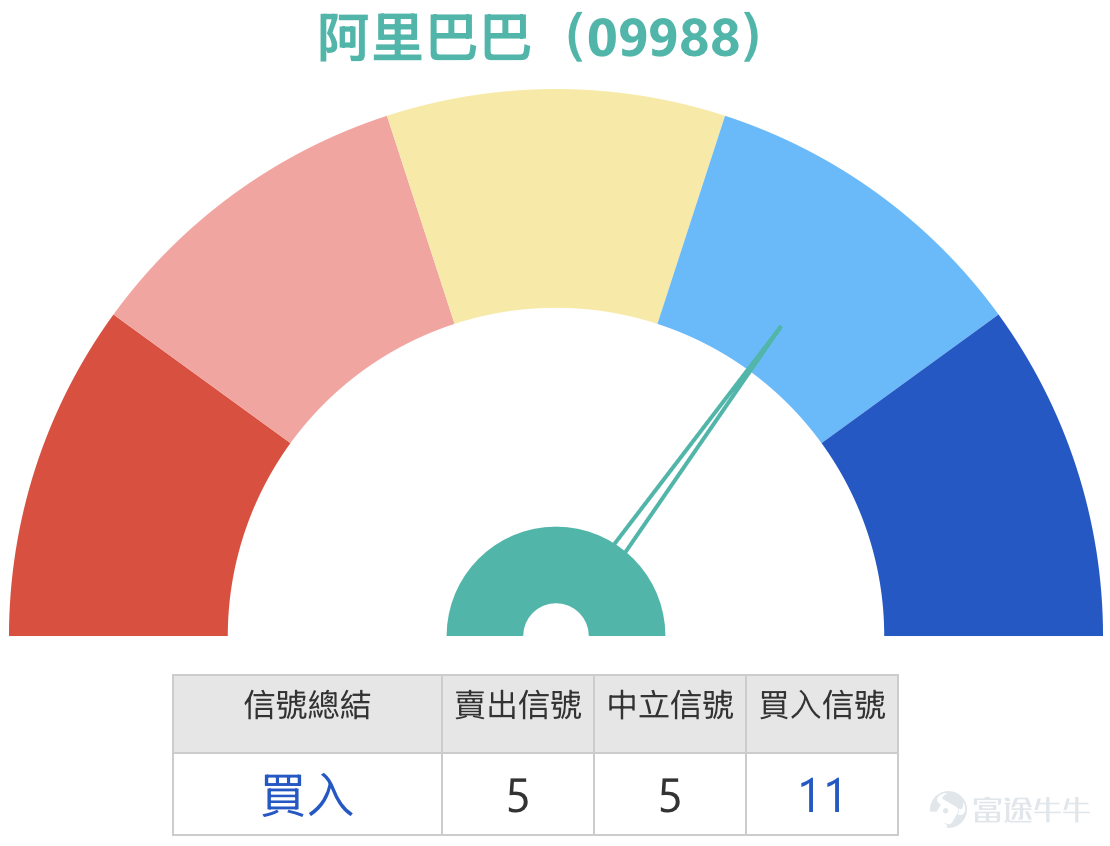
From a technical analysis perspective, Alibaba's (09988) share price has weakened significantly, breaking below the 10-day, 30-day, and 60-day moving averages, which are in a bearish alignment, indicating weak short-term trends. The Relative Strength Index (RSI) is at 25, already entering the oversold zone, suggesting that downward momentum may have been overextended, and a technical rebound demand is building. Multiple oscillation indicators are issuing buy signals, reflecting support at lower levels, increasing expectations for a short-term rebound. On the support side, the primary support is at 119.8, with a downside test at 106.2 if breached; resistance is concentrated at 137.9 and 154.7, with 137.9 near the 10-day line, making it the primary short-term rebound target.
![As of March 9, 2026, Alibaba (09988) closed at 127.7, down 2.3%, with a 5-day volatility of 11.2%, showing significant price fluctuations. In market news, Hong Kong-listed technology stocks were broadly under pressure on March 9, with Tencent, Meituan, and others also falling more than 2%. From a technical analysis perspective, Alibaba's (09988) share price has weakened significantly, breaking below the 10-day, 30-day, and 60-day moving averages, which are in a bearish alignment, indicating weak short-term trends. The Relative Strength Index (RSI) is at 25, already entering the oversold zone, suggesting that downward momentum may have been overextended, and a technical rebound demand is building. Multiple oscillation indicators are issuing buy signals, reflecting support at lower levels, increasing expectations for a short-term rebound. On the support side, the primary support is at 119.8, with a downside test at 106.2 if breached; resistance is concentrated at 137.9 and 154.7, with 137.9 near the 10-day line, making it the primary short-term rebound target. Notably, the previous view from [Hong Kong Stocks Podcast] emphasized that Alibaba's weakness relates to fundamental factors, not just broader market pressure, and investors need to closely monitor whether the stock price can stabilize near the 120 mark. Considering the latest share price of 125.5, which is between the support level of 119.8 and resistance at 137.9, short-term operations should be viewed as range-bound fluctuations, waiting for dips to accumulate or awaiting breakout signals. Reviewing the performance of the warrants, the four mentioned on March 3...](https://nnqimage.futunn.com/sns_client_feed/1162342/20260309/web-1773040565603-jw5uQwn4xs.png/big?area=1&is_public=true&imageMogr2/ignore-error/1/format/webp)
Notably, the previous view from [Hong Kong Stocks Podcast] emphasized that Alibaba's weakness relates to fundamental factors, not just broader market pressure, and investors need to closely monitor whether the stock price can stabilize near the 120 mark. Considering the latest share price of 125.5, which is between the support level of 119.8 and resistance at 137.9, short-term operations should be viewed as range-bound fluctuations, waiting for dips to accumulate or awaiting breakout signals.
Reviewing the performance of warrant products, four Alibaba bearish products mentioned by us on March 3 performed notably in the following two days, effectively capturing the downward movement of the underlying stock. JPMorgan Chase Bear Certificate (64231) recorded a 42% increase within two days after being mentioned, while the underlying stock fell by 6.31% during the same period; UBS Group Bear Certificate (65172) gained 35%; Bank of China Put Warrant (20584) rose 39%; and Guotai Junan Put Warrant (20512) increased by 40%.
![As of March 9, 2026, Alibaba (09988) closed at 127.7, down 2.3%, with a 5-day volatility of 11.2%, showing significant price fluctuations. In market news, Hong Kong-listed technology stocks were broadly under pressure on March 9, with Tencent, Meituan, and others also falling more than 2%. From a technical analysis perspective, Alibaba's (09988) share price has weakened significantly, breaking below the 10-day, 30-day, and 60-day moving averages, which are in a bearish alignment, indicating weak short-term trends. The Relative Strength Index (RSI) is at 25, already entering the oversold zone, suggesting that downward momentum may have been overextended, and a technical rebound demand is building. Multiple oscillation indicators are issuing buy signals, reflecting support at lower levels, increasing expectations for a short-term rebound. On the support side, the primary support is at 119.8, with a downside test at 106.2 if breached; resistance is concentrated at 137.9 and 154.7, with 137.9 near the 10-day line, making it the primary short-term rebound target. Notably, the previous view from [Hong Kong Stocks Podcast] emphasized that Alibaba's weakness relates to fundamental factors, not just broader market pressure, and investors need to closely monitor whether the stock price can stabilize near the 120 mark. Considering the latest share price of 125.5, which is between the support level of 119.8 and resistance at 137.9, short-term operations should be viewed as range-bound fluctuations, waiting for dips to accumulate or awaiting breakout signals. Reviewing the performance of the warrants, the four mentioned on March 3...](https://nnqimage.futunn.com/sns_client_feed/1162342/20260309/web-1773040584087-242YX2qHSe.png/big?area=1&is_public=true&imageMogr2/ignore-error/1/format/webp)
In terms of deploying warrant and bull-bear certificate products, investors can choose from the following products based on their own risk preferences, in conjunction with the current support and resistance levels.
In terms of warrants, Bank of China warrant (26562)$BIALIBA@EC2608E.C (26562.HK)$The exercise price of the UBS call warrant (26538) is 150.09 yuan, providing approximately 5.6 times leverage. This exercise price is related to the key resistance levels of the current stock price at 137.9 yuan and 154.7 yuan, making it suitable for investors who expect the stock price to break through the resistance and recover upwards. The core advantages of both are relatively low premiums and controllable time value costs, making them more attractive to valuation-sensitive investors. Regarding put warrants, the JPMorgan put warrant (26318)$JPALIBA@EP2607B.P (26318.HK)$The exercise price of the UBS put warrant (24646) is 122.78 yuan, providing approximately 4.2 times leverage. This exercise price is highly correlated with the key support level of the current stock price at 119.8 yuan, making it suitable for investors who expect the stock price to further test the support. The characteristics of both products are that they offer ideal leverage and implied volatility, allowing for a more efficient capture of the potential downward wave of the underlying stock.
In terms of bull certificates, JPMorgan's bull certificate (59339) has a redemption price of 111.2 HKD, offering a 7.5 times actual leverage with the lowest premium, suitable for investors expecting the stock price to stabilize and rebound at the support level of 119.8 HKD. UBS's bull certificate (54592) has a redemption price of 110 HKD, providing a 6.8 times actual leverage, the highest actual leverage and a relatively low premium, making it more advantageous for investors seeking amplified effects. Both redemption prices are below the key support level of 119.8 HKD, providing a certain buffer space.
In terms of bear certificates, UBS bear certificate (67837)$UB#ALIBARP2810F.P (67837.HK)$HSBC Bear Certificate (67020)$HS#ALIBARP2811D.P (67020.HK)$The redemption price is set at 150 yuan, providing approximately 5.5 times actual leverage. This redemption price is related to the key resistance levels of the current stock price at 137.9 yuan and 154.7 yuan, making it suitable for investors who expect the stock price rebound to be constrained by these resistance levels. The advantage of UBS bear certificates lies in having the highest actual leverage and the lowest premium, while HSBC bear certificates also have the highest actual leverage but a relatively lower premium, making both highly efficient choices for bearish strategies.
![As of March 9, 2026, Alibaba (09988) closed at 127.7, down 2.3%, with a 5-day volatility of 11.2%, showing significant price fluctuations. In market news, Hong Kong-listed technology stocks were broadly under pressure on March 9, with Tencent, Meituan, and others also falling more than 2%. From a technical analysis perspective, Alibaba's (09988) share price has weakened significantly, breaking below the 10-day, 30-day, and 60-day moving averages, which are in a bearish alignment, indicating weak short-term trends. The Relative Strength Index (RSI) is at 25, already entering the oversold zone, suggesting that downward momentum may have been overextended, and a technical rebound demand is building. Multiple oscillation indicators are issuing buy signals, reflecting support at lower levels, increasing expectations for a short-term rebound. On the support side, the primary support is at 119.8, with a downside test at 106.2 if breached; resistance is concentrated at 137.9 and 154.7, with 137.9 near the 10-day line, making it the primary short-term rebound target. Notably, the previous view from [Hong Kong Stocks Podcast] emphasized that Alibaba's weakness relates to fundamental factors, not just broader market pressure, and investors need to closely monitor whether the stock price can stabilize near the 120 mark. Considering the latest share price of 125.5, which is between the support level of 119.8 and resistance at 137.9, short-term operations should be viewed as range-bound fluctuations, waiting for dips to accumulate or awaiting breakout signals. Reviewing the performance of the warrants, the four mentioned on March 3...](https://nnqimage.futunn.com/sns_client_feed/1162342/20260309/web-1773040604228-KnD7VvFAqy.png/big?area=1&is_public=true&imageMogr2/ignore-error/1/format/webp)
In summary, investors optimistic about Alibaba's rebound may pay attention to the Bank of China call warrant (26562) to capture breakout opportunities, or the UBS bull certificate (54592) for higher leverage deployment; investors with a bearish outlook may consider the JPMorgan put warrant (26318) to hedge against downside risks, or the UBS bear certificate (67837) to capture downward trends with maximum leverage.
Interactive Questions:
Dear readers, Alibaba (09988) currently has an RSI of 25, entering the oversold zone. Do you think it can successfully rebound back above 137.9 yuan in the short term?
A) Yes, the oversold signal is strong, and a technical rebound is imminent.
B) No, consolidation around HK$119.8 is needed first; upward momentum will only resume after market sentiment stabilizes.
Feel free to share your thoughts in the comments section!
Reminder: This article does not constitute any investment advice.
This article is for reference only and does not constitute any investment advice. The market data, opinions, and analysis contained herein may change at any time without prior notice. We are not responsible for any loss or damage caused by reliance on the information in this article. Technical analysis only shows whether certain technical conditions are met; a comprehensive assessment of asset performance should combine other data and should not solely rely on this article to make trading decisions. Please note that past performance is not indicative of future results. Follow Jenny's insights on Hong Kong stock warrants for more professional analysis.
#Alibaba #09988 #HongKongStocks #TechnicalAnalysis #SupportAndResistance #Warrants #BullBearCertificates #CallOptions #PutOptions #HongKongWarrantsJenny
Risk Disclaimer: The above content only represents the author's view. It does not represent any position or investment advice of Futu. Futu makes no representation or warranty.Read more

Comments
to post a comment
4