
Xiaomi Group (01810.HK) Short-term Technical Analysis: Comprehensive Overview of Key Price Levels and Product Deployment
The recent share price movement of Xiaomi Group (01810.HK) has drawn significant market attention. As of March 4, 2026, Xiaomi closed at HKD 32.0, up slightly by 1.33% for the day, with an intraday low of HKD 31.2. Although there was a minor rebound in the share price, the overall trend since the beginning of the year remains on a downward trajectory. Investors are closely watching whether the stock can stabilize at this level and begin to rebound. According to the latest data on March 5, Xiaomi rebounded by 2.44%, trading at HKD 32.78.
From a technical analysis perspective, Xiaomi's share price has found initial support at the HKD 31.2 level, which is close to the recent low. Based on technical data as of March 4, Xiaomi's primary support level is at HKD 30.6, while the more critical second support level is at HKD 28.1. If the stock can successfully hold above the current level and move upward, the first resistance level will be at HKD 34.4, which will be an important test for a short-term rebound. If it can break through successfully, the next resistance level will be around HKD 36. Notably, Xiaomi's share price has fallen significantly from its early-year high, and multiple short-term technical indicators suggest that a rebound momentum is brewing. The system has summarized a 'Strong Buy' signal, with 13 buy signals and only 4 sell signals, indicating a strong majority of buy signals, providing crucial reference for short-term traders. The Relative Strength Index (RSI) is currently in the oversold region at 24. The stochastic oscillator also indicates an oversold condition and issues a buy signal, while the CCI indicator similarly suggests buying. These oscillators generally indicate that short-term selling pressure may be waning, creating conditions for a rebound. However, investors should also note that trend-following indicators such as MACD and Bollinger Bands still show sell signals, confirming that the medium-term downtrend has not yet reversed. In summary, the current technical signals present a 'rebound gamble under extreme oversold conditions,' representing a high-risk opportunity for contrarian trading, suitable for short-term operations rather than trend-following long positions.
In terms of market news, Xiaomi's recent developments have been mixed, causing volatility in the share price. On the positive side, the company has continued its share repurchase program, buying back approximately 3.1564 million shares on March 4 for about HKD 100 million, which helps boost market confidence. Additionally, sales of high-end mobile products increased by 40% last year, and sales in Western Europe also recorded growth, indicating underlying fundamental strengths. However, negative factors cannot be ignored. Several investment banks have successively downgraded Xiaomi's target price and investment ratings. Nomura drastically cut its target price from HKD 61 to HKD 33, a reduction of 45.9%, maintaining a 'Neutral' rating. Macquarie also lowered its target price to HKD 33 and downgraded the rating from 'Outperform' to 'Neutral.' Deutsche Bank maintained a 'Buy' rating but reduced its target price from HKD 71 to HKD 68.5. The divergence in institutional ratings reflects significant differences in market expectations for Xiaomi's future performance.
Reviewing the views presented on [Hong Kong Stock Podcast] on March 4, the show noted that Xiaomi’s share price has been on a downward trend since the beginning of the year. Although the share price slightly recovered to HKD 32 on March 4, the overall trend has not reversed. Investors are watching to see if the share price can stabilize above HKD 32 and what the next resistance levels might be. From a technical analysis perspective, the first resistance level is around HKD 34.4, and if it breaks through, there is a good chance it could further test the HKD 36 level. The show also reminded viewers that some investors in the warrant market continue to hold bearish warrants on Xiaomi. If considering following suit, attention should be paid to the selection of strike prices. Given the resistance levels of HKD 34.4 and HKD 36, choosing bearish warrant products with a strike price around HKD 40 poses a relatively lower risk of being called back in the short term.
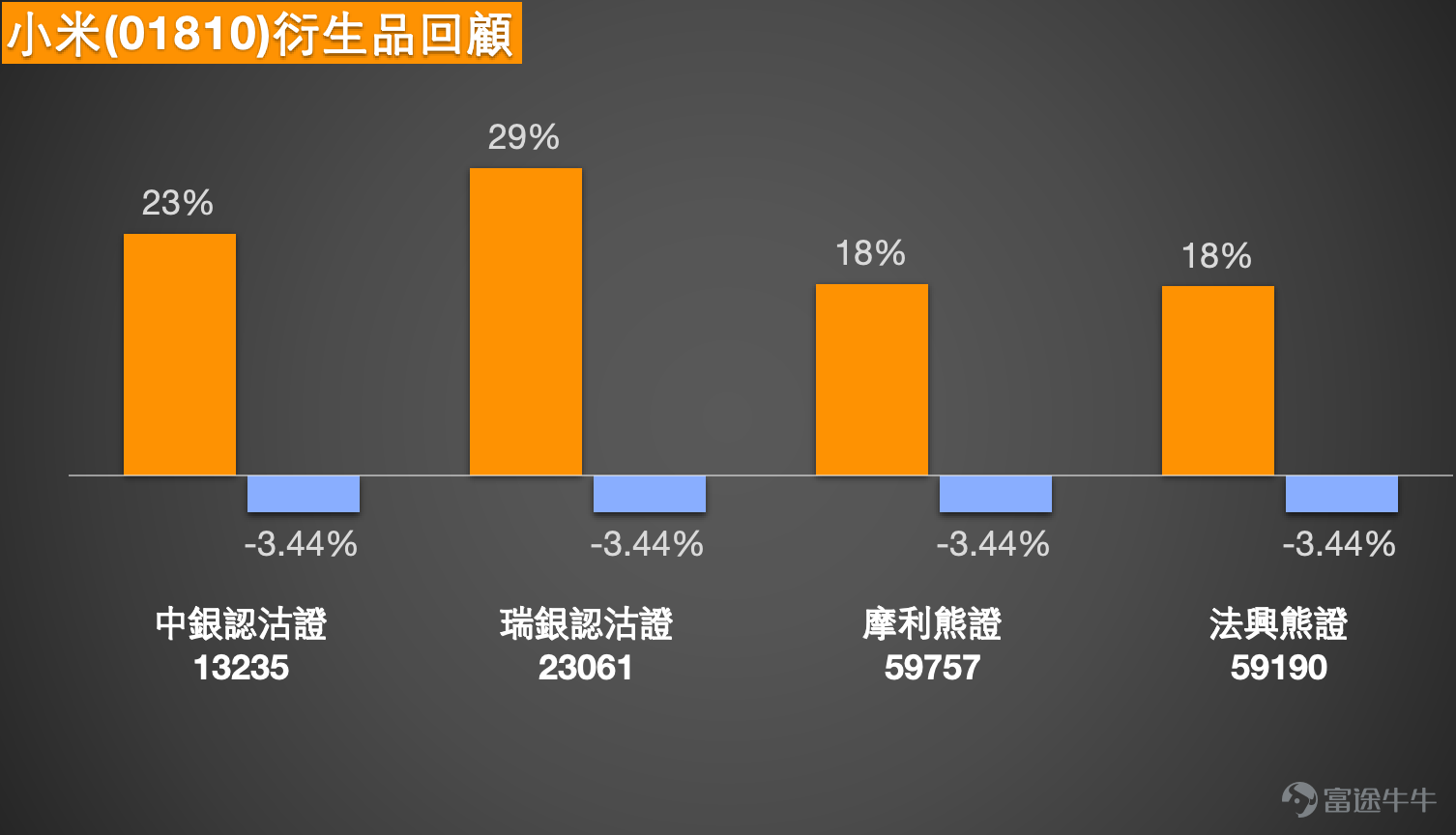
Regarding the review of warrant products, several Xiaomi-related derivatives mentioned on March 2 recorded significant performance in the subsequent two trading days (up to March 4). During this period, Xiaomi's underlying stock fell by 3.44%, while related put products saw substantial gains: Societe Generale Bear Certificate (59190) $SG#XIAMIRP28121.P (59190.HK)$ and Morgan Bear Certificate (59757) $MS#XIAMIRP2812C.P (59757.HK)$Both rose by 18%; UBS Group put warrant (23061)$UBXIAMI@EP2605A.P (23061.HK)$Showed the most outstanding performance with a 29% increase; BOC put warrant (13235)$BIXIAMI@EP2606B.P (13235.HK)$Also rose by 23%.

Given that Xiaomi's current stock price is at the HKD 32 level, combined with the aforementioned support level of HKD 30.6 and resistance level of HKD 34.4, investors can choose appropriate CBBCs (Callable Bull/Bear Contracts) or warrants based on their own views. For investors who are optimistic about Xiaomi stabilizing above HKD 32 and rebounding upwards, two call warrants can be considered: HSBC call warrant (22791), with a strike price of HKD 37.12, offering approximately 4.6x leverage. This product stands out for having the lowest premium among similar products, and its implied volatility and leverage levels are in relatively ideal states, making it suitable for cost-effective bullish strategies. Another option is the BOC call warrant (13186), with a strike price of HKD 37.15, also providing around 4.6x leverage. This warrant has the lowest implied volatility, effectively reducing volatility risk, offering a relatively stable high-leverage tool for investors who are bullish on the underlying stock. For bull contracts, one may consider Societe Generale bull contract (59415), with a stop-loss price of HKD 30, providing 12.8x actual leverage. This product has the lowest premium and relatively higher actual leverage. Another option is Societe Generale bull contract (55965), with a stop-loss price of HKD 30.5, offering 15.2x actual leverage, characterized by high actual leverage and low premium. When selecting bull contracts, ensure that the stop-loss price is below the support level of HKD 30.6 to provide sufficient safety buffer. The stop-loss prices for the two bull contracts mentioned above are HKD 30 and HKD 30.5 respectively, both below the primary support level, meeting the safety principle.

For investors who are bearish on Xiaomi’s future performance, believing that the stock price will be capped by the resistance level at HKD 34.4 or even retest the support level, two put warrants can be considered: UBS Group put warrant (23061), with a strike price of HKD 31.28, offering 6.3x leverage, which has relatively lower implied volatility, making it suitable for bearish deployment; BOC put warrant (13235), with a strike price of HKD 31.88, offering 5.1x leverage. This product provides the highest leverage with low implied volatility, but investors should note that the issuer has announced an early expiration of the product. For bear contracts, one may consider UBS Group bear contract (59592), with a stop-loss price of HKD 37.8, providing 6.2x actual leverage, featuring the lowest premium and relatively higher actual leverage; JPMorgan bear contract (60434), with a stop-loss price of HKD 37.8, offering 6x actual leverage, with the highest actual leverage and relatively low premium. When choosing bear contracts, ensure that the stop-loss price is above the resistance level of HKD 34.4. The stop-loss prices for the two bear contracts mentioned above are HKD 37.8, significantly above the first resistance level and also above the second resistance level of HKD 36, indicating relatively controllable short-term forced liquidation risk.
Overall, Xiaomi's stock price is currently in a technically oversold condition, and conditions for a short-term rebound are brewing, but the medium-term trend has not yet reversed. Investors should strictly control risks when deploying, select appropriate derivative tools according to key support and resistance levels, and pay attention to the distance between the stop-loss price and key levels to balance leverage benefits and safety margin.
Interactive Question:
Dear readers, how do you think Xiaomi Group (01810) will perform in the short term?
A) Stabilize above HKD 32 and test the resistance level at HKD 34.4
B) Rebound weakly, retesting the support level at HKD 30.6 or even HKD 28.1
Feel free to share your views in the comment section!
#Xiaomi Group #01810 #Hong Kong Stock #Technical Analysis #Support and Resistance Levels #Warrants #Bull and Bear Certificates #Call Options #Put Options #Bull Certificates #Bear Certificates #Hong Kong Stock Podcast #Simon Analysis #Oversold Rebound #Hong Kong Stock Warrants Jenny
Friendly Reminder: This article does not constitute any investment advice.
This article is for reference only and does not constitute any investment advice. The market data, opinions, and analysis contained herein may change at any time without prior notice. We are not responsible for any loss or damage caused by reliance on the information in this article. Technical analysis only shows whether certain technical conditions are met; a comprehensive assessment of asset performance should combine other data and should not solely rely on this article to make trading decisions. Please note that past performance is not indicative of future results. Follow Jenny's insights on Hong Kong stock warrants for more professional analysis.
Risk Disclaimer: The above content only represents the author's view. It does not represent any position or investment advice of Futu. Futu makes no representation or warranty.Read more

Comments
to post a comment
1
13