
US launches "economic offensive" against Iran; will oil prices see renewed volatility?

Long-term answers | Your account on the left shrinks, while your right hand is chased by the times — Be the person that no bombardment can ever wipe out.
Hello fellow investor! On your investment journey, you may find your emotions swayed daily by market ups and downs, your patience worn down by being stuck in positions, and bombarded by information yet feeling increasingly lost. However, it's okay to slow down. We have specially created"Long-Term Answers"a column that helps you return to the essence of investing, facing volatility with a long-term and rational perspective, and finding your own rhythm in an anxious market. If you're interested, feel free toClick hereJoin the learning group, and you will receive notifications when the column updates.
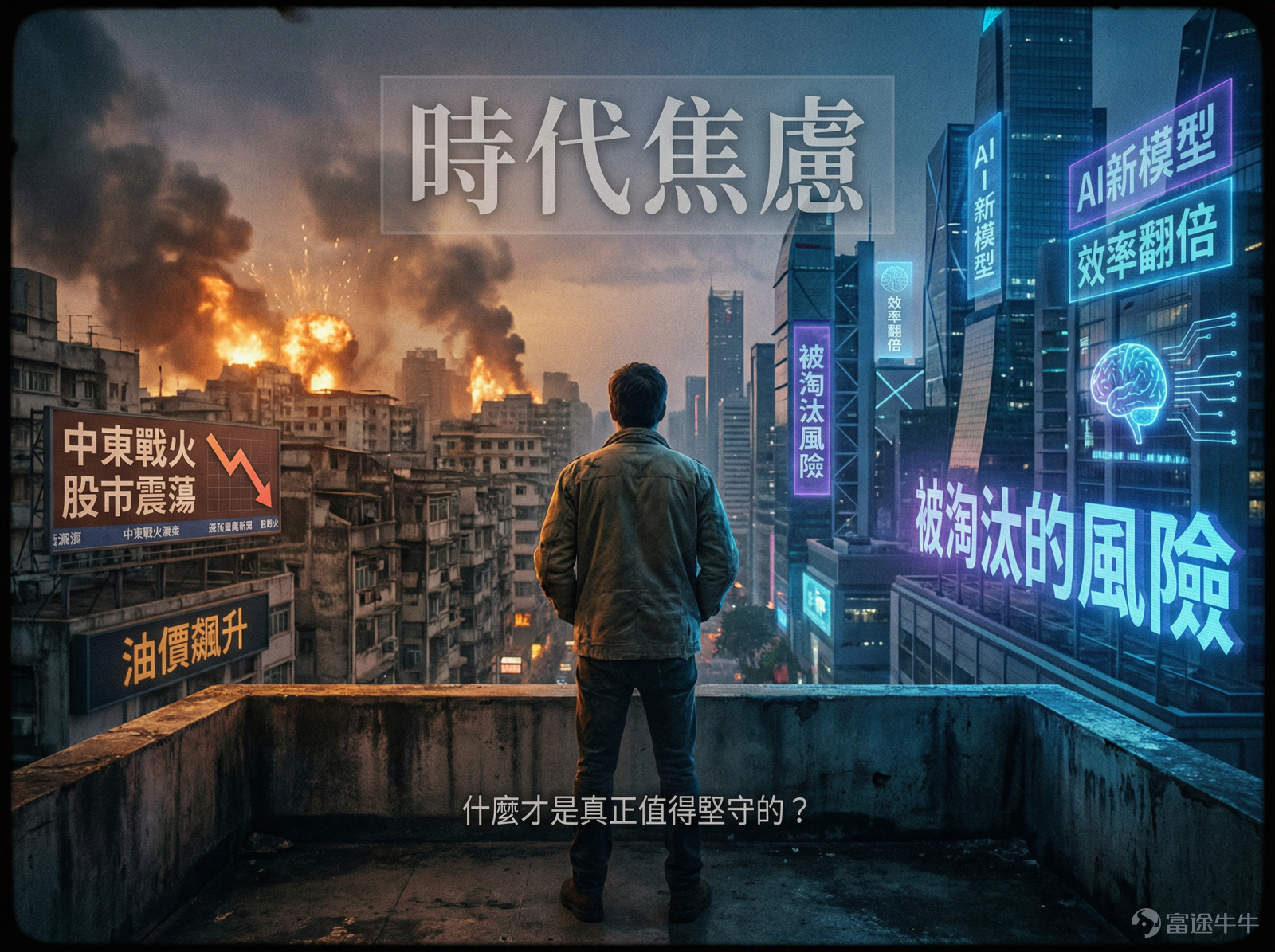
Under the bombardment in the Middle East, your account has likely suffered heavy losses. Stock markets around the world, including in the US, Europe, South Korea, Japan, and Hong Kong, China, have experienced significant turmoil. The US dollar index rebounded, oil prices surged, and precious metals priced in dollars fell as the rebound broke the traditional safe-haven logic.
The market is concerned that a prolonged US-Iran conflict could keep oil prices high, which would drive up US inflation and prevent the Federal Reserve from cutting interest rates. However, some voices suggest that judging from historical experience, this extreme scenario might just be another instance of 'the boy who cried wolf,' making long-term attrition unsustainable for both sides of the conflict.
In daily life, recently, everyone has likely been swept up by the rapid development of AI. Open your phone, and you'll find news about AI iterations everywhere: who launched a new model, who doubled efficiency with AI, who risks being phased out for not understanding AI. It feels like if you don't keep up with AI's pace, this era will leave you far behind.
These two events may seem unrelated, but they both reveal the same kind of anxiety of our times — we are living in a world where certainty has become a luxury, and the old order is being violently dismantled: one is bombing the supply chain in the physical world, the other is unraveling the value chain in the cognitive world.
You are caught in the middle,On the left is the fear of your account shrinking, on the right is the panic of being left behind by the times, and in the middle is the void of wanting to grasp something but feeling like you can't hold onto anything.
But this might be the opportunity to re-examine everything. We are forced to answer a more fundamental question:In an era where everything solid may vanish into thin air, what is truly worth holding on to?
![Hello fellow investor! On your investment journey, you may find your emotions swayed daily by market ups and downs, your patience worn down by being stuck in positions, and bombarded by information yet feeling increasingly lost. However, it's okay to slow down. We have specially created"Long-Term Answers"a column that helps you return to the essence of investing, facing volatility with a long-term and rational perspective, and finding your own rhythm in an anxious market. If you're interested, feel free to[Share Link: Click here]Join the learning group, and you will receive notifications when the column updates. Under the bombardment in the Middle East, your account has likely suffered heavy losses. Stock markets around the world, including in the US, Europe, South Korea, Japan, and Hong Kong, China, have experienced significant turmoil. The US dollar index rebounded, oil prices surged, and precious metals priced in dollars fell as the rebound broke the traditional safe-haven logic. The market is concerned that a prolonged US-Iran conflict could keep oil prices high, which would drive up US inflation and prevent the Federal Reserve from cutting interest rates. However, some voices suggest that judging from historical experience, this extreme scenario might just be another instance of 'the boy who cried wolf,' making long-term attrition unsustainable for both sides of the conflict. In daily life, recently, everyone has likely been swept up by the rapid development of AI. Open your phone, and you'll find news about AI iterations everywhere: who launched a new model, who doubled efficiency with AI, who risks being phased out for not understanding AI. It feels like if you don't keep up with AI's pace, this era will leave you far behind. This...](https://nnqimage.futunn.com/sns_client_feed/900080/20260304/web-1772615279399-gQGlaTjUYb.png/big?area=1&is_public=true&imageMogr2/ignore-error/1/format/webp)
Behind the heavy setbacks and fear, we return to the narrative of long-termism.
A friend of mine made quite a bit last year by heavily investing in tech stocks. At that time, he said: investing is about daring; having guts is an advantage. But recently, he hasn’t been able to sleep at night. Perhaps when things are going up, everyone overestimates their risk tolerance.
In a bull market, you think you can handle a 30% drawdown because you've never really experienced a 30% drop. But when it actually comes, you realize that number means: every time you glance at your phone, your breathing quickens; you’re distracted during work or while eating with your family; and you lie awake at night staring at the ceiling wondering what to do if it drops another 10%.
However, pain is both a reminder and an opportunity. When you feel the pain of your account getting hit, it might indicate that something in your investment approach could be wrong. This is the time to ask yourself:
Was my original investment based on understanding, or was it because everyone else was buying?
Is my risk tolerance real, or is it just a result of overconfidence during a bull market?
Have I put money that shouldn't be in the market (living expenses, emergency funds) into it?
Am I impatient, chasing after gains at the peak? Am I too stubborn to exit when I should have?
If I had the same amount of money in front of me now, would I invest it the way my current portfolio is structured? Or are there actually better options?
Life is like this too— we always fear missing out, falling behind, or being left behind by the times, but forget to ask ourselves:
What kind of life do I truly want: constant busy chasing, or steady and peaceful stability?
What assets (including abilities, mental strength, etc.) do I possess? What external resources do I have? What opportunities have I seized?
During those difficult times, how did I help myself get through them? Am I actually much stronger than I imagined?
When we reconstruct our investment and life narratives from the perspective of long-term thinking and resource orientation, we can more easily form our own investment system, find our life coordinates, and gradually shed external standards and fluctuating anxieties, regaining control and rhythm.
![Hello fellow investor! On your investment journey, you may find your emotions swayed daily by market ups and downs, your patience worn down by being stuck in positions, and bombarded by information yet feeling increasingly lost. However, it's okay to slow down. We have specially created"Long-Term Answers"a column that helps you return to the essence of investing, facing volatility with a long-term and rational perspective, and finding your own rhythm in an anxious market. If you're interested, feel free to[Share Link: Click here]Join the learning group, and you will receive notifications when the column updates. Under the bombardment in the Middle East, your account has likely suffered heavy losses. Stock markets around the world, including in the US, Europe, South Korea, Japan, and Hong Kong, China, have experienced significant turmoil. The US dollar index rebounded, oil prices surged, and precious metals priced in dollars fell as the rebound broke the traditional safe-haven logic. The market is concerned that a prolonged US-Iran conflict could keep oil prices high, which would drive up US inflation and prevent the Federal Reserve from cutting interest rates. However, some voices suggest that judging from historical experience, this extreme scenario might just be another instance of 'the boy who cried wolf,' making long-term attrition unsustainable for both sides of the conflict. In daily life, recently, everyone has likely been swept up by the rapid development of AI. Open your phone, and you'll find news about AI iterations everywhere: who launched a new model, who doubled efficiency with AI, who risks being phased out for not understanding AI. It feels like if you don't keep up with AI's pace, this era will leave you far behind. This...](https://nnqimage.futunn.com/sns_client_feed/900080/20260304/web-1772615279417-jwbmKSVqD8.png/big?area=1&is_public=true&imageMogr2/ignore-error/1/format/webp)
In a volatile world, find that unchanging anchor point.
Many people's anxiety about investing doesn't just stem from the losses themselves, but also from the confusion of 'I don’t know what’s going to happen next.' The essence of AI anxiety is the same. What you’re afraid of isn’t AI itself; you’re afraid of 'I don’t know if my skills will still be valuable in three years.'
The psychology behind these two fears isthe fear of losing control, both stemming froman inability to tolerate uncertainty.
For example, when it comes to investing, you can’t stand seeing a floating loss in your account, so you sell at the worst possible time. You can’t handle the anxiety of missing out, so you chase highs at the peak of market frenzy. In life, you can’t bear the anxiety of not knowing whether AI will replace you, so you either completely give up or frantically chase progress while neglecting everything else.
ButA truly mature investor — and a truly mature person — is someone who can coexist with 'I don’t know.'
They won’t panic and clear their positions just because they don’t know how the situation in the Middle East will unfold, nor will they blindly stay optimistic just because historical conflicts have been short-lived.
So what do they do? They stay clear-headed, remain flexible, keep some reserves, and then take steady steps forward amidst the chaos.
These individualsBeing able to distinguish between 'what you can control' and 'what you cannot control,' then fully focusing your attention on the former.
Will there be a ceasefire in the Middle East? You can't control that. Will AI replace your job? You can't control what will happen in the future either.
But what can you do today? You can review whether your investment rationale still holds; you can spend two hours learning an AI tool.
These things may seem small, but with every action, you shift from passively enduring uncertainty to actively building your own order within it.
They will.Reevaluate their portfolios, anticipate the worst-case scenario, ensuring that situations they cannot bear never happen, while embracing hope and waiting for the right opportunity to come.
The following investment principles can never be overstated: first protect your margin of safety, then talk about returns; first manage your current positions and risks, then seize opportunities.
Full positions, high leverage, blindly chasing hot trends—these are enough to cause damage in a calm market and present countless risks during volatile times.
You can ask yourself: if the worst-case scenario lasts for three months, will my portfolio and cash flow be able to withstand it?
If the answer is yes, and you believe that your investment logic remains sound, then you can continue observing without rushing into any moves.
But if the answer is that you can't hold on, then you need to act now. What you need at this moment is to create a buffer for your account and your life, so that external black swan events don’t become life-altering disasters for you. You need to ensure that no matter how the script is rewritten, you’re still able to step onto the field.
Then, wait for good things to happen. Whether in investing or in life, this kind of faith and optimism is necessary—doing the right thing and then patiently waiting for the results. Perhaps this is also a bit of hope and meaning we give ourselves in this restless and rapidly changing era.
![Hello fellow investor! On your investment journey, you may find your emotions swayed daily by market ups and downs, your patience worn down by being stuck in positions, and bombarded by information yet feeling increasingly lost. However, it's okay to slow down. We have specially created"Long-Term Answers"a column that helps you return to the essence of investing, facing volatility with a long-term and rational perspective, and finding your own rhythm in an anxious market. If you're interested, feel free to[Share Link: Click here]Join the learning group, and you will receive notifications when the column updates. Under the bombardment in the Middle East, your account has likely suffered heavy losses. Stock markets around the world, including in the US, Europe, South Korea, Japan, and Hong Kong, China, have experienced significant turmoil. The US dollar index rebounded, oil prices surged, and precious metals priced in dollars fell as the rebound broke the traditional safe-haven logic. The market is concerned that a prolonged US-Iran conflict could keep oil prices high, which would drive up US inflation and prevent the Federal Reserve from cutting interest rates. However, some voices suggest that judging from historical experience, this extreme scenario might just be another instance of 'the boy who cried wolf,' making long-term attrition unsustainable for both sides of the conflict. In daily life, recently, everyone has likely been swept up by the rapid development of AI. Open your phone, and you'll find news about AI iterations everywhere: who launched a new model, who doubled efficiency with AI, who risks being phased out for not understanding AI. It feels like if you don't keep up with AI's pace, this era will leave you far behind. This...](https://nnqimage.futunn.com/sns_client_feed/900080/20260304/web-1772615265486-X4bHLKJGzk.png/big?area=1&is_public=true&imageMogr2/ignore-error/1/format/webp)
That’s right,What we need to do is find what remains unchanged amidst the changes.
When your account is under heavy market fire, what truly allows you to sleep soundly isn’t just how perfectly you’ve set your stop-loss line—it’s knowing that no matter how volatile the market becomes, you have the ability to start over. When AI disrupts your industry, what truly keeps you from anxiety isn’t how many new tools you’ve learned—it’s knowing that your value doesn’t solely depend on productivity.
Of course, building such a strong core isn’t something that can be achieved overnight. However,Even if your account is currently under heavy pressure, and your career may be facing a crisis, the fact that you're still trying to understand the world, still considering your investments and life with long-term thinking, and still taking steps forward, is already the most important position you hold.
Rebuilding the relationship between life and investing; look up, and you'll see the evening glow.
Perhaps it's time to put investing back where it belongs, redefine what investing means, and redefine the relationship between life and investing.
The kind of investing that truly matters for ordinary people involves using idle funds to plan strategically, imposing discipline, and hedging volatility through strategy. When positions are stuck, learn to lower costs; when holding stocks, know how to protect gains. Don’t let short-term ups and downs sway your emotions, and don’t let temporary news disrupt your plans.
The truly rational approach is that you're using investments to build an additional layer of security for the future, rather than betting everything on a single market fluctuation. In fact, your account is only a part of your total assets, and not even the most important part.
Your health is an asset, your ability to learn and make sound judgments is an asset, your relationships with important people in your life are assets, having something meaningful to do every day is an asset, being able to make choices that suit you under challenging circumstances is an asset... and these, perhaps, are what will truly accompany you through all cycles of life.
I'm reminded of a story told by an old investor.
He lived through the 2008 financial tsunami when his account plummeted by 70%. During that time, he tossed and turned at night, constantly refreshing quotes, until one day he realized he was even watching the market in his dreams. He decided to shut down his computer and take his kids to the park for a walk.
That afternoon, as he watched his child chase the setting sun, he suddenly realized: even if my account goes to zero, I still have these hands that can hold my child’s, and these eyes that can start over again.
Later, he did indeed make a comeback, but he said the real turning point wasn’t the day the market rebounded—it was the day in the park when he decided not to let numbers define him anymore.
Perhaps accounts may shrink, AI may evolve, wars may ignite and then die down. But in daily life, the evening glow comes every day—as long as you’re still willing to look up; family and friends are still around, as long as you keep them close to your heart; and your future remains full of infinite possibilities, as long as you protect your health and mental strength.
![Hello fellow investor! On your investment journey, you may find your emotions swayed daily by market ups and downs, your patience worn down by being stuck in positions, and bombarded by information yet feeling increasingly lost. However, it's okay to slow down. We have specially created"Long-Term Answers"a column that helps you return to the essence of investing, facing volatility with a long-term and rational perspective, and finding your own rhythm in an anxious market. If you're interested, feel free to[Share Link: Click here]Join the learning group, and you will receive notifications when the column updates. Under the bombardment in the Middle East, your account has likely suffered heavy losses. Stock markets around the world, including in the US, Europe, South Korea, Japan, and Hong Kong, China, have experienced significant turmoil. The US dollar index rebounded, oil prices surged, and precious metals priced in dollars fell as the rebound broke the traditional safe-haven logic. The market is concerned that a prolonged US-Iran conflict could keep oil prices high, which would drive up US inflation and prevent the Federal Reserve from cutting interest rates. However, some voices suggest that judging from historical experience, this extreme scenario might just be another instance of 'the boy who cried wolf,' making long-term attrition unsustainable for both sides of the conflict. In daily life, recently, everyone has likely been swept up by the rapid development of AI. Open your phone, and you'll find news about AI iterations everywhere: who launched a new model, who doubled efficiency with AI, who risks being phased out for not understanding AI. It feels like if you don't keep up with AI's pace, this era will leave you far behind. This...](https://nnqimage.futunn.com/sns_client_feed/900080/20260304/web-1772615268020-oOfJ95tPxW.png/big?area=1&is_public=true&imageMogr2/ignore-error/1/format/webp)
Alright, that’s all for today!Click hereJoin the learning, stay tuned for updates"Long-Term Answers"You'll receive notifications when the column is updated. If you have specific content suggestions, everyone is strongly encouraged to share them!
Risk Disclaimer: The above content only represents the author's view. It does not represent any position or investment advice of Futu. Futu makes no representation or warranty.Read more


Comments (243)
to post a comment
407
90