Focus on GTC 2026! What signals did Jensen Huang's speech send?

Mark your calendars for March 16-19! NVIDIA's GTC conference is coming up—will this top-tier event signal a rebound for the stock price?
The NVIDIA GTC 2026 Conference will be held from March 16 to 19 in San Jose, California. Known as the 'AI industry's Spring Festival Gala,' this global AI hardware and software ecosystem event has drawn significant anticipation.
It’s worth noting that at 2 AM Beijing time on March 17, Jensen Huang will deliver a highly anticipated keynote speech, expected to set the tone for the entire AI supply chain for the year.
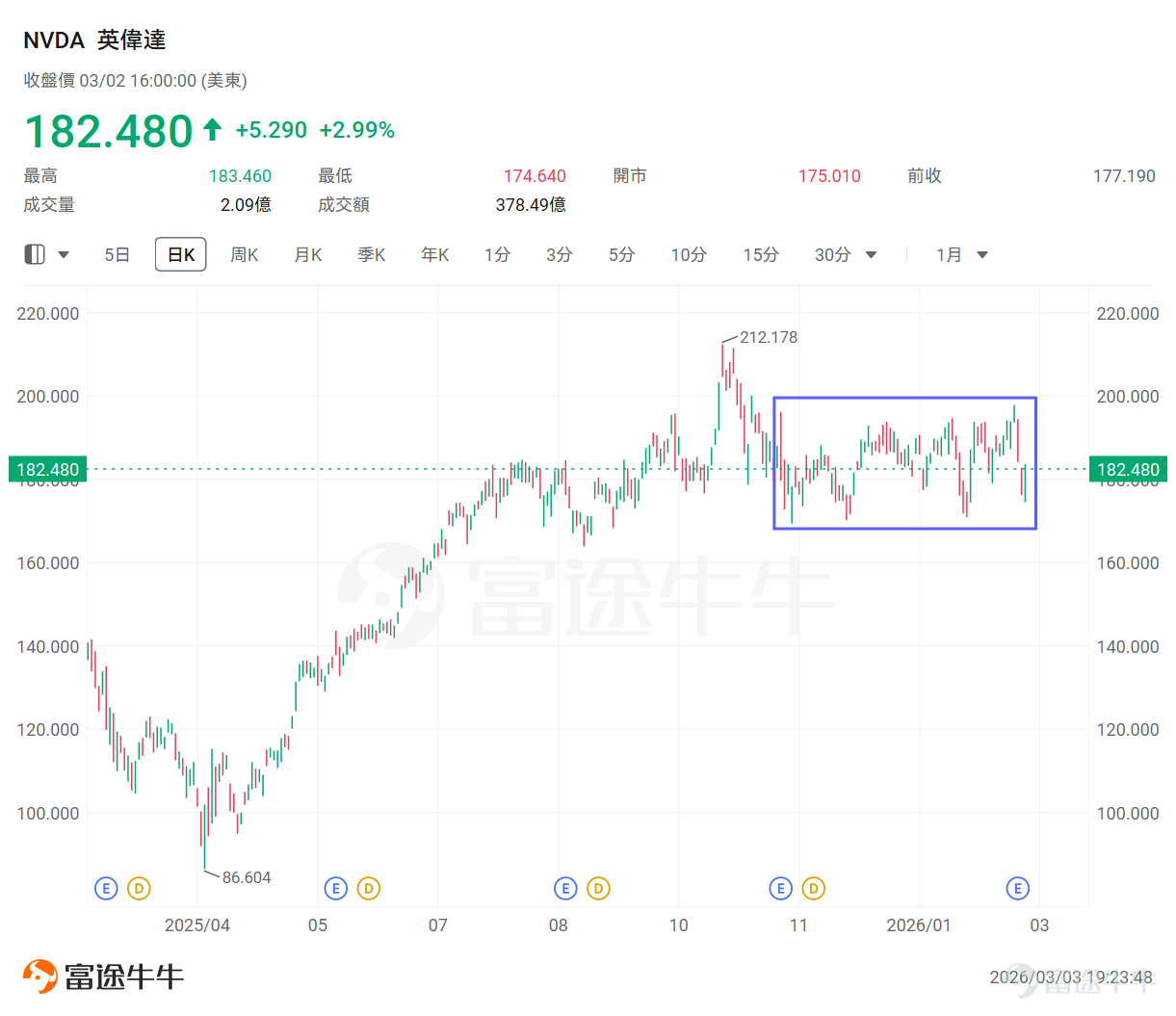
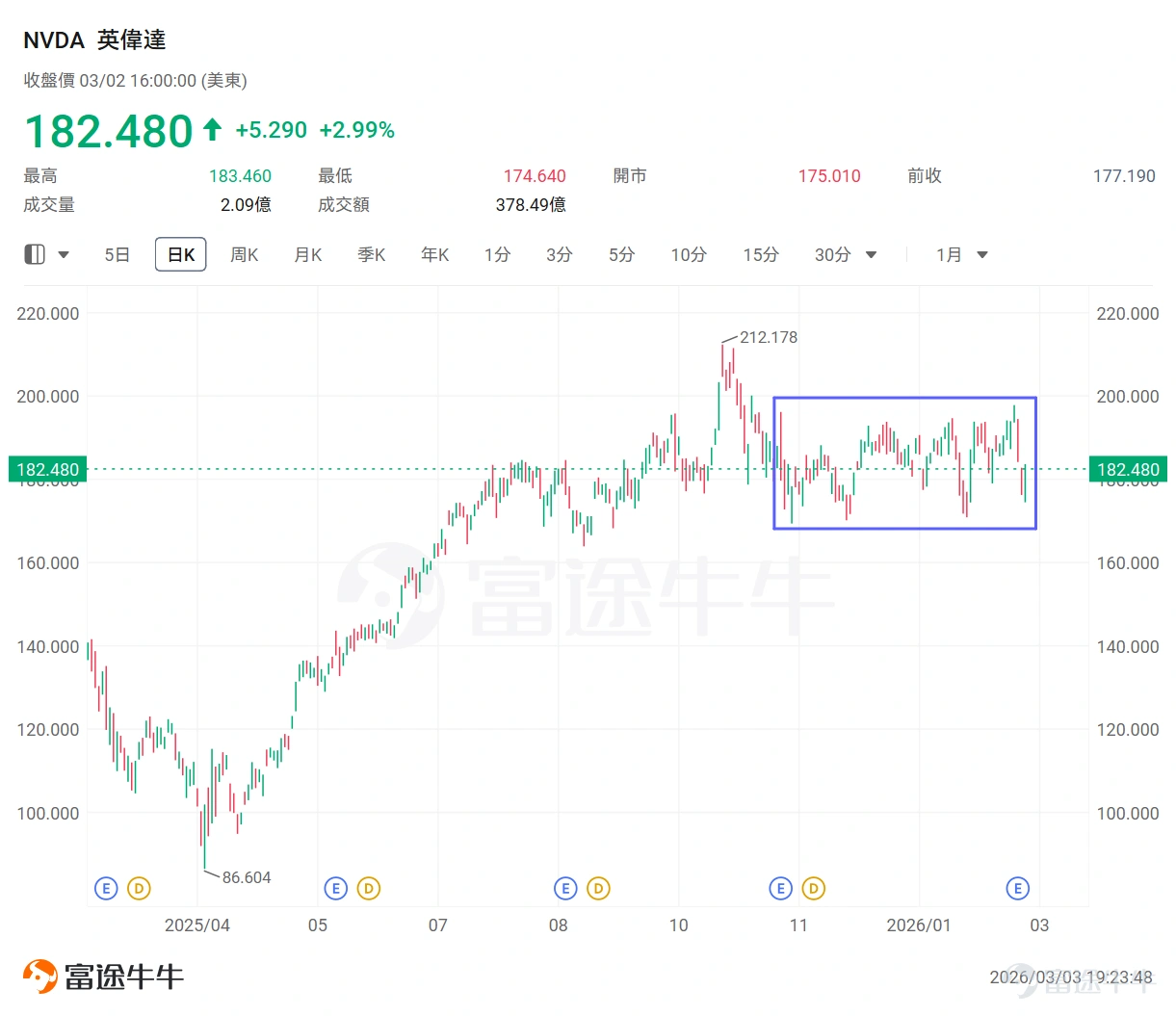
However, in stark contrast to the high enthusiasm within the industrial sector, $NVIDIA (NVDA.US)$the capital markets seem to be in a 'cooling-off period'. Since breaking through the $200 mark last year, its stock price has recently been hovering in the range of $170 to $200, with the previous explosive growth 'halo' seemingly fading.
--
--
--
At this point, many investors are likely most concerned about:What are the key highlights of this GTC conference? Can NVIDIA's stock regain momentum and rise again thanks to this catalyst?
NVIDIA's top event, GTC 2026, is coming soon! Will it trigger another rise in stock price?
NVIDIA CEO Jensen Huang, during a media interview, hyped up the upcoming GTC 2026 conference, explicitly stating that an entirely new chip, described as 'unprecedented in the world,' will be unveiled at the event. This has drawn widespread attention from the industry. As the leader in the AI chip sector, NVIDIA’s significant announcement is seen as further solidifying its leading position in the AI infrastructure domain.
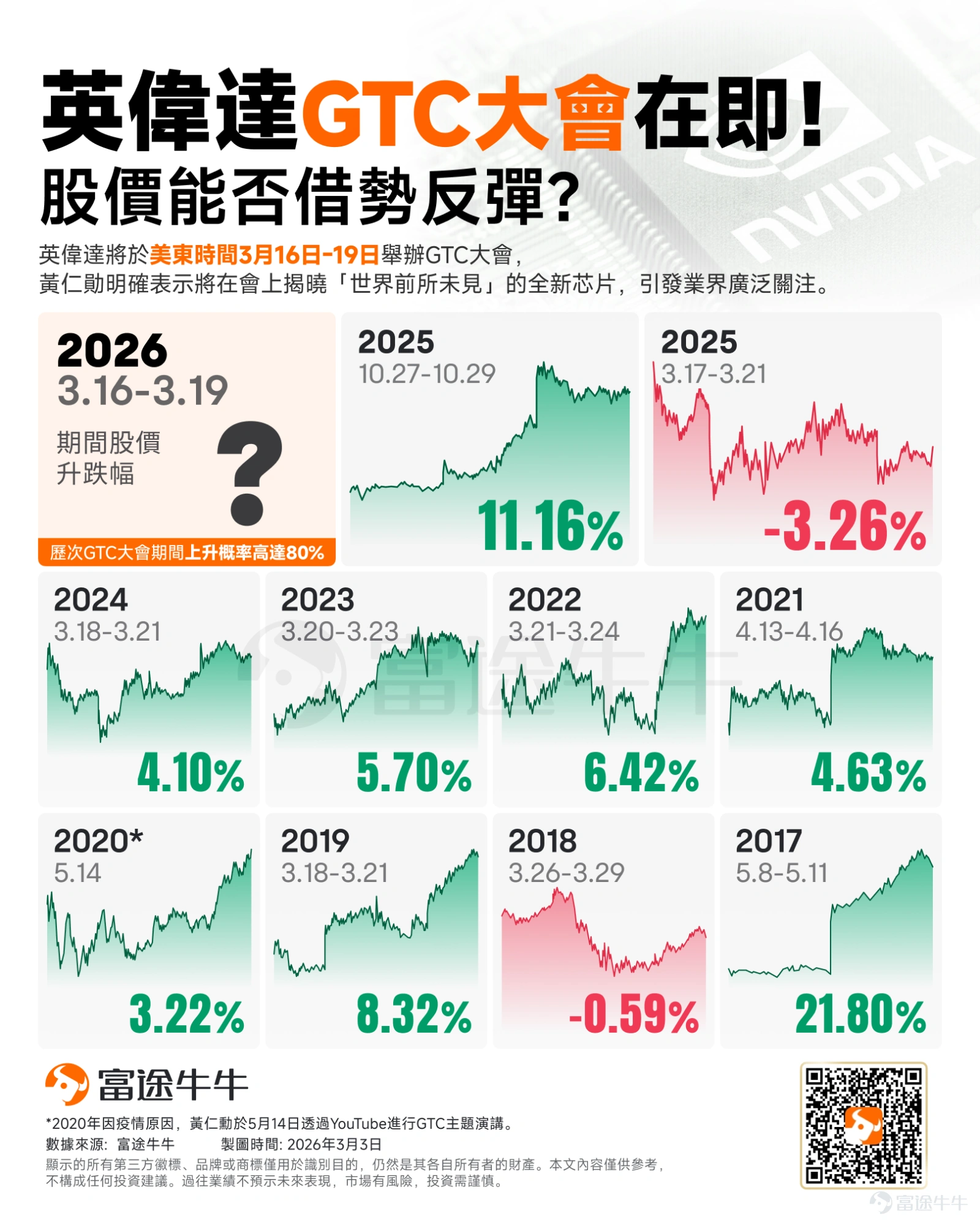
Statistical analysis shows that in the past 10 annual GTC events,NVIDIA’s probability of stock price increase was as high as 80%,with the range of gains and losses between -0.59% and 21.80%.This suggests that NVIDIA’s stock price could regain upward momentum.
--
--
--
Citi recently released a research report maintaining a 'Buy' rating for NVIDIA, raising its target price from $270 to $300. The bank specifically mentioned that the upcoming GTC conference would have a positive impact on NVIDIA’s stock price, expecting NVIDIA to showcase Groq SRAM low-latency inference, CPU, and optical networking technologies. Additionally, if NVIDIA pre-releases any clues about its fiscal year 2027 sales outlook, it could also act as a catalyst for NVIDIA’s stock price increase.
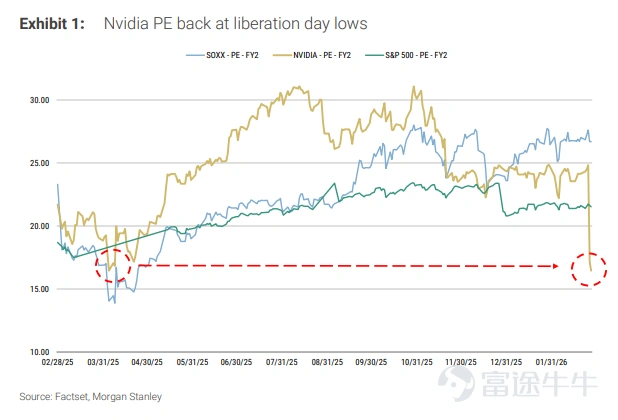
Morgan Stanley recently re-rated NVIDIA as a 'Top Pick.',The bank’s assessment is: NVIDIA's fundamentals are strengthening, but the market is being held back by two concerns—whether growth can 'endure' beyond 2026 and whether market share might slowly be eroded by ASICs and AMD. Morgan Stanley maintains an overweight rating and a $260 target price for NVIDIA, viewing the current valuation as a rare entry window.
Analysts indicate that NVIDIA's forward P/E ratio based on 2027 earnings is only around 18x, which presents an unexpectedly good entry point. Their rationale is not betting on another quarter of outperformance but rather on investor skepticism regarding 'growth durability,' which they believe will start easing in the coming months.
Moreover, Bank of America reiterated its Buy rating on NVIDIA's stock and raised the target price from $275 to $300. Truist Financial investment analysts also increased NVIDIA’s target price from $275 to $283, while Rosenblatt analysts raised NVIDIA’s target price from a previously undisclosed level to $300.
What are the core highlights of this GTC conference?
The market expects that NVIDIA will leverage the LPX inference rack, CPO optical interconnect, and Rubin supercomputing platform as the three key technological cores, combined with disruptive innovations in PCB materials, heat dissipation, and packaging processes, to achieve a complete reconstruction from inference to training, electrical interconnects to optical interconnects, hardware architecture to system integration. This is not only an iteration of NVIDIA's own computing power ecosystem but also a technological revolution for the AI computing industry, which will profoundly reshape the construction logic and competitive landscape of 'AI factories'.
1. Feynman: 1.6nm process + 3D stacked LPU, redefining AI computing architecture
NVIDIA may introduce the next-generation chip codenamed Feynman at the GTC conference and publicly unveil products based on TSMC A16’s 1.6nm technology for the first time. This would shift market attention regarding its computing roadmap from Vera Rubin to an even longer cycle.
A16 is described as a major leap in the semiconductor field, featuring Super Power Rail (SPR) and being referred to as 'the world’s smallest node technology'.
More noteworthy is the customer structure. Wccftech believes thatNVIDIA will become the first customer during the initial large-scale production phase of the A16 node and may be 'the only customer'.
Apart from the generational changes in manufacturing processes, Feynman has been given another potential clue: there is speculation that it mayintegrate Groq’s LPU hardware stack for the first time.The starting point for these discussions is that latency is becoming one of the key metrics that GPU manufacturers are focusing on optimizing.
In terms of commercialization timeline, Wccftech expects:Feynman's production is expected to start in 2028, with customer shipments likely between 2029 and 2030,depending on NVIDIA's strategic choices.
CPX and NVL144: Dedicated Optimization Platforms for Long-context Inference
To address the high cost of HBM4 and the massive demand for million-token long-context inference, NVIDIA has introduced a new variant based on the Rubin architecture —CPX GPU.The product now adopts the more cost-effective GDDR7 memory (with a single card having 96GB capacity and 1TB/s bandwidth). During the prefill phase of large language models (including loading context and calculating attention mechanisms), its performance reaches three times that of GB300 NVL72.
NVL144 rack: Integrates 144 Rubin GPUs + 144 CPX GPUs, providing 8 EFLOPS of computing power and 1.7PB/s bandwidth. It uses a cable-free modular architecture connected via a large PCB backplane, reducing assembly time from 2 hours to 5 minutes, significantly optimizing operational efficiency.
In other words, this adopts a 'heterogeneous collaboration' model – where CPX handles prefill and Rubin handles decoding. This approach combines the cost advantages of GDDR7 with the high bandwidth of HBM4, precisely targeting core commercial scenarios like AI search, long text generation, and multi-round dialogue.
3. Rubin Ultra NVL576: 600kW ultra-large-scale computing power, orthogonal backplane + CPO ushers in the optical interconnect era.
At this GTC, NVIDIA is expected to showcase its Scale-Up optical interconnect solution for scale expansion interconnection within the Rubin Ultra NVL576 architecture.
As NVIDIA's next-generation flagship computing power, Rubin Ultra NVL576 (codenamed Kyber) is scheduled for release in the second half of 2027. A single rack integrates 576 Rubin Ultra GPUs, with a total power consumption of 600kW, FP8 training performance of 5 EFLOPS, and NVFP4 inference performance of 15 EFLOPS, far surpassing the current NVL72 system in computing scale.Supporting this ultra-large-scale computing power are two of NVIDIA’s groundbreaking interconnect technologies: orthogonal backplane and CPO/NPO optical interconnect, marking NVIDIA's core transition from 'electrical interconnect' to 'optical interconnect'.
Orthogonal backplane' redefines the PCB landscape:It uses a 1㎡ area, 78-layer M9/PTFE hybrid PCB, directly replacing over 20,000 copper cables. The technology demands 'nuclear-level' layer alignment accuracy and extremely stringent thermal management, greatly raising the bar for high-end PCB manufacturing.
CPO/NPO Optical Interconnect Gains Dominance:NVL576 adopts a 'vertical + horizontal' CPO strategy, requiring approximately 792 photonic engines per rack. CPO technology reduces the power consumption of 1.6T optical modules from 30W to just 9W (a 3.5x improvement in energy efficiency and a 10x increase in reliability). With the introduction of SpectrumX and QuantumX series CPO switches, the 'optics advance, copper retreat' trend may see a major breakout.
4、Network Communication System Upgrade: NVLink + Spectrum X + Quantum X, Building the Computational Nerve Center for AI Factories
NVIDIA has created NVLink, Spectrum-X Ethernet, and Quantum-X InfiniBand to form an all-stack network communication solution that enables seamless integration from ultra-high-speed interconnects within a rack to large-scale AI factory-level expansion. This low-latency, high-bandwidth, and highly reliable 'computational neural network' is the core foundation for unleashing the full performance of LPX and Rubin platforms and ensuring efficient collaboration across large-scale clusters.
In addition, NVIDIA will announce more AI factory solutions and ecosystem partnership plans. Following OpenAI and Anthropic, more startups and large enterprises will unveil private AI factory deployment plans based on Rubin and LPX, further expanding NVIDIA’s computing ecosystem.
 Having read this far and want to learn about NVIDIA-related supply chain opportunities? Follow us,@牛牛課堂and our next article will analyze the underlying investment opportunities in detail.
Summary
Overall, NVIDIA has achieved this through LPX, CPO, and Rubin These three core technologies have not only restructured the underlying logic of AI infrastructure but also expanded their valuation boundaries through system-level innovation. This technological revolution has injected new momentum into the global computing power industry, but the ensuing four major challenges—efficiency limits, ecosystem compatibility, supply chain stability, and geopolitical competition— have become the 'common hurdles' that must be overcome in the entire AI era. This is not only NVIDIA's self-evolution but also a collective test for the entire computing power system as it moves to the next stage.
Risk Disclaimer: The above content only represents the author's view. It does not represent any position or investment advice of Futu. Futu makes no representation or warranty.Read more


Comment (1)
to post a comment
38
79