AI and electric vehicles drive growth! Can Xiaomi's rebound momentum continue?

Multiple institutions downgrade Xiaomi's rating and target price; can a short-term rebound be realized?
Multiple institutions downgrade Xiaomi's rating and target price; can a short-term rebound be realized?
Several investment banks successively lowered the target price and investment rating of Xiaomi Group (01810). Xiaomi's stock price came under significant pressure, hitting an intraday low of 31.52 yuan, marking a 52-week low. Based on the current price, Xiaomi has fallen for six consecutive days, with a decline of 12%.
Looking at the adjustment details from various investment banks, there is a clear divergence in institutions' judgment on Xiaomi's subsequent performance. Deutsche Bank lowered its target price from 71 yuan to 68.5 yuan, a decrease of 3.5%, while maintaining a 'Buy' rating. It was the only bank among all participating institutions to give a 'Buy' rating and also had the highest target price. The other three institutions gave 'Neutral' ratings. Among them, Nomura made the largest adjustment, cutting its target price from 61 yuan to 33 yuan, a drop of 45.9%, while keeping the 'Neutral' rating. This adjustment was the largest among all institutions. Macquarie also reduced its target price to 33 yuan, down 38.9% from the previous target of 54 yuan, and simultaneously downgraded its rating from 'Outperform' to 'Neutral,' making it the only institution to lower both the target price and investment rating. JPMorgan Chase cut its target price from 38 yuan to 35 yuan, a reduction of 7.9%, while maintaining a 'Neutral' rating.
Xiaomi's current stock price has clearly fallen below all key moving averages, showing a standard bearish alignment. Looking at key support and resistance levels, the primary support below is at 31.3 yuan. If this level is breached, the stock price may further fall to the second support level at 28.8 yuan. The resistance above initially lies at 34.5 yuan, which will be the first test for a rebound. Stronger resistance is around 36.5 yuan, coinciding with multiple moving average positions, making it more difficult to break through.
In terms of key indicators, the RSI has fallen to 27, entering the traditionally defined 'oversold' zone, which typically suggests that selling pressure may weaken in the short term, creating conditions for a rebound. The Stochastic Oscillator also shows an 'oversold' condition and gives a 'buy' signal. More notably, the Momentum Oscillator has generated a 'bottom divergence, buy' signal, often indicating that while prices are making new lows, downward momentum is weakening—a leading signal of a potential trend reversal. Additionally, the CCI indicator shows 'oversold, possible bottoming, buy.' However, against these potentially positive signals, trend-following indicators remain broadly bearish. The MACD clearly signals 'sell,' Bollinger Bands also indicate 'sell,' with the stock price near the lower band, showing that the downtrend remains dominant. The Ichimoku Cloud and Bull/Bear Power indicators also flash sell signals, confirming the current bearish market sentiment.
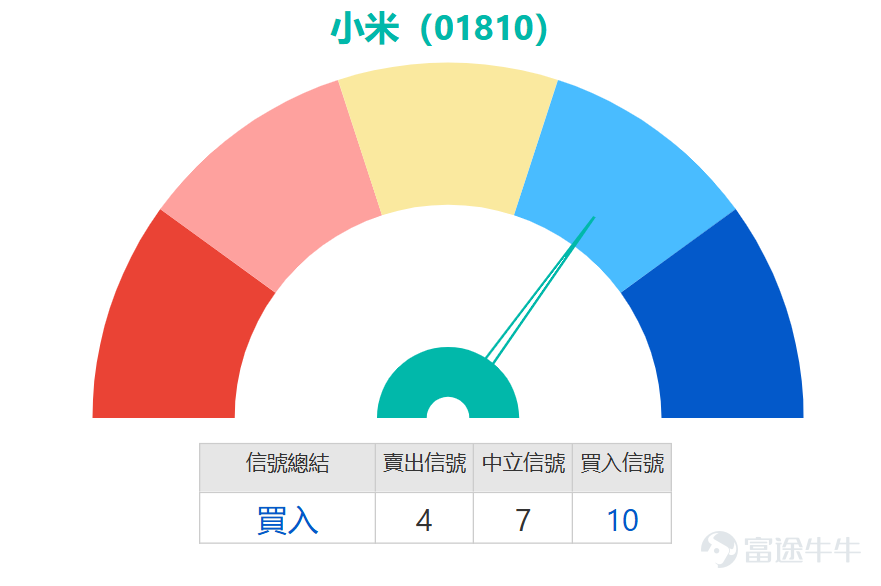
In summary, Xiaomi Group's stock price is currently at a critical technical juncture. The system gives a 'buy' summary signal; its core logic is not based on strengthening trends but rather on 'a rebound play under extreme oversold conditions.' This is a contrarian trading signal, mainly targeting short-term traders. If participating in this rebound, it must be clear that this is a short-term action, with the primary target being the resistance level at 34.5 yuan, and a strict stop-loss should be set below the support levels of 31.3 yuan or even 28.8 yuan to manage the risk of a continuing trend. Therefore, this is not a trend-following buying opportunity but a high-risk chance attempting a 'left-side trade' and 'capturing a rebound.'


Product Review:
Data shows that over the two trading days following February 25, 2026, Xiaomi Group's stock price cumulatively fell by 1.97%. This decline falls within the mild adjustment range and did not result in a sharp drop. However, the bearish derivative products linked to this underlying trend have shown significant returns. Among them, $SG#XIAMIRP2812M.P (64084.HK)$ rose by 35% during the same period, while $UB#XIAMIRP2810E.P (59592.HK)$ also increased by 22%. In comparison, $BIXIAMI@EP2607B.P (23123.HK)$ rose by 7%.

Product Picks:
Regarding call warrants, if investors are optimistic about Xiaomi’s future performance, they can consider $HSXIAMI@EC2612C.C (22791.HK)$ , with a strike price of 37.12 yuan and providing approximately 4.6 times leverage. The standout feature of this product is its premium, which is the lowest among similar options, while implied volatility and leverage levels are in relatively ideal states, making it suitable for cost-effective bullish strategies. Another option is $BIXIAMI@EC2612A.C (13186.HK)$ , with a strike price of 37.15 yuan and leverage of approximately 4.6 times as well. This warrant has the lowest implied volatility, effectively reducing volatility risk, and offers higher leverage, providing investors bullish on the underlying stock with a relatively stable high-leverage tool.
For investors who are bearish on the outlook, there are two put warrant options available. $UBXIAMI@EP2605A.P (23061.HK)$ , with a strike price of 31.28 yuan, offering leverage of approximately 6.7 times. Its premium is relatively low, adding value for bearish strategies. Another option is $BIXIAMI@EP2606B.P (13235.HK)$ , with a strike price of 31.88 yuan, providing leverage of about 5.5 times. The key advantage of this product lies in its implied volatility being the lowest among similar products, combined with relatively high leverage, making it suitable for investors who want to execute bearish strategies at a lower volatility cost.
In terms of bull certificate products, these are suitable for short-term bullish investors who can tolerate the risk of forced redemption. $SG#XIAMIRC2609I.C (59415.HK)$ has a redemption price of 30 yuan, actual leverage as high as approximately 10.7 times, and benefits from a low premium, which provides higher capital efficiency. $UB#XIAMIRC2609A.C (67825.HK)$ also has a redemption price of 30 yuan, with leverage around 10.4 times. Its leveraged price is relatively higher, offering an aggressive bullish tool for bold investors.
As for bear certificates, they are designed for investors who are bearish on the market and willing to accept the risk of being forced to close their positions if the redemption price is touched. $SG#XIAMIRP28121.P (59190.HK)$ has a redemption price set at 38 yuan, offering actual leverage of about 6.2 times, with the lowest premium among similar products and relatively high actual leverage. $MS#XIAMIRP2812C.P (59757.HK)$ has a redemption price of 38.5 yuan, with leverage of about 5.7 times, slightly lower than the previous one. However, its actual leverage is the highest among the recommended products, while maintaining a relatively low premium, offering another choice for investors seeking high-leverage bearish exposure.

Do you think Xiaomi Group's recent stock price drop is due to overly pessimistic market sentiment leading to unwarranted selling, or have there been unexpected changes in the fundamentals? If you hold Xiaomi Group’s position, would you choose to average down at the current price or cut your losses to avoid risks and wait for stabilization before buying back?
Disclaimer: This article does not constitute any investment advice. It is for reference only and does not constitute any investment advice. Market data, opinions, and analysis presented may change at any time without prior notice. We are not responsible for any loss or damage caused by reliance on the information in this article. Technical analysis only indicates whether certain technical conditions are met; asset performance should be comprehensively evaluated using additional sources, and trading decisions should not be made solely based on this article. Please note that past performance is not indicative of future results. For more market analysis, stay tuned to Jenny's daily updates on 'HK Stock Warrants'!
#Hong Kong Stocks #Real-time Analysis #Warrant Picks #Warrant Strategy #Derivatives Hedging #HK Warrants Jenny #Xiaomi Group #01810 #Tech Stocks $Hang Seng TECH Index (800700.HK)$$Hang Seng Index (800000.HK)$$Hang Seng China Enterprises Index (800100.HK)$
Risk Disclaimer: The above content only represents the author's view. It does not represent any position or investment advice of Futu. Futu makes no representation or warranty.Read more

Comments
to post a comment
1
4