
English
Back
Open Account
The US-Iran peace talks present conflicting narratives! What’s next for oil prices?
港股窩輪Jenny
joined discussion · Mar 3 14:06

Strategies for PetroChina and Sinopec Amid the Diverging Trends of the 'Three Oil Giants'

Recently, the energy sector in Hong Kong stocks has become a market focus, with significant divergence in the performance of the 'Three Oil Giants'. $PETROCHINA (00857.HK)$ and $CNOOC (00883.HK)$ The strong performance saw share prices of both companies hitting new 52-week highs; in contrast, $SINOPEC CORP (00386.HK)$ the performance showed a volatile tug-of-war between bulls and bears, significantly weaker than the other two.
Capital flows indicate rising market attention towards the oil and gas sector. In the warrants market, all three major oil and gas stocks recorded net inflows, with bullish (long) positions dominating. Among them, CNOOC attracted the most interest, with single-day net inflows into bullish positions reaching as high as HK$11.73 million; PetroChina followed closely with HK$3.97 million in bullish inflows; even Sinopec, which has lagged behind in performance, recorded HK$1.49 million in net bullish inflows, reflecting that investors are not giving up on its potential opportunities at lower levels.
The core driver of this round of stock price divergence lies in the fundamental differences in business structures among the three companies. PetroChina and CNOOC have significantly higher proportions of upstream oil and gas exploration and production businesses, making their performance highly correlated with international oil prices, thus allowing them to directly benefit from recent upward fluctuations in global oil prices. On the other hand, Sinopec’s focus is more on downstream refining, petrochemicals, and sales, where rising oil prices will increase raw material costs, squeezing profit margins for refining operations, thereby pressuring the stock price. Looking ahead, the allocation value of the oil and gas sector needs to be judged based on trends in international oil prices and corporate earnings release rhythms. Before a clear trend reversal in oil prices occurs, the divergence within the sector may persist in the short term.
Individual Stock Technical Analysis and Strategy
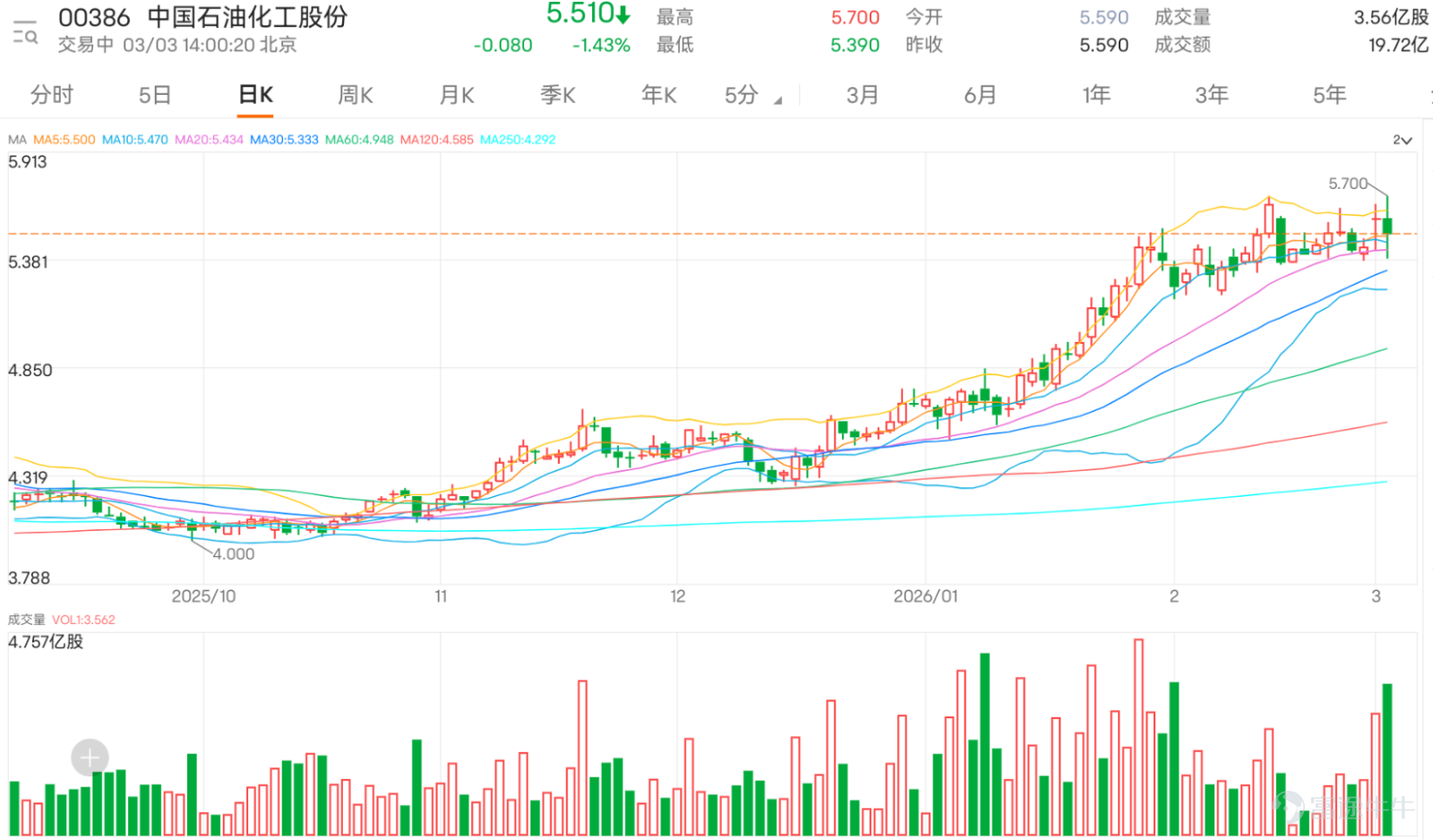
Sinopec (00386): While the stock price remains volatile, technically it still holds above the 10-day moving average (HK$5.47), 30-day moving average (HK$5.33), and 60-day moving average (HK$4.95), with the moving averages forming a bullish alignment, indicating a favorable medium- to long-term trend. Support can be observed at two levels: the first support near the 30-day moving average at HK$5.29, acting as a short-term boundary between strength and weakness; the second support is around the stage low at HK$5.09. Resistance is found near previous highs at HK$5.79 and HK$5.89. Technical indicators have issued a short-term 'sell' signal with an intensity of 8 (out of 10), but this signal primarily warns against chasing gains rather than signaling a trend reversal. Short-term traders may consider holding back and waiting for a pullback to the first support level before considering entry; medium- to long-term investors can refer to the 60-day moving average for opportunistic accumulation.
Recently, the energy sector in Hong Kong stocks has become a market focus, with significant divergence in the performance of the 'Three Oil Giants'. $PETROCHINA (00857.HK)$ and $CNOOC (00883.HK)$ The strong performance saw share prices of both companies hitting new 52-week highs; in contrast, $SINOPEC CORP (00386.HK)$ the performance showed a volatile tug-of-war between bulls and bears, significantly weaker than the other two. Capital flows indicate increasing market attention to the oil and gas sector. In the warrants market, all three major oil stocks recorded net inflows, with bullish positions (long) dominating. CNOOC was the most sought after, with bullish inflows reaching 11.73 million yuan in a single day; PetroChina followed closely with 3.97 million yuan in bullish inflows; even Sinopec, which lagged behind in performance, recorded 1.49 million yuan in bullish inflows, reflecting that investors are not giving up on its potential low-position opportunities. The core driver of this round of stock price divergence lies in fundamental differences in the business structures of the three companies. PetroChina and CNOOC have significantly higher proportions of upstream oil and gas exploration and production businesses, making their performance highly correlated with international oil prices, thus allowing them to directly benefit from the recent volatility and upward trend in international oil prices. Conversely, Sinopec's business focus leans more towards downstream refining, petrochemicals, and sales; rising oil prices will increase raw material costs, squeezing profit margins in the refining business, thereby pressuring its stock price. Looking ahead, the allocation value of the oil and gas sector needs to be considered alongside international oil price trends...
PetroChina (00857): The stock demonstrates strong upward momentum, forming a clear bullish pattern, with recent trading volumes increasing, showing sufficient momentum. The current stock price is approaching a key resistance zone, with the first resistance at HK$10.8 and stronger resistance at HK$11.2. Below, support on pullbacks can be monitored at HK$9.6 (near the 10-day moving average) and HK$9.2. Technical indicators issue a short-term 'sell' signal with an intensity of 9, suggesting a strategy of 'buying on dips rather than chasing highs.' Aggressive investors might consider taking partial profits when upward momentum weakens at the resistance zone; those optimistic about future prospects should patiently wait for a pullback to the HK$9.6 or HK$9.2 support zones and look for stabilization signals before buying in batches, setting stop-loss below HK$9.2.
Recently, the energy sector in Hong Kong stocks has become a market focus, with significant divergence in the performance of the 'Three Oil Giants'. $PETROCHINA (00857.HK)$ and $CNOOC (00883.HK)$ The strong performance saw share prices of both companies hitting new 52-week highs; in contrast, $SINOPEC CORP (00386.HK)$ the performance showed a volatile tug-of-war between bulls and bears, significantly weaker than the other two. Capital flows indicate increasing market attention to the oil and gas sector. In the warrants market, all three major oil stocks recorded net inflows, with bullish positions (long) dominating. CNOOC was the most sought after, with bullish inflows reaching 11.73 million yuan in a single day; PetroChina followed closely with 3.97 million yuan in bullish inflows; even Sinopec, which lagged behind in performance, recorded 1.49 million yuan in bullish inflows, reflecting that investors are not giving up on its potential low-position opportunities. The core driver of this round of stock price divergence lies in fundamental differences in the business structures of the three companies. PetroChina and CNOOC have significantly higher proportions of upstream oil and gas exploration and production businesses, making their performance highly correlated with international oil prices, thus allowing them to directly benefit from the recent volatility and upward trend in international oil prices. Conversely, Sinopec's business focus leans more towards downstream refining, petrochemicals, and sales; rising oil prices will increase raw material costs, squeezing profit margins in the refining business, thereby pressuring its stock price. Looking ahead, the allocation value of the oil and gas sector needs to be considered alongside international oil price trends...
For investors optimistic about the outlook and looking to utilize leverage instruments to capture potential volatility, the following call warrant products can be considered. For Sinopec (00386), $BPCP&CC@EC2609A.C (22453.HK)$ offering approximately 6.5x leverage with a strike price of HK$5.55, its characteristic advantage lies in relatively low implied volatility, helping reduce value erosion caused by declines in market volatility, suitable for investors with clear directional views but aiming to control volatility costs. Another option is $BICP&CC@EC2609A.C (29658.HK)$ , offering approximately 6.7x leverage with a strike price of HK$5.56, its premium and implied volatility are competitive among similar products during the same period.
As for PetroChina (00857), $BIPETCH@EC2605A.C (23259.HK)$ offering approximately 9.8x leverage with a strike price of HK$11.01, its leverage and implied volatility combination is considered balanced, providing effective price sensitivity while managing time decay risk. Another recommended product is $UBPETCH@EC2605A.C (23217.HK)$ , The leverage is slightly higher at about 10.2 times, with the same exercise price of 11.01 yuan. Its main advantage lies in its premium and implied volatility being at the lowest levels among similar products during the same period. This makes it an attractive choice for investors seeking higher leverage and cost efficiency. Investors should note that all derivative investments involve high risks and require careful decision-making based on their own risk tolerance and independent judgment of the underlying stock trends.
Recently, the energy sector in Hong Kong stocks has become a market focus, with significant divergence in the performance of the 'Three Oil Giants'. $PETROCHINA (00857.HK)$ and $CNOOC (00883.HK)$ The strong performance saw share prices of both companies hitting new 52-week highs; in contrast, $SINOPEC CORP (00386.HK)$ the performance showed a volatile tug-of-war between bulls and bears, significantly weaker than the other two. Capital flows indicate increasing market attention to the oil and gas sector. In the warrants market, all three major oil stocks recorded net inflows, with bullish positions (long) dominating. CNOOC was the most sought after, with bullish inflows reaching 11.73 million yuan in a single day; PetroChina followed closely with 3.97 million yuan in bullish inflows; even Sinopec, which lagged behind in performance, recorded 1.49 million yuan in bullish inflows, reflecting that investors are not giving up on its potential low-position opportunities. The core driver of this round of stock price divergence lies in fundamental differences in the business structures of the three companies. PetroChina and CNOOC have significantly higher proportions of upstream oil and gas exploration and production businesses, making their performance highly correlated with international oil prices, thus allowing them to directly benefit from the recent volatility and upward trend in international oil prices. Conversely, Sinopec's business focus leans more towards downstream refining, petrochemicals, and sales; rising oil prices will increase raw material costs, squeezing profit margins in the refining business, thereby pressuring its stock price. Looking ahead, the allocation value of the oil and gas sector needs to be considered alongside international oil price trends...
At different stages of the international oil price cycle (such as unilateral rise, high volatility, or decline), which type of energy company would you prioritize investing in? Please explain your rationale.
Reminder: This article does not constitute any investment advice. It is for reference only and does not constitute any form of investment recommendation. Market data, opinions, and analysis presented may change at any time without prior notice. We are not responsible for any losses or damages caused by reliance on the information provided herein. Technical analysis shows whether certain technical conditions are met; asset performance should be comprehensively evaluated with additional data, and trading decisions should not be made solely based on this article. Note that past performance does not guarantee future results. For more market analysis, stay tuned to 'HK Stock Warrants Jenny' daily updates!
#HongKongStocks #RealTimeAnalysis #WarrantsSelection #WarrantsStrategy #DerivativesHedging #HongKongWarrantsJenny #Sinopec #PetroChina #EnergySector$Hang Seng Index (800000.HK)$$Hang Seng China Enterprises Index (800100.HK)$$Crude Oil Futures (JUN6) (CLmain.US)$
Risk Disclaimer: The above content only represents the author's view. It does not represent any position or investment advice of Futu. Futu makes no representation or warranty.Read more
Thumbs Up
3
276K Views
Report
Comments
Write a Comment...
3
1