
Earnings Options Strategy | Is Broadcom's AI chip the ace up its sleeve strong enough? The market is focused on three key things
On March 4th, after the US stock market closes, $Broadcom (AVGO.US)$ Broadcom will announce its Q1 results for the FY2026. As the AI chip design company with the second-largest market cap after NVIDIA, the market eagerly awaits the incremental information this earnings report may bring. Following NVIDIA’s dramatic post-earnings stock performance last week, the atmosphere around Broadcom's earnings feels somewhat like a stress test: on one side, continued heavy investment in AI infrastructure; on the other, the market is starting to question the return on AI investments. The current market is more sensitive to valuations across the AI semiconductor supply chain, resulting in higher volatility.
What the Market is Waiting For: Clear Guidance, Focus on Guidance and Margin Commentary
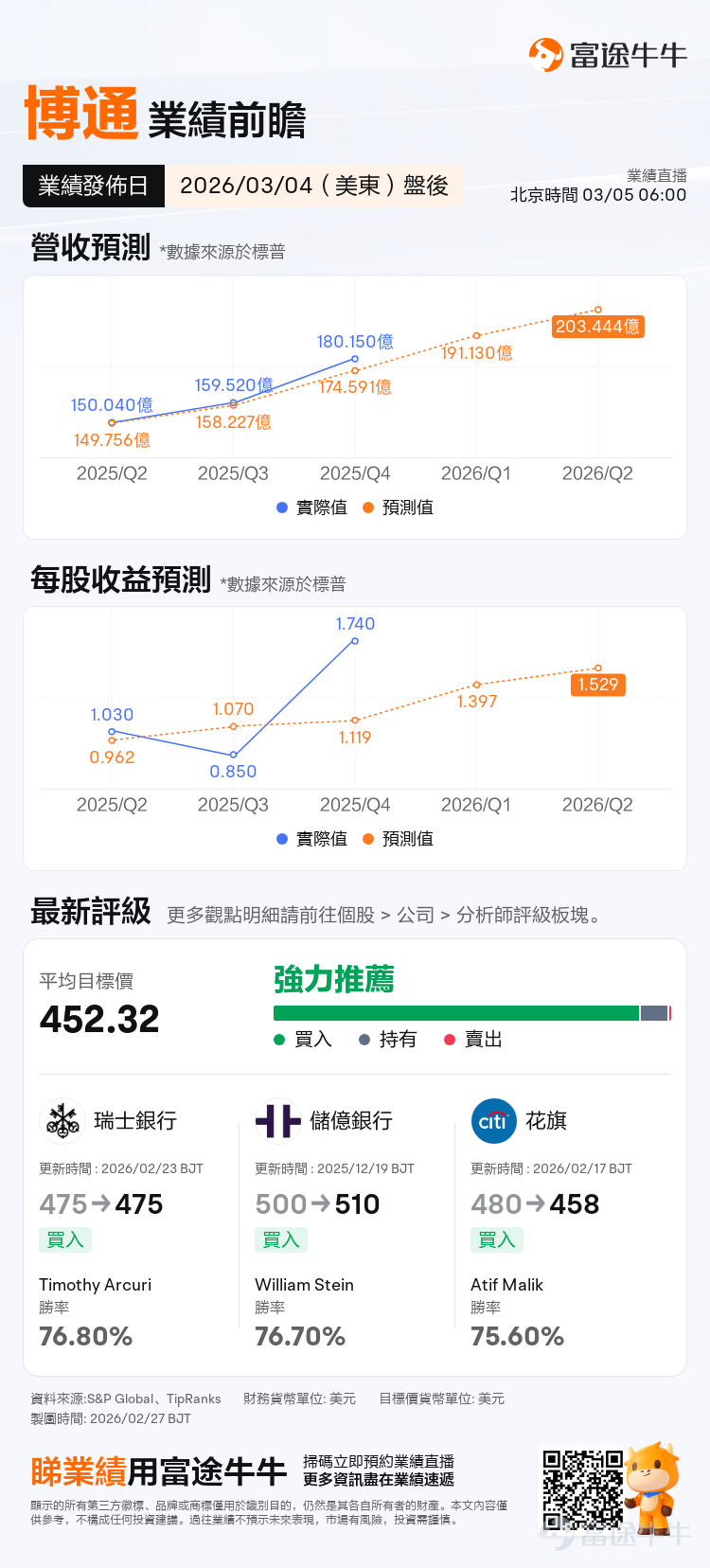
Based on the previous quarter’s guidance, Broadcom expects Q1 revenue of approximately $19.1 billion; an adjusted EBITDA margin target of 67%; and AI semiconductor revenue to double year-over-year to $8.2 billion, primarily driven by custom AI accelerators (ASICs) and AI Ethernet switching chips.
The current market consensus closely aligns with the company’s guidance, with data showing: this quarter’s revenue at approximately $19.113 billion, and EPS at around $1.397. Therefore, the key focus on earnings night isn’t about whether there’s growth, but rather the quality of that growth:
- Whether the $8.2 billion in AI revenue materializes, and the extent of growth in backlog;
- Whether gross margins continue to be structurally pressured lower by AI;
Whether the customer base for AI chips has expanded.

Stock Price Review: Volatile Decline, Growth Concerns Emerge
In the last quarter's earnings report, Broadcom's numbers weren't bad,and guidance was relatively optimistic. However, the statement during the conference call that 'gross margin will decline'directly dampened market sentiment. The company then projected that due to the increase in AI-related revenue share, the overall gross margin would see a sequential decline of approximately 100 basis points.
Entering 2026, Broadcom's stock price continues to fluctuate and gradually decline, primarily driven by ongoing concerns over whether massive capital expenditures in the AI sector can be sustained. Comparing the stock price movement, it’s not hard to notice that when NVIDIA, the core leader in the AI space, sees its stock price retreat, Broadcom often experiences significant declines as well, with investors seemingly expressing worries about the entire AI chip sector.
This is also the core backdrop for why Broadcom’s stock price couldn’t break out of its trend in the past two months: the market is waiting for a more definitive answer on 'profitability quality.' During this period, the market's stance has been clear: the AI story remains intact, orders and product timelines are progressing; what’s truly holding back the stock price is the boundary of margin decline and the expected elasticity brought by customer concentration in custom chips.

How to validate the AI focus? Pay attention to whether the customer base can expand.
Regarding the AI semiconductor-related business metrics for this quarter, management had already clarified in previous earnings calls: Q1 AI semiconductor revenue is projected to be $8.2 billion. However, what truly determines whether Broadcom's valuation can rise further is whether management can answer two tougher questions:
First, can custom chips expand beyond"A few large customers" transitioning to "more customers, more generations". The previous quarter's earnings report mentioned that Broadcom disclosed a backlog of orders for the next 18 months, with AI-related orders totaling as much as $73 billion, but concentrated among a few large customers; the more concentrated the customer base, the more the market worries that any slowdown by one will lead to an expectation gap. Whether this quarter can disclose that related products have entered a broader base of major customers and whether there is an increase in the backlog of orders will be the core focus of the market.
Secondly, whether the technology roadmap can bring new revenue streams. Broadcom recently disclosed that it expects to sell at least one million chips based on its 3D stacking technology by 2027, with Fujitsu as the first customer. Engineering samples are currently being tested, and commercial production is expected to proceed this year. The company also noted,this may correspond to a multi-billion-dollar new revenue pool.。
The significance of this line for Q1 earnings is not about immediate realization in the quarter, but rather how management provides clear guidance: the pace of customer adoption, mass production milestones, and the synergy path with TSMC’s advanced process/encapsulation.

Options Strategy: This earnings report is more like a "volatility event," how to approach options trading resembles making a tactical play.
First, let’s look at how the pre-earnings options market is pricing. As of Friday, February 27th US stock market close, the options market priced in an implied post-earnings volatility of around 9%.

Considering the fluctuations after the last few quarters' results, the stock price movement following Broadcom’s earnings releases has been significant, often exceeding market expectations. With the current pressure across the AI semiconductor sector, can Broadcom stand out?
In terms of options strategies, several actionable ideas include:
Bullish but unwilling to pay for high implied volatility (IV):Bull Call Spread, using a structured approach to lower cost, betting on the combination of an $8.2 billion revenue beat, optimistic guidance, and maintained gross margins.
Bearish:Bear Put Spread, primarily betting on continued gross margin declines and conservative Q2 guidance.
For those holding the underlying stock and looking to collect higher premiums during earnings week:Covered Call, provided you accept that any post-earnings surge will be capped.

Overall, if revenue, AI semiconductor income, and profit margins remain stable with decent guidance, the market is more likely to view Broadcom as a higher-conviction asset in the AI hardware supply chain. However, if any one of these factors weakens significantly, given the current environment of reduced risk appetite and growing concerns over an AI bubble, the stock price may come under pressure after earnings.
Risk Disclaimer: The above content only represents the author's view. It does not represent any position or investment advice of Futu. Futu makes no representation or warranty.Read more


Comments (5)
to post a comment
13
29