US-Iran tensions flare up again: How will Strait risks impact assets?

Middle East conflicts drive up risk aversion: How have stock markets reacted during past geopolitical conflicts? These three "modern warfare investment undercurrents" are worth watching closely!
As the US and Israel jointly launched airstrikes on Iran, the already intricate and conflict-ridden situation in the Middle East has officially entered a "white-hot" phase, simultaneously triggering risk aversion in the market.
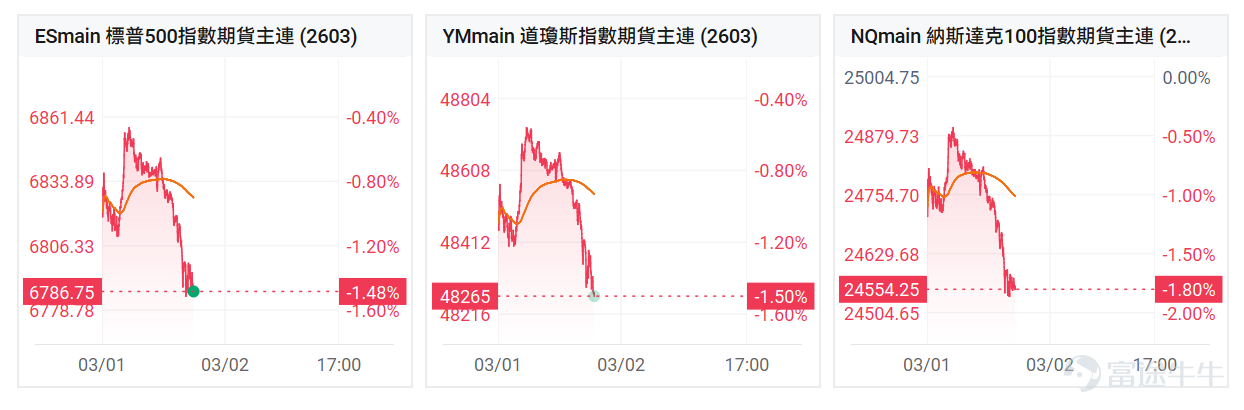
According to John Briggs, head of US interest rate strategy at Natixis, traders will adopt a strategy of "seeking safety first, then asking questions." As of press time, global financial markets have been volatile, with Nasdaq futures down 1.80%, S&P 500 futures down 1.48%, and Dow futures down 1.50%.

--
--
--
According to research from Soochow Securities, for the asset side, the sudden escalation of tensions in the Middle East directly impacts global risk appetite, and in the short term, the market may presenta typical risk-averse pattern of "gold and oil rising together, while risky assets face pressure."
In fact, since 1990, there have been many major geopolitical events around the world; below we select 11 representative events,and by observing the performance of the S&P 500 index after these events, it can be seen that geopolitical events usually only cause short-term volatility and do not have long-term effects on the market.

At this crossroads, many fellow investors are likely closely watching: how will this geopolitical conflict unfold? In the face of the resulting market turbulence, how should we seek certainty? On a deeper level, in an era where the AI wave is sweeping across the globe, what profound changes have occurred in the forms and underlying logic of modern warfare?
How will this geopolitical conflict unfold?
In the critical observation window over the next week, the direction of the capital market depends on the intensity of the conflict:
– If it's a short, intense conflict (blitzkrieg): The panic index (VIX) will quickly reverse in an inverted V-shape after a brief spike. The geopolitical premium on crude oil will be squeezed out rapidly after short-covering,Liquidity will swiftly flow back into the core macro narrative of 2026 — AI infrastructure.The market’s focus will return to computing power production capacity and order fulfillment.
– If it evolves into a prolonged war of attrition: Global supply chain disruptions will bring about stagflation-like pressures. Capital will demand high 'efficiency returns,' mercilessly selling off long-duration assets dependent on low-interest-rate expectations,Flocking to core assets with strong pricing power and abundant cash flow.Precious metals will enter a supercycle driven by safe-haven demand and de-dollarization expectations, while strategic resource metals (such as copper and aluminum) will experience a 'Davis Double Play' fueled by rigid AI computing demand and panic stockpiling by nations during wartime.
Paradigm Shift: The Underlying Logic of Modern Warfare in the AI Era Is Changing Drastically
The joint US-Israeli airstrikes on Iran conceal three underlying logics reshaping future great power competition and asset pricing beneath the smoke of traditional geopolitical rivalry: control over space infrastructure, practical applications of AI technology, and the reallocation of global strategic resources. These three variables are becoming critical investment coordinates that the market must watch closely.
Based on the three major logics above, Futubull AI has also compiled a list of relevant concept stocks for fellow investors' reference:

--
--
--
1. Military and Defense Sector
1.Starlink and drones are rewriting the modern combat paradigm
On March 1, it was confirmed that Iran's Supreme Leader and several senior military executives were killed in the attack. Reports suggest that behind this 'long-range, rapid, and precise strike,' Starlink's low-orbit satellite constellation played a core supporting role.
With the advantages of wide low-orbit coverage, strong anti-destruction capability, and low latency,Starlinksuccessfully broke through ground-based communication control and electromagnetic interference. From comprehensive communications, real-time reconnaissance, high-precision guidance, to transmitting encrypted commands and supportingDronereal-time control, Starlink has completely closed the data loop from 'target locking' to 'implementing strikes.' This marks that commercial low-orbit satellite networks have officially become critical space-based infrastructure, with their strategic value and the urgency of accelerated deployment by countries reaching unprecedented levels.
2. Militarized application of AI technology
AI has gone beyond merely generating text and code and is now officially the 'brain' of modern warfare.
According to the Wall Street Journal, the US Central Command utilized $Palantir (PLTR.US)$ a platform that deeply integrates Anthropic's Claude large language model. Within a highly classified network environment, AI was fully applied for rapid intelligence assessment, dynamic target identification, and complex combat scenario simulations. This is not only a tactical upgrade but also a strong validation of the immense potential of cutting-edge software algorithms deeply integrated with military operations.
Core targets:
In the aerospace and defense sectors, $GE Aerospace (GE.US)$ , aircraft engine manufacturer $RTX Corp (RTX.US)$ 、 $Boeing (BA.US)$ , F-35 fighter jet manufacturer, and key NATO supplier $Lockheed Martin (LMT.US)$ ;In military drones,missile defense system manufacturers, military drones, and autonomous defense systems $Northrop Grumman (NOC.US)$ , small tactical drones and guidance systems $AeroVironment (AVAV.US)$ , military tactical drones and simulation systems $Kratos Defense & Security Solutions (KTOS.US)$ , a leading supplier in the US focusing on automated industrial drones, anti-drone systems, and dedicated wireless communication technologies $Ondas (ONDS.US)$ are all worth paying attention to.
Cyber warfare has become a key component of modern warfare,thus sectors like defense data analysis $Palantir (PLTR.US)$ , cybersecurity companies $Palo Alto Networks (PANW.US)$ 、 $CrowdStrike (CRWD.US)$ 、 $Cloudflare (NET.US)$ may present investment opportunities.
II. Gold stocks
As the saying goes, 'Antiques in prosperous times, gold in turbulent times.'
According to a research report by CITIC Securities, regarding gold, risk-averse sentiment often starts catalyzing before military conflicts begin, with gold prices showing two patterns afterward. For conflicts that are anticipated by the market before they start, gold prices often spike on the first day of the conflict and then retreat. For unexpected conflicts, gold prices tend to reach a short-term peak around ten days after the start of the conflict and retreat once the situation becomes clear.Over the long term, as the US shifts toward strategic contraction and global instability rises, geopolitical factors will continue to act as a sustained catalyst for gold.
Therefore, gold stocks in the US stock market such as $Newmont (NEM.US)$ 、 $Agnico Eagle (AEM.US)$ 、 $Wheaton Precious Metals (WPM.US)$ 、 $Barrick Mining (B.US)$ have recently been worth paying attention to.
Three, resource stocks
On the surface, the conflict revolves around nuclear issues and geopolitical tensions,but at its core, it is a blatant resource war,which officially heralds the arrival of the 'Year of Commodities.'
From a global macro perspective of reserves, Venezuela and Iran hold significant strategic importance. Following the US actions against Venezuela (with proven crude oil reserves accounting for 19% of the world's total) on January 3rd, which secured substantial energy interests, the focus has now shifted again to Iran, which holds 12% of global reserves and the world’s second-largest natural gas reserves. Combined, these two countries control nearly 31% of the world’s oil lifeline.OilThis underlying trend indicates that the core of major power competition is accelerating towards the absolute control of strategic resources, which will profoundly reshape the pricing logic of global commodities in the long term.
In addition,Iran is rich in uranium resources,and its uranium production accounts for a certain proportion of the global total. The attack may lead to a reduction in Iran's nuclear material exports, pushing up global uranium prices. Based on this, uranium stocks may attract capital interest.
Moreover, the escalation of conflicts in the Middle East has heightened global anxiety over energy security. The risk of supply disruptions in traditional fossil fuels (such as oil) may drive countries to shift towards clean energy. Nuclear power generation, known for its stability and low carbon emissions, is becoming an important energy option.
Core targets:
Therefore, oil and gas stocks in the US market are worth investors' attention, including $Exxon Mobil (XOM.US)$ 、 $Chevron (CVX.US)$ 、 $Shell (SHEL.US)$ 、 $TotalEnergies (TTE.US)$ , among others.
Among nuclear power-related stocks, $Honeywell (HON.US)$ 、 $Constellation Energy (CEG.US)$ 、 $Vistra Energy (VST.US)$ 、 $Oklo Inc (OKLO.US)$are worth keeping an eye on.
Uranium mining stocks that deserve attention include $Cameco (CCJ.US)$ 、 $NexGen Energy (NXE.US)$ 、 $Centrus Energy (LEU.US)$ 、 $Energy Fuels (UUUU.US)$ , among others.
Summary
Overall, in the face of short-term turbulence caused by geopolitical conflicts, investors need not panic excessively or blindly dump core assets. While managing defensive positions, we should look beyond the fog of war and recognize the irreplaceable value of AI infrastructure, the space economy, and physical AI in future national security strategies. This is the greatest certainty we can grasp amidst uncertainty.
💡 Investment Tip: Not sure which stock to start researching? Leave it to Futubull AI!
Reading this and facing the uncertainty of geopolitical conflicts, want to quickly understand capital flows? Ask [Futubull AI]! Let AI be your personal investment research assistant and unlock investment opportunities in seconds.
👉 You can try asking Futubull AI like this:
Risk Disclaimer: The above content only represents the author's view. It does not represent any position or investment advice of Futu. Futu makes no representation or warranty.Read more


Comments (8)
to post a comment
150
217