
Weekly Options Strategy 0302 | Shadows of the Middle East situation and non-farm payroll ahead; pitfalls of consensus trading and game theory in play; Broadcom earnings report incoming, can its stock price break through?
This article is from the "Weekly Options Strategy" column, which brings fellow investors a review of last week's market, the hot topics of the week, and an analysis of potential options trading opportunities. Welcome!Click hereJoin the learning session, and you will receive notifications when new updates to the column are available.
Dear fellow investors, happy Monday~
The joint US-Israeli operation resulted in the death of a senior Iranian official. Iran announced the blockade of the Strait of Hormuz, directly tying geopolitical risks to the global energy artery. Signs of oil tanker congestion have appeared on both sides of the Strait of Hormuz.
The non-farm payroll report will be released at 21:30 Beijing time this Friday (March 6). This report will reveal the state of the US job market in February and is a key indicator for assessing economic momentum and the direction of Federal Reserve policy.
At this moment, the market is at a critical juncture of risk reassessment. We have outlined the core logic and response strategies for you.
Middle East Conflict: Traps of Consensus Trading and Scripted Game Theory
The current market crisis triggered by the joint US-Israeli military action is within a typical geopolitical risk 'observation window.' The market is entering a volatility phase dominated by 'event news flow,' with the central contradiction lying in the game between 'emotional premium under short-term limited conflict' and 'supply shock caused by long-term loss of control.'
There is no direct historical script that can simply be applied to how this geopolitical situation will affect asset performance and capital flows.Key factors include how long the conflict lasts, the scope of strikes and counterstrikes, the extent of the 'blockade,' and its impact on oil prices.
Opportunity Analysis
(1) Risk Appetite (Short-term Dominance):
Geopolitical 'black swan' events directly hit investor sentiment, triggering global risk-aversion trades. The typical manifestation includes pressure on US stocks (especially high-valuation growth and tech stocks), while safe-haven assets such as the US dollar, US Treasuries, and gold see capital inflows.
However, history shows that geopolitical conflict premiums tend to result in short-lived market rallies.Such shocks are often 'V-shaped' instantaneous hits, which do not alter the fundamental trends of the economy and earnings. The current spike in the VIX index has partially priced in this risk. Unless it significantly exceeds expectations, in extreme cases, if it causes severe turmoil in financial markets, the turmoil and selloff could further trigger a liquidity crisis (manifested by a sharp rise in the US Dollar Index).
(2) Oil prices and inflation (long-term critical factor):
This is the core determinant of whether the situation can evolve from an 'event' into a 'trend'.The Strait of Hormuz is a crucial chokepoint for about 30% of global seaborne crude oil. Any threat of shipping disruption will directly push up oil prices, reshaping the global inflation trajectory and policy expectations of central banks (especially the Federal Reserve).
If oil prices remain consistently above $90 per barrel, it will substantially delay the timing of interest rate cuts, thereby exerting dual pressure on valuations and economic growth.The current fundamental situation is that global oil supply in 1H26 is slightly excessive. However, if blockades persist and drive oil prices higher, it would quickly reverse the supply-demand balance.
Options strategy
The evolution of the current conflict can be described as rapidly changing and unpredictable. Adopting a 'risk control first, trading second' response strategy is more appropriate.
Market reflexivity should be heeded—consensus equals risk, and any ceasefire signal could trigger a stampede-like pullback.
The next 72 hours will be a critical decision-making window, during which investors can closely monitor the following micro-signals:1) Premium quotes for Persian Gulf routes in the London shipping insurance market; 2) Traffic density through the Strait of Hormuz in real-time vessel tracking data.
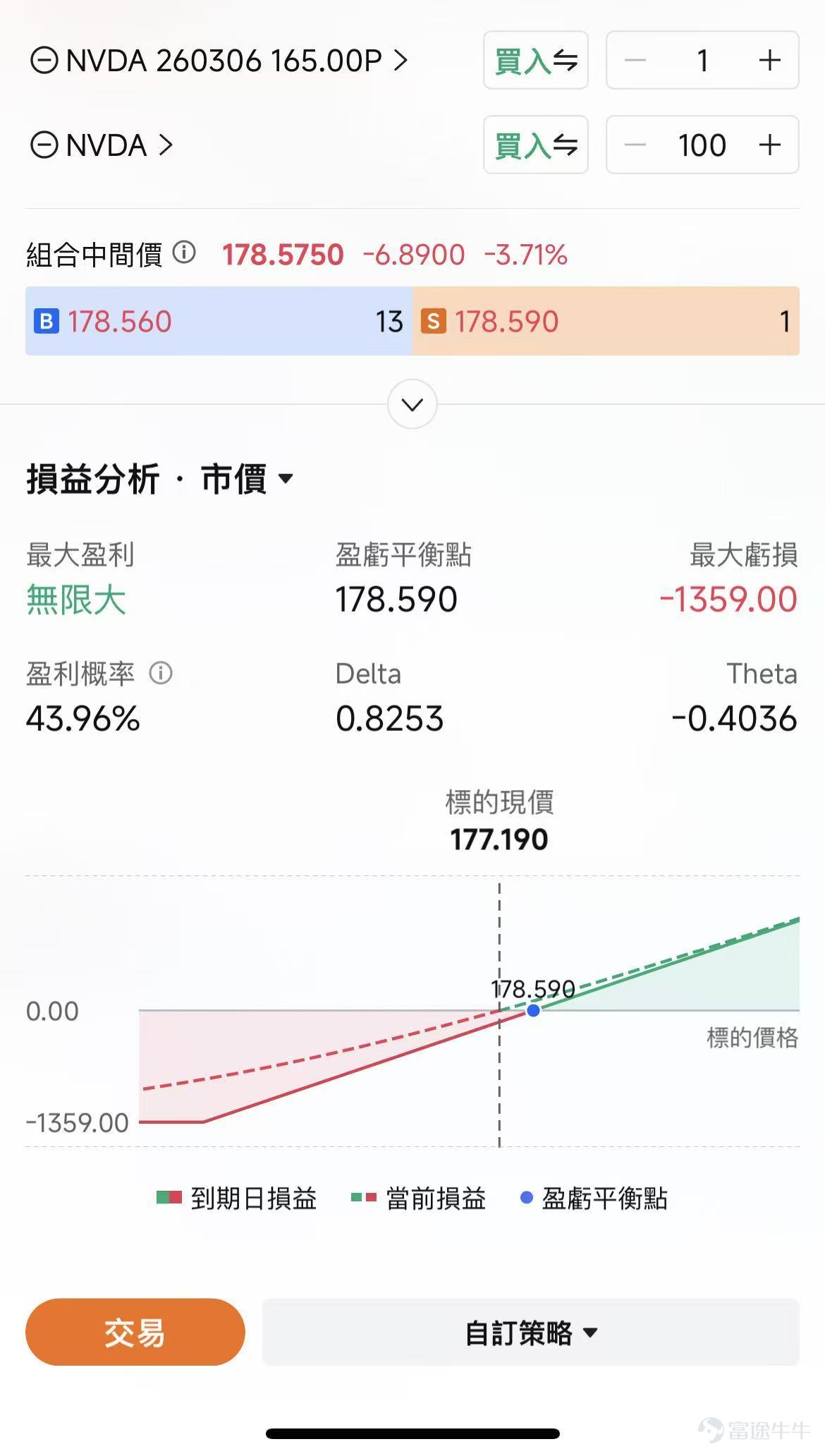
(1) For investors holding tech/growth stock positions seeking downside protection (defensive type)
– Strategy: Protective Put
– Suitable for investors: Long-term holders optimistic about technology stocks who are unwilling to reduce their positions at this moment。 $NVIDIA (NVDA.US)$ / $Advanced Micro Devices (AMD.US)$ / $Tesla (TSLA.US)$ The AI-chain assets represented, along with crypto-assets ( $Circle (CRCL.US)$ / $Strategy (MSTR.US)$ are highly sensitive to risk-free rates (inflation expectations) and risk appetite. In this environment, they may face a 'double whammy' (both valuation and sentiment hit), leading to significantly amplified volatility. This makes them a key focus area for risk hedging.
– Logic: Purchase out-of-the-money put options with a degree of moneyness around 5-10%. This is equivalent to buying 'disaster insurance' for the portfolio. At a controllable cost (premium), it protects against deep declines in technology stocks caused by upward revisions in interest rate expectations and risk aversion under an 'escalation scenario.' In a 'base scenario,' the rebound in spot prices should cover the premium loss.
*Illustrations are for explanatory purposes only and do not represent specific investment advice*
![This article is from the "Weekly Options Strategy" column, which brings fellow investors a review of last week's market, the hot topics of the week, and an analysis of potential options trading opportunities. Welcome![Share Link: Click here]Join the learning session, and you will receive notifications when new updates to the column are available. Dear fellow investors, happy Monday~ The joint US-Israeli operation resulted in the death of a senior Iranian official. Iran announced the blockade of the Strait of Hormuz, directly tying geopolitical risks to the global energy artery. Signs of oil tanker congestion have appeared on both sides of the Strait of Hormuz. The non-farm payroll report will be released at 21:30 Beijing time this Friday (March 6). This report will reveal the state of the US job market in February and is a key indicator for assessing economic momentum and the direction of Federal Reserve policy. At this moment, the market is at a critical juncture of risk reassessment. We have outlined the core logic and response strategies for you. Middle East Conflict: Traps of Consensus Trading and Scripted Game Theory The current market crisis triggered by the joint US-Israeli military action is within a typical geopolitical risk 'observation window.' The market is entering a volatility phase dominated by 'event news flow,' with the central contradiction lying in the game between 'emotional premium under short-term limited conflict' and 'supply shock caused by long-term loss of control.' There is no direct historical script that can simply be applied to how this geopolitical situation will affect asset performance and capital flows.How long the conflict lasts and the extent of the strikes and counterattacks, "...](https://nnqimage.futunn.com/sns_client_feed/999908/20260302/web-1772440871311-xgc3GHD4Ah.jpeg/big?area=2&is_public=true&imageMogr2/ignore-error/1/format/webp)
(2) For investors optimistic about ongoing event developments seeking short-term directional gains (aggressive)
– Suitable for investors: Active traders with strong risk tolerance and the ability to closely track event progress.
– Strategy: Directly buy call options on beneficiary stocks. Leverage high-risk bets on events evolving in a single direction. The risk is extremely high, making it a purely short-term trading tool requiring strict stop-loss settings. Alternatively, use a Bull Call Spread to maintain a bullish stance while limiting losses.
– Directional long: Gold ( $SPDR Gold ETF (GLD.US)$ ) is the preferred hedge against geopolitical risks.Energy (oil and gas extraction, oil services) is theThe most direct pricing target ( $Occidental Petroleum (OXY.US)$ / $Exxon Mobil (XOM.US)$ / $Chevron (CVX.US)$ , tanker shipping owners will directly benefit from the potential increase in sailing distances due to Cape of Good Hope rerouting and skyrocketing freight rates ( $Frontline (FRO.US)$$DHT Holdings (DHT.US)$ ). The deterioration of regional security will reinforce expectations of rigid global defense spending, especially in Europe and East Asia, benefiting major defense contractors ( $RTX Corp (RTX.US)$ / $Lockheed Martin (LMT.US)$/ $Palantir (PLTR.US)$ ). For short-term out-of-the-money call options on related assets, choose industry leaders with good liquidity and full exposure to industry beta.
*Illustrations are for explanatory purposes only and do not represent specific investment advice*
![This article is from the "Weekly Options Strategy" column, which brings fellow investors a review of last week's market, the hot topics of the week, and an analysis of potential options trading opportunities. Welcome![Share Link: Click here]Join the learning session, and you will receive notifications when new updates to the column are available. Dear fellow investors, happy Monday~ The joint US-Israeli operation resulted in the death of a senior Iranian official. Iran announced the blockade of the Strait of Hormuz, directly tying geopolitical risks to the global energy artery. Signs of oil tanker congestion have appeared on both sides of the Strait of Hormuz. The non-farm payroll report will be released at 21:30 Beijing time this Friday (March 6). This report will reveal the state of the US job market in February and is a key indicator for assessing economic momentum and the direction of Federal Reserve policy. At this moment, the market is at a critical juncture of risk reassessment. We have outlined the core logic and response strategies for you. Middle East Conflict: Traps of Consensus Trading and Scripted Game Theory The current market crisis triggered by the joint US-Israeli military action is within a typical geopolitical risk 'observation window.' The market is entering a volatility phase dominated by 'event news flow,' with the central contradiction lying in the game between 'emotional premium under short-term limited conflict' and 'supply shock caused by long-term loss of control.' There is no direct historical script that can simply be applied to how this geopolitical situation will affect asset performance and capital flows.How long the conflict lasts and the extent of the strikes and counterattacks, "...](https://nnqimage.futunn.com/sns_client_feed/999908/20260302/web-1772440871736-DBdN6qbRxL.jpeg/big?area=2&is_public=true&imageMogr2/ignore-error/1/format/webp)
– Directional short: Conversely, buy short-term out-of-the-money put options on industries negatively affected, such as airlines. This is a direct bet on 'profit downgrades caused by cost shocks.' ( $United Airlines (UAL.US)$ /$Delta Air Lines (DAL.US)$ / $American Airlines (AAL.US)$ )
(3) For investors who already hold energy/defense positions and wish to lock in profits while retaining upside potential (conservative type)
– Suitable for investors: Leverage the market's panic sentiment to gradually unwind some significantly appreciated energy/defense trading positions and consider reallocating funds to high-quality assets that have been unduly punished and have low correlation with geopolitical risks.
– Strategy:While holding the stock, you can sell out-of-the-money Call options (call warrants) as a way to take profits. If the stock price does not rise above the strike price, there is no need to exercise the option to sell the underlying stock, and you can collect the premium. However, if the stock price rises above that level, you will lose the additional gains that the underlying stock might have brought.
Non-farm data will be released on Friday; under the shadow of geopolitical tensions, the economic 'thermometer' approaches again—how will the US stock market respond?
The non-farm payroll report will be released at 21:30 Beijing time this Friday (March 6).This report will reveal the state of the US job market in February and serve as a key reference for assessing economic momentum and the Federal Reserve’s policy direction.
The recent escalation of geopolitical tensions in the Middle East following the assassination of Iran's supreme leader has become a major uncertainty disrupting global markets, potentially influencing market risk appetite this week alongside the non-farm data. The market currently expects the US to add 58,000 non-farm jobs in February, compared to 130,000 in the previous report.
![This article is from the "Weekly Options Strategy" column, which brings fellow investors a review of last week's market, the hot topics of the week, and an analysis of potential options trading opportunities. Welcome![Share Link: Click here]Join the learning session, and you will receive notifications when new updates to the column are available. Dear fellow investors, happy Monday~ The joint US-Israeli operation resulted in the death of a senior Iranian official. Iran announced the blockade of the Strait of Hormuz, directly tying geopolitical risks to the global energy artery. Signs of oil tanker congestion have appeared on both sides of the Strait of Hormuz. The non-farm payroll report will be released at 21:30 Beijing time this Friday (March 6). This report will reveal the state of the US job market in February and is a key indicator for assessing economic momentum and the direction of Federal Reserve policy. At this moment, the market is at a critical juncture of risk reassessment. We have outlined the core logic and response strategies for you. Middle East Conflict: Traps of Consensus Trading and Scripted Game Theory The current market crisis triggered by the joint US-Israeli military action is within a typical geopolitical risk 'observation window.' The market is entering a volatility phase dominated by 'event news flow,' with the central contradiction lying in the game between 'emotional premium under short-term limited conflict' and 'supply shock caused by long-term loss of control.' There is no direct historical script that can simply be applied to how this geopolitical situation will affect asset performance and capital flows.How long the conflict lasts and the extent of the strikes and counterattacks, "...](https://nnqimage.futunn.com/sns_client_feed/999908/20260302/web-1772440867760-jgC5XXrkLW.png/big?area=2&is_public=true&imageMogr2/ignore-error/1/format/webp)
Opportunity Analysis
The reason non-farm data can trigger significant market volatility is that it reshapes economic expectations and interest rate paths, directly impacting corporate profit prospects and valuation levels. For the US stock market, the quality of the data itself isn't the only factor—it's the gap between the data and market expectations, internal structural divergences, and its interplay with other economic data that collectively determine the market's ultimate reaction. Meanwhile, external geopolitical risks (such as the current situation in Iran) may amplify market fluctuations.
(1) Weak data, rate cut trades gain momentum
If the upcoming non-farm employment figure is significantly lower than market expectations, and the unemployment rate rises while wage growth slows, this will be seen as a clear signal of weakening US economic momentum. Such weakness may stem from businesses scaling back hiring due to economic uncertainties or the impact of large-scale AI adoption.
When weak data is released, it may initially hit market sentiment by triggering concerns about an economic recession, causing US stocks, especially cyclical sectors, to come under pressure and decline. If this is compounded by risk aversion due to rising tensions with Iran, selling pressure in the market could intensify in the short term.On the other hand, such concerns can also translate into expectations of a loosening in the Fed's monetary policy.
The current market expectation is that the Federal Reserve will remain 'on hold' for the next quarter and will not begin its next rate cut until June or July of this year.
![This article is from the "Weekly Options Strategy" column, which brings fellow investors a review of last week's market, the hot topics of the week, and an analysis of potential options trading opportunities. Welcome![Share Link: Click here]Join the learning session, and you will receive notifications when new updates to the column are available. Dear fellow investors, happy Monday~ The joint US-Israeli operation resulted in the death of a senior Iranian official. Iran announced the blockade of the Strait of Hormuz, directly tying geopolitical risks to the global energy artery. Signs of oil tanker congestion have appeared on both sides of the Strait of Hormuz. The non-farm payroll report will be released at 21:30 Beijing time this Friday (March 6). This report will reveal the state of the US job market in February and is a key indicator for assessing economic momentum and the direction of Federal Reserve policy. At this moment, the market is at a critical juncture of risk reassessment. We have outlined the core logic and response strategies for you. Middle East Conflict: Traps of Consensus Trading and Scripted Game Theory The current market crisis triggered by the joint US-Israeli military action is within a typical geopolitical risk 'observation window.' The market is entering a volatility phase dominated by 'event news flow,' with the central contradiction lying in the game between 'emotional premium under short-term limited conflict' and 'supply shock caused by long-term loss of control.' There is no direct historical script that can simply be applied to how this geopolitical situation will affect asset performance and capital flows.How long the conflict lasts and the extent of the strikes and counterattacks, "...](https://nnqimage.futunn.com/sns_client_feed/999908/20260302/web-1772440871312-zd1MFZOlWU.png/big?area=2&is_public=true&imageMogr2/ignore-error/1/format/webp)
Data source: CME FedWatch. Data as of March 2, 2026.
If inflation data does not show a significant upward trend during this period, the Fed’s rate-cut timeline is likely to be moved forward. Historical experience shows that preventive rate cuts when the economy is not in a recession often benefit the stock market by reducing corporate financing costs and increasing the discounted value of future cash flows.
(2) Strong data highlights economic resilience.
If non-farm payroll data once again far exceeds expectations like it did in January, strong data will weaken the market's bet on Fed rate cuts, and expectations that interest rates will remain higher for longer will dominate. In the short term, US stocks may experience 'hawkish volatility,' meaning indices are pressured by expectations of tighter monetary policy, but there will be significant internal divergence.
![This article is from the "Weekly Options Strategy" column, which brings fellow investors a review of last week's market, the hot topics of the week, and an analysis of potential options trading opportunities. Welcome![Share Link: Click here]Join the learning session, and you will receive notifications when new updates to the column are available. Dear fellow investors, happy Monday~ The joint US-Israeli operation resulted in the death of a senior Iranian official. Iran announced the blockade of the Strait of Hormuz, directly tying geopolitical risks to the global energy artery. Signs of oil tanker congestion have appeared on both sides of the Strait of Hormuz. The non-farm payroll report will be released at 21:30 Beijing time this Friday (March 6). This report will reveal the state of the US job market in February and is a key indicator for assessing economic momentum and the direction of Federal Reserve policy. At this moment, the market is at a critical juncture of risk reassessment. We have outlined the core logic and response strategies for you. Middle East Conflict: Traps of Consensus Trading and Scripted Game Theory The current market crisis triggered by the joint US-Israeli military action is within a typical geopolitical risk 'observation window.' The market is entering a volatility phase dominated by 'event news flow,' with the central contradiction lying in the game between 'emotional premium under short-term limited conflict' and 'supply shock caused by long-term loss of control.' There is no direct historical script that can simply be applied to how this geopolitical situation will affect asset performance and capital flows.How long the conflict lasts and the extent of the strikes and counterattacks, "...](https://nnqimage.futunn.com/sns_client_feed/999908/20260302/web-1772440871311-yjB0bs1f8O.png/big?area=2&is_public=true&imageMogr2/ignore-error/1/format/webp)
In this scenario, funds may rotate from highly valued growth stocks to sectors such as finance, consumer staples, and healthcare.
Additionally, there is a neutral scenario: where the data is largely in line with expectations. In this case, the market has already priced in most of the information, and the report itself is unlikely to substantially change the existing policy narrative, while developments in geopolitical events may dominate short-term market fluctuations.
Options strategy
Last Friday’s escalation of US-Iran tensions has already increased market volatility. As of last Friday’s close, SPY's implied volatility (IV) stood at 19.47%, which is at the 70th percentile over the past year, while QQQ’s IV was 24.32%, at the 72nd percentile.The relatively high 'volatility premium' indicates that the market is willing to pay a higher premium for future uncertainty.
In terms of trading volume, $SPDR S&P 500 ETF (SPY.US)$ and $Invesco QQQ Trust (QQQ.US)$ the Put/Call Ratio has remained above 1 recently, showing strong market demand for buying Puts either as protection or due to bearish sentiment.Since the substantive attack by the US and Israel on Iran began last Saturday, market volatility is expected to increase further this week.
(1) Using small bets for potentially large gains, following the trend
Investors with higher risk appetites can leverage developments in geopolitical events and economic data this week, to buy short-term options expiring on the same day, utilizing the leverage characteristics of options to seek profits amidst high market volatility. Investors need to time their entry well and maintain strong stop-loss discipline.
(2) Buy 'insurance' for current holdings
If your current position is heavy and you are concerned about market turbulence but do not want to exit at a loss, consider buyingProtective Put.It is a straightforward and effective 'insurance' strategy. The core of this strategy is to pay a premium (insurance fee) to lock in the downside risk of the underlying asset while retaining the potential for medium- to long-term appreciation of the asset.
For example, while holding 100 shares of SPY, buy one corresponding Put option.
If the stock price rises: the spot position profits, the Put option expires worthless, and the loss is limited to the premium paid. Total profit = gain from stock price increase - premium paid.
If the stock price falls: the spot position incurs a loss, but the Put option gains value. The total loss is capped at (strike price - stock purchase price - premium cost), resulting in limited maximum loss.
It should be noted that if the market remains calm after the non-farm payroll data and the situation in Iran does not worsen, implied volatility (IV) may quickly decline. Even if the stock price remains unchanged, the premium of the Put option may depreciate due to negative Vega, causing a paper loss on the 'insurance' itself.
Broadcom Earnings Report Incoming: Can the Stock Break Through?
$Broadcom (AVGO.US)$ Broadcom will release its fiscal first-quarter 2026 earnings report after the market closes on March 4. The key focus of the current market is on the company's ability to deliver results under high expectations.Due to high growth expectations such as a doubling of AI semiconductor revenue being fully priced in, the stock's technical picture is under pressure, with options implied volatility remaining elevated.As of this writing, the stock has retraced approximately 24% from its historical high of $412.8 to $313.89.
The market consensus expects revenue for this quarter to increase by 28.14% year-over-year to $19.113 billion, with earnings per share (EPS) rising by 22.58% year-over-year to $1.397. However, given that the stock price fell 11% after last quarter's results, which exceeded expectations across the board, due to backlog orders not reaching 'extreme frenzy' levels and margin pressure warnings, investors should be cautious:If this earnings report merely 'meets expectations,' it could trigger a 'sell-the-news' type of pullback. Only significantly better-than-expected data or more optimistic forward guidance from management is likely to push the stock price out of its current range-bound trading zone.
The market's main focus is on the following three aspects:
(1) Upside potential in AI guidance and progress with new clients: Last quarter, the company projected that AI semiconductor revenue for the first quarter of fiscal 2026 would double year-over-year. Against the backdrop of robust macro spending, the market will watch whether management quantifies further growth potential for AI revenue throughout fiscal 2026 and the sustainability of orders from major clients like Anthropic. Beyond core client Google, the market is eager to understand the contribution from new clients and specific mass production timelines.
(2) Margin trends: Attention must be paid to the potential dilutive effect on overall gross margins caused by rapid scaling of custom businesses, and whether high-margin software business scale effects can effectively offset this impact.
(3) Resilience of software business: The key focus is on growth stability and customer retention rates post-VMware integration. A potential risk point is that VMware’s customer churn rate may rise over the next couple of years as three-year contracts expire. Additionally, management’s stance and response to market concerns about 'AI potentially disrupting enterprise software businesses' will also be crucial.
Opportunity Analysis
Technicals show a pullback from highs, entering a key support area.Most indicators show that the short-term trend is weak or entering the oversold zone. The stock price has broken below all major moving averages (MA5/10/20/30/60) and is approaching the vicinity of the 200-day moving average, with the moving averages showing a bearish alignment.
On the eve of the earnings report, the options' implied volatility (IV) has surged to63.5% approximately, with the IV percentile reaching as high as92%, which is at a relatively high level over the past year. The options market is pricing in a one-day stock price fluctuation of ±8.79% after the earnings release. Broadcom's historical post-earnings stock price movements have exceeded market expectations in five out of the last eight quarters. Recently, the ratio of put to call open interest has been hovering around 1, reflecting a tug-of-war between bullish and bearish forces.
Based on the open interest distribution across the nearest four option expiration dates, call options are mainly concentrated at the $310/$350 strike prices, with the max pain point for the March 6 expiration being $310.
![This article is from the "Weekly Options Strategy" column, which brings fellow investors a review of last week's market, the hot topics of the week, and an analysis of potential options trading opportunities. Welcome![Share Link: Click here]Join the learning session, and you will receive notifications when new updates to the column are available. Dear fellow investors, happy Monday~ The joint US-Israeli operation resulted in the death of a senior Iranian official. Iran announced the blockade of the Strait of Hormuz, directly tying geopolitical risks to the global energy artery. Signs of oil tanker congestion have appeared on both sides of the Strait of Hormuz. The non-farm payroll report will be released at 21:30 Beijing time this Friday (March 6). This report will reveal the state of the US job market in February and is a key indicator for assessing economic momentum and the direction of Federal Reserve policy. At this moment, the market is at a critical juncture of risk reassessment. We have outlined the core logic and response strategies for you. Middle East Conflict: Traps of Consensus Trading and Scripted Game Theory The current market crisis triggered by the joint US-Israeli military action is within a typical geopolitical risk 'observation window.' The market is entering a volatility phase dominated by 'event news flow,' with the central contradiction lying in the game between 'emotional premium under short-term limited conflict' and 'supply shock caused by long-term loss of control.' There is no direct historical script that can simply be applied to how this geopolitical situation will affect asset performance and capital flows.How long the conflict lasts and the extent of the strikes and counterattacks, "...](https://nnqimage.futunn.com/sns_client_feed/999908/20260302/web-1772440871497-emVvqyslWa.png/big?area=2&is_public=true&imageMogr2/ignore-error/1/format/webp)
Options strategy
(1) Short Volatility: Selling an Iron Condor Spread:
– Applicable Scenario: Expecting that the stock price will oscillate within a wider range after earnings but without extreme one-sided moves. The core objective is to profit from the decay of high implied volatility (IV Crush) after the event.
– Action: Simultaneously sell a call spread and a put spread close to the current market price to create a profitable range. For example, a combination could be constructed as 'buy 305 puts, sell 315 puts / sell 325 calls, buy 335 calls'.
– Logic: This is a classic event-driven strategy. Regardless of whether the stock price rises or falls after earnings, as long as it ends within the preset upper and lower bounds, the sold options will expire worthless, allowing investors to collect the full premium. The risk lies in the potential for significant unexpected surges or crashes in the stock price, which would trigger assignment risk for the seller, but the purchased far-out options act as 'insurance,' capping the maximum loss.
The illustration is for explanatory purposes only and does not represent specific investment advice.
![This article is from the "Weekly Options Strategy" column, which brings fellow investors a review of last week's market, the hot topics of the week, and an analysis of potential options trading opportunities. Welcome![Share Link: Click here]Join the learning session, and you will receive notifications when new updates to the column are available. Dear fellow investors, happy Monday~ The joint US-Israeli operation resulted in the death of a senior Iranian official. Iran announced the blockade of the Strait of Hormuz, directly tying geopolitical risks to the global energy artery. Signs of oil tanker congestion have appeared on both sides of the Strait of Hormuz. The non-farm payroll report will be released at 21:30 Beijing time this Friday (March 6). This report will reveal the state of the US job market in February and is a key indicator for assessing economic momentum and the direction of Federal Reserve policy. At this moment, the market is at a critical juncture of risk reassessment. We have outlined the core logic and response strategies for you. Middle East Conflict: Traps of Consensus Trading and Scripted Game Theory The current market crisis triggered by the joint US-Israeli military action is within a typical geopolitical risk 'observation window.' The market is entering a volatility phase dominated by 'event news flow,' with the central contradiction lying in the game between 'emotional premium under short-term limited conflict' and 'supply shock caused by long-term loss of control.' There is no direct historical script that can simply be applied to how this geopolitical situation will affect asset performance and capital flows.How long the conflict lasts and the extent of the strikes and counterattacks, "...](https://nnqimage.futunn.com/sns_client_feed/999908/20260302/web-1772440871738-VVgozjwMXT.png/big?area=2&is_public=true&imageMogr2/ignore-error/1/format/webp)
(2) Bullish long-term outlook and looking to build a position at lower levels: Sell cash-secured put options.:
– Applicable Scenario: Bullish on Broadcom over the long term, willing to accumulate shares at a lower price while aiming to generate returns in a volatile or rising market.
– Action: Sell out-of-the-money put options (for instance, near support levels or at a 15-25% discount to the current price) to collect substantial premiums due to high implied volatility (IV). If the stock price does not drop after earnings, the entire premium is retained; if the stock falls below the strike price, shares are acquired at the target price.
– Logic: Profit from high IV. The current technicals indicate an oversold condition with underlying support, making it relatively unlikely for the price to fall significantly below the strike price.
(3) For conservative bullish investors: Bull call spread strategy.
– Applicable Scenario: Belief that the long-term upward trend in AI hardware remains intact, aiming to capitalize on a rebound in share price using a cost-controlled approach.
– Action: Buy a call option with a lower strike price while simultaneously selling a call option with a higher strike price of the same quantity. For example, construct a combination such as 'buy 305 call options and sell 385 call options'.
– LogicBy selling options, part of the premium cost was offset, lowering the breakeven point and hedging against some risks associated with IV (implied volatility) decline. The downside is that the potential profit cap is locked. The main risk is that the entire net premium paid may be lost.
The illustration is for explanatory purposes only and does not represent specific investment advice.
![This article is from the "Weekly Options Strategy" column, which brings fellow investors a review of last week's market, the hot topics of the week, and an analysis of potential options trading opportunities. Welcome![Share Link: Click here]Join the learning session, and you will receive notifications when new updates to the column are available. Dear fellow investors, happy Monday~ The joint US-Israeli operation resulted in the death of a senior Iranian official. Iran announced the blockade of the Strait of Hormuz, directly tying geopolitical risks to the global energy artery. Signs of oil tanker congestion have appeared on both sides of the Strait of Hormuz. The non-farm payroll report will be released at 21:30 Beijing time this Friday (March 6). This report will reveal the state of the US job market in February and is a key indicator for assessing economic momentum and the direction of Federal Reserve policy. At this moment, the market is at a critical juncture of risk reassessment. We have outlined the core logic and response strategies for you. Middle East Conflict: Traps of Consensus Trading and Scripted Game Theory The current market crisis triggered by the joint US-Israeli military action is within a typical geopolitical risk 'observation window.' The market is entering a volatility phase dominated by 'event news flow,' with the central contradiction lying in the game between 'emotional premium under short-term limited conflict' and 'supply shock caused by long-term loss of control.' There is no direct historical script that can simply be applied to how this geopolitical situation will affect asset performance and capital flows.How long the conflict lasts and the extent of the strikes and counterattacks, "...](https://nnqimage.futunn.com/sns_client_feed/999908/20260302/web-1772440869517-ApOhfHEuK5.png/big?area=2&is_public=true&imageMogr2/ignore-error/1/format/webp)
Futu Securities Analyst Xu Anyu
CE: BWS681
(The author is a licensed person regulated by the SEC, and neither they nor their associates hold any financial interest in the recommended stock issuer.)
Finally, here's a small perk for fellow investors—welcome to claim it!Options Beginner Pack
This event is exclusively for invited HK users, click to learn moreDetailed event rules >>
Futu's simulated trading challenge is now open for registration! Zero cost, zero risk, and you can win stock cash vouchers!Click to learn more
![This article is from the "Weekly Options Strategy" column, which brings fellow investors a review of last week's market, the hot topics of the week, and an analysis of potential options trading opportunities. Welcome![Share Link: Click here]Join the learning session, and you will receive notifications when new updates to the column are available. Dear fellow investors, happy Monday~ The joint US-Israeli operation resulted in the death of a senior Iranian official. Iran announced the blockade of the Strait of Hormuz, directly tying geopolitical risks to the global energy artery. Signs of oil tanker congestion have appeared on both sides of the Strait of Hormuz. The non-farm payroll report will be released at 21:30 Beijing time this Friday (March 6). This report will reveal the state of the US job market in February and is a key indicator for assessing economic momentum and the direction of Federal Reserve policy. At this moment, the market is at a critical juncture of risk reassessment. We have outlined the core logic and response strategies for you. Middle East Conflict: Traps of Consensus Trading and Scripted Game Theory The current market crisis triggered by the joint US-Israeli military action is within a typical geopolitical risk 'observation window.' The market is entering a volatility phase dominated by 'event news flow,' with the central contradiction lying in the game between 'emotional premium under short-term limited conflict' and 'supply shock caused by long-term loss of control.' There is no direct historical script that can simply be applied to how this geopolitical situation will affect asset performance and capital flows.How long the conflict lasts and the extent of the strikes and counterattacks, "...](https://nnqimage.futunn.com/sns_client_feed/999908/20260302/web-1772441793942-iT3l9uBUhf.png/big?area=2&is_public=true&imageMogr2/ignore-error/1/format/webp)
Disclaimer
This content does not constitute any offer, solicitation, recommendation, opinion, or guarantee of any securities, financial products, or tools. The risk of loss in buying and selling options can be substantial. In some cases, your losses may exceed the initial margin amount deposited. Even if you set contingent orders, such as 'stop-loss' or 'limit' orders, these may not necessarily prevent losses. Market conditions may make these orders unexecutable. You might be required to deposit additional margin within a short period. If you fail to provide the required amount within the specified time, your open positions may be liquidated. However, you will still be responsible for any account deficit arising from this. Therefore, before trading, you should study and understand options and carefully consider whether such trading suits you based on your financial situation and investment objectives. If you trade options, you should be familiar with the procedures upon exercising options and at expiration, as well as your rights and obligations when exercising options and at expiration.
Risk Disclaimer: The above content only represents the author's view. It does not represent any position or investment advice of Futu. Futu makes no representation or warranty.Read more


Comments (219)
to post a comment
309
39