
From 1.6 million to 880,000 shares: Analysis of the 40% drop in street holdings of BYD (1211) over four days and the implications for capital movement
After experiencing a round of pullback in late February, BYD's (01211) share price has shown initial signs of stabilization above a key support level, with multiple technical indicators issuing a 'strong buy' signal. This article will analyze the short-term trend, key support and resistance levels of BYD, as well as provide an in-depth explanation on how to use warrants and bull/bear certificates for precise deployment, based on the latest market dynamics as of March 2, 2026, technical analysis data, and professional insights from [HK Stock Podcast].
From a technical perspective, BYD closed at HKD 97.68 on February 27, with the share price currently situated within the convergence zone of several important moving averages: the 10-day line is at HKD 97.68, the 30-day line at HKD 97.06, and the 60-day line at HKD 96.82. The entangled state of the moving average system reflects that the market's average cost is similar, indicating a critical moment for direction selection.
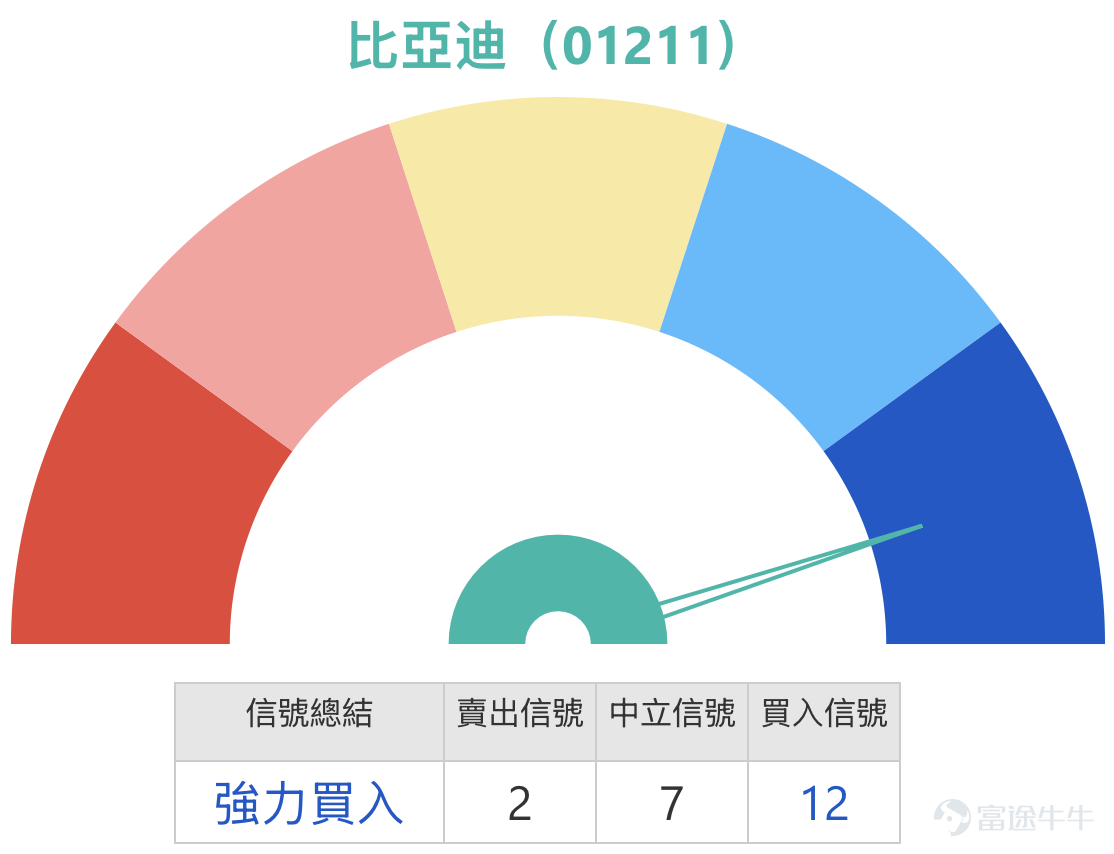
Based on the provided data analysis, the short-term support level for this stock is clearly set at HKD 91.7, with a more critical defensive area at HKD 87.4. In terms of resistance, the first threshold lies at HKD 98.6; if it can successfully break through and stabilize above this level, the next target will be HKD 102.5. The probability of an upward move is 0.53, with a 5-day volatility of 7.9%, indicating sufficient fluctuation space for short-term trading opportunities. Most notably, the summarized technical indicator signal is 'strong buy' with an intensity score of 12, where the stochastic oscillator indicates 'oversold region, buy,' and the VR trading ratio also shows 'oversold, possible bottoming, buy.' The CCI indicator similarly issues a buy signal, with multiple oscillators pointing to a bottoming region, providing strong technical support for a short-term rebound.
Observing from the market news perspective, BYD's recently announced production and sales data for February has become a focal point for market attention. The company’s announcement shows that in February 2026, new energy vehicle sales were approximately 190,200 units, a year-on-year increase of 15.27%. However, another set of data indicates that compared to the same period last year, cumulative new energy vehicle sales for the first two months were about 400,200 units, representing a year-on-year decline of 35.8%. This data needs to be interpreted considering the industry context: factors such as the Spring Festival holiday and fewer effective sales days have generally pressured domestic auto terminal retail sales in February, with many automakers seeing a month-on-month drop in sales. BYD’s performance demonstrates resilience in delivery volume typical of leading companies. Notably, the company’s total export of new energy vehicles in February amounted to 100,600 units, with a total installed capacity of power batteries and energy storage batteries reaching approximately 18.773 GWh, highlighting the growth momentum in overseas market expansion and battery business, which deserves attention.
In terms of institutional views, one investment bank has given a buy rating in the past 90 days, with an average target price of HKD 134.7. First Shanghai's latest research report gives BYD a buy rating with a target price of HKD 134.7. These major bank views provide fundamental backing for BYD's medium- to long-term trend.
![After experiencing a round of pullback in late February, BYD's (01211) share price has shown initial signs of stabilization above a key support level, with multiple technical indicators issuing a 'strong buy' signal. This article will analyze the short-term trend, key support and resistance levels of BYD, as well as provide an in-depth explanation on how to use warrants and bull/bear certificates for precise deployment, based on the latest market dynamics as of March 2, 2026, technical analysis data, and professional insights from [HK Stock Podcast]. From a technical perspective, BYD closed at HKD 97.68 on February 27, with the share price currently situated within the convergence zone of several important moving averages: the 10-day line is at HKD 97.68, the 30-day line at HKD 97.06, and the 60-day line at HKD 96.82. The entangled state of the moving average system reflects that the market's average cost is similar, indicating a critical moment for direction selection. Based on the provided data analysis, the short-term support level for this stock is clearly set at HKD 91.7, with a more critical defensive area at HKD 87.4. In terms of resistance, the first threshold lies at HKD 98.6; if it can successfully break through and stabilize above this level, the next target will be HKD 102.5. The probability of an upward move is 0.53, with a 5-day volatility of 7.9%, indicating sufficient fluctuation space for short-term trading opportunities. Most notably, the summarized technical indicator signal is 'strong buy' with an intensity score of 12, where the stochastic oscillator indicates 'oversold region, buy,' and the VR trading ratio also shows 'oversold, possible bottoming, buy.' The CCI indicator similarly issues a buy signal, with multiple oscillators pointing to a bottoming region, providing strong technical support for a short-term rebound.](https://nnqimage.futunn.com/sns_client_feed/1162342/20260302/web-1772424732018-nSbckiSCel.png/big?area=1&is_public=true&imageMogr2/ignore-error/1/format/webp)
In the February 11 episode of [Hong Kong Stock Podcast], host Simon provided an in-depth analysis of BYD's stock movement. He noted that BYD’s share price had briefly touched HKD 100, and investors were closely watching whether it could stabilize above this level and further challenge the target of HKD 110. From a technical perspective, Simon pointed out that to reach HKD 110, two key resistance levels must be breached: the immediate short-term resistance at HKD 103.1, followed by a potential rise to HKD 108.1 en route to the HKD 110 target. For investors optimistic about deploying call warrants, Simon emphasized that products with a strike price around HKD 106 expiring in August are preferable. These products offer a leverage of up to 5.2 times with only a 7.9% out-of-the-money (OTM) level, making their terms relatively suitable. Meanwhile, products with strike prices around HKD 110 or HKD 112 have more options but suffer from issues such as exceeding 10% OTM levels and expiration in April, leading to higher time decay for short-term maturities, which he advised against. Simon's core view is that selecting call warrants should prioritize longer-dated products, as they experience lower time decay, effectively reducing value erosion for warrant holders.
Reviewing the performance of four BYD-related products mentioned on February 25 over the following two trading days clearly illustrates the correlation between derivatives and the underlying stock’s movement. The Societe Generale bear contract (57764) and UBS Group bear contract (63979) $UB#BYD RP2809A.P (63979.HK)$ , against the backdrop of a 3.85% drop in the underlying stock over two days, recorded increases of 40% and 35%, respectively; while the UBS put warrant (22314) $UB-BYD @EP2608A.P (22314.HK)$and Bank of China put warrant (22386)$BI-BYD @EP2608A.P (22386.HK)$ rose by 14% and 19%, respectively. This case vividly demonstrates the leveraged nature of derivatives: when investors accurately predict market direction, bear contracts and put warrants can deliver returns significantly higher than the underlying stock—multiples or even tenfold of the stock’s decline. More importantly, these products allow investors to hedge or take bearish positions with less capital, without needing to sell the underlying shares.
![After experiencing a round of pullback in late February, BYD's (01211) share price has shown initial signs of stabilization above a key support level, with multiple technical indicators issuing a 'strong buy' signal. This article will analyze the short-term trend, key support and resistance levels of BYD, as well as provide an in-depth explanation on how to use warrants and bull/bear certificates for precise deployment, based on the latest market dynamics as of March 2, 2026, technical analysis data, and professional insights from [HK Stock Podcast]. From a technical perspective, BYD closed at HKD 97.68 on February 27, with the share price currently situated within the convergence zone of several important moving averages: the 10-day line is at HKD 97.68, the 30-day line at HKD 97.06, and the 60-day line at HKD 96.82. The entangled state of the moving average system reflects that the market's average cost is similar, indicating a critical moment for direction selection. Based on the provided data analysis, the short-term support level for this stock is clearly set at HKD 91.7, with a more critical defensive area at HKD 87.4. In terms of resistance, the first threshold lies at HKD 98.6; if it can successfully break through and stabilize above this level, the next target will be HKD 102.5. The probability of an upward move is 0.53, with a 5-day volatility of 7.9%, indicating sufficient fluctuation space for short-term trading opportunities. Most notably, the summarized technical indicator signal is 'strong buy' with an intensity score of 12, where the stochastic oscillator indicates 'oversold region, buy,' and the VR trading ratio also shows 'oversold, possible bottoming, buy.' The CCI indicator similarly issues a buy signal, with multiple oscillators pointing to a bottoming region, providing strong technical support for a short-term rebound.](https://nnqimage.futunn.com/sns_client_feed/1162342/20260302/web-1772424751796-2oQjIhZeJU.png/big?area=1&is_public=true&imageMogr2/ignore-error/1/format/webp)
Observing the latest street-level open interest data, BYD-related derivatives showed signs of profit-taking or rollover activity during the period from February 24 to February 27. Data indicates that open interest fell consecutively from a high of 1.6 million contracts on the 24th to 885,000 contracts on the 27th, with a cumulative decrease of over 40%. Meanwhile, although trading volume exceeded 40 million contracts on both the 25th and 26th, buying and selling volumes by market makers remained largely balanced, indicating that the market did not overwhelmingly favor adding positions. Instead, traders tended to close positions or adjust strategies amid stock volatility. Open interest as a percentage of total also retreated from 3.9% to a healthy 2.21%, suggesting reduced pressure from accumulated short-term profits. If the stock successfully breaks through the HKD 98.6 resistance, the current low open interest may provide room for new inflows.
Based on the assessment that BYD's share price is currently at a key support level and technical indicators are signaling strong buy signals, investors can deploy products in both bullish and bearish directions, but need to closely integrate term analysis with the stock’s technical levels.
Product selection for bullish direction
If investors believe that BYD can stabilize above the HKD 91.7 support level and successfully challenge resistances at HKD 98.6 or even HKD 102.5, they can consider the following two call warrants. First is HSBC’s call warrant (23658), offering 8.2 times leverage with a strike price set at HKD 99.16. This is a slightly out-of-the-money product with a strike price marginally above the current stock price, ideal for those expecting a breakout above the HKD 98.6 resistance and targeting HKD 102.5 or higher. Its standout feature is that both its premium and implied volatility are the lowest among similar products in the market, meaning its price is less affected by changes in implied volatility, making it relatively 'cheap' with transparent investment costs. When choosing this product, investors can target HKD 98.6 first and look toward HKD 102.5 upon a successful breakout.
Another option is UBS Group's call warrant (23812), providing 7.8 times leverage with the same strike price of HKD 99.16 and a relatively low premium. This product’s leverage is comparable to HSBC’s, with similar terms, offering investors an alternative issuer choice. Both call warrants have strike prices of HKD 99.16, approximately 1.5% above the current stock price of HKD 97.68, representing a moderate OTM level. They offer desirable leverage without demanding excessive upside, aligning well with technical resistances at HKD 98.6 and HKD 102.5.
For investors bullish on a rebound but seeking more direct price sensitivity, bull contracts can be considered. UBS Group’s bull contract (54544) has a stop-loss level set at HKD 88, offering 10.6 times actual leverage with low premiums and a buffer zone of about HKD 9.7 between the stop-loss and current price. The stop-loss is set above the critical support of HKD 87.4, providing a relatively safe operational range. Another option is J.P. Morgan’s bull contract (64840) with a stop-loss at HKD 88.2, offering higher actual leverage of 10.8 times and the lowest premium, making it highly sensitive to rebounds. When choosing bull contracts, the key is to focus on the distance between the stop-loss and current price. A stop-loss around HKD 88 is below the short-term support of HKD 91.7, offering sufficient cushion for short-term rebounds.
![After experiencing a round of pullback in late February, BYD's (01211) share price has shown initial signs of stabilization above a key support level, with multiple technical indicators issuing a 'strong buy' signal. This article will analyze the short-term trend, key support and resistance levels of BYD, as well as provide an in-depth explanation on how to use warrants and bull/bear certificates for precise deployment, based on the latest market dynamics as of March 2, 2026, technical analysis data, and professional insights from [HK Stock Podcast]. From a technical perspective, BYD closed at HKD 97.68 on February 27, with the share price currently situated within the convergence zone of several important moving averages: the 10-day line is at HKD 97.68, the 30-day line at HKD 97.06, and the 60-day line at HKD 96.82. The entangled state of the moving average system reflects that the market's average cost is similar, indicating a critical moment for direction selection. Based on the provided data analysis, the short-term support level for this stock is clearly set at HKD 91.7, with a more critical defensive area at HKD 87.4. In terms of resistance, the first threshold lies at HKD 98.6; if it can successfully break through and stabilize above this level, the next target will be HKD 102.5. The probability of an upward move is 0.53, with a 5-day volatility of 7.9%, indicating sufficient fluctuation space for short-term trading opportunities. Most notably, the summarized technical indicator signal is 'strong buy' with an intensity score of 12, where the stochastic oscillator indicates 'oversold region, buy,' and the VR trading ratio also shows 'oversold, possible bottoming, buy.' The CCI indicator similarly issues a buy signal, with multiple oscillators pointing to a bottoming region, providing strong technical support for a short-term rebound.](https://nnqimage.futunn.com/sns_client_feed/1162342/20260302/web-1772424810467-e4nPv0zDuM.png/big?area=1&is_public=true&imageMogr2/ignore-error/1/format/webp)
Options for bearish positions
For investors concerned that the stock price may fail to break through the resistance level at 98.6 yuan or might retest lower support levels after a short-term rebound, put warrants and bear contracts can be considered. The BOC Put Warrant (23995) offers 2.9x leverage with an exercise price of 90 yuan. Its key feature is having the lowest premium among similar products, making it suitable for those who are bearish on the underlying stock and looking to capture declines towards support levels at 91.7 yuan or even 87.4 yuan. This product’s exercise price is below the current stock price, classifying it as an in-the-money put warrant, which provides higher sensitivity to downward movements and directly reflects share price declines.
For aggressive short-term bears expecting sustained pressure on the stock price, bear contracts serve as higher-leverage tools. The UBS Bear Contract (63979) has a call price of 106 yuan, offering 8.5x effective leverage with low premium. Its call price is set above the resistance level of 102.5 yuan, effectively avoiding risks from short-term rebounds. The Societe Generale Bear Contract (57764), also with a call price of 106 yuan, offers 8.4x effective leverage and relatively low premium. These two products align with Simon's strategy recommended in the February 11 [HK Stocks Podcast] to choose products with call prices above 105 yuan, minimizing risks of being called due to stock price rebounds. When deploying bear contracts, consider 91.7 yuan and 87.4 yuan support levels as target references, and gradually take profits or adjust positions when the stock approaches these levels.
Investing in CBBCs and bull/bear certificates essentially involves comprehensive judgment on the direction, volatility, and timing of the underlying stock. The advantage lies in allowing investors to choose products with different terms based on their risk tolerance and precise market outlook. However, it is crucial to remember that leverage is a double-edged sword—it amplifies returns but also accelerates losses. Additionally, bull/bear certificates have a mandatory recall mechanism. Before deployment, fully understand the product terms and associated risks, especially the concept of 'premium' analyzed in this article, which should be an important reference metric when selecting products.
Overall, under the backdrop of strong buy signals from technical indicators, BYD is brewing opportunities for a short-term rebound. The stock price is currently in a tug-of-war around the resistance level at 98.6 yuan; a successful breakout could open up upside potential to 102.5 yuan. The 91.7 yuan level serves as key short-term support, holding this position could extend the rebound momentum. However, investors should be mindful of differing interpretations of February sales data and the overall sentiment in the auto sector. Investors should select appropriate tools—whether bullish or bearish—based on their risk tolerance, strictly set stop-losses, and dynamically observe product terms alongside critical price levels of the underlying stock.
Interactive Question:
Do you think BYD's current rebound will successfully break through the resistance level at 98.6 yuan and stabilize? Or will it retest the support level at 91.7 yuan?
When deploying call warrants, would you prioritize products with lower premiums (e.g., 23658) or those with higher leverage? Feel free to share your thoughts in the comments.
Reminder: This article does not constitute any investment advice.
This article is for reference only and does not constitute any investment advice. The market data, opinions, and analysis contained herein may change at any time without prior notice. We are not responsible for any loss or damage caused by reliance on the information in this article. Technical analysis only shows whether certain technical conditions are met; a comprehensive assessment of asset performance should combine other data and should not solely rely on this article to make trading decisions. Please note that past performance is not indicative of future results. Follow Jenny's insights on Hong Kong stock warrants for more professional analysis.
#BYD #01211 #HongKongStocks #TechnicalAnalysis #Warrants #BullBearCertificates #PremiumAnalysis #CallWarrants #StrongBuy #AutomobileSector
Risk Disclaimer: The above content only represents the author's view. It does not represent any position or investment advice of Futu. Futu makes no representation or warranty.Read more

Comments
to post a comment
2
12