
NVIDIA's Q4 earnings report was impressive, but why is the market not responding positively?

Options Sir Breaks Down Hot Topics | Another Sharp Drop After Earnings, Has the Market's Concern About NVIDIA Become Overblown? Focus on These Two Events in the Short Term
NVIDIA is currently in a state of 'slow upward movement, but also difficult to see significant declines.' On one hand, the stock price reaction suggests that investors seem to have higher expectations, which relates to the ongoing uncertainty in the market regarding NVIDIA’s data center business growth trajectory beyond 2027. The market is hoping that company management can clearly alleviate concerns about 'gross margins and market competition' to break free from the current state of 'relatively pessimistic valuation.'
On the other hand, certainty in short-term performance provides effective support for the company. The stock’s valuation has compressed to a low level, and amid the AI wave, it remains a cornerstone. Investors need to exercise patience and maintain resolve with NVIDIA, and may consider incorporating options strategies.
What happened?
Last night$NVIDIA (NVDA.US)$ plunged by 5%, and this sharp fluctuation directly weighed down the performance of the AI supply chain and overall large-cap tech stocks.
By most measures, NVIDIA delivered solid earnings and guidance, surpassing market (including sell-side and buy-side) expectations across the board. Most notably, revenue guidance for the first quarter of fiscal year 2027 (April 2026 quarter) was approximately $5 billion higher than the sell-side consensus, and short-term gross margin guidance remained firmly around 75%.
Even so, the stock price reaction suggests that investors seem to have higher expectations, which is related to the market's ongoing uncertainty about NVIDIA's data center business growth trajectory beyond 2027. But taking a step back, Based on the market’s expectations for earnings per share in fiscal year 2027, the stock’s price-to-earnings ratio has compressed to 22 times, its stock price is like a compressed spring, with potential gradually building up.
What are the main concerns as the stock price continues to move sideways?
1. First, pressure on the free cash flow of major hyperscale cloud customers has raised doubts about the sustainability of demand for NVIDIA.
According to disclosed data, tech giants are pushing capital expenditures from the 'hundreds of billions' level to the 'trillions' range. Amazon, Google, and Meta have all shown significant increases in capital spending. The total capital expenditure of the top five U.S. hyperscale cloud companies is expected to increase by approximately 70% year-over-year to exceed $650 billion by 2026.The substantial expansion of capital expenditure budgets has raised concerns among investors regarding a significant compression of their free cash flow.
The market no longer simply equates 'high capital expenditure' with 'future growth certainty' to justify premium valuations.On the contrary, investors are increasingly focusing on a core contradiction: amid unclear incremental revenue generation potential from AI, continuous heavy investment is progressively making companies’ balance sheets and business models 'heavier.' This trend not only dilutes their return on investment and profit margins but may alsoerodetheir original advantage of a capital-efficient, asset-light business model.
2. Second, there are concerns about whether gross margins can be sustained amid competition from ASICs and AMD.
In this earnings report, the gross margin for this quarter was 75%, up 1.6 percentage points from the previous quarter, which is in line with market expectations. NVIDIA's gross margin has climbed from an initial 60% to over 75%. Last year, it dropped to around 70% due to supply chain transition issues and inventory provision related to export controls. Now, with the mass production ramp-up of B300 completed, it has returned to the 75% level.
However, 75% appears to be the bottleneck for NVIDIA’s gross margin growth. Compared to competitors $Advanced Micro Devices (AMD.US)$ whose gross margin guidance is 55%-58%,NVIDIA enjoys a gross margin advantage of approximately 20 percentage points,which directly reflects NVIDIA's product technology edge and market pricing power, and also serves as a key support for its long-term valuation.
This also means that the majority of profits in the supply chain are captured by NVIDIA.Under such immense demand for computing power, the risk of relying solely on NVIDIA is extremely high.。Downstream customers, considering economic benefits, will inevitably seek alternatives, such as $Broadcom (AVGO.US)$ and $Advanced Micro Devices (AMD.US)$ 。
a recent example being Meta,which, while committing to purchase millions of NVIDIA GPUs, is investing billions of dollars in $Alphabet-C (GOOG.US)$$Alphabet-A (GOOGL.US)$ TPU rented successfully, while also signing a trillion-dollar order with AMD. Additionally, the second half of the year may face slight pressure due to rising component costs and the ramp-up of Rubin’s new products. Interested users can refer to our previously published reportOption Sir Breaks Down Hot Topics | AMD Secures Another Massive Order from Meta Worth Billions — Expectations Fulfilled, Turning Point Approaching?》。
Thus, how long the current 75% gross margin can be sustained is also an aspect that the market is concerned and worried about, especially regarding the uncertainty in performance after fiscal year 2027.
What’s the outlook moving forward? When will NVIDIA rebound?
Over the past nine months, despite consistently exceeding earnings expectations and showing improved growth rates, the stock price has been consolidating sideways, causing its P/E ratio to decline relative to historical levels.The stock's P/E ratio is indeed very low.
This is partly reasonable,in the past, NVIDIA was purely seen as a high-growth stock, with its valuation expanding linearly or even exponentially alongside earnings expectations, and stock price increases were mainly driven by valuation multiples.However, with the company's market cap now approaching $5 trillion, maintaining ultra-high growth expectations in itself becomes more challenging at such a massive scale.. The operating profit margin is already at an extremely high level, leaving limited room for further substantial increases, which restricts the potential for profit beats driven by margin expansion.
This is roughly the fifth time in the past three years that such 'widespread concern' has emerged, where the market fears growth will slow down.
However, this concern may be excessive., this pessimism is not irreversible, with two upcoming catalysts in the near futureNew positive information is expected to be provided to the market, and investors can keep an eye on it.
1. NVIDIA CEO Jensen Huang's fireside chat at the Morgan Stanley TMT (Technology, Media, and Telecom) conference: March 4th
2. The GTC Conference (GPU Technology Conference) in March: Jensen Huang will deliver a speech on March 16th,which is NVIDIA's most important annual event. It is expected to bringupdates to the product roadmap,demonstrating continued technological leadership.
What trading strategies can investors consider?
NVIDIA is currently in a state of 'unable to fall but rising slowly, with reduced volatility,'requiring patience and steadfastness towards NVIDIA. The market consensus already expects the company to achieve high growth by fiscal year 2027, with divergence mainly concerning the period after 2027. The market hopes that company management can clearly alleviate concerns about 'gross margin and market competition,' which would help the company move away from its current 'relatively pessimistic valuation' status.However, it is currently difficult to prove itself.
On the other hand,The certainty of short-term performance provides the company with effective downside support.Under the wave of AI, it remains a stabilizing force.
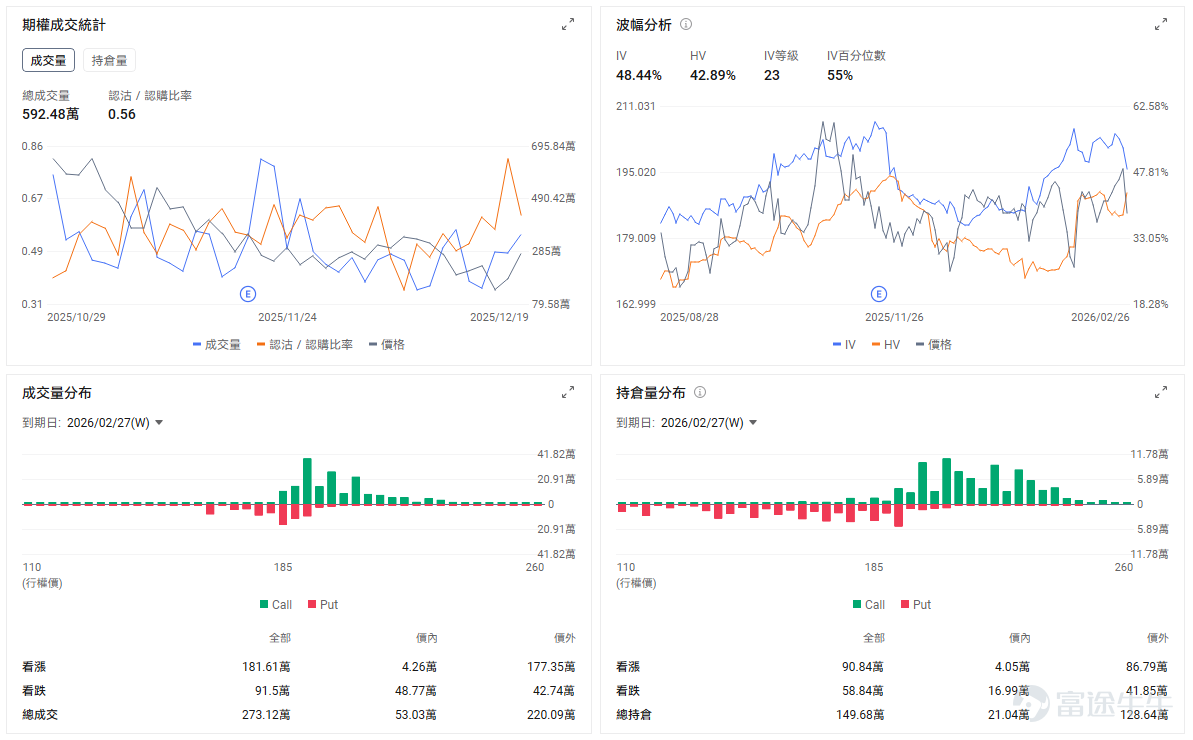
In terms of option signals, the current IV (48.44%) remains significantly higher than HV (42.89%), with an IV Rank percentile at 55%, indicating a historically moderate to slightly elevated level, suggesting that option prices are not extreme.Short-term signals are cautiously biased,A surge in trading volume accompanied by a sharp increase in option trading volume and rising demand for put hedging indicates that short-term adjustment pressures have not fully dissipated, and volatility may continue.Mid-term signals show support,Implied volatility has retreated from extremely high levels, combined with large-scale put option selling transactions, reflecting that some funds now believe short-term risks have been partially released, and there are expectations of potential support forming at key price levels (e.g., $180).
$200 Call Wall This level has become a significant technical and psychological resistance point after the earnings report. The failure of the stock price to break through this level decisively after the earnings release, followed by a high-volume decline, confirms the effectiveness of the resistance at this position.

NVIDIA’s technicals have weakened significantly in the short term due to a surge in trading volume during the selloff and outflows from major players. Short-term indicators suggest it has entered oversold territory, hinting at a potential technical rebound, but medium-term moving average support has been lost. Attention should be paid to the stock price at key support levels.The tug-of-war between bulls and bears in the $175-$180 range.
In this 'can't fall, but rises slowly' indecisive state, investors can consider several different options strategies to position themselves:
1. Strategy One: Selling Cash-Secured Put Options
– Suitable for: Empty or lightly positioned, willing to buy underlying stocks at a lower price, with moderate risk appetite (value investors).
– Strategy Description: Sell put options at a specific strike price and collect the premium. If the stock price is above the strike price when the option expires, the premium is pure profit; if below, you must buy the stock at the strike price (take over the shares).
(The design images displayed on screen are for illustrative purposes only and do not constitute any investment advice or guarantees; market conditions fluctuate frequently, and the option prices shown do not represent real-world values.)

2. Strategy Two: Long-Term Equity Anticipation Securities (LEAPS) Call Options
– Suitable for: Investors optimistic about the company’s long-term development, unwilling to endure short-term volatility, and hoping to leverage gains using options, with higher risk tolerance.
– Strategy Description: Buy in-the-money call options with expiration dates typically one year or longer. Suitable purposes includelong-term investment, confidence in the company's fundamentals, or as an 'alternative to common stock.'Selecting in-the-money options maximizes resistance to time decay (Theta) and implied volatility (IV) declines. The main benefits are avoiding short-term bullish-bearish battles, achieving high capital efficiency by paying relatively less premium compared to the stock price while gaining similar upside returns (Delta is usually chosen between 0.70 and 0.80). Additionally, the risk is limited; the maximum risk and loss is the premium paid at purchase.
(The design images displayed on screen are for illustrative purposes only and do not constitute any investment advice or guarantees; market conditions fluctuate frequently, and the option prices shown do not represent real-world values.)

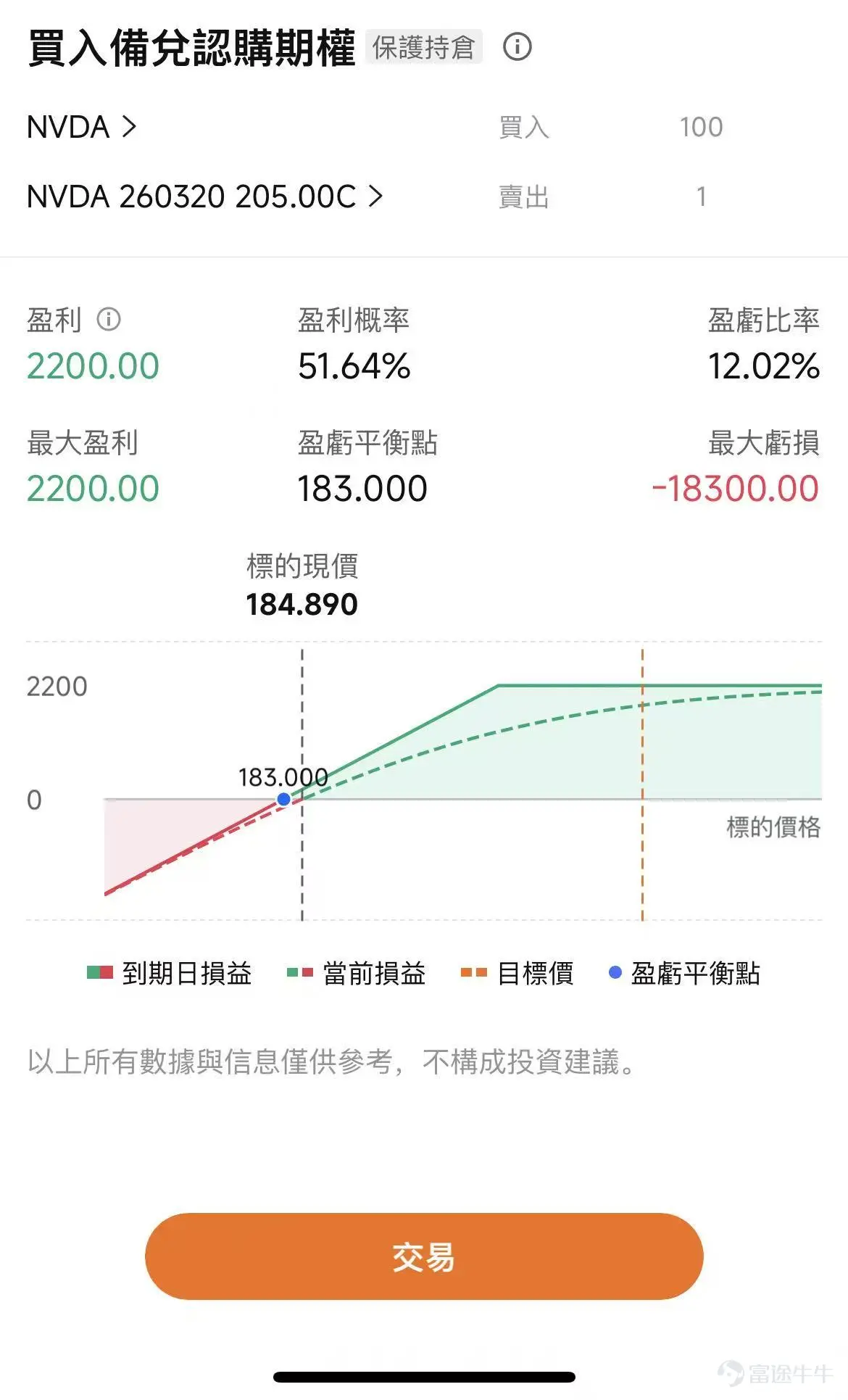
3. Strategy Three: Covered Call
– Suitable for: Investors who already hold NVIDIA common stock (at least 100 shares), are willing to sacrifice some potential upside gains in exchange for stable cash flow, and have a lower risk appetite.
– Strategy Description: While holding the underlying stock, sell call options above the current stock price. The aim is to enhance returns through premium income, which also offsets some of the losses when the stock price falls. The collected premium effectively lowers the cost basis of the position, providing excellent psychological downside protection. If the stock price does not exceed the strike price, there's no need to deliver the underlying stock upon exercise, and the premium is retained. However, if the stock price rises above this level, you forgo additional potential gains from the underlying stock.
(The design images displayed on screen are for illustrative purposes only and do not constitute any investment advice or guarantees; market conditions fluctuate frequently, and the option prices shown do not represent real-world values.)
Finally, here's a small perk for fellow investors—welcome to claim it!Options Beginner Pack
This event is exclusively for invited HK users, click to learn moreDetailed event rules >>
Futu's simulated trading challenge is now open for registration! Zero cost, zero risk, and you could win stock cash vouchers!

Disclaimer
This content does not constitute any offer, solicitation, recommendation, opinion, or guarantee of any securities, financial products, or tools. The risk of loss in buying and selling options can be substantial. In some cases, your losses may exceed the initial margin amount deposited. Even if you set contingent orders, such as 'stop-loss' or 'limit' orders, these may not necessarily prevent losses. Market conditions may make these orders unexecutable. You might be required to deposit additional margin within a short period. If you fail to provide the required amount within the specified time, your open positions may be liquidated. However, you will still be responsible for any account deficit arising from this. Therefore, before trading, you should study and understand options and carefully consider whether such trading suits you based on your financial situation and investment objectives. If you trade options, you should be familiar with the procedures upon exercising options and at expiration, as well as your rights and obligations when exercising options and at expiration.
Risk Disclaimer: The above content only represents the author's view. It does not represent any position or investment advice of Futu. Futu makes no representation or warranty.Read more


Comments (19)
to post a comment
133
92