
Will NetEase rebound in the short term or test the bottom again? Comprehensive deployment strategy from call warrants to put warrants
$NTES (09999.HK)$ NetEase (09999), after experiencing a five-month decline, has shown signs of stabilization near the key support level of HKD 172.9, combined with the latest capital flow in the market and technical indicators signaling a bottom, suggesting that a short-term rebound may have begun. This article will analyze the short-term trend and key price levels for NetEase based on data from February 27, recent market news, and insights from the [Hong Kong Stock Podcast], as well as explain in detail how to capture this potential trading opportunity using CBBCs and warrants.
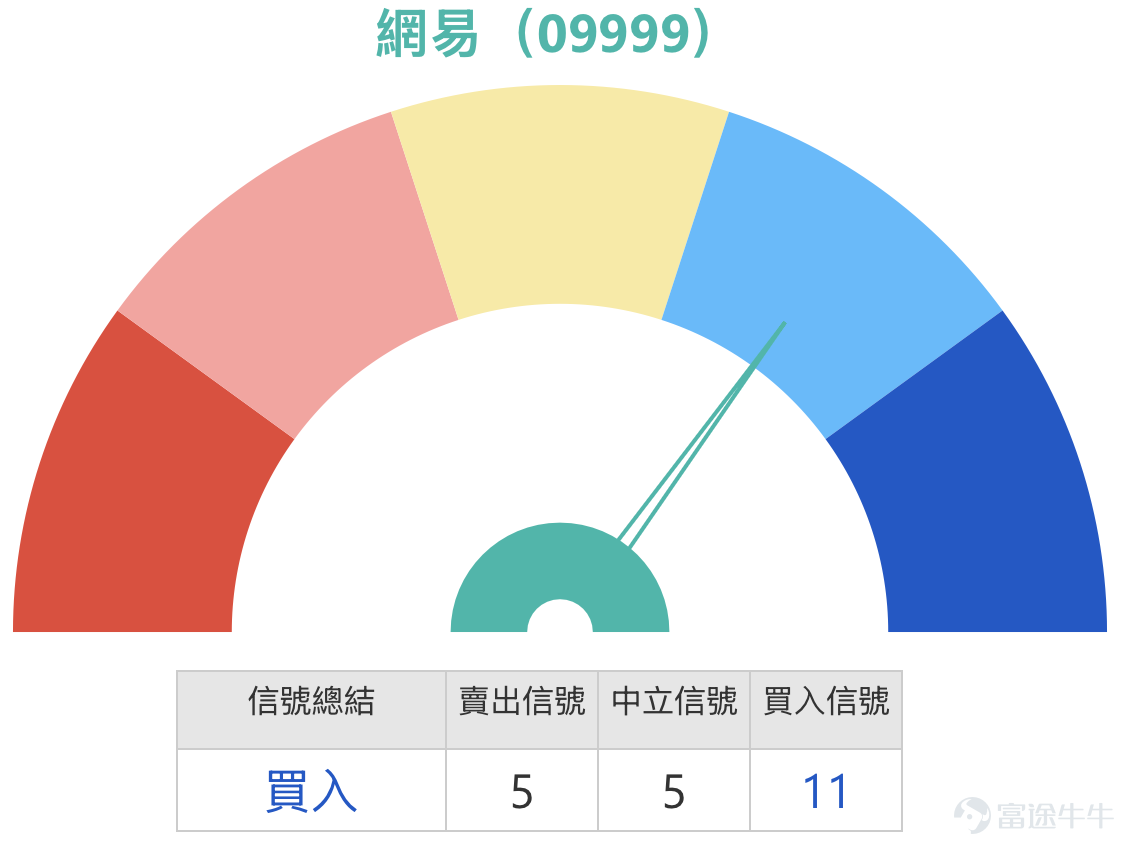
From a technical perspective, NetEase’s stock is trading at HKD 179.1, with a gain of 2.34%, successfully reclaiming the area near the 10-day moving average (HKD 182.87). The analysis shows that the short-term support is clearly set at HKD 172.9; if this level holds, it will provide a solid foundation for a rebound. A more critical defensive zone is at HKD 164.9. On the upside, the first resistance level is located at HKD 188.3, and if it can break through and stabilize above that, the next target would be HKD 201. The probability of an upward move is 0.62, with a 5-day volatility of 8.1%, indicating some short-term fluctuation space, presenting opportunities for short-term trading. Notably, multiple technical indicators are starting to flash 'buy' signals with a strength of 11, where the VR turnover ratio indicates 'severe oversold conditions, possible bottoming,' consistent with buy signals from stochastic oscillators and the CCI indicator, collectively painting a technical picture of support at lower levels and brewing for a rebound.
Market sentiment also supports NetEase's rebound. On February 27, NetEase recorded a cross-trade of approximately 233,300 shares at HKD 179.35 per share, involving HKD 41.84 million in funds, occurring as the stock rebounded, possibly reflecting major players making moves. Meanwhile, the active buy-sell ratio reached 59:41, with net active buying exceeding HKD 77 million, indicating strong buying interest. Additionally, UBS Group issued a report on February 25 maintaining a 'Buy' rating on NetEase, pointing out that deferred revenue hit a record high of RMB 20.5 billion, providing robust support for future earnings, while anticipating the launch of a new game product cycle in the second half of the year. These fundamental positives provide underlying logic supporting a short-term technical rebound.
![$NTES (09999.HK)$ NetEase (09999), after experiencing a five-month decline, has shown signs of stabilization near the key support level of HKD 172.9, combined with the latest capital flow in the market and technical indicators signaling a bottom, suggesting that a short-term rebound may have begun. This article will analyze the short-term trend and key price levels for NetEase based on data from February 27, recent market news, and insights from the [Hong Kong Stock Podcast], as well as explain in detail how to capture this potential trading opportunity using CBBCs and warrants. From a technical perspective, NetEase’s stock is trading at HKD 179.1, with a gain of 2.34%, successfully reclaiming the area near the 10-day moving average (HKD 182.87). The analysis shows that the short-term support is clearly set at HKD 172.9; if this level holds, it will provide a solid foundation for a rebound. A more critical defensive zone is at HKD 164.9. On the upside, the first resistance level is located at HKD 188.3, and if it can break through and stabilize above that, the next target would be HKD 201. The probability of an upward move is 0.62, with a 5-day volatility of 8.1%, indicating some short-term fluctuation space, presenting opportunities for short-term trading. Notably, multiple technical indicators are starting to flash 'buy' signals with a strength of 11, where the VR turnover ratio indicates 'severe oversold conditions, possible bottoming,' consistent with buy signals from stochastic oscillators and the CCI indicator...](https://nnqimage.futunn.com/sns_client_feed/1162342/20260227/web-1772175779202-kjdBXi6GcG.png/big?area=1&is_public=true&imageMogr2/ignore-error/1/format/webp)
In the February 26 [Hong Kong Stock Podcast], host Simon provided an in-depth review of NetEase’s movement. He noted that since falling from its January high of HKD 232.6, NetEase has seen significant declines but remains technically capable of a rebound. Simon specifically mentioned that short-term support lies around HKD 169.4, and if this breaks, the next support will shift to near HKD 160.1, so investors should be mentally prepared for further downside exploration. However, integrating technical signals shows slightly bullish indications prevailing, meaning chances for a technical rebound are brewing. Simon’s view aligns with the aforementioned technical indicators flashing buy signals, both pointing to the HKD 172.9-169.4 region as a crucial defense line for short-term bulls.
Reviewing the two NetEase put warrants mentioned on February 24, their performance over the following two trading days vividly illustrates the linkage between derivatives and underlying stock movements. The JPMorgan put warrant (24127) and UBS Group put warrant (24274) both surged by 7% as the underlying stock fell by 2.45% over two days. This case demonstrates the advantage of warrant products: when directional judgment is accurate, warrants can offer returns far exceeding those of the underlying stock. More importantly, put warrants serve as effective hedging tools, allowing investors expecting bearish markets or seeking portfolio protection to achieve hedging purposes with less capital without selling the underlying stock. This represents one of the core values of derivative instruments—offering flexible strategies to handle various market scenarios, enabling long, short, and hedging trades.
Based on the current assessment that NetEase’s stock is at a key support level and poised for a rebound, investors can deploy products in both bullish and bearish directions but must closely tie term analysis to the stock’s technical levels.
Product selection for bullish direction
If investors believe that NetEase can stabilize above the support level of 172.9 yuan and successfully challenge resistance levels at 188.3 yuan or even 201 yuan, they may consider the following two call warrants. First is the UBS Group call warrant (25753) $UB-NTES@EC2609A.C (25753.HK)$ , which offers 5.62x leverage with a strike price set at 249.88 yuan. This is a relatively out-of-the-money product, requiring higher potential upside in the underlying stock price, making it suitable for investors expecting significant rebound or even challenging higher levels. Its implied volatility is 47.82%, and its premium is 42.46%. Investors should note that its time decay is relatively faster and is more suited for short-term trading. Another option is the Bank of China call warrant (24003) $BI-NTES@EC2610A.C (24003.HK)$ , offering 5.57x leverage with a strike price of 250 yuan, similar terms to 25753, but with a slightly lower implied volatility of 44.21% and a premium of 43.64%. The choice between them depends on the investor's sensitivity to implied volatility. The strike prices of these two products are much higher than the current stock price, reflecting market expectations that if NetEase successfully breaks through resistance, the upward trend could extend towards technical resistance levels around 201 yuan or even higher as mentioned earlier in the article.
For those who anticipate a rebound but wish to reduce reliance on substantial stock price increases, bull contracts can be considered. The UBS Group bull contract (54539) $UB#NTES RC2612A.C (54539.HK)$ has a recovery price set at 151 yuan, providing 5.8x actual leverage with low premium and about 28 yuan buffer zone from the current price, resulting in relatively controllable recovery risk, making it suitable for capturing short-term rebounds. Another UBS Group bull contract (68651) $UB#NTES RC2604E.C (68651.HK)$ has a recovery price at 153 yuan, offering higher actual leverage of 6.3x and an even lower premium, making it more sensitive to stock price rebounds. When choosing bull contracts, the key is to focus on the distance between the recovery price and the current price. A recovery range between 151 yuan and 153 yuan is below our mentioned short-term support level of 172.9 yuan, providing investors with relatively safer short-term operational space.
![$NTES (09999.HK)$ NetEase (09999), after experiencing a five-month decline, has shown signs of stabilization near the key support level of HKD 172.9, combined with the latest capital flow in the market and technical indicators signaling a bottom, suggesting that a short-term rebound may have begun. This article will analyze the short-term trend and key price levels for NetEase based on data from February 27, recent market news, and insights from the [Hong Kong Stock Podcast], as well as explain in detail how to capture this potential trading opportunity using CBBCs and warrants. From a technical perspective, NetEase’s stock is trading at HKD 179.1, with a gain of 2.34%, successfully reclaiming the area near the 10-day moving average (HKD 182.87). The analysis shows that the short-term support is clearly set at HKD 172.9; if this level holds, it will provide a solid foundation for a rebound. A more critical defensive zone is at HKD 164.9. On the upside, the first resistance level is located at HKD 188.3, and if it can break through and stabilize above that, the next target would be HKD 201. The probability of an upward move is 0.62, with a 5-day volatility of 8.1%, indicating some short-term fluctuation space, presenting opportunities for short-term trading. Notably, multiple technical indicators are starting to flash 'buy' signals with a strength of 11, where the VR turnover ratio indicates 'severe oversold conditions, possible bottoming,' consistent with buy signals from stochastic oscillators and the CCI indicator...](https://nnqimage.futunn.com/sns_client_feed/1162342/20260227/web-1772175598188-sCnkKXUnBl.jpeg/big?area=1&is_public=true&imageMogr2/ignore-error/1/format/webp)
Product selection for bearish direction
Investors concerned that NetEase may fail to break through resistance or that the stock price may retest lower support can consider put warrants. The UBS Group put warrant (24274) $UB-NTES@EP2608A.P (24274.HK)$ offers 3.2x leverage with a strike price of 190.78 yuan. It stands out by having the lowest premium and implied volatility among similar products in the market, meaning its price is less affected by changes in implied volatility and is relatively 'cheap' in valuation. The J.P. Morgan put warrant (24127) $JP-NTES@EP2608A.P (24127.HK)$It offers a slightly higher leverage of 3.1 times, with a strike price of 190.88 yuan, and implied volatility is also at a relatively low level. The strike prices of these two products are near 190 yuan, higher than the current underlying stock price, making them in-the-money put warrants. Their prices have stronger linkage with the underlying stock and can more directly reflect declines in the stock price. When deploying put warrants, the support levels of 172.9 yuan and 164.9 yuan can be used as target references. When the stock price approaches these levels, one may consider gradually taking profits or adjusting positions.
Investing in CBBCs (Callable Bull/Bear Contracts) and warrants essentially involves a comprehensive judgment on the direction, volatility, and timing of the underlying stock. The advantage lies in investors being able to select products with different terms based on their risk tolerance and precise market judgment, using a small amount of principal to implement strategies while strictly controlling the maximum loss (i.e., the invested principal), without bearing the uncertainty of long-term stock price fluctuations like direct stock investments. However, it must be remembered that leverage is a double-edged sword—it amplifies returns but also accelerates losses. Additionally, bull/bear contracts have a forced recall mechanism, so product terms and risks must be fully understood before deployment.
Overall, NetEase's stock price, after experiencing a deep correction, now stands at a short-term watershed. There is clear support below backed by technical indicators, while facing resistance above. Market capital inflows are becoming active, and major banks have released optimistic signals. Investors should closely monitor the defensive nature of the 172.9 yuan support level and whether there will be a breakout at the 188.3 yuan resistance level. Based on individual risk appetite, suitable tools among the aforementioned derivative products should be selected for deployment. Whether betting on a rebound or hedging risks, strict stop-losses must be set, and product terms should be dynamically observed in conjunction with key price levels of the underlying stock.
Interactive Questions:
Do you think NetEase’s current rebound can successfully break through the first resistance level at 188.3 yuan? Or will it encounter resistance and pull back before reaching this level?
When deploying for a rebound, do you prefer high-leverage out-of-the-money call warrants or bull contracts with distant recall prices and lower risk? Feel free to share your thoughts.
Reminder: This article does not constitute any investment advice.
This article is for reference only and does not constitute any investment advice. The market data, opinions, and analysis contained herein may change at any time without prior notice. We are not responsible for any loss or damage caused by reliance on the information in this article. Technical analysis only shows whether certain technical conditions are met; a comprehensive assessment of asset performance should combine other data and should not solely rely on this article to make trading decisions. Please note that past performance is not indicative of future results. Follow Jenny's insights on Hong Kong stock warrants for more professional analysis.
#NetEase #09999 #HongKongStocks #TechnicalAnalysis #Warrants #BullBearCertificates #CallOptions #PutOptions #ReboundSignal #CapitalFlow
Risk Disclaimer: The above content only represents the author's view. It does not represent any position or investment advice of Futu. Futu makes no representation or warranty.Read more

Comments
to post a comment
1